

Start With a Clear Local Visibility Baseline
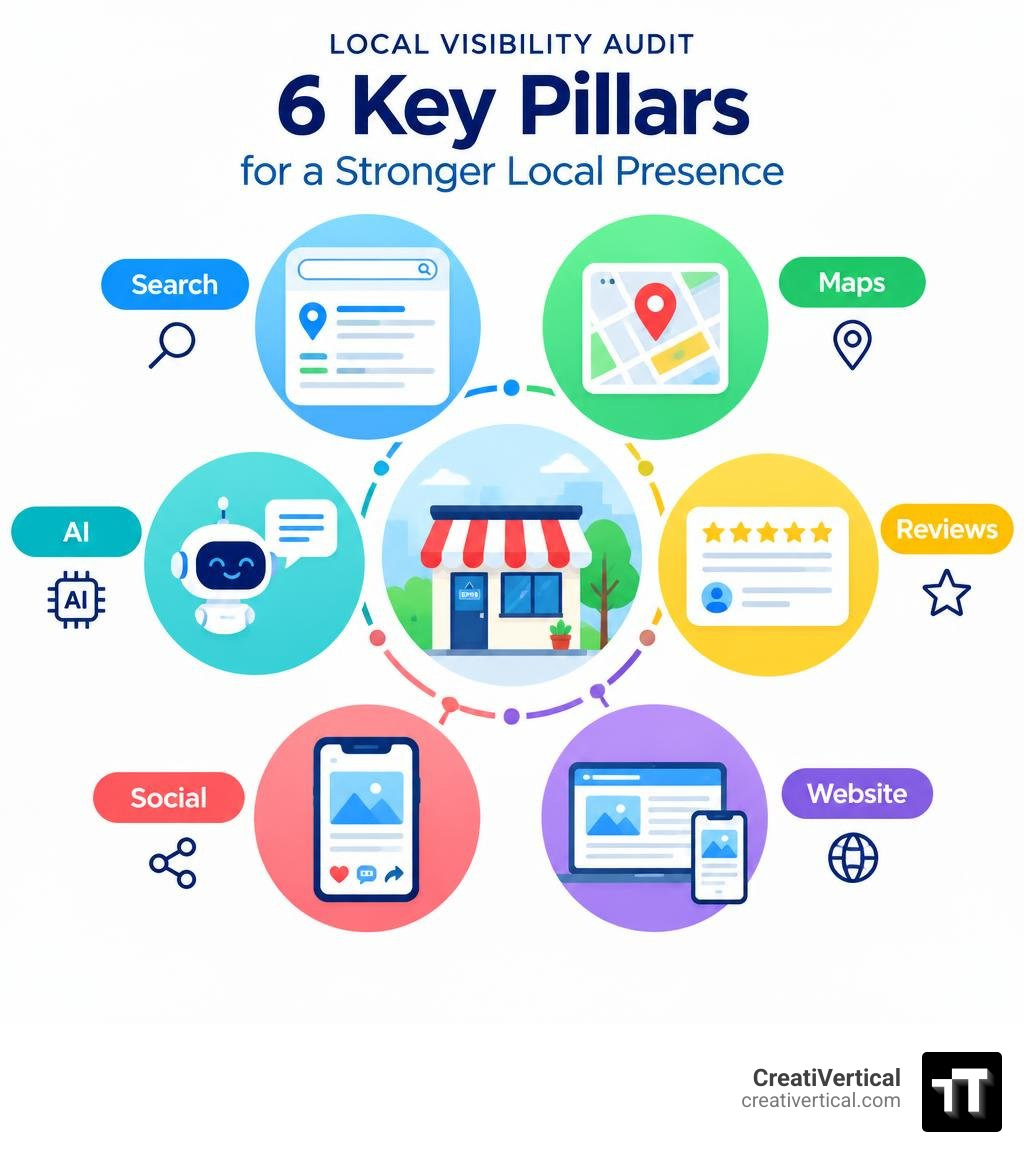
To evaluate a local business’s online visibility, check where and how often customers can find it across Google Search, Google Maps, reviews, social profiles, the website, and AI-driven answers. Then connect that visibility to meaningful actions: calls, direction requests, website visits, form submissions, and bookings.
Start with this simple baseline:
- Search and Maps: Track rankings for your main services from several points across your real service area, not only from your office.
- Google Business Profile: Check that the profile is verified, complete, current, and generating calls, clicks, and direction requests.
- Listings and reviews: Compare your name, address, phone number, hours, categories, ratings, review volume, freshness, and response rate across major platforms.
- Website and social channels: Confirm the site works well on mobile, key pages are indexed, local service information is clear, and profiles send visitors to the right place.
- AI search results: Test whether Google AI features, ChatGPT, and Perplexity mention or cite your business for relevant local questions.
Local visibility is no longer just a blue-link ranking. Customers may choose a business from the Map Pack, read reviews without clicking, find an answer in an AI result, or visit a social profile before they ever reach a website. That makes an audit a practical way to find the gaps between being present online and being easy to discover, trust, and contact.
I’m Nicholas Cunha, founder of CreatiVertical, a family-run Kansas City agency working across web development, SEO, PPC, AI enablement, and AI search visibility. With more than two decades of agency and project work, I help organizations master how to evaluate online visibility of local business assets and turn the findings into practical website, search, and automation improvements.
Helpful local visibility tracking and ranking guides:
The Foundations: Understanding Proximity, Prominence, and Relevance
Google evaluates local entities through three core pillars: relevance, distance (proximity), and prominence. Understanding these signals prevents wasted effort on tactics that do not move the needle.
- Relevance: How well a local business profile or web page matches the intent behind a search query.
- Distance: How far the geographic location of the searcher (or the explicit location modifier) is from the business.
- Prominence: How well-known, authoritative, and trusted the business is across the web, established via review signals, citations, quality backlinks, and directory mentions.
Mastering these factors is essential when targeting near me searches to win local customers, as Google dynamically adjusts results based on the user’s immediate coordinates.
Why Single-Point Local Searches Distort Reality
The most common mistake business owners make during an audit is opening a browser from behind their front desk, typing their service, and seeing their listing in the top spot.
This single-point search creates an artificial sense of security. Because Google places heavy weight on proximity, your listing naturally ranks highest when you are standing directly inside your own facility. To understand your actual reach, you need to check where your business ranks on Google Maps from your customer’s location rather than relying on searches made from your office desk.
Proximity Bias and Service-Area Reach
Proximity bias means ranking strength decays as the physical distance from your location increases. Industry data shows that roughly 70% of service businesses rank within the top 3 Map Pack positions only within a 5-mile radius unless they build significant digital prominence.
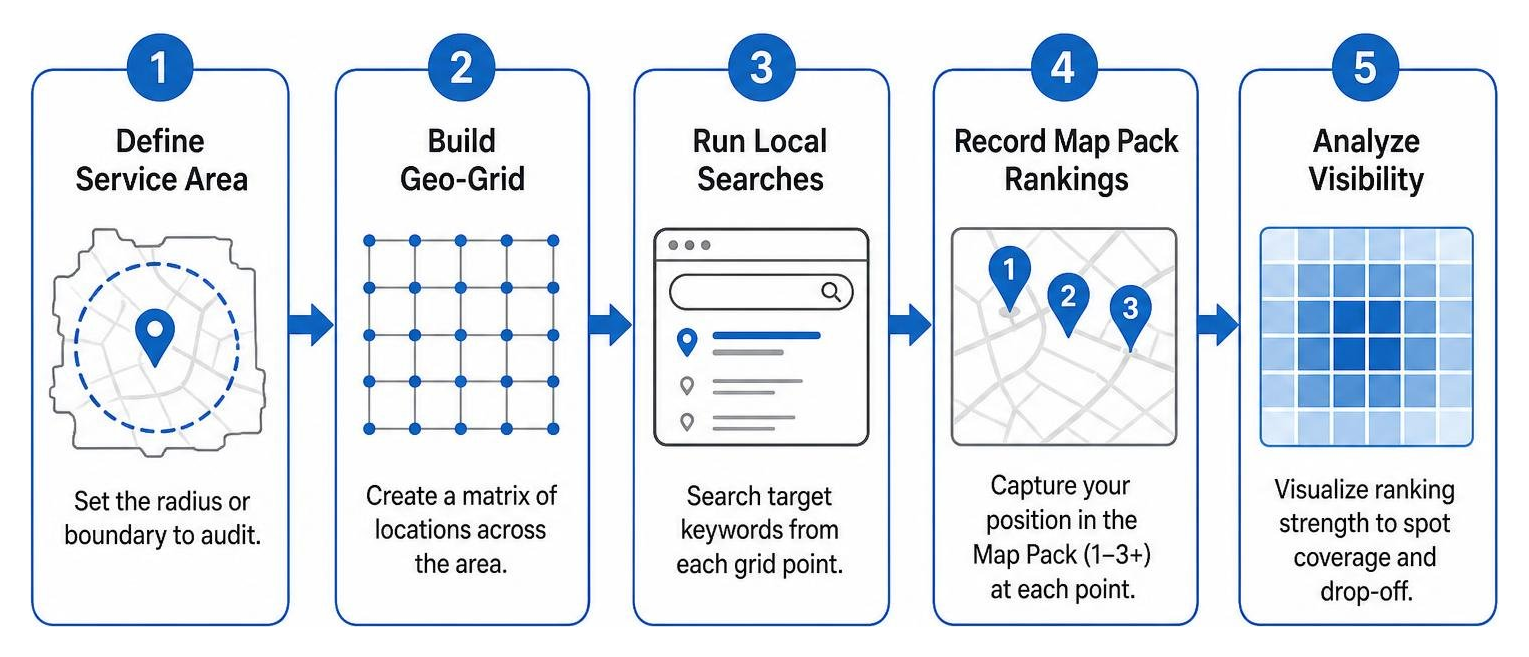
To diagnose proximity falloff, run geo-grid scans across your service area. A standard grid evaluates ranking positions across a matrix of coordinates (such as a 7×7 grid spaced 1 mile apart). This reveals whether your visibility forms a tight bubble or extends across neighboring communities like Blue Springs, Lee’s Summit, Independence, or Grain Valley.
Step-by-Step Guide: How to Evaluate Online Visibility of Local Business Across Core Channels
A complete audit requires examining every touchpoint where customers discover your company. With roughly 27.2% of U.S. search traffic resolving as zero-click interactions, evaluating your digital footprint beyond standard website visits is essential. Following a structured step-by-step local online visibility framework ensures no discovery channel gets overlooked.

Core Metrics: How to Evaluate Online Visibility of Local Business in Search and Maps
Evaluating map and organic search visibility involves tracking specific performance indicators rather than relying on guesswork. When starting local SEO performance tracking, focus on:
- Map Pack Rankings: Track top-3 placement percentages across target keywords using geo-grid tools.
- Organic Search Impressions and Clicks: Review Google Search Console data filtered for non-branded queries containing local modifiers.
- Local Share of Voice (SoV): Measure the percentage of grid points where your business appears in the top 3 spots relative to primary competitors.
Evaluating Google Business Profile and Direct Customer Engagement
Only about 35% of small businesses claim and maintain a Google Business Profile (GBP), making profile optimization a significant opportunity. Verified profiles with rich media consistently outperform sparse listings. In fact, profiles with 15 or more photos per location see noticeably stronger engagement across customer actions.
When auditing your profile, review our guide to complete business profile management and verify the following elements:
- Primary Category Accuracy: Ensure your primary category aligns with your primary revenue driver.
- Secondary Categories: Include relevant supporting services without keyword stuffing.
- Customer Conversion Actions: Track month-over-month growth in direct calls, direction requests, and website clicks via GBP Performance reporting.
- Visual Assets: Confirm your profile features recent, high-resolution interior, exterior, and team photos.
Auditing NAP Consistency and Citation Integrity
Search engines cross-reference your Name, Address, and Phone number (NAP) across independent directories to confirm legitimacy. Inconsistencies confuse algorithms and dilute local trust signals.
Conduct a citation audit by searching your exact phone number in quotes across major search engines. Check your listings on Tier-1 platforms (Apple Maps, Bing Places, Yelp, YellowPages) and industry-specific aggregators to eliminate:
- Old suite numbers or outdated physical addresses.
- Mismatched tracking phone numbers that conflict with your primary business line.
- Duplicate listings generated by automated directory scrapers.
Review Ecosystem and Reputation Health Assessment
Consumer trust directly impacts search performance. Industry studies show that 97% of consumers read reviews for local businesses, and 89% expect business owners to respond to feedback. Furthermore, 31% of consumers will only consider using a business rated 4.5 stars or higher, while 47% will bypass companies with fewer than 20 total reviews.
Managing your reputation is a core pillar of enhancing local search presence.
| Review Metric | Audit Benchmark | Risk Threshold | Why It Matters |
|---|---|---|---|
| Overall Star Rating | 4.5 – 5.0 Stars | Below 4.2 Stars | Affects consumer conversion and local prominence filters. |
| Total Review Volume | 20+ Reviews Minimum | Under 10 Reviews | 47% of consumers avoid businesses with fewer than 20 reviews. |
| Review Freshness | Within Last 90 Days | Older than 3 Months | 74% of users prioritize reviews written in the last 3 months. |
| Response Rate | 90% – 100% of Reviews | Below 50% Replied | 80% of buyers favor businesses replying to all reviews. |
| Response Speed | Within 24–48 Hours | Over 7 Days | Signals active customer care and ongoing operational engagement. |
Review Volume, Velocity, and Freshness Benchmarks
Search engines monitor review velocity (the regular pace at which new feedback arrives) to verify ongoing operations. A business with 200 reviews from two years ago but zero reviews this month often ranks lower than a competitor gaining 5 fresh reviews every week. Aim for steady, monthly review acquisition rather than sudden, unnatural spikes.
Response Rates and Customer Interaction Signals
Responding to reviews is not just good customer service—it supports visibility. Data indicates that 42% of consumers avoid businesses that ignore customer reviews entirely.
When conducting an audit, confirm that responses address specific feedback, use natural conversational language, and avoid generic copy-pasted templates.
Technical SEO, Website Infrastructure, and AI Search Visibility
Your website anchors your local presence. While your Google Business Profile captures high-intent map searches, your website drives organic search authority and feeds data to modern AI engines. Building a practical local business SEO strategy requires a technically sound web foundation.

On-Page Signals, Local Schema, and Location Pages
Local relevance must be hard-coded into your site’s structure. Research shows that sites combining location-specific H1 headings with embedded Google Maps have a 40% higher probability of ranking within the top 3 Map Pack results.
Follow these on-page requirements to support improving local Google rankings:
- Dedicated Service-Area Pages: Create unique landing pages for distinct cities served rather than combining multiple areas onto a single page.
- Structured Data (Schema): Implement clean JSON-LD LocalBusiness schema detailing exact geo-coordinates, official business name, telephone, opening hours, and accepted payment types.
- Interactive Maps: Embed an official Google Map on contact and location pages to reinforce entity associations.
Technical & AI Auditing: How to Evaluate Online Visibility of Local Business in 2026
Evaluating local search visibility now extends into Generative Engine Optimization (GEO). Search engines and AI assistants—such as Google AI Overviews, ChatGPT, and Perplexity—rely on structured web data and consistent citations to answer local queries.
To evaluate your presence in AI-driven search, set up regular tracking for conversational discovery. Monitor non-branded conversational queries (e.g., “Who is the most reliable precision machining shop in the Kansas City area?”) and track whether AI models cite your business as a trusted recommendation.
Executing a 20-Minute Local Visibility Audit Routine
Auditing your visibility does not need to take weeks. Using a structured 20-minute diagnostic framework lets you identify critical visibility gaps quickly. Comparing these findings against competitors through conducting local SEO competitor analysis keeps your marketing focused on high-impact fixes.
Phase-by-Phase Diagnostic Checklist
- Minutes 0–5: The Geo-Grid Scan: Run a multi-point ranking check on your primary service keyword to identify geographic blind spots.
- Minutes 5–10: GBP Health Check: Verify primary categories, confirm opening hours, review recent photos, and check your response rate on recent reviews.
- Minutes 10–15: Citation & NAP Audit: Search your primary phone number and address across search engines to locate duplicate or conflicting directory entries.
- Minutes 15–20: Website & Schema Verification: Test mobile page speed, verify SSL security, and run your homepage through schema validation tools to confirm your
LocalBusinessstructured data is error-free.
Common Diagnostic Mistakes and False Positives
When auditing local visibility, avoid these common traps:
- Assuming Office Rank Equals Market Dominance: As covered, proximity bias will make your business appear #1 when searching on-site. Always use geo-grid tools or location-neutral proxies.
- Keyword Stuffing Profile Names: Adding location keywords or service lists into your legal business name violates Google guidelines and risks profile suspension.
- Ignoring Mobile Usability: Over 90% of U.S. adults own a smartphone, and the majority of local discovery happens on mobile. If your click-to-call buttons fail or text is unreadable on smaller screens, your conversion rate will suffer.
Frequently Asked Questions About Local Business Visibility
How often should a local business perform a complete visibility audit?
Perform a high-level check every 30 days to monitor review velocity, GBP engagement actions, and NAP consistency. Conduct a comprehensive technical, citation, and geo-grid audit every 90 days. Quarterly audits allow you to catch local algorithm updates, address competitor moves, and update seasonal service offerings.
Can a service-area business rank without a physical storefront?
Yes. Service-area businesses (such as mobile mechanics, plumbers, or home inspectors) can create a verified Google Business Profile with their physical address hidden from public view. You can specify designated service areas by city, county, or ZIP code. To support rankings, build out dedicated service-area pages on your website that feature relevant customer testimonials, neighborhood service descriptions, and local schema markup.
What is the most reliable way to track AI search engine citations locally?
The most effective approach is establishing a target query set of 15 to 20 conversational, non-branded questions that reflect your core offerings. Manually run these queries through Google AI Overviews, Perplexity, and ChatGPT on a recurring monthly schedule. Log whether your business name, website URL, or GBP listing is directly cited in the AI summary, and note which competitors appear alongside you.
Conclusion: Turning Visibility Audits Into Ongoing Growth
Evaluating your online visibility is not a one-time project; it is an ongoing diagnostic routine that guides sustainable digital growth. Once you identify where your search presence drops off—whether due to proximity limits, citation errors, review gaps, or missing schema—you can apply structured fixes that expand your reach.
At CreatiVertical, we work as an ongoing growth partner for businesses across Kansas City, Lake Tapawingo, Blue Springs, Lee’s Summit, Independence, and Grain Valley, as well as specialized B2B organizations. We combine web development, SEO, and AI enablement into cohesive digital systems that help your business stay visible and competitive.
To take the next step in improving your search presence, explore our guide featuring actionable tips to improve local visibility online and begin refining your local marketing strategy today.