

Why a Local Citation Building Service Is Worth Evaluating
A local citation building service helps put your business name, address, and phone number on relevant directories and keeps those details accurate. If you’re comparing services, look for one that checks existing listings first, fixes errors and duplicates, chooses sites that fit your location and industry, and shows you which listings went live. Ask who controls the listings and whether updates cost extra.
Accurate citations can help customers find and trust your business. They may also support local search visibility, but no citation package can promise a Google Maps ranking. Many consumers rely on general business information sites to find and vet local businesses, and inconsistent or incorrect details online can make a prospective customer choose a competitor instead. Google’s own guidance on managing your Business Profile underscores how important it is to keep your name, address, and phone number accurate everywhere they appear.
I’m Nicholas Cunha, founder of CreatiVertical, and I’ve worked in web development and SEO for more than 20 years, including work in Kansas City and the Caribbean. That experience shapes how I evaluate a local citation building service: by the accuracy and usefulness of its listings, not just the number it sells.
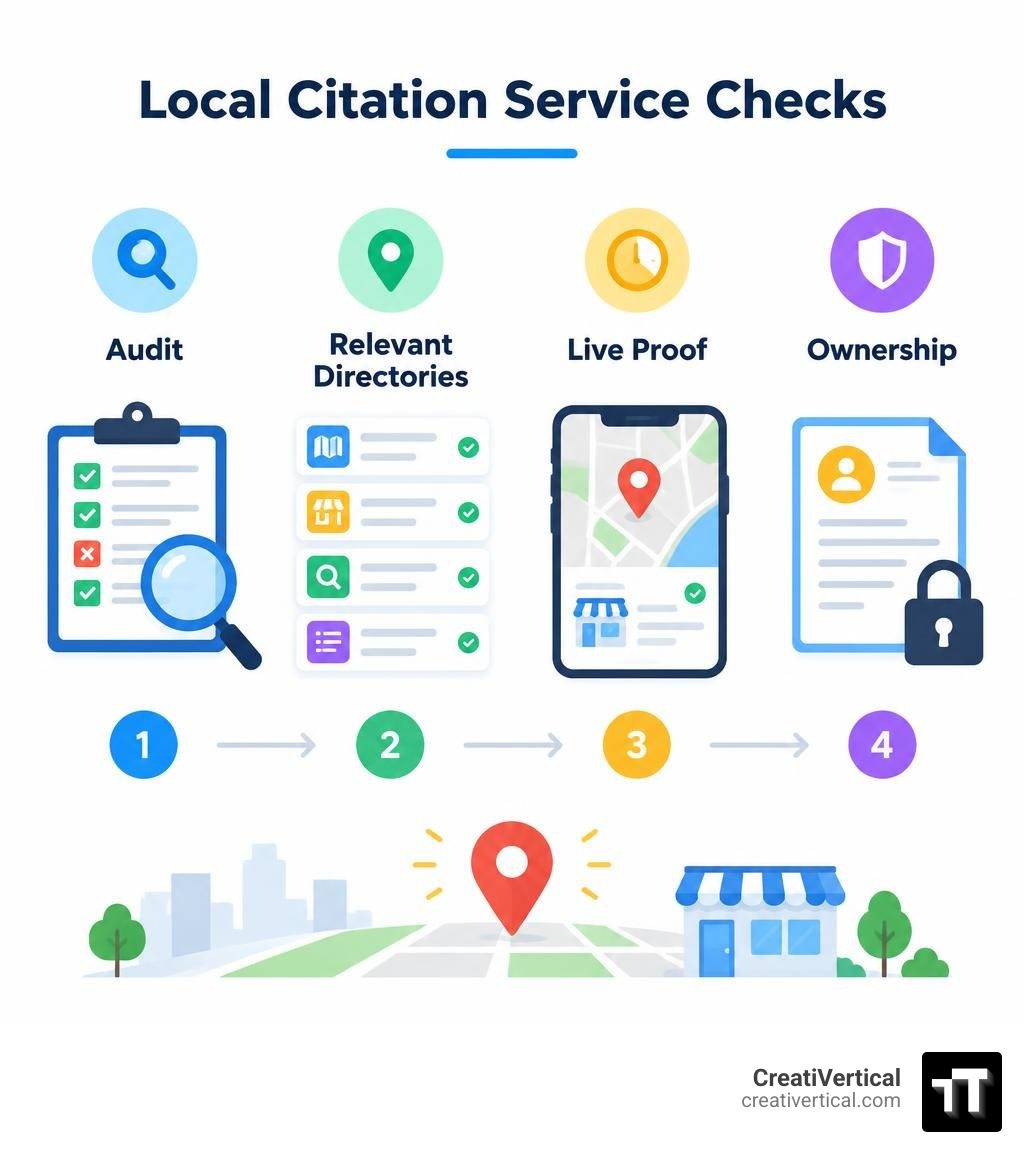
Common local citation building service vocab:
What Are Local Citations and Why Do They Drive Visibility?
A local citation is any online reference to your core business identity: your Name, Address, and Phone number (commonly abbreviated as NAP). Citations serve as digital street signs, signaling to search engines, navigational apps, and prospective customers that your physical presence is verified, active, and legitimate.
These references typically divide into two distinct categories:
- Structured Citations: Mentions that appear on dedicated business directories, yellow pages portals, map applications, and social platforms. These profiles feature standardized fields for your NAP, operating hours, service categories, website link, and geo-coordinates.
- Unstructured Citations: Mentions of your business data embedded naturally within unstructured content—such as local news features, blog posts, event sponsorships, community portals, or vendor partner pages. While they lack formal form fields, search engine crawlers easily parse this text to confirm your geographic footprint.
Citations act as foundational inputs for entity recognition. Search engines like Google gather corroborating data across the web to validate their understanding of real-world businesses. When algorithms repeatedly verify matching NAP data across diverse, reputable directories, confidence in that entity increases, establishing a stronger baseline for improving local online visibility.
| Citation Format | Primary Platform Examples | Data Structure | Direct SEO & Discovery Function |
|---|---|---|---|
| Structured | Google Business Profile, Apple Business Connect, Yelp, Bing Places, YellowPages, Chamber of Commerce | Strict form fields (NAP, categories, hours, website URL) | Establishes baseline core entity identity and categorical relevance |
| Unstructured | Local news articles, industry blogs, event listings, press releases, partner directories | Conversational prose, press mentions, footer attributions | Provides contextual authority, regional prominence, and organic link equity |
The Critical Role of NAP Consistency and Data Accuracy
NAP consistency means every platform displays your exact business details without conflicting variations, obsolete phone lines, or old street addresses. Maintaining uniformity is about preserving consumer trust and ensuring algorithmic clarity.
Inaccurate business information carries real consequences. Many consumers rely on business information sites like Google, Yelp, and Tripadvisor to find local businesses, and a meaningful share say they would avoid a business if they encounter incorrect information online. Some will even seek out an alternative nearby if a listing mistakenly shows a location as closed.

Search algorithms assess conflicting data similarly. If your Google listing shows one suite number while historic directories display a previous address, algorithms face ambiguity. This confusion can reduce local visibility. Pairing an organized citation baseline with proactive measures, such as auditing Google Business Profile management, protects your brand from gradual data decay.
How Citations Impact Generative Engine Optimization (GEO)
As modern discovery evolves, generative AI platforms like ChatGPT, Perplexity, and Google’s AI Overviews change how customers find local service providers. These large language models do not maintain proprietary databases of physical businesses; instead, they retrieve and synthesize live structured data from trusted web directories and aggregators.
When a user asks an AI assistant for recommendations—such as precision machining partners or specialized offshore fiduciary counsel—the engine scans verified business sources to validate entity legitimacy before generating an answer. Clean, structured directory listings provide the clear semantic grounding these tools require. A systematic citation foundation is an essential step when evaluating your local business visibility across modern search.
How to Select a Local Citation Building Service for Sustainable Growth

Selecting an external provider requires looking past arbitrary submission volumes. An effective local citation building service prioritizes high-authority platforms, local relevance, and strict listing verification over automated bulk submissions.
A specialized agency evaluates directories using domain authority metrics, indexation rates, and vertical relevance. Top-tier directories provide significantly more authority signals than hundreds of unmoderated, low-tier directory sites. Whether you’re a Kansas City-area business or working in a specialized industry, targeting authoritative platforms ensures meaningful local signals.
Ownership is another critical factor. Many business owners discover too late that certain platforms only “rent” listings. Once an ongoing subscription ends, those synced entries can revert to unverified or outdated states. Selecting a service that secures permanent, hand-claimed ownership guarantees your business data remains stable long after the initial campaign wraps up.
Manual vs. Automated Local Citation Building Service Features
Understanding the operational differences between manual submissions and automated aggregator networks helps you determine the best fit for your marketing goals:
| Feature / Metric | Manual Citation Building | Automated Aggregator Syndication (e.g., Yext) |
|---|---|---|
| Submission Method | Hand-crafted entries by specialists directly on each target directory | Centralized API feed pushing data to partner networks |
| Listing Ownership | Permanent ownership; client retains all direct login credentials | Leased presence; profiles risk reverting or locking if fees end |
| Pricing Model | Transparent one-time fee per listing or pay-as-you-go tiers | Mandatory recurring monthly or annual software subscriptions |
| Live-Listing Rate | High acceptance rates on active, manually verified targets | Broad network distribution, variable platform acceptance |
| Niche & Geo Customization | High; targets hyper-local chambers and industry portals | Limited primarily to established global/national network partners |
| Duplicate Remediation | Direct manual claiming, merging, or ticketed suppression | Automated overwriting across active API endpoints only |
What to Expect from an Agency-Grade Local Citation Building Service
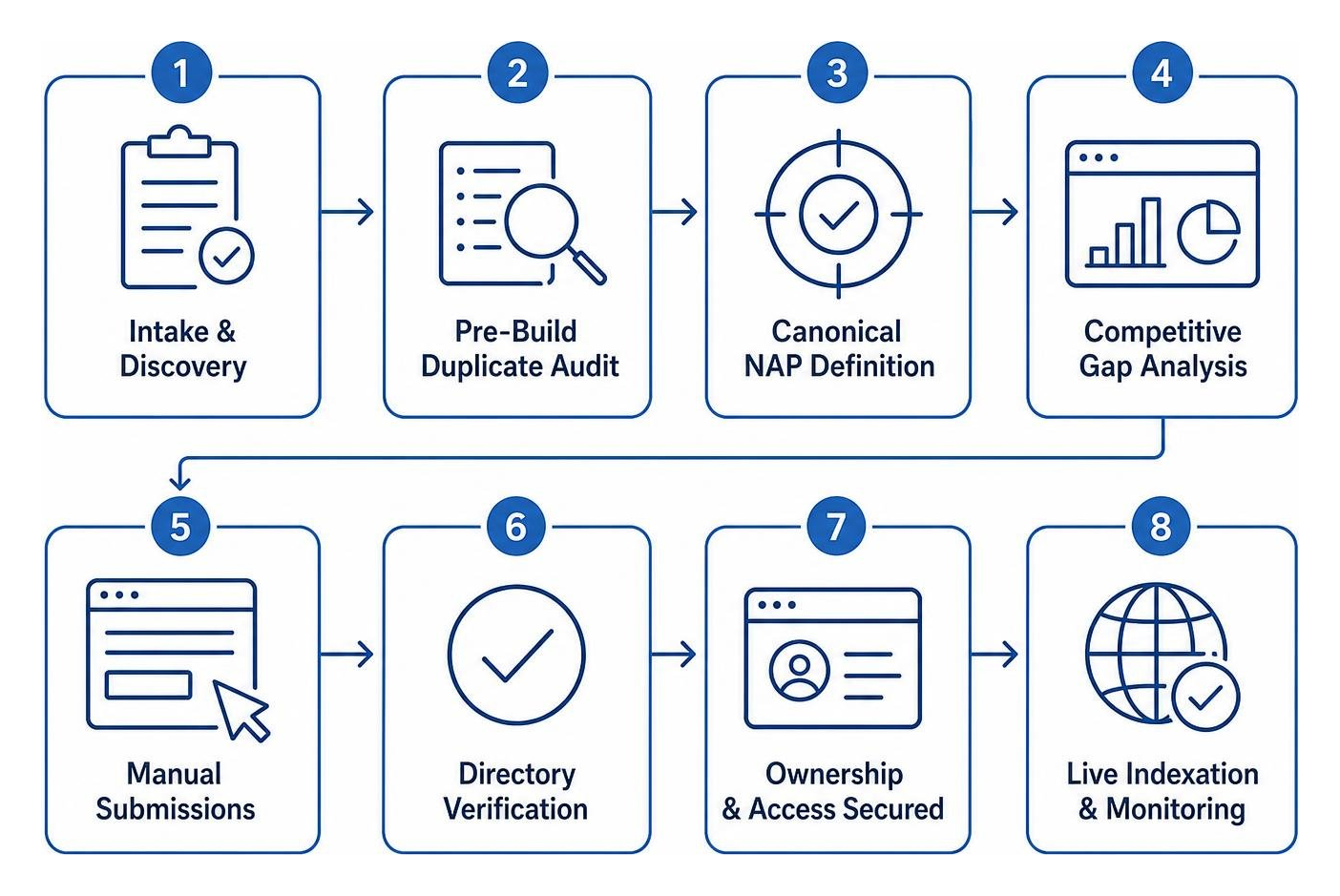
A quality agency handles submissions systematically rather than simply entering data into an automated tool:
- Pre-Build Duplicate Audit: Identifying and recording every historic, broken, or conflicting citation already indexed across search engines.
- Canonical NAP Definition: Establishing a single, verified master business profile (address formatting, suite numbers, tracking lines) before submitting updates.
- Competitive Gap Analysis: Reviewing where top regional competitors hold verified citations and targeting those industry-specific directories. A structured approach to analyzing local competitors helps identify the highest-value platforms.
- Transparent Deliverables: Providing detailed reporting spreadsheets containing direct live URLs, submitted media screenshots, and secure login credentials for every claimed account.
Citation Strategy: Volume, Auditing, and Verification
Effective citation strategies focus on relevance rather than sheer volume. High-competition metros naturally require broader directory footprints than smaller suburban markets, but targeting platforms with strong category alignment delivers the best return. Industry-specific directories—such as legal portals, medical registries, and regional trade association lists—carry strong topical relevance that supports strategies for ranking for near me searches.
Resolving Duplicate Listings and Inconsistent Business Data
Over time, businesses naturally experience data drift. Rebranding, telephone system upgrades, physical relocations, or inconsistent past marketing efforts often leave behind multiple contradictory profiles on major directories.
Duplicate listings dilute algorithmic trust. When search engines encounter two distinct addresses for the same brand name, local ranking signals split between the profiles. An agency-grade service resolves these conflicts by manually claiming legacy records, submitting merge requests to directory support teams, and updating obsolete entries to match your canonical record. Keeping these foundational signals clean makes tracking local SEO performance far more reliable.
Measuring Ranking Movement and Indexation Timelines
Citation updates do not change local rankings overnight. Once a directory approves a submission, search engine crawlers must discover, parse, and index that individual URL before its data influences the broader entity graph.
- Submission to Live Status: Manual directory reviews typically take between 5 to 14 business days, though certain moderated platforms take several weeks.
- Indexation Phase: Search engine bots gradually crawl third-party directory pages. Some services use indexation workflows to speed up discovery.
- Observed Movement: Noticeable adjustments in local pack visibility or organic search impressions typically emerge over 45 to 60 days when integrated into a broader no-nonsense local business SEO strategy.
Frequently Asked Questions About Local Citation Building
How many citations does my business actually need?
There is no single universal target. A viable baseline for most local service businesses ranges between 30 and 80 well-chosen, high-authority directories. Highly competitive markets or heavily regulated fields (such as legal, healthcare, or financial services) often benefit from adding secondary niche-specific directories over time. Focus on claiming high-authority, relevant platforms rather than chasing hundreds of low-quality sites.
Are citations a one-time investment or a recurring subscription?
Direct manual citation campaigns are typically structured as one-time investments. Once a provider claims and verifies a directory profile under your own credentials, you own that digital listing indefinitely without recurring hosting fees. In contrast, automated API aggregators operate on recurring subscription models where ongoing fees are required to keep the listings synced.
What happens if a directory submission fails to go live?
Directory editorial standards and moderation schedules vary. While most manual submissions achieve high initial acceptance rates, reputable providers monitor these submissions and replace any rejected or unindexed directories with equivalent high-authority alternatives at no extra cost.
Conclusion
Building and maintaining clean citations creates the reliable foundation search engines and modern AI tools need to verify your business. While citations alone do not guarantee top rankings, accurate directory data ensures prospective clients find verified phone numbers, correct addresses, and clear details wherever they search.
At CreatiVertical, we treat citation management and local search as core components of your broader digital foundation. Rather than selling isolated marketing tasks, we design, build, and support unified web systems—combining technical development, organic search optimization, and AI discovery to help your business build lasting authority. To refine your local footprint, explore our practical guide on improving local visibility online to chart your path forward.