

Why Local Online Visibility Matters in 2026
How local businesses can improve online visibility comes down to being easy to find, easy to trust, and easy to contact wherever nearby customers research their options.
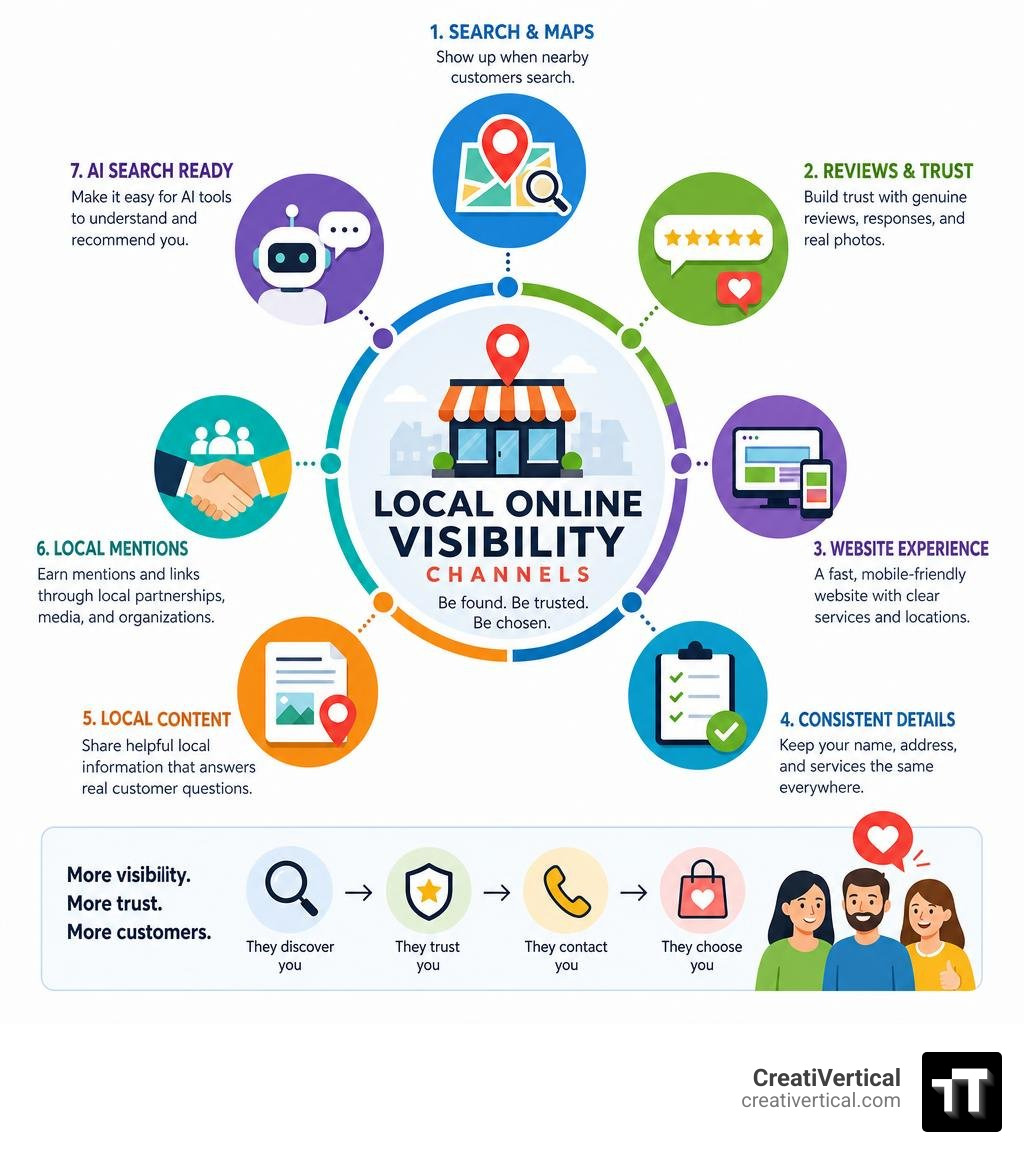
For most service-based businesses, the highest-impact priorities are:
- Show up accurately on Google Search and Maps with a complete, active Google Business Profile.
- Build proof of trust through genuine, recent customer reviews, helpful responses, and real photos of your work.
- Create a fast, mobile-friendly website with clear pages for each service and location you serve.
- Keep business details consistent across your website, Google, Apple Maps, Bing, industry directories, and social profiles.
- Publish useful local information that answers real customer questions about your services, neighborhoods, and community.
- Earn local mentions and links through partnerships, community involvement, local media, and relevant organizations.
- Make your information easy for AI search tools to understand with clear writing, structured data, accurate listings, and visible expertise.
Local discovery no longer happens in one place. Customers may search Google Maps, read reviews, ask ChatGPT or Perplexity for recommendations, browse social posts, or check a local organization’s website before they call. The businesses that appear consistently across those moments have a stronger chance of earning the inquiry.
I’m Nicholas Cunha, founder of CreatiVertical, with more than 20 years of hands-on web, SEO, digital project, and applied AI experience across small markets, public-sector organizations, professional services, and Kansas City businesses. This guide explains how local businesses can improve online visibility using practical steps that support both traditional search and AI-powered discovery.
How local businesses can improve online visibility terms explained:
Google Business Profile Mastery: How Local Businesses Can Improve Online Visibility
Google Business Profile (GBP) remains a critical digital front door for many neighborhood establishments and regional service companies. Industry studies consistently indicate that Google Business Profile signals are among the more influential factors in local map pack rankings. Businesses with fully completed and actively maintained profiles also tend to gain better online visibility and more requests for driving directions than incomplete listings.
If you want to understand how local businesses can improve online visibility, managing your Google Business Profile is a practical place to start.
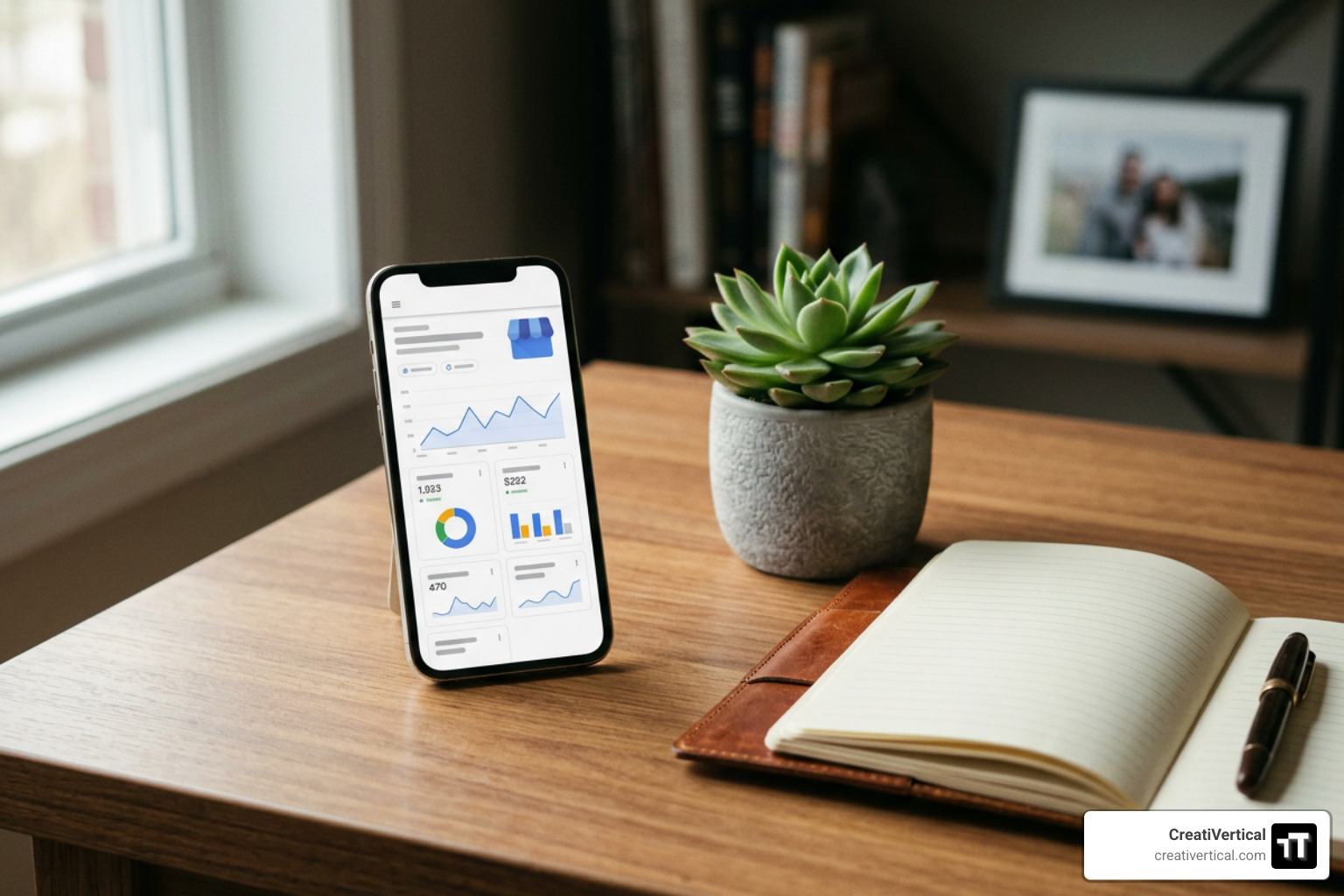
Setting up your profile correctly involves more than just entering your business name and address:
- Complete Profile Verification: Secure your listing using Google’s preferred verification method, whether that involves video verification showing your physical workspace, equipment, or business signage, or postcard verification.
- Strategic Category Selection: Choose your primary category carefully. If you are a kitchen remodeling contractor, select “Kitchen Remodeler” rather than a broad term like “General Contractor.” Select 5 to 7 secondary categories that represent specific, valuable offerings without diluting your main core expertise.
- Granular Service Listings: Add every individual service you perform as a separate item within your profile rather than clumping them into general paragraphs. Provide clear descriptions and realistic starting price indicators where appropriate.
- Authentic Visual Proof: Replace generic stock imagery with authentic photos. Upload at least 10 to 20 original photographs depicting your physical storefront, branded vehicles, actual team members, and real project completions. Highlighting actual work can build trust with nearby prospects.
- Weekly Profile Updates: Treat your GBP like an active business communication channel. Publish weekly posts featuring project spotlights, seasonal advice, temporary operating hour changes, and company announcements to signal active operations to search engines.
- Manage the Q&A Section: Seed your profile’s Questions & Answers section with common inquiries you receive over the phone, such as service area boundaries, warranty options, or financing terms, and answer them directly from your verified owner profile.
For a deeper dive into preventing profile dormancy and executing structured profile maintenance, see our comprehensive guide on how to stop ghosting Google with active Business Profile management.
Building Trust and Authority Through Reviews and Local Reputation

Consumer research reveals that the vast majority of buyers read online reviews before choosing a local service provider, and most consumers search for local businesses online on a regular basis. Online reviews represent a primary driver of Google’s local “prominence” ranking calculation. In 2026, consumer expectations have reached an all-time high: most prospective buyers require strong overall star ratings before considering a local company, while many will only consider businesses boasting top-tier ratings.
Search engines evaluate three core components of review profiles: volume, recency, and velocity (the steady pace at which new reviews arrive). Securing genuine reviews received steadily over time provides far stronger ranking and trust signals than receiving a sudden burst of reviews followed by months of complete silence.
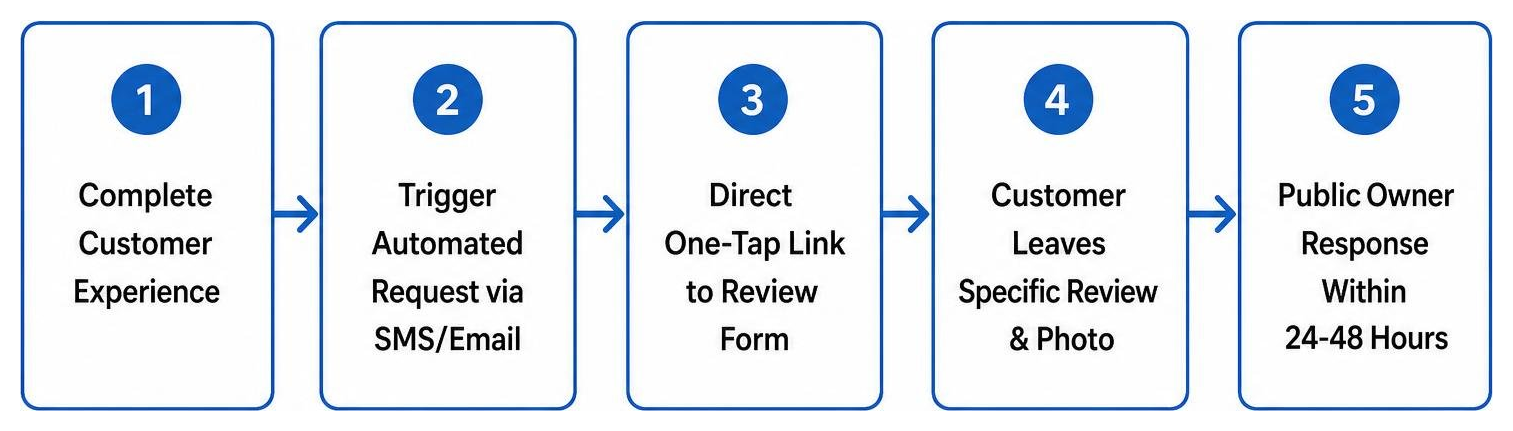
How Local Businesses Can Improve Online Visibility with Automated Review Generation
Relying on verbal requests alone rarely creates predictable review volume. Implementing an automated review generation system ensures that every satisfied customer receives a frictionless opportunity to leave feedback.
- Automate Post-Service Triggers: Integrate your customer relationship management (CRM) tool or invoicing software with automated dispatch systems that send an email or SMS prompt within 2 to 24 hours of project completion.
- Eliminate Friction with Direct Links: Never instruct a client to “search for us on Google.” Provide a short, direct URL that opens the review composition window on their smartphone with a single click.
- Prompt for Helpful Details: Encourage clients to mention the specific service performed, the technician’s name, and their neighborhood location in their write-up. Reviews that contain natural service keywords and geographic locations help search engines and AI assistants connect your profile with relevant local queries.
- Respond to 100% of Reviews: Write customized public replies to every review—both positive and negative—within 24 to 48 hours. Thank happy clients personally, and respond to critical feedback with practical, calm solutions. A thoughtful, constructive response to a negative review often builds more trust with prospective buyers than a string of perfect five-star ratings.
Avoiding Common Mistakes That Damage Local Reputation
When learning how local businesses can improve online visibility, knowing what not to do is just as crucial as executing the right strategies. Steer clear of these common pitfalls:
- Review Gating: Filtering dissatisfied clients into private feedback forms while directing only happy clients to public review sites violates Google’s terms of service and risks profile suspension.
- Incentivized or Fake Reviews: Offering discounts, gift cards, or payments in exchange for reviews violates FTC guidelines and major platform policies. Search algorithms frequently purge unnatural review clusters.
- Keyword Stuffing the Business Name: Adding extra keywords or geographic tags to your official Google Business Profile title (e.g., “Smith Plumbing – Best Emergency Plumber Kansas City”) risks immediate profile suspension. Match your profile title strictly to your legal registration and physical signage.
- Ad Overreliance Without Organic Groundwork: Relying entirely on paid pay-per-click (PPC) ads without fixing your organic map pack presence, website performance, or review reputation creates high acquisition costs that disappear the moment ad spend stops.
Technical SEO, Schema Markup, and AI Search Optimization
How Local Businesses Can Improve Online Visibility Across AI Engines like ChatGPT and Perplexity
Search behavior is undergoing a major transformation. A substantial and growing portion of local discovery queries now occur through conversational AI platforms like ChatGPT, Perplexity, and Google AI Overviews. These tools do not simply return a list of links; they synthesize information from across the web to recommend specific local businesses directly.
To capture visibility in conversational answers, local firms must embrace Generative Engine Optimization (GEO):
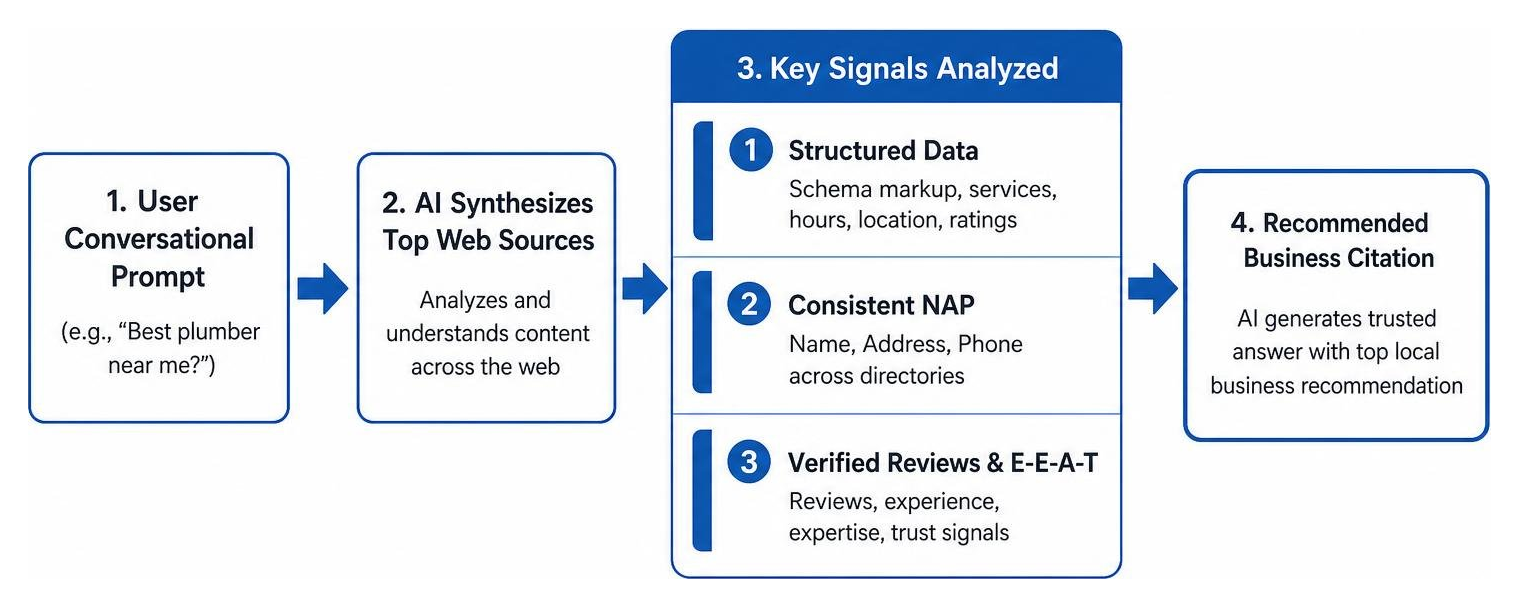
- Structure Content for Natural Language Processing: AI engines prefer clear, concise answers to specific questions. Organize service pages using straightforward H2 and H3 subheadings formatted as questions, followed by direct 2-to-3 sentence answers.
- Implement Comprehensive Schema Markup: Structured data (JSON-LD) translates your website’s content into machine-readable code. Implement
LocalBusinessschema alongsideService,AggregateRating, andFAQPagemarkup to explicitly define your precise location coordinates, operating hours, service catalogs, and customer review scores. - Build Visible E-E-A-T (Experience, Expertise, Authoritativeness, Trustworthiness): AI platforms cite businesses that demonstrate clear real-world experience. Publish detailed case studies, showcase team qualifications, highlight local business licenses, and maintain clear contact details across your site.
- Claim Public Profiles and Directory Listings: AI tools train on open web sources, including regional business resources like the Kansas City Small Business Resource Directory and local community databases.
On-Page Geo-Targeting and Website Performance
Your website serves as the authoritative anchor for your entire digital ecosystem. A significant share of local searchers click on results inside the Google Local Pack, and the majority of smartphone users searching for local services visit or call a business within a short timeframe. If your mobile site loads slowly or is difficult to navigate, those leads quickly bounce to competitors.
- Mobile-First Optimization: Design your layout primarily for mobile users. Ensure buttons are easy to tap, phone numbers feature click-to-call functionality, and navigation menus remain simple. Target Core Web Vitals performance benchmarks: Largest Contentful Paint (LCP) under 2.5 seconds and Interaction to Next Paint (INP) under 200 milliseconds.
- Dedicated Service and Location Landing Pages: Avoid combining all offerings onto a single generic “Services” page. Build individual, detail-rich pages for each core service you provide. If you serve multiple distinct suburbs or municipalities across the metropolitan area, construct dedicated service area pages featuring localized customer quotes, recent project descriptions, and custom regional information.
- Hyperlocal Content Strategy: Write content that reflects real involvement in your service territory. Discuss regional weather challenges, municipal compliance codes, neighborhood architecture styles, or local community events to naturally establish regional search relevance.
Learn more about capturing immediate local demand in our detailed guide on ranking for ‘near me’ searches and winning local customers.
Citations, NAP Consistency, and Local Link Ecosystems
Managing Core Citations and Eliminating Data Discrepancies
Name, Address, and Phone Number (NAP) consistency across external directories remains a foundational requirement for local search algorithms. Discrepancies in suite numbers, phone variations, or historic business names create ambiguity for search crawlers, eroding local ranking authority.
| Citation Tier | Platform Types | Key Examples | Strategic Focus |
|---|---|---|---|
| Tier 1: Core Map Search | Major Search & Map Platforms | Google Business Profile, Apple Maps, Bing Places, Waze | 100% exact NAP match with official legal entity documents |
| Tier 2: Primary Directories | High-Authority Web Platforms | Yelp, Facebook Business Page, YellowPages, BBB | Complete profile descriptions, photos, and active review tracking |
| Tier 3: Industry & Regional | Specialized & Local Outlets | Local Chamber of Commerce, Trade Associations, Regional Portals | High-relevance backlinks and geo-targeted trust validation |
Conduct periodic audits of your core citations to fix conflicting data. You can find useful guidelines on building a visible local brand in the US Chamber of Commerce Discovery Guide.
Earning Local Backlinks Through Partnerships and Community Media
While standard SEO relies heavily on national domain authority, local SEO thrives on hyper-local link authority. A single backlink from a respected neighborhood newspaper, local charity, or regional business organization frequently conveys more local ranking strength than dozens of generic directory listings.
- Sponsor Community Events: Support local youth sports teams, neighborhood festivals, or non-profit fundraisers. These sponsorships frequently earn contextual backlinks from local event pages and news mentions.
- Partner with Complementary Businesses: Build referral networks with non-competing service providers—such as a residential remodeler partnering with a local interior designer or a real estate attorney linking with a local mortgage brokerage. Swap helpful advice and feature partner spotlights on your blog.
- Engage with Local Media: Share real business expertise, seasonal tips, or local economic insights with regional reporters and community news blogs to earn authoritative press mentions and links.
- Join Regional Business Associations: Ensure your business is active in your local Chamber of Commerce, regional trade groups, and downtown merchant associations.
Read our practical, direct approach to building regional search presence in our guide on no-nonsense local business SEO strategy.
Frequently Asked Questions About Improving Local Online Visibility
How long does it take for local SEO efforts to show measurable results?
Most service businesses begin seeing early ranking lifts and increased direction inquiries within 60 to 90 days of resolving profile issues, standardizing NAP data, and starting systematic review generation. However, local SEO growth compounds over time. Building dominant map rankings and earning sustainable AI search citations typically requires 3 to 6 months of continuous effort.
Do service-area businesses without a storefront need local SEO?
Yes. Service-area businesses (such as plumbers, electricians, mobile detailers, or field consultants) that meet clients on-site can fully utilize local SEO. Google Business Profile allows service-area providers to hide their physical street address while defining up to 20 specific service areas by city, county, or zip code. Local ranking factors evaluate your registered location, designated service coverage, reviews, and website relevance without exposing a residential home address.
Why are traditional organic clicks declining in local search?
Traditional organic web clicks have decreased in part due to zero-click search behavior and the introduction of AI Overviews. Search engines now answer consumer inquiries directly on the search results page via local map packs, direct calling buttons, booking widgets, and AI-generated summaries. Rather than relying solely on website traffic, local businesses must focus on appearing directly inside those interactive search features and AI recommendation blocks.
Conclusion
Understanding how local businesses can improve online visibility requires recognizing that local search is an interconnected digital ecosystem. Achieving high map rankings and earn AI recommendations is not about discovering a hidden secret or running a single short campaign; it requires consistent operational follow-through across several core areas:
- Maintaining an updated, complete Google Business Profile.
- Systematically requesting and responding to client reviews.
- Ensuring exact NAP detail consistency across core directories.
- Delivering a fast, mobile-optimized website experience.
- Publishing helpful content tailored to your specific service area.
- Building active, real-world community partnerships.
At CreatiVertical, we help local companies, professional service firms, and industrial businesses build complete digital growth systems. As an ongoing growth partner based in the Kansas City area, we align modern web design, search engine optimization, AI search visibility (GEO), and conversion optimization into a cohesive strategy engineered for long-term leads.
Ready to sharpen your local presence and systematically win more local customers? Explore our actionable blueprint on 7 tips to improve local visibility online, or reach out to us today to start building your custom local search strategy.