

Why Your Local Business SEO Strategy Determines Who Gets the Customer
A solid local business SEO strategy is the difference between your phone ringing and your competitor’s phone ringing — and most small business owners don’t realize how much ground they’re losing until they search for their own services and don’t show up.
Here’s the short version of what a local business SEO strategy involves:
| Step | What It Does |
|---|---|
| Optimize your Google Business Profile | Gets you into the map pack — the top 3 local results |
| Build consistent NAP citations | Tells Google your business information is trustworthy |
| Create location and service pages | Matches your website to what local customers search for |
| Collect and respond to reviews | Boosts prominence — a direct ranking signal |
| Earn local backlinks | Builds authority in your geographic market |
| Optimize for AI Overviews | Gets your business cited by ChatGPT, Perplexity, and Google AI |
The numbers make the case fast. 30% of all mobile searches are location-related, and 78% of people who search for something nearby visit a business within a day. Yet most local businesses leave that traffic on the table — either because their Google Business Profile is incomplete, their website has no location-specific content, or their citations are a mess of inconsistent names and addresses.
This guide walks you through every layer of a modern local search strategy: the Google Business Profile fundamentals that most businesses rush through, the website structure that actually ranks, the review systems that build prominence over time, and the emerging AI search layer that is quietly reshaping how customers find local businesses in 2026.
I’m Nicholas Cunha, founder of CreatiVertical — I’ve spent over twenty years building digital strategies for businesses ranging from Kansas City small businesses to government institutions in the British Virgin Islands, and a local business SEO strategy is consistently the highest-return investment I see for businesses with a geographic market. Let’s get into it.
What is Local SEO and How Does It Differ From Traditional Search?
To build an effective local business SEO strategy, we first have to understand the difference between local search and traditional organic search.
Traditional SEO focuses on ranking websites for queries without a geographic constraint. If someone searches for “how to clean industrial lubricants,” they are looking for information. Google serves up a list of standard organic blue links from websites all over the world. Proximity does not matter; only topical authority and page-level trust do.
Local SEO, however, is designed for queries with local intent. When a user searches for “machined parts manufacturer near me” or “BVI law firm corporate restructuring,” Google understands that the searcher wants a business nearby.
Instead of just showing standard links, Google modifies the search engine results page (SERP) to display the “Local Pack” (also known as the Map Pack or 3-Pack). This is a dedicated map element showing the top three local business listings. Beneath the Local Pack, Google displays traditional organic results, but heavily weights them based on the searcher’s geographic location.
| Feature | Traditional SEO | Local SEO |
|---|---|---|
| Primary Goal | Rank for informational or global keywords | Rank in the Local Map Pack and local organic results |
| Primary Ranking Signal | Backlinks, content depth, domain authority | Proximity, Google Business Profile optimization, reviews |
| Search Intent | Informational, transactional (global) | Navigational, transactional (geographic) |
| Key Platform | Your website | Your website + Google Business Profile + local directories |
Understanding this distinction changes how we allocate our marketing budget. While traditional SEO requires competing against global giants with massive budgets, local SEO allows a local business in Missouri to dominate its immediate territory. Because Google prioritizes proximity and local relevance, a well-optimized local business can easily outrank national competitors within its service area.
The Three Pillars of Google’s Local Ranking Formula
Google uses three core pillars to evaluate and rank local businesses in both the Map Pack and local organic search. To build a framework that consistently wins, we must optimize for all three:
- Relevance: How well does your business listing match what the user is searching for? Google determines this by analyzing your Google Business Profile categories, your services list, and the structured content on your website.
- Distance: How close is your business to the searcher or the geographic term used in the query? While you cannot change your physical location, you can ensure Google knows exactly where you are and what areas you serve.
- Prominence: How well-known or trustworthy is your business? This is evaluated using signals from across the web: your review count and velocity, consistent directory citations, local backlinks, and your website’s organic authority.
For a highly detailed breakdown of how these three pillars interact mechanically, you can analyze how search engines process proximity and prominence signals across your digital footprint.
The Core Pillars of a Modern Local Business SEO Strategy
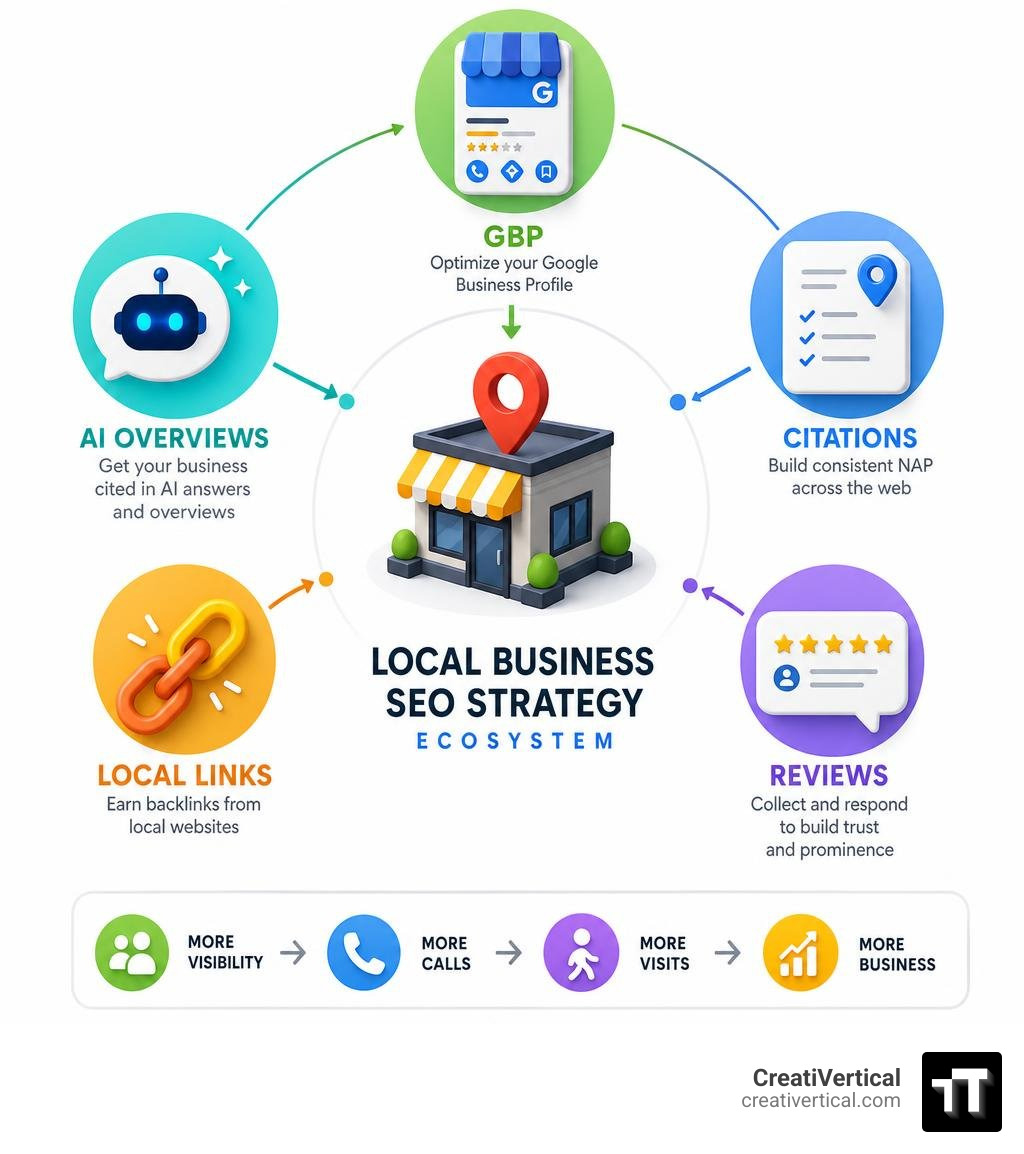
A successful local search campaign is not a one-time setup; it is a cohesive system. If your website is optimized but your Google Business Profile (GBP) is neglected, your rankings will stall. If your GBP is perfect but your website has thin, duplicate content, Google will limit your visibility.
To help our partners stand out, we look at local search as an interconnected ecosystem. You can visualize this relationship by checking out our guide on how to Stand Out Locally with Kansas City SEO.


Let’s break down the execution steps for the three main pillars of a modern local business SEO strategy: Google Business Profile mastery, high-converting website optimization, and systematic review generation.
Optimizing Your Google Business Profile for Maximum Prominence
Your Google Business Profile is the absolute foundation of your local presence. In fact, 36% of SEO specialists agree that GBP optimization is the single most important ranking factor for the Map Pack.
To claim, verify, and fully optimize your profile for maximum prominence, follow this strict checklist:
- Business Name Compliance: Use your exact, legal business name. Do not stuff keywords into your business name (e.g., writing “Kansas City Precision Machining – CNC Lathe Parts” if your legal name is simply “Kansas City Precision Machining”). Google regularly suspends listings for this violation.
- Category Selection: Choose your primary category with extreme care. It must represent your core business. You can also select up to 9 secondary categories. Look at your top-ranking local competitors to see which categories they use.
- Complete Business Description: Write a compelling, 750-character description. Focus on what your business does, your experience, the specific areas you serve, and a clear call to action.
- High-Quality Photos: Profiles with photos receive significantly more direction requests and clicks. Upload at least 20 high-quality, original photos of your building exterior, interior workspace, and team. Commit to adding 2 to 5 new photos every month to show Google your listing is active.
- Services and Products: Underused but highly powerful, the Services section feeds directly into Google’s relevance engine. List every service you offer individually with a clear description and pricing if applicable.
- Q&A Seeding: Do not wait for customers to ask questions. You can legally seed your own Q&A section. Write and post 8 of your most frequently asked questions from your own business profile, and answer them authoritatively.
For an even deeper look at how to structure these profiles for long-term growth, focus on building a comprehensive profile that answers every potential customer question before they even visit your website.
Building a High-Converting Local Business SEO Strategy on Your Website
While your GBP drives Map Pack visibility, your website controls your organic rankings and converts search traffic into paying customers. If you want to rank for multiple services across different neighborhoods, you must build a clear, logical site architecture.
Avoid the common mistake of creating a single “Locations” page that lists twenty different cities with no unique text. This triggers search engine duplicate content filters and suppresses your rankings. Instead, build dedicated, high-quality location pages and service pages.
If you are a local service provider or a B2B business in Missouri, your website should feature:
- Dedicated Service Pages: Create a unique page for every core service you offer. If you are an industrial manufacturer, do not lump CNC milling, lathe turning, and surface grinding onto one page. Give each service its own dedicated URL with rich, technical descriptions.
- Hyperlocal Location Pages: If you serve multiple areas — such as Kansas City MO and Lake Tapawingo MO — build a unique page for each location. Each page should have at least 500 to 1,500 words of completely original content, including localized customer testimonials, local landmarks, and an embedded Google Map.
- Clear Keyword Mapping: Map your geo-targeted keywords to specific pages. For example, your homepage might target “SEO Services in Kansas City,” while a dedicated landing page targets “AI SEO in Lake Tapawingo.”
To see how we structure these high-performing local funnels, review our dedicated SEO Services in Kansas City page. You can also browse the Best Local SEO Companies for Mid Business in Missouri 2026 to see how regional agency capabilities are evaluated across the state.
To make sure you are targeting the right search phrases before writing your content, align your pages with a clear Keyword Research Strategy.

Why a Local Business SEO Strategy Fails Without Review Velocity
You can have a beautiful website and a completed GBP, but without a systematic review generation system, your prominence score will remain flat. 17% of SEO specialists deem online reviews as the most important ranking factor for Map Pack rankings. Furthermore, 95% of customers read online reviews before making a purchase.
However, in 2026, it is no longer just about your total review count. Google’s algorithms heavily prioritize review velocity — the frequency and consistency with which you receive new reviews. A business with 200 reviews from three years ago will easily be outranked by a business with 45 reviews, provided they receive 3 to 5 fresh, detailed reviews every month.
When building your review acquisition system, keep these rules in mind:
- No Review Gating: You must never “gate” reviews by pre-screening customers with a private survey and only sending Google review links to happy clients. This is a direct violation of Google’s terms of service and FTC guidelines.
- No Incentives: Do not offer discounts, free products, or entry into raffles in exchange for reviews. Late 2024 FCC regulations carry heavy penalties for incentivized or fake reviews.
- Automate the Ask: Integrate review requests directly into your workflow. Send an automated email or SMS 24 to 48 hours after completing a service, containing a direct link to your GBP review page.
- Respond to Everything: Respond to every single review — both positive and negative — within 24 hours. This signals to both Google and prospective customers that your business is active, attentive, and highly professional.
Navigating the New Frontier: AI Overviews, GEO, and Agentic Search
The search landscape is undergoing its most radical transformation in a decade. Traditional search engines are evolving into answer engines. Today, Google processes roughly 14 billion searches daily, but AI systems like ChatGPT, Perplexity, and Claude handle another 4 to 5 billion queries.
With the rise of Google’s AI Overviews (formerly SGE), users are presented with synthesized, conversational answers at the very top of the page, often pushing traditional organic listings down. This shift has birthed a new discipline: Generative Engine Optimization (GEO).

While this may sound intimidating, local businesses are uniquely protected. AI engines cannot physically perform a service, nor can they replicate real-world proximity. When someone asks an AI engine for a local recommendation, the AI must rely on trusted web databases, structured schema, and highly localized business profiles to generate its answer.
To stay ahead of this shift, focus on optimizing your digital footprint so that generative engines can easily parse and verify your business details. You can also learn more about how traditional and generative search systems are merging by reading about Search Ecosystem Optimization.
If you are located in or near Lake Tapawingo, you can see how local digital strategies are adapting to these AI-first search trends by learning about the local business community directly on the official City Of Lake Tapawingo, MO: Home .
How to Get Cited by AI Search Engines
To ensure your business is recommended by systems like ChatGPT, Perplexity, and Google AI Overviews, your website must be optimized for generative engines. AI models do not read websites the same way humans do; they look for structured, highly authoritative data points that verify your real-world footprint.
Here is how to optimize your digital presence for AI citations:
- Write for Conversational Queries: People ask AI engines complete questions rather than typing fragmented keywords. Instead of just targeting “B2B lubricant manufacturer MO,” create content that answers, “Who is the most reliable industrial lubricant manufacturer in Missouri for high-temperature applications?”
- Prioritize E-E-A-T (Experience, Expertise, Authoritativeness, Trustworthiness): AI models are programmed to ignore generic, AI-generated content. They prioritize original human expertise. Publish detailed case studies, original project photos, and author bios detailing your professional credentials.
- Format for Easy Extraction: Use clear, logical heading hierarchies (H2s and H3s), short paragraphs (2 to 3 sentences), and bulleted lists. AI engines love structured data because it is easy to parse and synthesize into an answer.
For a complete overview of how we adapt our clients’ websites to these changing search behaviors, explore our Adaptive SEO Services.
Technical Foundations and Local Link Building
A flashy design means nothing if search engine crawlers cannot index your site or if mobile users abandon your pages due to slow load times. Technical SEO is the engine room of your digital presence. Google uses mobile-first indexing for all local search results, meaning your mobile website performance dictates your desktop rankings.
To build a flawless technical foundation, implement these core elements:
- LocalBusiness Schema Markup: This is a specific block of code added to your website that tells search engines exactly what your business is, your physical address, your phone number, your opening hours, and your precise GPS coordinates. Only 30% of local businesses use schema properly — implementing it gives you an immediate competitive edge.
- Mobile Optimization: Ensure your website is responsive, features clear, thumb-friendly tap targets, and has a highly visible click-to-call button in the header.
- Page Speed and Core Web Vitals: Run your site through Google PageSpeed Insights. Target a mobile performance score of 90+. Compress your images, leverage browser caching, and eliminate render-blocking resources.
To run a diagnostic on your current technical health, read our guide on Technical SEO or browse our broader Category: SEO archives.
Earning Local Backlinks That Move the Needle
While traditional SEO relies on earning links from high-authority global websites, local SEO is driven by geographic relevance. A single backlink from a trusted, local business or community organization in your city will carry more ranking weight than a dozen generic links from global blogs.
Here are highly effective local link-building strategies that actually work:
- Community Sponsorships: Sponsor local youth sports teams, charity events, or community cleanups. These organizations almost always feature a “Sponsors” page on their website that links back to your business.
- Local Business Partnerships: Reach out to complementary, non-competing businesses in your area. For example, if you are a commercial web developer, partner with a local commercial photographer and trade high-quality backlinks on your respective websites.
- Chamber of Commerce Listings: Join your local Chamber of Commerce. Their directories are highly trusted by search engines and provide a powerful, geographically relevant backlink.
To understand how to execute these outreach campaigns safely without violating Google’s spam guidelines, read our complete guide on Link Building.
Frequently Asked Questions About Local SEO
How long does it realistically take to see results from local SEO?
The ranking timeline depends entirely on your business’s starting point and the competitiveness of your local market.
For a brand-new business with a fresh Google Business Profile and no existing citations, expect 3 to 6 months of consistent effort before seeing meaningful Map Pack visibility and organic website rankings. The first 30 to 90 days are focused on foundation building: verifying your profiles, correcting citations, and implementing technical website optimizations.
For an established business that already has some reviews and citations, systematic optimization can yield noticeable ranking improvements and increased lead volume within 60 to 90 days.
Do I need a physical address to rank in the local map pack?
No, you do not need a public storefront physical address to rank in the local pack. Google fully supports Service-Area Businesses (SABs) — such as plumbers, mobile mechanics, or on-site IT consultants — who travel to their customers.
When setting up your Google Business Profile, you can choose to hide your physical address from the public while defining your specific service areas by city, county, or ZIP codes (up to 20 areas). Google will still use your registered address behind the scenes to calculate proximity, but your physical location will not be displayed on Google Maps.
How does review velocity affect my local rankings?
Review velocity refers to how often your business receives new reviews. Google’s local algorithm treats review velocity as a major prominence and trust signal.
If you have 100 reviews but haven’t received a new one in six months, Google’s algorithm may assume your business is less active or that your service quality has changed. Conversely, a business that receives 2 to 3 detailed, high-quality reviews every single week signals to Google that they are active, trusted by locals, and highly relevant. Consistent review acquisition is far more valuable than a one-time burst of feedback.
Conclusion
A successful local business SEO strategy is not about chasing short-term algorithm hacks. It is about building a highly visible, incredibly consistent digital system that search engines trust and customers love. From completing your Google Business Profile to structuring location pages and maintaining a steady flow of fresh reviews, every piece of the puzzle works together to drive real-world revenue.
At CreatiVertical, we don’t believe in transactional, one-off marketing projects. We operate as an ongoing growth partner, delivering complete digital systems — spanning web design, technical SEO, and cutting-edge AI search visibility — to keep your business ahead of the curve.
If you are ready to stop playing hide-and-seek with your local customers, explore our 7 Tips to Improve Local Visibility Online or get in touch with us today to build a search strategy that fuels your business for the long haul.