

Why Most Technical B2B Companies Get Branding Wrong (And What It Costs Them)
B2B technical brand development is the process of defining, positioning, and communicating what your company stands for — built from your actual technical capabilities, translated into language your buyers understand and trust.
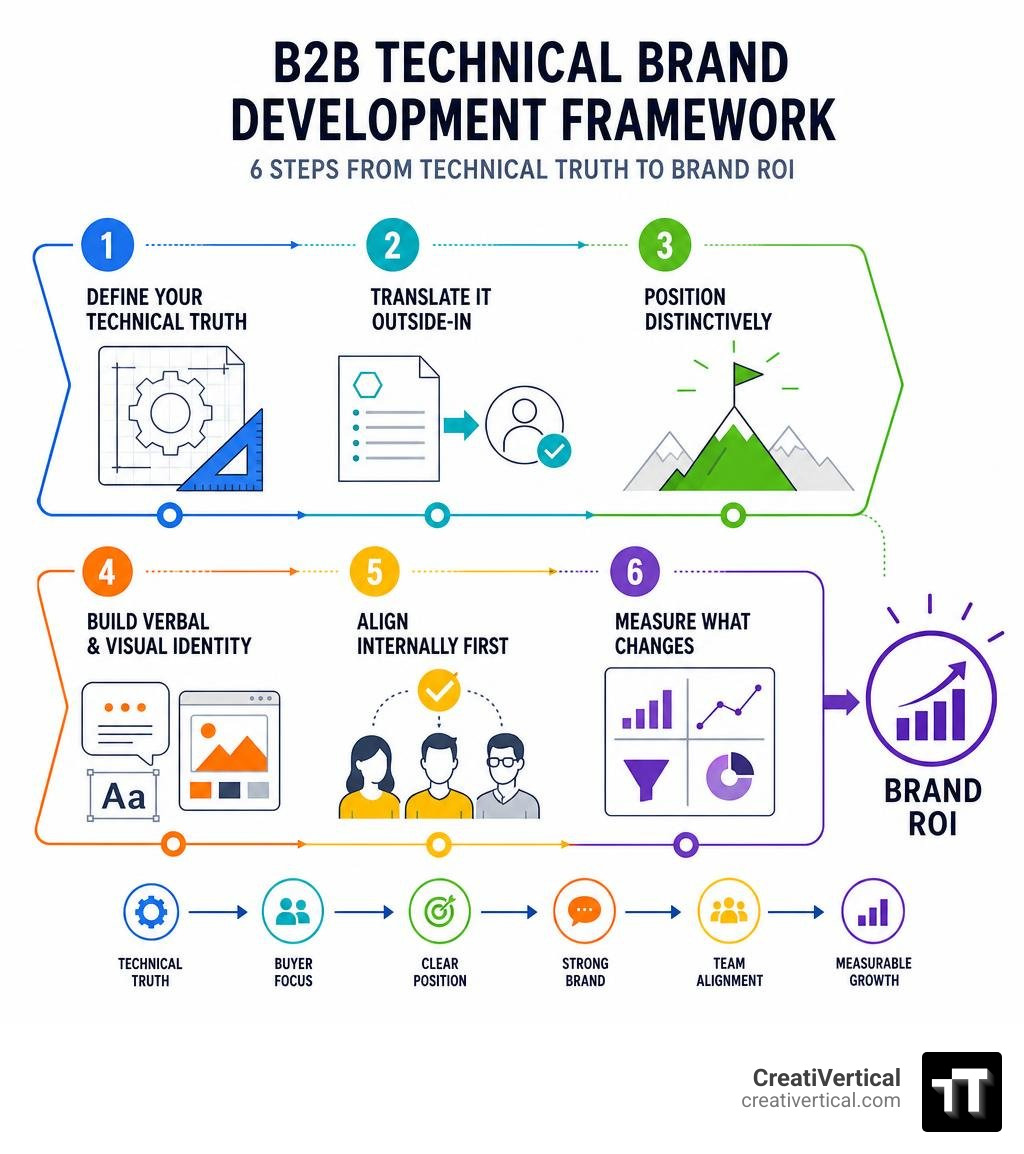
Here’s the short version of what it involves:
- Define your technical truth — what you genuinely do better, backed by real product facts
- Translate it outside-in — from engineering specs to buyer outcomes and solved problems
- Position distinctively — own one clear value attribute your competitors can’t credibly claim
- Build verbal and visual identity — brand voice, messaging, and design that signal precision
- Align internally first — employees and sales teams before any external launch
- Measure what changes — lead quality, win rates, branded search, and pricing power
If your company builds technically complex products — industrial equipment, precision-machined components, automation systems, industrial chemicals — you already know the product is good. The problem is usually this: your brand communicates from the inside out.
Engineers describe what they built. Buyers need to understand what problem it solves for them.
That gap is expensive. Research shows that 77% of B2B ads score poorly on effectiveness. Only 38% of B2B CMOs believe their marketing is substantially different from their competitors. And less than half can summarize their brand story in eight words or fewer.
For technical companies, the cost is real: longer sales cycles, price pressure from buyers who can’t tell you apart from competitors, and a sales team that struggles to articulate what makes you worth more.
This guide gives you a practical framework to fix that — without dumbing down your technology or drowning in marketing theory.
I’m Nicholas Cunha, founder of CreatiVertical, and I’ve spent over twenty years working on B2B technical brand development across industrial, government, and offshore professional-services markets — from precision manufacturers to public-sector technology vendors. That’s the lens this guide is written from: real buying environments, long sales cycles, and audiences who can spot a weak value proposition immediately.
The Core Framework of B2B Technical Brand Development
Branding in the technical business-to-business (B2B) space is fundamentally different from consumer (B2C) branding. B2C brands often sell on immediate emotion, lifestyle, and impulse. Technical B2B purchases, on the other hand, are high-stakes, long-term commitments.
When a B2B buyer selects a supplier for precision equipment, industrial lubricants, or custom battery systems, they are managing corporate risk. A bad decision can stall a production line, breach compliance standards under FISMA or FedRAMP, or trigger expensive legal liabilities.
Because of this risk, B2B purchasing decisions are rarely made by a single person. They are managed by buying committees that include engineers, procurement officers, operations managers, and C-suite executives.

To navigate these complex buying committees, companies must look beyond superficial marketing assets. True brand building in this space is an engineering project in its own right. It requires a methodical, data-driven approach to translate technical capabilities into market-facing trust. For a deeper look at the foundational mechanics of this process, you can read our guide on How to Build a B2B Brand Strategy for Technical Products.
Why B2B Technical Brand Development Demands Precision Over Fluff
Many technical companies fall into the trap of believing that branding is purely aesthetic—a new logo, a fresh color palette, or a collection of buzzwords like “cutting-edge” and “best-in-class.” In reality, technical buyers are naturally skeptical of marketing fluff. They value expertise, precision, and verified data above all else.
If your marketing consists of generic claims unsupported by technical truth, your brand will fail to build trust. When everyone claims to be “the leading provider of innovative solutions,” those words lose all meaning. This is why 77% of B2B ads score poorly on effectiveness. They lack the specific, concrete proof points that technical buyers require to justify a high-stakes purchase.
Your brand must bridge the gap between technical accuracy and high-level business outcomes. While a spec sheet tells a buyer what your product is, your brand must communicate why it matters to their business, how it reduces their operational risk, and why they can trust you to deliver on your promises.
Moving from Inside-Out Engineering to Outside-In Value
The most common failure mode in technical branding is “inside-out bias.” This occurs when a company designs its messaging around its internal engineering achievements rather than the customer’s actual pain points.
Engineers are understandably proud of the complex mechanisms, code bases, or chemical formulations they develop. However, when communicating with the market, leading with the technical mechanism rather than the outcome creates a translation problem. The buyer does not buy the mechanism first; they buy the solved problem.
To build a strong brand, you must invert this perspective. An outside-in approach starts with the buyer’s world:
- What operational pressures are they facing?
- What are the costly bottlenecks in their current workflows?
- What compliance or safety risks keep them up at night?
Once you have defined the buyer’s challenges, you can map your technical capabilities directly to those needs. This shift in perspective is the core of strategic Brand Development. It ensures your marketing assets speak the language of the buyer while maintaining the rigorous technical accuracy required to pass engineering scrutiny.
Defining and Positioning Your Technical Truth
To stand out in a crowded market, your company must define a distinct market position. If your competitors’ technical specifications are nearly identical to yours, your brand positioning becomes the primary differentiator.
Unfortunately, many companies fail to achieve this distinctiveness. According to industry data, only 38% of B2B CMOs believe their marketing is substantially different from their competitors. When your positioning is generic, you force buyers to make decisions based on price alone, which erodes your margins and commoditizes your expertise.
Defining your “technical truth” is about finding the intersection of what your technology actually does, what the market desperately needs, and what your competitors cannot easily copy. For a comprehensive look at how to bridge this gap, explore the concepts in Deep Tech Brand Strategy: How to Translate Technical Complexity Into Buyer Trust.
The OSP Value Map and Bottom-Up Positioning
One of the most effective tools for defining your technical truth is a bottom-up positioning framework, such as the Value Map. Rather than guessing what your brand should stand for from the top down, a bottom-up approach builds your positioning directly from your product’s factual capabilities.
The process involves five key steps:
- Identify the Technical Truth: Conduct internal interviews with your subject matter experts (SMEs)—the engineers, product managers, and developers who built the technology. Document every feature and ask why it was created.
- Understand the Audience: Conduct external interviews with actual customers. Find out what challenges they were trying to solve when they bought your product and what real-world benefits they have experienced.
- Map Features to Challenges: Categorize your product’s features and map them directly to the specific customer challenges they address.
- Create Value Cases: For each feature set, write a simple “Value Case” that answers three questions:
- What is the customer’s desired benefit?
- What challenge is preventing them from achieving that benefit?
- How does your technical feature solve that challenge?
- Refine and Validate: Prioritize the mapped challenges and benefits with your team, then validate them against actual customer feedback to ensure your messaging resonates.
By anchoring your positioning in verified technical facts, you create a single source of truth that aligns your product development, sales, and marketing efforts.
Crafting a Non-Generic Positioning Statement
Once you have mapped your value, you can distill these insights into a concise positioning statement. A strong positioning statement should be so specific to your company that if you substituted a competitor’s name into the statement, it would no longer be accurate.
You can use this practical formula to draft your statement:
How [Our Brand], in [Our Market Category], helps [Our Target Audience] address [Their Core Challenge] with [Their Key Benefit] by offering [Our Unique Technical Solution].
For example, an industrial lubricant manufacturer might write: “How LubriTech, in high-temperature industrial lubricants, helps steel mill maintenance managers eliminate unplanned equipment downtime with 99.9% uptime reliability by offering our patented synthetic ester formulation that resists thermal degradation up to 1,200°F.”
This statement is clear, specific, and technically verifiable. It avoids empty buzzwords and speaks directly to the buyer’s operational reality. For more insights on how to align your brand positioning with real market needs, refer to our resources on Brand Development Positioning.

Balancing Technical Precision with Compelling Storytelling
A common misconception in technical industries is that storytelling is too “soft” for serious B2B buyers. However, storytelling in a technical context is not about manufacturing emotional drama; it is about sequencing information so that it is easy to understand.
Your verbal identity—your brand voice, tone, and messaging architecture—must balance technical precision with clear, accessible language. This does not mean “dumbing down” your technology. It means organizing your communication so that non-technical decision-makers can grasp the business value quickly, while technical evaluators can easily access the deep technical data they need to verify your claims.
| Feature-Heavy Messaging (Inside-Out) | Outcome-Focused Messaging (Outside-In) |
|---|---|
| “Our proprietary system features an advanced thermal management architecture utilizing dual-phase cooling loops and micro-channel heat exchangers.” | “We prevent thermal throttling in high-load servers, maintaining 100% processing speed even during peak computational demands.” |
| “The model XYZ-900 utilizes a 32-bit ARM Cortex-M4 microcontroller running at 120 MHz with integrated hardware floating-point unit.” | “Our controller processes sensor data in real-time, allowing robotic arms to adjust their path within 2 milliseconds to avoid collisions.” |
| “Our industrial lubricant formulation contains a proprietary blend of synthetic polyol esters and extreme-pressure additives.” | “We extend the lifespan of heavy machinery by 40% under extreme temperatures, reducing your annual maintenance costs.” |
Simplifying Complex Product Portfolios
As technical companies grow, they often suffer from product portfolio bloat. Acquisitions, custom engineering projects, and rapid product development cycles can lead to a confusing array of sub-brands, model numbers, and overlapping solutions.
When a product portfolio is too complex, it increases the cognitive load on potential buyers. If a visitor arrives at your website and cannot easily figure out which product matches their needs, they will leave.
To improve customer clarity, you must simplify your brand architecture. This often involves consolidating multiple sub-brands under a unified corporate brand. Rather than spending valuable marketing resources to build awareness for ten different product names, focus your efforts on building equity in your corporate name. Organize your products into clear, intuitive categories based on the user’s application or industry. You can learn more about managing these structures in our guide on Category Branding.
The 8-Word Brand Story and Purpose-Driven Messaging
Simplifying your message also means being able to summarize your brand story concisely. Industry surveys show that only 41% of B2B CMOs can summarize their brand story in eight words or fewer. If your own leadership cannot state your brand promise quickly, your customers certainly won’t remember it.
An effective brand story should act as an organizational promise. It should be short, rhythmic, and memorable. For example, a cybersecurity firm working under FedRAMP frameworks might use: “We secure public sector data without compromise.”
Furthermore, modern B2B buyers are increasingly looking for companies that stand for a clear purpose. Research indicates that 63% of buyers globally prefer to purchase from companies that reflect their personal values and beliefs. In technical industries, this purpose is often tied to safety, reliability, environmental sustainability, or domestic manufacturing resilience.
When your brand purpose is aligned with your corporate actions—such as committing to clean manufacturing processes or adhering to strict ethical sourcing guidelines—it builds deep, long-term trust that goes far beyond the technical specifications of your product.
Visual Identity and Digital Hub Design for Technical Audiences
Your visual identity—your logo, color palette, typography, and graphic elements—is the first thing a buyer sees. In technical B2B markets, your design must signal precision, organizational maturity, and industry credibility.
Avoid the generic design clichés of the tech world, such as abstract blue gradients, glowing neon shapes, or meaningless AI-generated blobs. These visual tropes make your company look interchangeable and can actually reduce your credibility with serious buyers. Instead, opt for a “quietly technical” design aesthetic. Use clean, structured layouts, precise typography, and visual elements inspired by actual engineering schemas, architectural grids, or system maps.
Designing the Website as a Credibility Hub
For B2B technical brands, your website is not just a digital brochure; it is the central hub of your business credibility. Because modern B2B buyers conduct extensive independent online research before ever speaking to a sales representative, your website must do the heavy lifting of building trust.
To design a high-performing technical website:
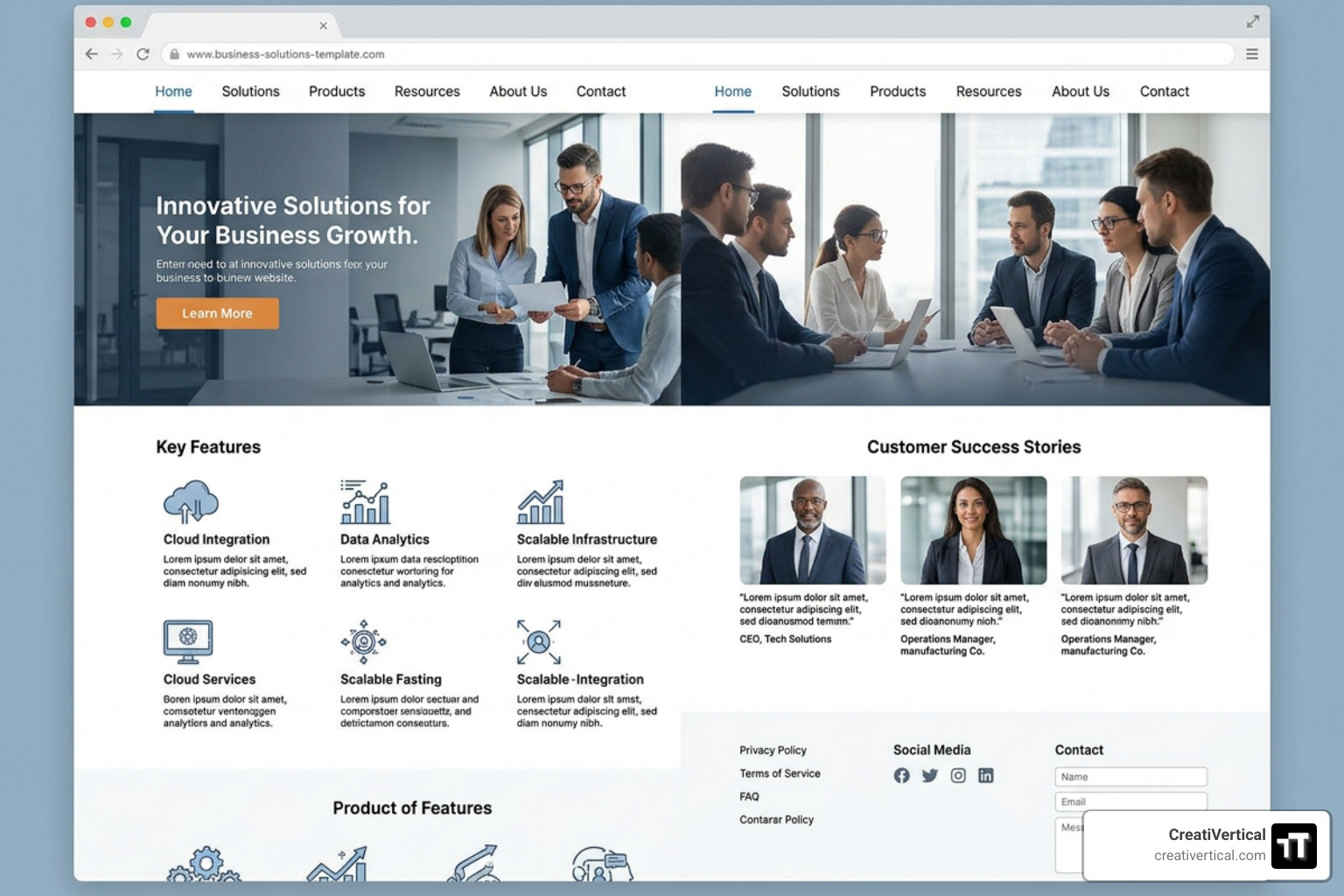
- Position Value Above the Fold: State your unique value proposition clearly in the main header. A visitor should understand exactly what you do and who you serve within three seconds of landing on your page.
- Provide Clear Social Proof: Display verified customer testimonials, case studies, and industry certifications prominently.
- Organize Technical Documentation: Make it easy for engineers and technical evaluators to find datasheets, CAD models, API documentation, and compliance certificates. If you hide your technical data behind complex forms or gate it unnecessarily, you create friction for the very people you want to influence.
- Optimize for Developer and Engineering Surfaces: If your product is software or hardware components, ensure that developer-facing surfaces like your documentation layout, GitHub repositories, and CLI tools are as polished and user-friendly as your marketing homepage.
3D and Motion Design for Invisible Technologies
Many technical companies manufacture products or software that are essentially invisible—whether it is a complex software algorithm, a microscopic chemical reaction, or an internal mechanical process deep within a machine.
This is where 3D visualization and motion design become essential brand tools. Instead of relying on dense paragraphs of text to explain how your technology works, use clean, schematic 3D animations to make the invisible visible.
A 10-second motion graphic showing how a fluid flows through a valve, or how data moves securely through a network, can communicate a complex technical concept faster and more accurately than a 2,000-word white paper. These visual systems should be developed in parallel with your brand strategy, ensuring that your animations and product demonstrations are consistent with your overall brand voice and positioning.
Internal Alignment and Launch Strategy
A successful brand development project is not just an external marketing launch; it is an internal alignment process. If your employees do not understand or believe in your brand promise, they cannot deliver on it.
This is particularly true for technical sales teams and customer support engineering groups who interact directly with your clients every day. To ensure your brand is communicated consistently at every touchpoint, you must align your internal team before sharing your new brand with the world. You can read more about managing these transitions in our resource on Project Category Branding.
Engaging Employees First to Prevent Brand Terrorism
In his classic work on industrial branding, strategist Leslie de Chernatony introduced the concept of the “branding terrorist”—an employee who, either through a lack of understanding or active resistance, undermines brand consistency by using outdated logos, off-brand messaging, or personal design preferences in their communications.
To prevent this, you must invest heavily in internal marketing. While over 80% of B2B CMOs acknowledge the critical importance of employee communications during a rebrand, only 10% allow for more than one month of internal preparation before launching externally.
Take the time to:
- Appoint Brand Champions: Identify key team members across engineering, sales, and operations to champion the new brand guidelines.
- Conduct Hands-On Training: Run workshops to explain the strategic thinking behind the new positioning and show teams how to use the new verbal and visual assets.
- Build a Living Brand Portal: Create an easily accessible digital portal containing all your brand assets, templates, and voice guidelines, rather than distributing a static PDF that will quickly become outdated.
By building cultural uniformity internally, you ensure that every external contact—from a formal sales presentation to a quick customer support call—reflects your unified brand values.
Activating the Brand Across Sales and Marketing
Once your internal team is aligned, you can equip your sales and marketing departments with the tools they need to succeed. This requires close collaboration to ensure your marketing messaging integrates seamlessly with your sales enablement materials.
Your brand guidelines should be translated into practical sales assets, including:
- Consistent slide decks that lead with buyer outcomes rather than product specs.
- High-quality datasheets and white papers that maintain your visual identity.
- Standardized email templates and social media guidelines for your sales development teams.
When your sales and marketing efforts are aligned around a single, powerful brand message, you shorten your sales cycles and make it easier for your team to close high-value deals. To explore how we help companies coordinate these efforts, check out our insights on working with a B2B Marketing Agency.

Quantifying the Business Value of Technical Branding
One of the biggest hurdles in securing executive buy-in for brand development is the perception that branding is an intangible, unmeasurable expense. However, a strong brand is a highly valuable corporate asset that has a direct, quantifiable impact on your bottom line.
For example, research shows that in crowded markets, two competing companies with similar technical offerings can see a 30% price premium difference based entirely on the strength and trust associated with their brand. A strong brand reduces decision complexity for buyers, allowing you to defend your margins and avoid price-cutting wars.
Leading Indicators of Brand Strength
While the financial impact of branding can take time to show up in your lagging financial metrics, you can track several leading indicators to measure your brand strength in real-time:
- Branded Search Volume: Track how many people are searching specifically for your company name on search engines. An increase in branded search is a direct indicator of growing brand awareness.
- Inbound Lead Quality: Monitor the types of questions your prospects are asking when they contact you. Are they asking generic questions about price, or are they asking specific questions about how your solution can solve their complex problems?
- RFP Volume and Win Rates: Track whether you are being invited to participate in more high-value Request for Proposals (RFPs) and whether your team’s win rate is improving.
- Answer Engine Optimisation (AEO) Citations: Monitor how often your brand is cited as an authority by AI search engines like ChatGPT, Claude, and Perplexity when users ask industry-related questions.
Measuring the ROI of B2B Technical Brand Development
To calculate the long-term return on investment (ROI) of your branding efforts, you must look at its impact on your overall marketing efficiency and business value.
Studies show that brand influence on supplier selection is typically around 5%, but can be increased to 7% or more with a deliberate, well-executed positioning strategy. While a 2% increase might sound modest, for a mid-market industrial manufacturer or government contractor, that shift can represent millions of dollars in incremental revenue and market share gains.
Additionally, a strong brand reduces your overall customer acquisition cost (CAC). When prospects are already familiar with your company and trust your expertise before they ever speak to a sales representative, your sales team spends less time educating the market and more time closing deals. This increases your sales velocity and maximizes the efficiency of your entire marketing spend.
Frequently Asked Questions
How long does a full B2B technical rebrand take?
A comprehensive B2B technical rebranding project typically takes 4 to 8 months to complete, depending on the complexity of your product portfolio and the size of your organization.
The process is generally broken down into three main phases:
- Discovery and Research (4-6 weeks): Conducting stakeholder interviews, competitor analysis, and customer research to define your technical truth.
- Strategy and Platform Development (4-8 weeks): Crafting your brand positioning, verbal identity, and messaging frameworks.
- Creative Execution and Asset Creation (8-12 weeks): Designing your new visual identity, building your website, creating sales enablement materials, and preparing your internal team for launch.
How do we get buy-in from our engineering team for a rebrand?
To get your engineering team excited about a rebrand, you must avoid abstract creative jargon and frame the project around clear, data-driven business objectives.
Engineers respect methodical processes, facts, and structured frameworks. Involve them early in the discovery phase by conducting subject matter expert (SME) interviews. Ask them to help you map your product’s features to customer challenges, and show them how the new brand positioning is directly supported by their actual engineering achievements. When engineers see that the rebrand is designed to accurately represent their hard work rather than cover it up with marketing fluff, they will become your strongest brand advocates.
What is Answer Engine Optimisation (AEO) and why does it matter for technical brands?
Answer Engine Optimisation (AEO)—also known as Generative Engine Optimization (GEO)—is the practice of optimizing your digital content so that it is easily read, understood, and cited by AI-powered search engines and large language models (LLMs) like ChatGPT, Gemini, Perplexity, and Copilot.
For technical B2B brands, AEO is becoming a critical distribution channel. Modern buyers frequently use AI search tools to research complex technical topics, compare products, and compile vendor lists. If your website content is not structured correctly, or if your technical data is hidden behind forms, AI models cannot access your information, and your brand will be left out of these AI-generated recommendations. By structuring your technical content with clear schema markup and publishing authoritative, fact-based articles, you ensure your brand is cited as a trusted source by these next-generation search tools.
Conclusion
Building a powerful B2B technical brand is not about creating a superficial marketing veneer; it is about making your genuine technical capabilities legible, clear, and highly trusted in a competitive market.
At CreatiVertical, we operate as an ongoing growth partner for our clients. We specialize in helping local Kansas City businesses alongside three highly technical B2B audiences:
- Industrial and B2B Manufacturers: Companies producing precision equipment, lubricants, machined parts, and industrial chemicals.
- Government-Facing Technology Vendors: Businesses navigating complex security and compliance frameworks like FedRAMP and FISMA.
- Offshore and Caribbean Professional Services: Law firms and fiduciary providers in jurisdictions like the BVI and Cayman.
We don’t just deliver one-off design projects; we build complete, performance-focused digital systems—integrating web design, search engine optimization, AI search visibility, and custom workflow automation—to help you scale your business with confidence.
If you are located in the Kansas City metro area, Missouri, or Lake Tapawingo, we would love to connect and discuss how we can help you turn your technical complexity into a powerful, trust-building market presence. You can find our physical office details via our CreatiVertical MapQuest Listing.
To explore how we can help you clarify your messaging, align your teams, and accelerate your sales cycles, visit our B2B Marketing Agency in Kansas City page.