

Core Signals That Drive Local Map Pack Ranking
To improve your local map pack ranking, start with four practical moves: choose the most specific primary Google Business Profile category, complete every profile field, earn a steady stream of authentic customer reviews, and keep your name, address, and phone number consistent across the web. These steps directly strengthen the three criteria Google uses to select local results: relevance, distance, and prominence.
According to theStacc glossary on local pack ranking factors, mastering these elements is the foundation of local visibility. When you are optimizing for near me queries, understanding how these three criteria interact prevents wasted effort on tactics that do not move the needle.
Relevance, Distance, and Prominence Mechanics
Every search query triggers an algorithmic evaluation across three distinct dimensions:
- Relevance: How well a business profile matches what the user is searching for. Google looks at your primary and secondary Google Business Profile (GBP) categories, services listed, website content, and business description to determine topical alignment.
- Distance: How far the searcher is from the physical location of the business or its stated service area. Following major local algorithm updates (such as the Vicinity update), Google places heavy weight on proximity, causing rankings to change as a user moves across town.
- Prominence: How well-known, trusted, and established the business is in the real world and across the web. Prominence relies on review volume, star ratings, review velocity, local directory citations, brand mentions, and organic backlinks.
Two-Stage Selection and S2 Cell Coverage
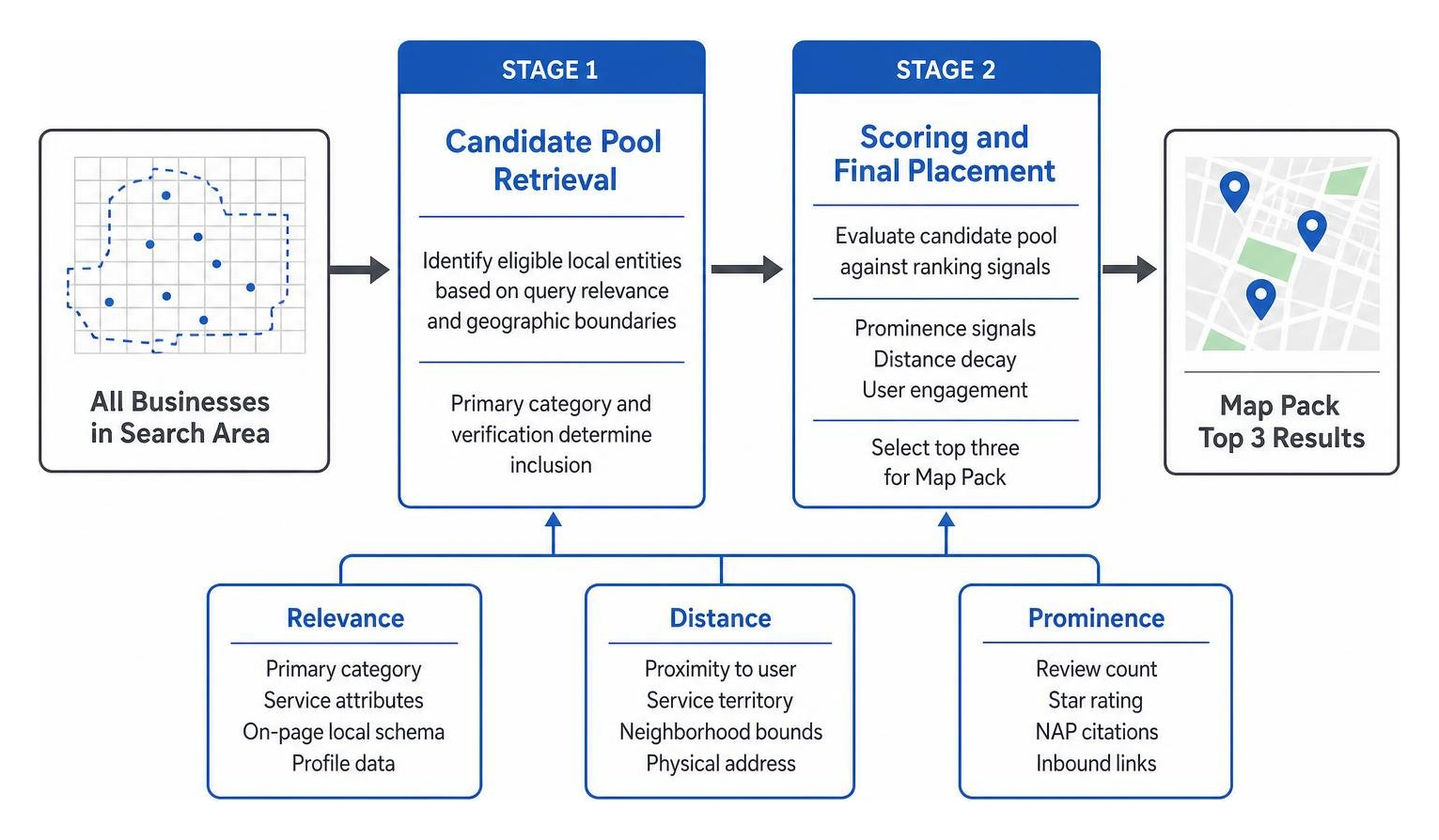
Google does not evaluate every business in a metropolitan area simultaneously for the top three spots. Instead, the selection process works in two distinct stages:
- Stage 1: Candidate Pool Retrieval. Google identifies an initial pool of eligible local entities based on strict query relevance and geographic boundaries. At this stage, your primary category and basic verification status determine whether your business is included.
- Stage 2: Scoring and Final Placement. The algorithm evaluates the candidate pool against prominence signals, distance decay functions, and user engagement metrics to select the final three profiles shown in the Map Pack.
As explained in the Lumina guide to Google Map Pack rankings, mapping software divides geographic areas into mathematical grid units known as S2 cells. While Google does not publish explicit cell thresholds, local ranking systems measure visibility and authority across these distinct coordinate grids.
The 3-Pack Advantage: Click Distribution vs. Local Finder
Appearing in the top three map listings delivers a significant traffic advantage over standard organic blue links or secondary directory pages. With over 60% of local searches occurring on mobile devices and 98% of consumers searching online for local businesses in the past year, the Map Pack captures the vast majority of local search engagement.
Breakdown of Map Pack Click Distribution
The local pack captures roughly 42% to 44% of all clicks on local searches before users ever scroll to traditional organic listings. However, click share is heavily concentrated at the very top:
- Position #1: Captures approximately 44% of local pack clicks.
- Position #2: Captures approximately 22% of clicks.
- Position #3: Captures approximately 14% of clicks.
- “More places” / Position #4+: Drops sharply to around 6% of user clicks.
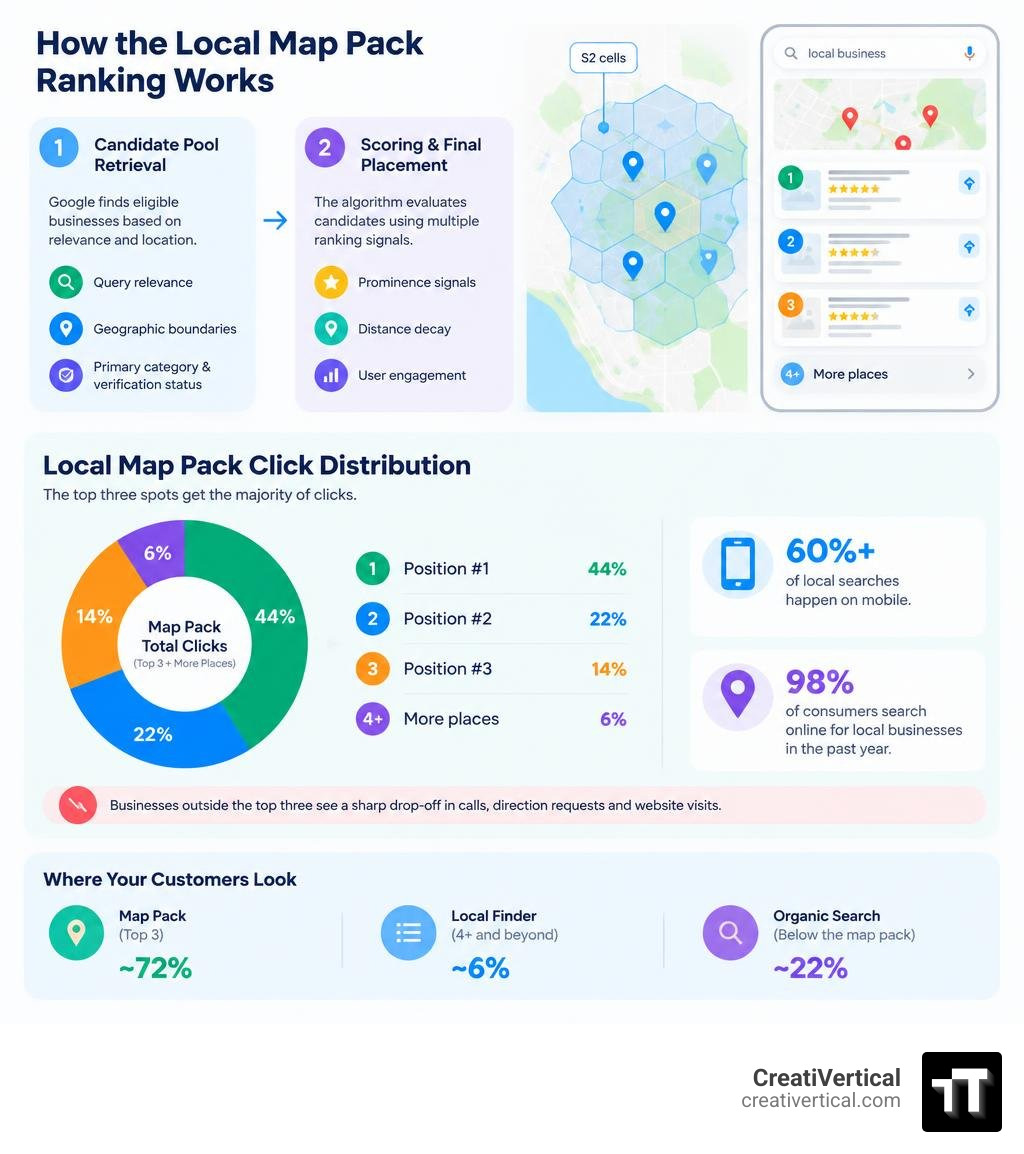
Businesses outside the top three experience an immediate drop-off in inbound phone calls, direction requests, and direct website visits.
Map Pack vs. Local Finder and Organic Search
Understanding where your prospective customers land clarifies why ranking within the primary three positions matters:
| Search Feature | Placement on SERP | Typical Click Share | Key Features Displayed | User Action Triggers |
|---|---|---|---|---|
| Map Pack (3-Pack) | Top of page (above organic) | ~42%–44% | Map view, top 3 listings, rating, hours, address | Click to call, website visit, get directions |
| Local Finder | Secondary screen (“More places”) | ~6% | Expanded list of 20+ local competitors | Extended comparison shopping |
| Organic Blue Links | Below the Map Pack | ~30%–40% | Web page titles, meta snippets, sitelinks | In-depth research, long-form content reading |
To understand broader visibility beyond the map module, explore our definitive guide to improving local online visibility.
Actionable Steps to Improve Relevance, Distance, and Prominence
Improving your local map placement requires a systematic approach to profile completeness, data integrity, and customer engagement.
Step-by-Step Optimization to Boost Local Map Pack Ranking
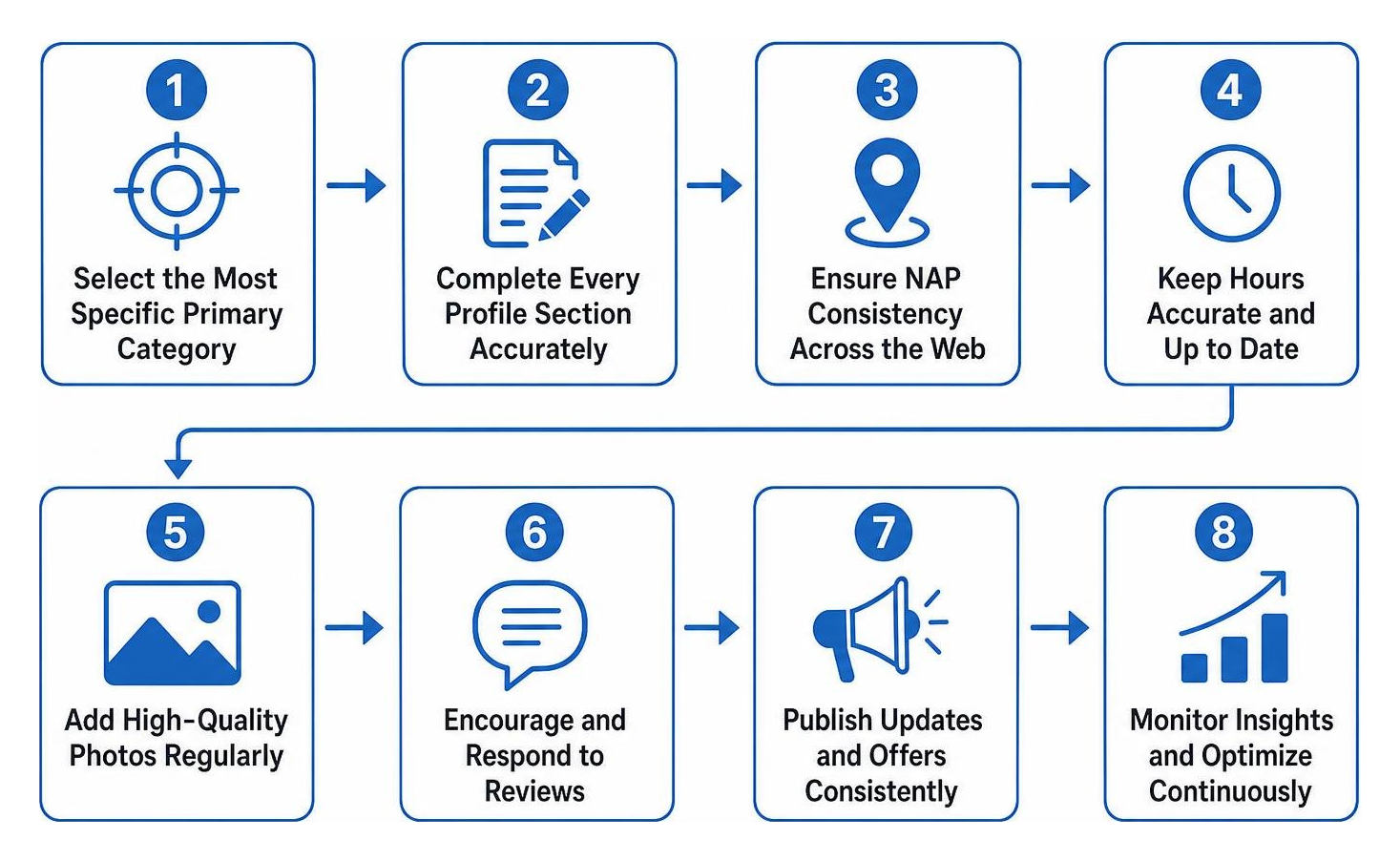
Follow this operational routine to maximize relevance and prominence across your target service radius:
- Select the Most Specific Primary Category: The primary category is the single strongest relevance field in your Google Business Profile. Avoid broad umbrella categories if a precise trade category exists.
- Add Relevant Secondary Categories: Include complementary service categories to capture long-tail local searches without diluting your primary focus.
- Populate All Profile Fields: Fill out business hours, special holiday hours, service descriptions, and business attributes. Listings with photos get 42% more requests for directions and 35% more website clicks.
- Deploy LocalBusiness Schema on Your Website: Mark up your website homepage and location pages with structured JSON-LD data matching your profile details.
- Publish Regular Profile Updates: Share weekly updates, seasonal offers, and project summaries directly through Google Business Profile posts.
For detailed profile maintenance, consult our Google Business Profile management playbook.
Building Review Velocity and Local Citation Strength
Review-related variables make up roughly 70% of the top 20 ordinal correlations with local pack position. Businesses in competitive local packs average 80+ reviews.
- Maintain Consistent Review Velocity: Acquire authentic customer feedback steadily over time (aiming for 5–10 new reviews per month) rather than gathering dozens in a single week followed by months of silence.
- Encourage Natural Service Mentions: Ask satisfied clients to describe the specific service provided and neighborhood location in their feedback.
- Audit Name, Address, and Phone (NAP) Consistency: Ensure your business name, physical address, and phone number match across core directories, local chambers of commerce, and trade portals.
- Acquire Local Backlinks: Earn links from neighborhood associations, local business partnerships, and community sponsorships.
For an end-to-end framework, check out our step-by-step guide to local visibility online and review practical tactics for growing small businesses.
Monitoring and Pitfalls That Hurt Local Visibility
Even well-established businesses can lose ground if their profile data degrades or if they engage in high-risk local SEO tactics.
Common Mistakes That Prevent 3-Pack Qualification
Avoid these standard missteps that suppress your rankings:
- Keyword Stuffing the Business Name: Adding extra keywords to your official business name violates Google guidelines and risks listing suspension.
- Using Virtual Offices or P.O. Boxes: Attempting to establish proximity using unstaffed shared mailboxes frequently triggers automatic profile suspension.
- Unresolved Citation Inconsistencies: Outdated phone numbers or prior addresses across web directories weaken Google’s entity trust signals.
- Ignoring Competitor Spam: Regularly audit your local search landscape and suggest edits on ineligible competitor listings using our local SEO competitor analysis guide.
Geogrid Methods to Measure Local Map Pack Ranking Across City Grids
Single-point rank tracking from a desktop browser fails to show how your business performs across an entire metropolitan area.
Geogrid tracking tools simulate search queries from a matrix of physical coordinates across a community, mapping your rank position at each point. This produces a visual heatmap showing:
- Your primary ranking core directly surrounding your physical address.
- Ranking drop-offs as distance increases into neighboring suburbs.
- Geographic areas where competitors outrank you due to density or prominence advantages.
To dive deeper into geographic tracking metrics, see the Local SEO Data definition of the 3-Pack and learn how to build custom dashboards in our local SEO reporting dashboard guide.
Frequently Asked Questions About Local Rankings
How long does it take to enter the Google 3-Pack?
Timelines depend on market competitiveness, baseline profile maturity, and geographic proximity. In low-to-moderate competition environments, businesses that resolve category issues and build steady review velocity can see meaningful rank improvements within 60 to 90 days. Highly competitive metropolitan markets often require 6 to 12 months of sustained citation building, review acquisition, and website optimization.
Can a service-area business rank without a physical storefront?
Yes. Service-area businesses (SABs) that travel to customers—such as plumbers, electricians, and mobile service providers—can hide their physical address on their Google Business Profile and define specific service territories. While proximity remains measured from the underlying verified address, strong relevance and prominence allow SABs to compete effectively across their designated trade radius.
What is the ideal monthly review velocity for ranking?
Rather than targeting an arbitrary total number, prioritize consistency. Earning 5 to 10 authentic, detailed customer reviews per month signals active operations and provides fresh content. Google weighs review recency and steady accumulation far more heavily than sudden spikes followed by dormancy.
Conclusion
Securing a consistent spot in Google’s 3-Pack is an ongoing operational commitment rather than a one-time configuration task. By aligning your business categories, sustaining review velocity, maintaining spotless NAP consistency, and monitoring geographic ranking changes with geogrid scans, you build the local authority required to earn high-value local search traffic.
At CreatiVertical, we design and manage complete, performance-focused digital systems—combining web development, search engine optimization, AI search visibility, and automated workflows to help neighborhood businesses and specialized B2B companies chart a clear course toward sustainable visibility.
Explore our curated local visibility strategies to expand your neighborhood reach.