
Why Local Visibility Online Decides Who Gets the Call
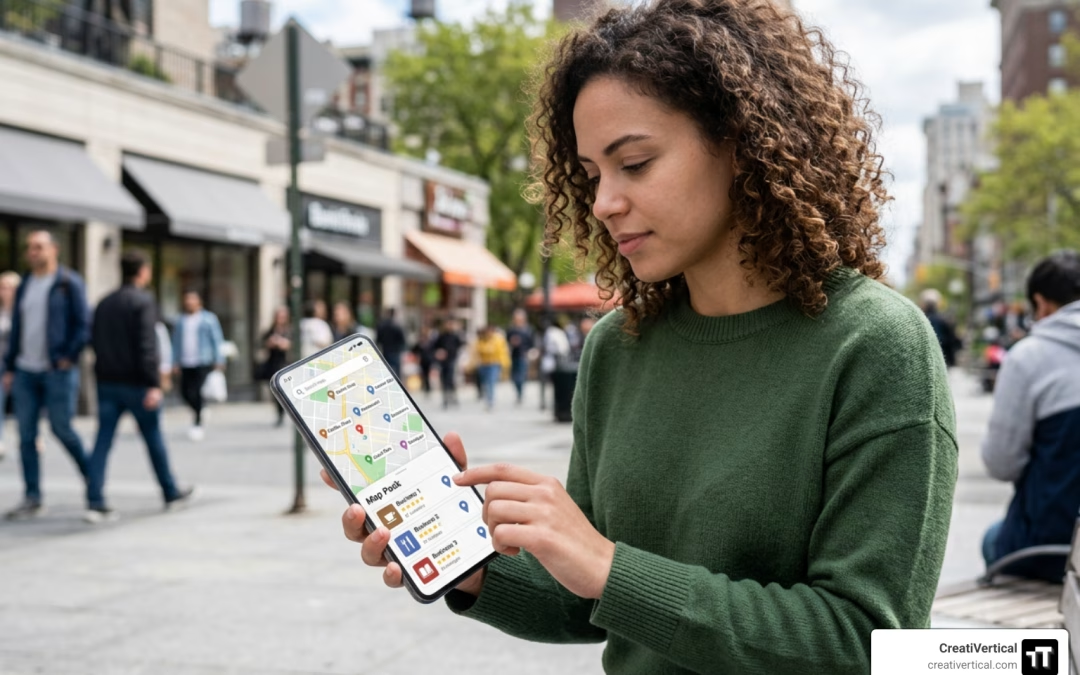
Local visibility online is how easily customers in your area can find your business when they search — on Google Maps, in the local pack, or through AI tools like ChatGPT and Gemini.
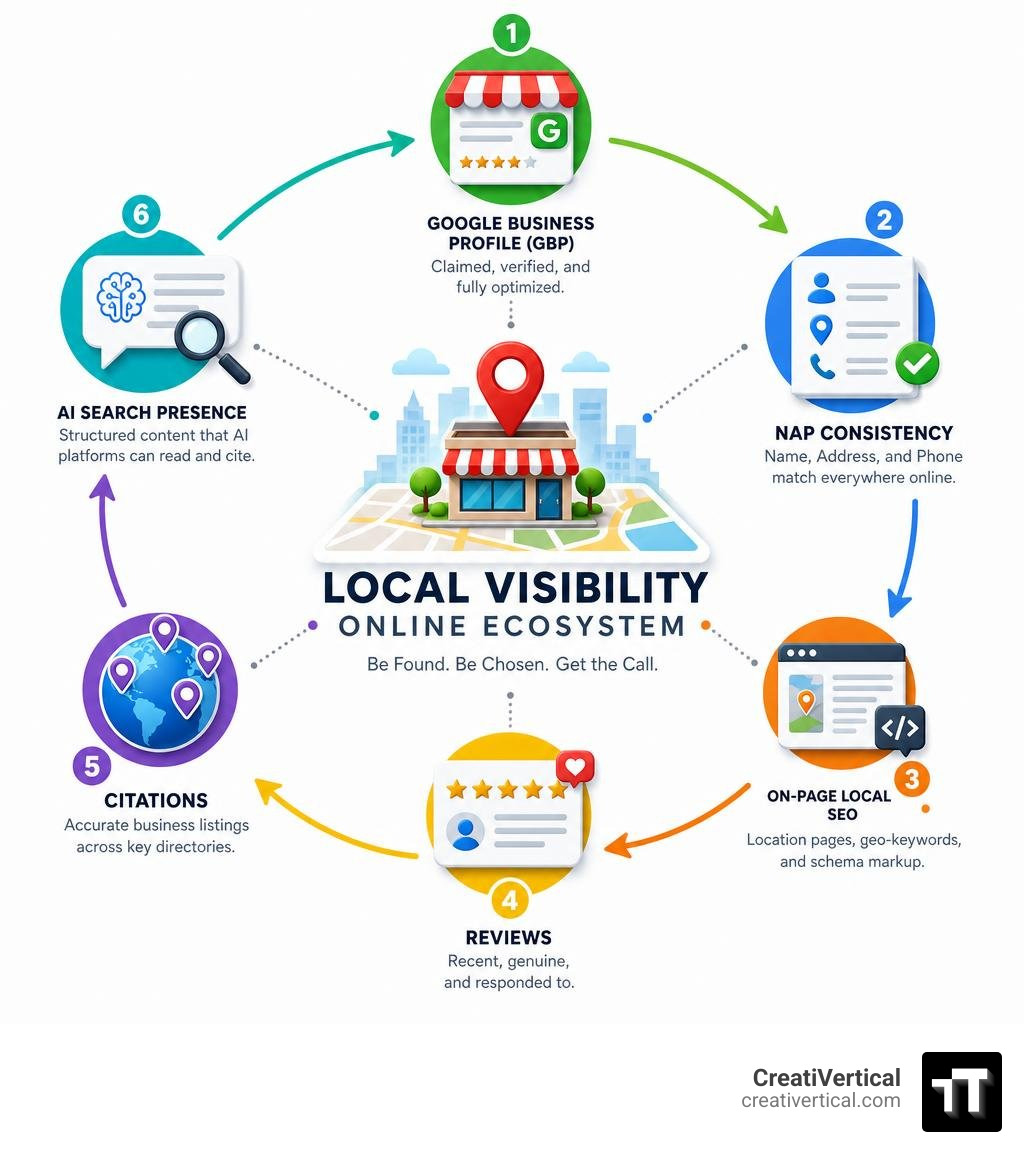
Here’s what it takes to show up:
- Google Business Profile (GBP) — claimed, verified, and fully filled out
- NAP consistency — your Name, Address, and Phone number match everywhere online
- On-page local SEO — location pages, geo-targeted keywords, and schema markup on your website
- Reviews — recent, genuine, and responded to
- Citations — your business listed accurately across key directories
- AI search presence — structured content that AI platforms like ChatGPT and Gemini can read and cite
Get those six things right and you’re competitive in most local markets. Miss them and a better-optimized competitor gets the call instead.
Consider this: according to research on local search behavior, 46% of Google searches include local intent, and 76% of people who search for something nearby visit a business within 24 hours. That’s not a slow-burn brand play — that’s someone ready to buy, right now, looking for whoever shows up first.
The problem most small businesses run into isn’t effort. It’s optimizing the wrong things — or optimizing in the wrong order.
This guide walks you through every layer of local visibility, from the basics of Google Business Profile to the newer challenge of showing up in AI-generated recommendations. Whether you’re a Kansas City service business, a multi-location brand, or a company that operates without a physical storefront, the same core principles apply.
I’m Nicholas Cunha, founder of CreatiVertical — I’ve spent over twenty years helping businesses in small and competitive markets, from the British Virgin Islands to Kansas City, build real local visibility online through SEO, web strategy, and applied AI. The following guide reflects what actually works in the field, not just in theory.
1. What is Local Visibility Online and Why It Matters
When someone in Kansas City MO searches for a service provider, they are rarely looking for a national conglomerate. They want a local specialist who can show up on time and solve their problem. This is where local visibility online transitions from a marketing metric into your primary driver of new business.
Traditional SEO targets broad, informational search queries across the globe. Local SEO, however, is a highly targeted discipline. It relies on a completely different set of ranking signals to connect a searcher with nearby physical businesses or service-area providers.
According to industry research on local search ranking factors, local rankings operate on a distinct system of proximity, relevance, and prominence. Understanding how these factors interact is the first step toward claiming your space in the local search landscape.
The Shift in Local Search Behavior
Local search has evolved rapidly. We have moved far beyond simple “near me” keyword strings. Today’s consumers use natural language to find immediate solutions, often resulting in “zero-click searches” where the user finds the phone number, address, or hours of operation directly in the search results without ever clicking through to a website.
Furthermore, Google’s mobile-first indexing gives absolute priority to mobile-friendly sites in search rankings. With 57% of local searches occurring on mobile devices, your website must load instantly and be incredibly easy to navigate on a phone. If a potential client in Lake Tapawingo MO pulls up your site at a stoplight and has to pinch-to-zoom just to find your contact info, they will bounce back to the map results immediately.
Proximity, Relevance, and Prominence
Google evaluates local search queries using three primary pillars:
- Proximity (Distance): How close is your business to the searcher’s physical location at the moment of the search? Proximity is a massive ranking driver, accounting for roughly 55% of Local Pack ranking decisions. While you cannot change your physical location, you can ensure Google knows exactly where you are.
- Relevance: How well does your business match what the user is looking for? This relies on your business categories, the services listed on your website, and the keywords found in your reviews.
- Prominence: How well-known and trusted is your business? Google measures this through your review count, review recency, link authority, and how often your brand is mentioned across the web.
By aligning your digital presence with these three pillars, you signal to search engines that your business is the most logical, authoritative option to show the user.
2. Optimizing the Core Pillars: Google Business Profile and NAP Citations
Your Google Business Profile (GBP) is the undisputed anchor of your local search presence. It is the single most powerful signal group, carrying roughly 32% of the total ranking weight in the local map pack.
If your profile is incomplete, unverified, or neglected, no amount of on-page optimization will get you into the coveted “Map Pack” (the top three local listings displayed on Google Search).
Maximizing Google Business Profile Impact
To optimize your GBP for maximum local reach, you must look beyond the basic setup.
- Select Your Primary Category with Precision: Your primary category is the most influential ranking signal on your profile. Choose the most specific category that describes your core business. If you are a specialized commercial law firm, do not simply choose “Attorney.” Choose “Corporate Attorney” or “Trial Attorney.” You can then use secondary categories to capture your broader service offerings.
- Prevent the “30-Day Danger Zone”: Profiles that stop uploading photos or publishing updates often experience sudden drops in visibility. Google values active, “live” entities. Aim to upload two to three authentic, original photos of your team, workspace, or completed projects every week. Avoid stock photography; search engines and users can spot it instantly.
- Utilize GBP Posts and Services: Use weekly GBP posts to highlight promotions, share helpful tips, or announce local community involvement. Ensure every service you offer is listed individually with a detailed, keyword-rich description.
For businesses operating in smaller Missouri communities, local directories are incredibly valuable. For example, listing your business on local community resources like the Local Businesses – Lake Tapawingo, MO – Patch or referencing guidelines from the City Of Lake Tapawingo, MO: Home establishes hyper-local relevance that search engine algorithms love.
Building and Auditing Consistent NAP Citations
A citation is any online mention of your business Name, Address, and Phone number (NAP). These citations exist on business directories, social media platforms, and local blog posts.
There are two types of citations:
- Structured Citations: Formal business listings on directories like Yelp, Yellow Pages, Bing Places, and Apple Maps.
- Unstructured Citations: Mentions of your business on local news sites, blogs, or community group pages.
The golden rule of citations is absolute consistency. If your address is listed as “123 Main Street, Suite A” on your website, but shows up as “123 Main St. #A” on Yelp, search engine crawlers can get confused. This inconsistency weakens your prominence signal, making search engines less confident in displaying your business.
To build a clean citation profile:
- Perform a Citation Audit: Search for old phone numbers, previous addresses, or slight variations of your business name.
- Clean Up Existing Listings: Before building new citations, fix the broken ones. Tools like Moz Local or manual audits can help identify these discrepancies.
- Focus on Quality Over Quantity: Mass directory submissions to low-quality, spammy directories do not work anymore. Focus your efforts on major search platforms, industry-specific directories, and trusted local Missouri directories.
When formatting your geographic details, ensure your location pages are structured logically, making it easy for both search engines and users to find your service areas across the state.
3. On-Page Local SEO and Review Strategies
Your website is the digital storefront of your business. While your Google Business Profile gets people to notice you on the map, your website is what convinces them to stay, trust you, and ultimately convert.
To rank organically for local search terms, your website needs to be built with geographic search intent in mind.
Structuring Location Pages and Schema Markup
If your business serves multiple neighborhoods or cities across the Kansas City metro area, you need dedicated location pages. Do not make the mistake of creating “city-swap” pages where the content is identical except for the city name. Search engines easily identify this as thin, duplicate content.
Instead, build unique location pages that feature:
- Hyper-Local Content: Mention local landmarks, specific neighborhoods you serve, and projects completed in that specific area.
- Embedded Google Maps: Help search engines verify your physical proximity.
- Local Testimonials: Display reviews from clients who live in that specific city or neighborhood.
To tie this all together, implement Local Business Schema Markup. Schema is a structured data code added to your website that translates your human-readable content into structured data that search engines can easily read. It explicitly tells search engines your exact business name, address, phone number, operating hours, and service categories.
For a clear example of how to structure your local digital presence, you can explore our tailored SEO Services in Kansas City to see how we build high-performing, geographically targeted digital spaces.

Generating and Managing Online Reviews for Local Visibility Online
Reviews are the lifeblood of local business. They are a massive ranking factor (accounting for roughly 20% of the local ranking signal weight) and the ultimate trust-building tool for human users. Research shows that 84% of people trust online reviews as much as personal recommendations, and 90% of consumers read business responses to reviews.
To build a highly effective review strategy, focus on three key metrics:
- Review Recency: A business with 200 reviews from three years ago will often lose visibility to a competitor with 20 fresh reviews. Google prioritizes active, relevant businesses.
- Review Velocity: This is the speed at which you acquire reviews. Do not try to buy 100 reviews overnight; a sudden spike in reviews can trigger fraud filters and get your profile suspended. Instead, build a steady, automated system that requests reviews via SMS or email within 24 to 48 hours of service delivery.
- Review Responses: Always respond to your reviews — both positive and negative. When responding, write like a human, not a corporate robot. Use the opportunity to naturally include service keywords (e.g., “Thank you for choosing us for your commercial litigation needs in Kansas City!”). This helps search engines associate your business with those specific services.
To understand how a strong local search footprint looks in action, take a look at our visual example of how businesses Stand Out Locally with Kansas City SEO.

4. Navigating the AI Search Era: GEO vs. Traditional SEO
The local search landscape is undergoing its most significant shift in two decades. While traditional search engines still drive massive traffic, AI search platforms — including ChatGPT, Google Gemini, Perplexity, and Apple Intelligence — are rapidly changing how users find local service providers.
This shift has introduced a new digital marketing discipline: Generative Engine Optimization (GEO).
| Feature | Traditional Local SEO | Generative Engine Optimization (GEO) |
|---|---|---|
| Primary Goal | Rank in the top 3 of Google’s Map Pack | Get recommended and cited by AI engines |
| Data Sources | Google Business Profile, local directory citations | Websites, Wikipedia, Reddit, Yelp, Bing Places |
| User Query Style | Short keywords (e.g., “lawyer KC MO”) | Conversational questions (e.g., “who is a trusted corporate lawyer near Lake Tapawingo?”) |
| Result Type | List of businesses with map pins | A single, synthesized recommendation with citations |
How AI Search Engines Surface Local Businesses
AI search engines do not crawl the web the same way Google’s traditional search algorithm does. They gather information from a massive variety of unstructured web data, directories, and discussion platforms.
For example, ChatGPT does not use Google’s database at all. Instead, it pulls its local business recommendations from Bing Places, Wikipedia, Yelp, the Better Business Bureau (BBB), and TripAdvisor. If your business has a perfect Google Business Profile but zero presence on Bing Places or Yelp, you are effectively invisible to ChatGPT users.
Google’s AI Overviews draw from a combination of Google Business Profile data, user reviews, Reddit discussions, and detailed business websites. To monitor and optimize for this complex ecosystem, tools like the GitHub – local-falcon/local-visibility-skill: Expert AI Visibility & Local SEO guidance for AI agents – optimize for map pack rankings and AI search platforms · GitHub are invaluable for tracking how AI search engines talk about your brand across multiple engines.
Optimizing Your Website for AI Recommendations
To ensure your business is recommended by conversational AI platforms, you need to structure your website’s content to match how these models extract information:
- Write in Natural, Conversational Language: Optimize for the exact questions your customers ask. Use clear H2 and H3 headers framed as questions, followed immediately by direct, factual answers.
- Build Strong Entity Signals: AI models look for “entities” (verified concepts, people, or businesses). Ensure your website clearly defines who you are, what you do, and where you do it.
- Aim for the AI Recommendation Threshold: AI engines prefer highly trusted businesses. Research indicates that having roughly 150+ reviews across multiple platforms (Google, Yelp, Facebook) makes it far more likely that an AI model will comfortably recommend your business for local queries.
5. Measuring ROI, Avoiding Mistakes, and Balancing Your Strategy
Improving your local visibility online is a long-term investment. To ensure your efforts are delivering a real return, you must track the right metrics and avoid the common traps that drain marketing budgets.
Tracking Local Visibility Online Performance Metrics
Do not get distracted by “vanity metrics” like overall website traffic. For local businesses, the only metrics that truly matter are those that indicate direct customer intent:
- Direction Requests: A clear sign that someone intends to visit your physical location.
- Click-to-Call Volume: The number of users calling your business directly from your local listing or mobile site.
- Local Rank Tracking with Heatmaps: Traditional rank trackers only show your ranking from a single point in a city. However, rankings change block-by-block.
Using a specialized rank tracker like the GeoHeatWhisper – Local SEO Heat Map Tool & Rank Tracker allows you to visualize your ranking dominance across a highly precise geo-grid, showing you exactly where your visibility drops off so you can target your optimization efforts.

Balancing Organic SEO, Paid Ads, and Review Generation
A successful local marketing strategy is balanced. It uses organic local SEO for long-term, compounding growth, while leveraging paid options like Google Local Service Ads (LSAs) for immediate lead generation.
When budgeting for your digital presence, keep in mind that typical market rates for professional local SEO retainers generally range from a few hundred dollars to several thousand dollars per month, depending heavily on your industry’s competition and your geographical target area.
If you are looking to build a cohesive, performance-focused system that integrates web design, local SEO, and AI search visibility, exploring our full suite of Digital Marketing Services in Kansas City can help you chart a clear path forward.
Frequently Asked Questions about Local Visibility
What are the most common mistakes businesses make with local SEO?
The most common mistake is neglecting foundational details. This includes having duplicate Google Business Profiles, using inconsistent NAP details across directories, stuffing keywords into your business name (which can lead to instant profile suspension), and relying on low-quality stock photos instead of real images of your team and work.
How long does it take to see results from local visibility efforts?
Local SEO is a compounding strategy. While some basic optimizations (like correcting a primary category or fixing a broken phone number) can show positive ranking shifts within a few weeks, a comprehensive local campaign typically takes three to six months to show significant, stable growth in highly competitive markets.
Do service-area businesses without a storefront need local SEO?
Absolutely. Service-area businesses (SABs) like plumbers, electricians, or mobile professional services do not need a physical storefront to rank. Google allows you to hide your physical address on your Google Business Profile and define specific service areas (up to 20 areas or zip codes). Your rankings will still rely heavily on your relevance, reviews, and website authority.
Conclusion
Building real local visibility online is not about chasing shortcuts or trying to trick search engine algorithms. It is about consistently providing clear, accurate, and authoritative signals that prove your business is the most trusted option in your community.
From securing your Google Business Profile to structuring your website for the next generation of AI-driven search engines, every optimization step you take builds a stronger foundation for your business’s growth.
At CreatiVertical, we do not believe in one-off marketing projects. We operate as an ongoing digital growth partner, building complete, high-performance systems that keep your business visible, credible, and chosen.
If you are ready to elevate your brand’s digital presence and dominate your local market, explore our 7 Tips to Improve Local Visibility Online or reach out to our team in Kansas City today to chart your course.