

What It Really Means to Outsource Web App Development
When you decide to outsource web app development, you’re handing off the planning, design, coding, testing, and maintenance of a web application to an external team — while keeping as much or as little oversight as you choose.
Here’s the short version for anyone who needs a quick answer:
| Question | Quick Answer |
|---|---|
| What is it? | Delegating web app build and/or maintenance to an outside vendor or team |
| Who does it? | Freelancers, boutique agencies, or large offshore development firms |
| What does it cost? | Roughly $20,000 for simple apps up to $400,000+ for complex enterprise platforms |
| How long does it take? | 8–14 weeks for an MVP; 4–9 months for a full-scale product |
| Biggest benefit | Access to global talent at 30–50% lower cost than building in-house |
| Biggest risk | Misaligned scope, weak IP protection, or poor vendor vetting |
The market behind this decision is large and growing. Global app outsourcing revenue was expected to reach $121.6 billion in 2024 and is projected to cross $129.9 billion by 2028. That growth isn’t driven by cost-cutting alone — 65% of businesses say outsourcing helps them focus on their core functions, according to Deloitte. Companies like Slack, Skype, and WhatsApp relied on outsourced development in their early stages. That pattern hasn’t slowed down.
For Kansas City businesses, offshore professional services firms, industrial B2B companies, and government technology vendors alike, the question is rarely whether to consider outsourcing — it’s how to do it without getting burned.
I’m Nicholas Cunha, founder of CreatiVertical, and I’ve spent over twenty years delivering web and digital projects — including government and institutional work in the British Virgin Islands — where outsourcing web app development across borders and jurisdictions was simply the reality of operating in a small offshore market. That experience shapes everything in this guide.
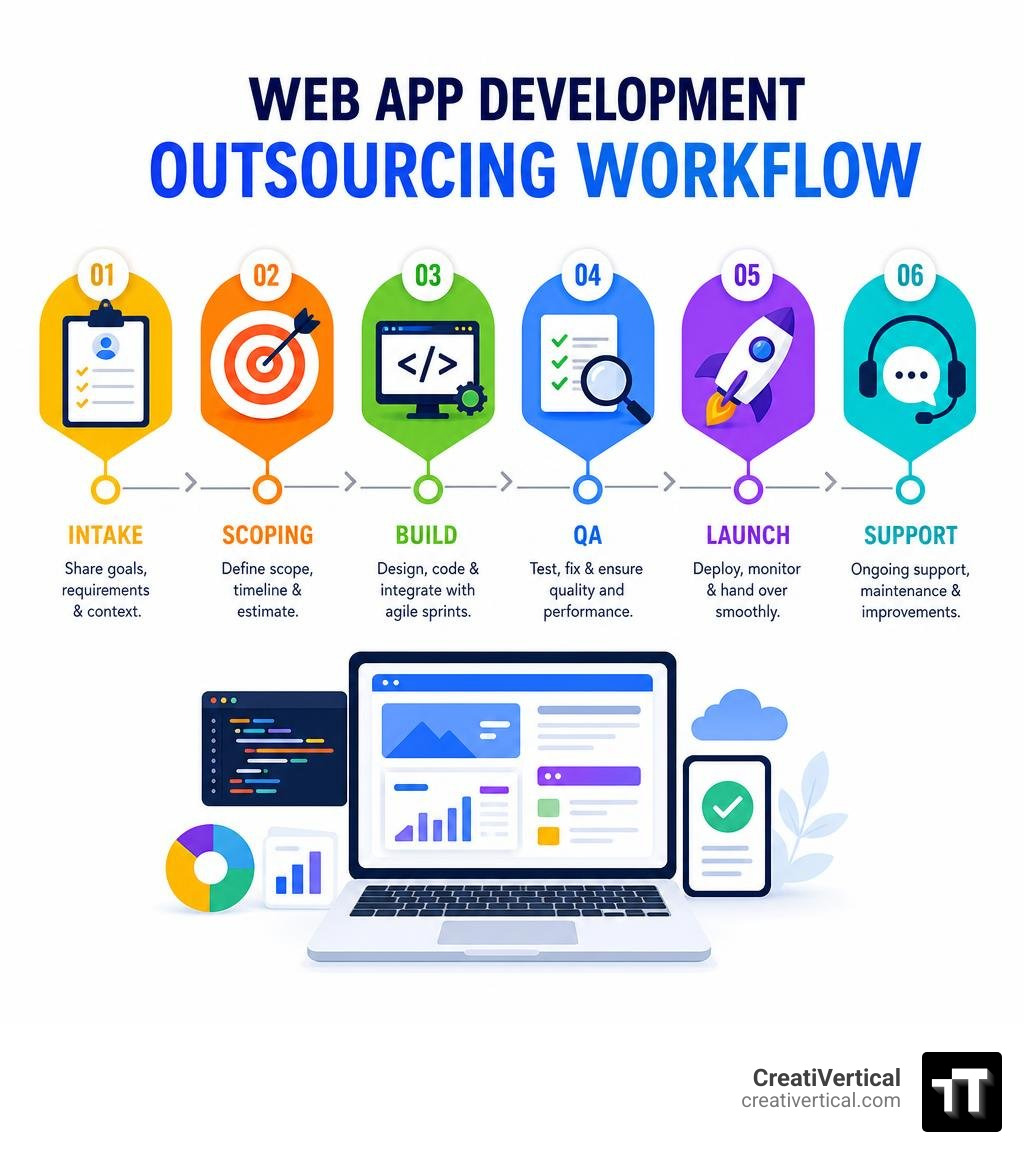
Outsource web app development terms to remember:
Defining Web App Development Outsourcing and Primary Scope Models
To understand how to outsource web app development effectively, it helps to separate interactive web applications from standard marketing websites. A website displays static content; a web application runs software right in the browser. Whether you are building a custom CRM, a multi-tenant SaaS application, or a client-facing document portal, the underlying architecture involves user states, databases, payment gateways, and custom business logic.
When delegating this scope, businesses choose how much operational control stays internal and how much moves to the external team. If you want a deeper tactical breakdown, read our detailed guide on Outsourcing Web Development Services: A Step-by-Step Survival Guide.
Key Benefits to Outsource Web App Development Projects
Why do growing companies choose external teams rather than building internal engineering departments from scratch? The decision usually comes down to five distinct business advantages:
- Speed to Market: Assembling an internal software team can take three to six months in recruitment overhead alone. Outsourced teams come pre-assembled with established workflows, letting you kickoff projects in days or weeks.
- Access to Specialized Global Talent: Finding local senior talent in specialized fields like AI integration, cloud orchestration, or complex frontend frameworks can be difficult and expensive. Outsourcing expands your talent search worldwide.
- Cost Optimization: Companies frequently report 30% to 50% overall cost savings compared to maintaining dedicated in-house engineering staff when factoring in healthcare, payroll taxes, physical hardware, and software licensing.
- Focus on Core Business Functions: Delegating complex technical execution allows internal product owners and leadership to focus on customer acquisition, regulatory compliance, and business strategy.
- Operational Scalability: Scaling an engineering team up or down based on current development phases (such as ramping up for launch and scaling down for maintenance) is much cleaner with external contracts than with internal layoffs.
Core Scope Models: Full-Cycle vs. Team Extension
Outsourcing isn’t one-size-fits-all. Depending on your existing internal technical expertise, engagements fall into distinct scope frameworks:
- Full-Cycle Project Outsourcing: The external agency handles everything from initial product discovery and architecture planning to design, development, quality assurance, deployment, and ongoing post-launch maintenance. This model works best for companies without in-house technical teams or those launching an entirely new standalone product line.
- Dedicated Development Team (Team Extension / Staff Augmentation): The outsourcing partner provides specialized software engineers, database admins, or QA testers who plug directly into your existing development structure and follow your internal engineering manager’s direction.
- Project Rescue and Modernization: An experienced external team takes over a troubled, buggy, or abandoned codebase, performs a comprehensive architectural audit, and refactors or modernizes the platform to stabilize performance.
Global Sourcing Locations and Pricing Frameworks
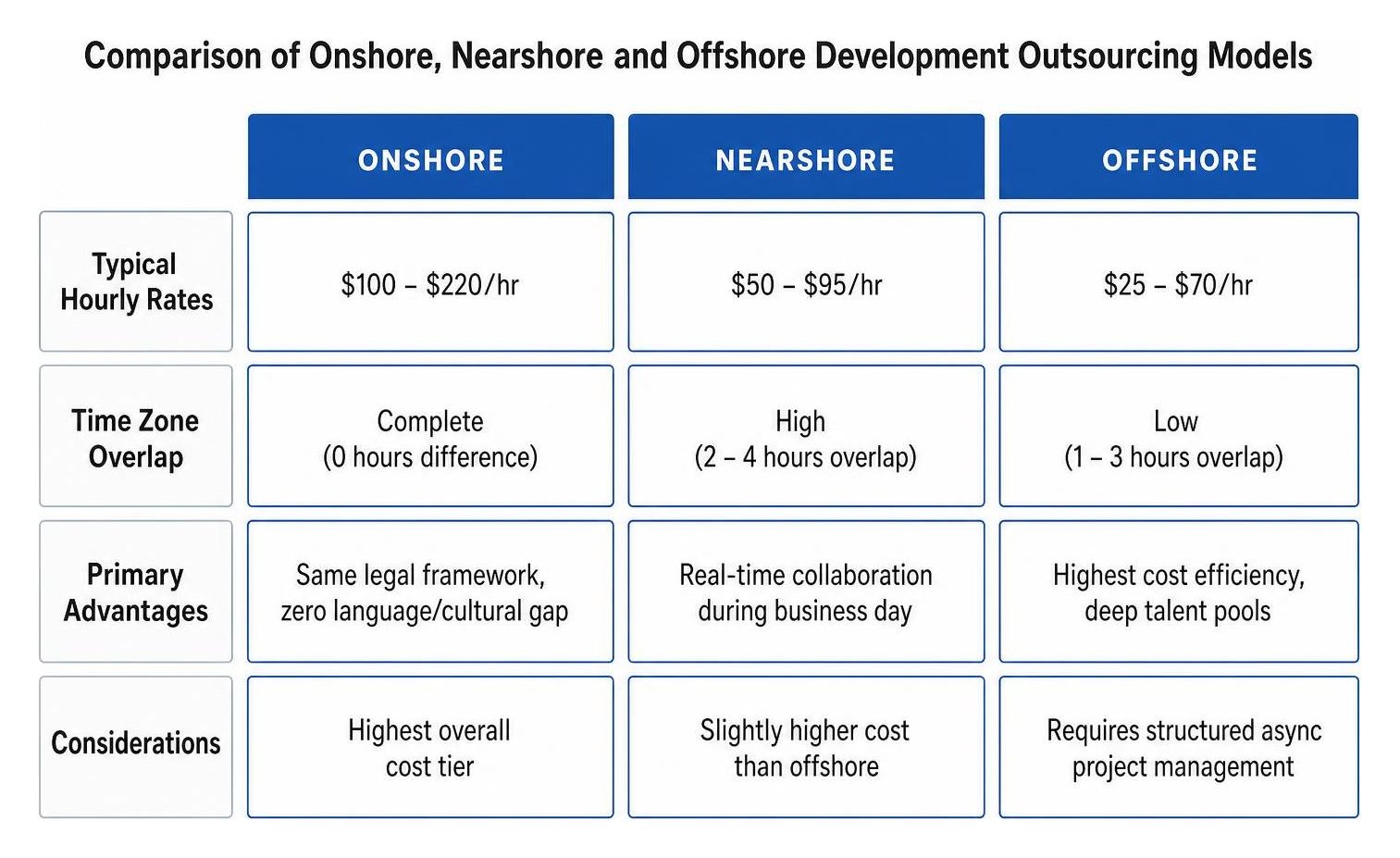
Where you source your developers directly influences team communication patterns, daily workflow, and total expenditure. Geographic models typically split into three primary categories:
- Onshore: Hiring developers located within your native country (such as a US business hiring a domestic agency). While timezone alignment and cultural context are seamless, rates are highest ($100–$200+ per hour).
- Nearshore: Partnering with teams in neighboring time zones (e.g., US companies hiring teams in Latin America). Rates are moderate ($50–$90 per hour) with strong daily working hour overlap.
- Offshore: Contracting with teams in distant regions such as Eastern Europe or South Asia. Rates offer maximum savings ($25–$70 per hour), though managing asynchronous communication requires structured management routines.
| Sourcing Model | Typical Hourly Rates | Time Zone Overlap | Primary Advantages | Considerations |
|---|---|---|---|---|
| Onshore | $100 – $220/hr | Complete (0 hours difference) | Same legal framework, zero language/cultural gap | Highest overall cost tier |
| Nearshore | $50 – $95/hr | High (2 – 4 hours overlap) | Real-time collaboration during business day | Slightly higher cost than offshore |
| Offshore | $25 – $70/hr | Low (1 – 3 hours overlap) | Highest cost efficiency, deep talent pools | Requires structured async project management |
Fixed Price vs. Time & Material vs. Dedicated Team Models
Choosing the right financial model keeps your project scope aligned with your financial budget:
- Fixed Price Model: Best for small, tightly bounded projects with frozen specifications. You pay a predetermined fee for a set deliverable. The tradeoff? Any mid-stream scope change requires formal change requests and budget updates.
- Time and Material (T&M): Ideal for iterative, agile projects where requirements evolve based on user testing. You pay for actual hours worked plus expenses. Teams with complex web applications like specialized SaaS tools often leverage Outsourcing SaaS Development | Madgeek solutions under T&M or dedicated monthly team rates to adapt quickly to changing user demands.
- Dedicated Team Model: A long-term arrangement where you pay a predictable monthly rate per dedicated developer. The team acts as your virtual engineering department, blending deep institutional knowledge with project consistency.
Development Cost Factors and Hidden Expenses
What drives the baseline cost of custom software? Industry costs for outsourcing a web app range from $20,000 for simple MVPs up to $400,000+ for enterprise-grade solutions.
Beyond baseline coding, plan for hidden operational costs:
- Third-Party API Licenses: Paid integrations like Google Maps, Twilio, or specialized AI models.
- Cloud Infrastructure Hosting: Monthly server bills on AWS, Azure, or GCP as user volume scales.
- Post-Launch Maintenance: Typically budgeting 15% to 20% of the initial development cost annually for OS upgrades, library security updates, and bug fixes. For more insight into budgeting software builds, view our resource on What Should a New Website Cost?.
How to Outsource Web App Development Successfully: A Step-by-Step Process

A successful web application build is rarely an accident; it is the direct result of a structured execution framework. If you are preparing to work with a partner like Custom Web Application Development Services | TMS Outsource, having your internal requirements prepared accelerates momentum.
Essential Team Roles and Modern Tech Stacks
A balanced web application team combines specialized talent across several core engineering disciplines:
- Solution Architect / Lead Engineer: Designs system data models, database structures, and overall platform performance strategies.
- UX/UI Designer: Translates business workflows into clean, intuitive wireframes and interactive visual prototypes.
- Frontend Developers: Experts in modern client-side technologies like TypeScript, React, Next.js, or Vue.js.
- Backend Developers: Server-side logic experts building microservices or APIs in Node.js, Python, PHP/Laravel, or .NET.
- Quality Assurance (QA) Engineers: Automated and manual testing specialists ensuring functional stability and OWASP security compliance.
- DevOps Engineer: Infrastructure architects building CI/CD deployment pipelines, containerization (Docker, Kubernetes), and cloud hosting setups.
The 8-Step Execution Blueprint to Outsource Web App Development
When you are ready to outsource web app development, follow this sequence to avoid common missteps:
- Define Business Goals and Scope: Document user journeys, essential MVP features, and measurable success metrics before speaking to external providers.
- Vendor Discovery: Search industry platforms, review past client portfolio case studies, and gather recommendations.
- Issue Request for Proposals (RFP): Send standardized scope documentation to shortlisted agencies to compare technical approach, architecture recommendations, and pricing models.
- Evaluate Proposals and Code Audits: Assess agency responses based on technical competence, communication quality, and engineering standards rather than selecting strictly on the lowest price bid.
- Contracting, NDA, and IP Agreements: Execute non-disclosure agreements, legal master service agreements (MSA), and strict intellectual property transfer terms.
- Agile Sprint Execution: Run bi-weekly development sprints with regular client demos, keeping execution transparent through tools like Jira, GitHub, and Slack.
- Quality Assurance and Penetration Testing: Validate features through cross-browser testing, load testing, and security scanning in a staging environment.
- Deployment and SLA Kickoff: Launch the platform into production, execute user onboarding, and transition into a formal post-launch Service Level Agreement (SLA).
Freelancer vs. Agency: Vendor Selection and Risk Mitigation

One early decision you will face is whether to hire independent freelance software engineers or partner with a full-service agency.
- Freelancers: Highly cost-effective for targeted tasks, bug fixes, or minor plugin extensions. However, managing individual freelancers creates high project management overhead for your team, and reliability risks exist if a freelancer suddenly becomes unavailable.
- Agencies: Provide multi-disciplinary teams (PM, Designer, Backend, QA) bound by formal legal contracts and SLAs. Agencies offer built-in accountability, structured code quality checks, and resource redundancy if individual team members change.
For companies exploring agency solutions, our practical advice on 5 Tips for Choosing a Website Development Company offers clear evaluation criteria.
Protecting Intellectual Property, Data Security, and Code Quality
When delegating code production across corporate boundaries, protecting your core intellectual assets is mandatory:
- Explicit IP Transfer Clauses: Your contract must explicitly state that all source code, architectural diagrams, design assets, and database schemes become 100% your exclusive property upon payment.
- Data Security Protocols: Ensure your development vendor complies with global data security frameworks relevant to your market, such as GDPR, SOC 2, HIPAA, or ISO 27001.
- Repository Management: Require developers to check code directly into your organization’s private GitHub or GitLab repository from day one so you maintain complete control over project commits.
Evaluating Technical Competence and Communication Channels
Before signing an outsourcing agreement, audit how the agency operates in real-world scenarios:
- Review Real-World Track Records: Look for verified client feedback and portfolio examples on platforms like Clutch or Google Reviews.
- Conduct Technical Interviews: Have a trusted technical advisor interview proposed agency engineers or conduct small live coding assessments.
- Establish Overlapping Working Hours: Agree on a minimum of 2 to 4 hours of daily synchronous overlap for real-time meetings and standups.
- Verify Async Tool Usage: Confirm the team uses structured async tools like Slack, Jira, and Loom to maintain clear documentation across time zones. For additional vetting tips, check out our guide on how to Find Reliable Website Development Agency Tips.
Frequently Asked Questions About Web Application Outsourcing
Will my business own 100% of the source code and intellectual property?
Yes — provided your contract is drafted properly. Always ensure your Master Services Agreement (MSA) includes a clear “Work Made for Hire” or explicit IP assignment clause transferring all rights, source code, designs, and patentable logic to your company upon payment fulfillment.
How long does it take to develop and launch a custom web app MVP?
A focused, well-scoped Minimum Viable Product (MVP) typically takes 8 to 14 weeks from initial kickoff to launch. More complex enterprise platforms or multi-tenant SaaS applications requiring intricate API integrations generally take 4 to 9 months.
How do we manage time zone differences with offshore development teams?
Time zone differences are best managed by creating daily overlapping windows (typically 2 to 4 hours) for live daily standups, sprint reviews, and planning sessions. The remaining hours leverage asynchronous communication tools (Jira ticket updates, recorded Loom demos, GitHub pull requests) so work continues around the clock.
Building Your Long-Term Web Application Strategy
Deciding to outsource web app development is more than a short-term project task — it is a strategic business decision that accelerates digital growth when executed with the right partner.
Whether you are a local Kansas City business automating operations, a B2B industrial manufacturer building a custom customer portal, an offshore financial services provider scaling digital client intake, or a government technology vendor navigating complex compliance standards, the key is choosing an agency partner that acts as an ongoing growth collaborator rather than a transactional vendor.
At CreatiVertical, we treat software development as an interconnected system of design, engineering, SEO visibility, and ongoing platform maintenance. If you are ready to explore how a tailored web application can fuel your business roadmap, explore our full Website Development capabilities or reach out to start a conversation today.