

What a Website Development Agency Actually Does (and How to Pick the Right One)
A website development agency builds, maintains, and optimizes the digital systems your business depends on — far beyond just making something that looks good.
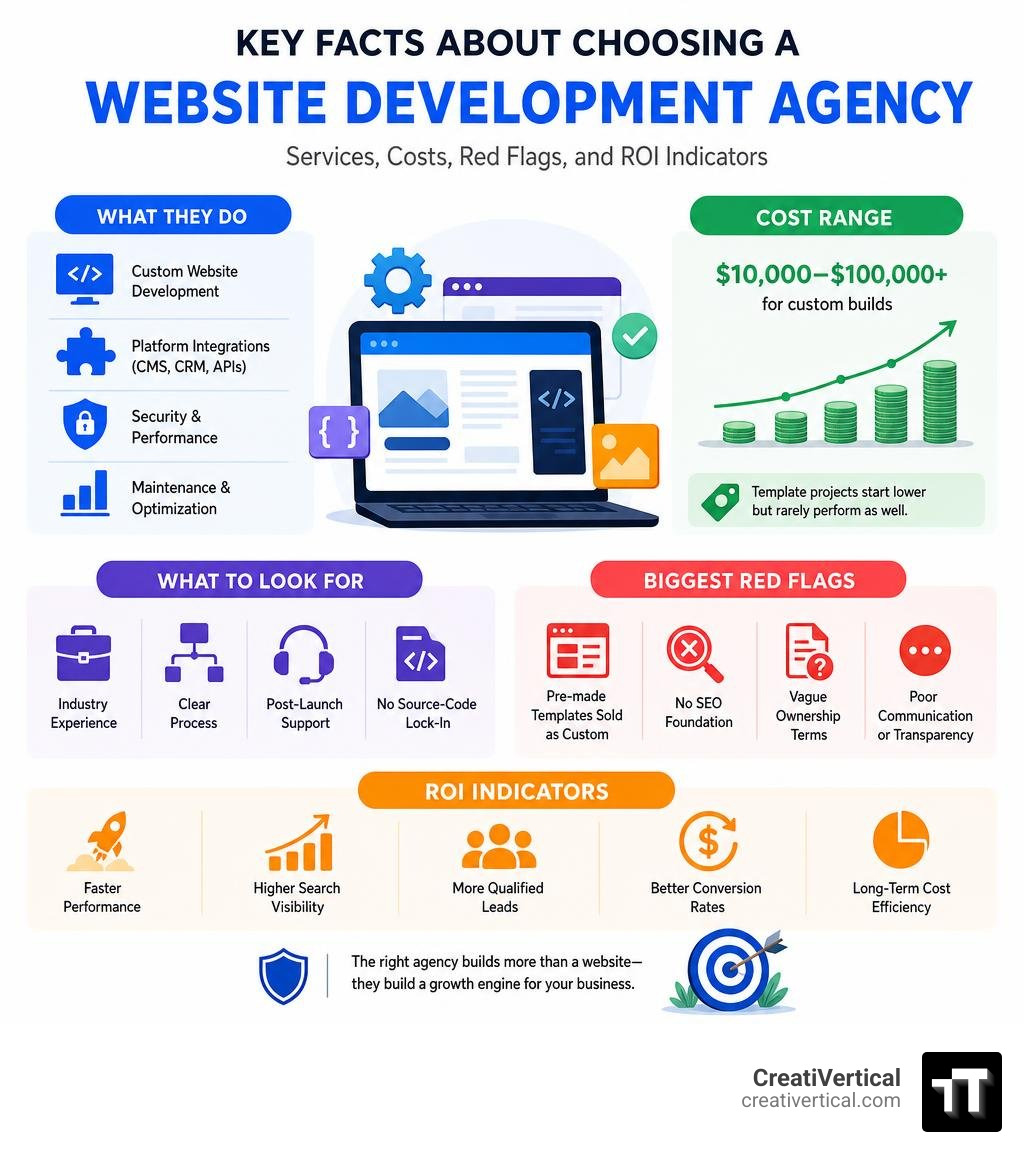
Quick answer if you’re in a hurry:
| What you need to know | The short version |
|---|---|
| What they do | Build custom websites, integrate platforms (CMS, CRM, APIs), handle security and performance |
| Agency vs. freelancer | Agencies offer broader skills, accountability, and ongoing support; freelancers cost less but carry more risk |
| Cost range | Roughly $10,000–$100,000+ for custom builds; template projects start lower but rarely perform as well |
| What to look for | Industry experience, clear process, post-launch support, no source-code lock-in |
| Biggest red flags | Pre-made templates sold as custom, no SEO foundation, vague ownership terms |
Your website is often the first thing a procurement officer, law firm client, or industrial buyer evaluates before ever speaking to you. If it’s slow, outdated, or invisible in search, you’re losing deals before the conversation starts. With over 92,000 web development companies listed on Clutch.co alone, choosing the right partner is genuinely hard — and the wrong choice is expensive.
This guide gives you practical, specific tips to find an agency worth trusting.
I’m Nicholas Cunha, founder of CreatiVertical — I’ve spent over twenty years running website development agency projects across the BVI, the Caribbean, and Kansas City, including digital work for government bodies, industrial B2B clients, and offshore professional-services firms. The tips below come from real decisions I’ve watched clients get right and wrong.
What to Expect When Partnering with a Website Development Agency
When you hire a professional website development agency, you are not just paying for someone to arrange images and text on a page. You are hiring an engineering team to construct a secure, high-performance digital asset designed to grow your pipeline.
A true development partner provides a complete suite of services that turns complex ideas into functional realities:
- Custom Coding & Software Engineering: Building tailored, clean code from scratch using modern frameworks (such as React, Astro, or Next.js) rather than relying on bloated, pre-packaged themes that slow down your load times.
- Content Management System (CMS) Integration: Setting up an intuitive, scalable CMS like headless WordPress, Webflow, or Sanity so your internal marketing team can easily update copy, upload resources, and publish articles without needing a developer for every minor tweak.
- API and Third-Party Integrations: Connecting your website directly to your enterprise resource planning (ERP) software, customer relationship management (CRM) systems like Salesforce or HubSpot, payment gateways, and client portals.
- Security & Compliance Frameworks: Hardening your database, configuring secure sockets layer (SSL) certificates, setting up web application firewalls (WAF), and ensuring compliance with international regulations (like GDPR) or local government standards.
- Performance and Scalability Optimization: Structuring your site’s infrastructure to handle traffic spikes, execute rapid database queries, and achieve near-perfect mobile performance.
By focusing on these core pillars, professional Website Development shifts your online presence from a static digital brochure into an active, automated sales representative that works while you sleep.
5 Tips to Find a Reliable Partner for Your Digital System
Finding a development team that aligns with your operational goals requires looking past flash portfolios and focusing on execution. Use these five foundational guidelines to evaluate potential agencies:
- Prioritize Strategic Alignment Over Visual Trends: A beautiful website that does not convert visitors or integrate with your backend workflows is a failed investment. Your agency must prioritize your business objectives first.
- Verify Technical and Architectural Capability: Ensure the agency has deep, certified experience in the exact tech stack your project requires—whether that is a custom headless system or a secure enterprise platform.
- Evaluate Their Long-Term Partnership Mentality: Walk away from agencies that only want to deliver a one-off launch and disappear. Your digital system requires continuous maintenance, security patching, and optimization to remain effective.
- Confirm Structured Project Management Protocols: A reliable agency uses clear milestones, transparent tracking boards (such as Jira or ClickUp), and structured sprint reviews so you always know exactly where your budget is going.
- Establish Transparent Communication Channels: You should have direct access to the technical lead or a dedicated project manager, not just a sales representative who passes messages back and forth.
1. Define Your Technical Needs Before Contacting a Website Development Agency
Before you schedule a single discovery call, you must clarify what you actually need your website to do. If you approach an agency with a vague request like “we need a new website,” you invite bloated quotes and misaligned proposals.
Start by mapping out your operational requirements:
- Do you need custom software built into the backend, or is a standard informational site sufficient?
- Will you require complex platform integrations, such as syncing inventory from an industrial warehouse database or feeding legal intake forms directly into a secure practice management system?
- Who will maintain the site post-launch, and what platform (such as custom WordPress, Webflow, or a headless CMS) best fits your team’s technical comfort level?
Defining these parameters early helps you filter out agencies that only build on a single platform. If an agency tries to force your complex, database-heavy B2B portal into a simple visual builder, it is a sign their technical capabilities are limited. For a deeper breakdown of how these requirements shape your budget, read our guide on What Should a New Website Cost? to establish realistic expectations.
2. Look for Specialized Industry Expertise Over Generic Portfolios
A generic creative agency might design a stunning consumer brand website, but they will likely struggle when faced with the strict regulatory, security, and operational requirements of specialized B2B and professional service sectors.
Different industries require completely different technical foundations:
- Offshore Professional Services: Law firms, trust companies, and fiduciary providers operating in jurisdictions like the Cayman Islands or the British Virgin Islands need absolute data confidentiality, secure client portals, and multi-language capabilities. We understand the unique needs of this sector and outline these specific requirements in our resource on Websites for Caribbean Companies.
- Industrial and B2B Manufacturing: Manufacturers of precision equipment, lubricants, machined parts, and industrial chemicals do not need flashy animations. They need highly organized product catalogs, downloadable technical data sheets (TDS), safety data sheets (SDS), and intuitive search tools that help engineers and procurement officers find exact specifications instantly.
- Government-Facing Technology Vendors: Organizations bidding on public-sector contracts must adhere to rigid security compliance frameworks like FedRAMP, FISMA, or state-level guidelines. The code must be clean, highly accessible (WCAG compliant), and hosted on secure, authorized environments.
When interviewing a website development agency, ask for case studies within your exact niche. If they cannot explain how they handle your industry’s specific compliance or technical challenges, they are not the right partner for your digital system.
3. Evaluate Their Approach to Security, Performance, and AI Search Visibility
A modern website must be built for the reality of today’s internet, which means prioritizing security, speed, and how artificial intelligence systems read your data.
Security and Compliance
Your agency should have a clear, proactive strategy for security. This includes automated daily backups, secure database configurations, defense against SQL injections, and strict compliance with data privacy laws. If you serve European clients, GDPR compliance (including cookie consent and secure data storage) must be integrated into the architecture from day one.
Performance and Core Web Vitals
Slow load times kill conversions and damage your search rankings. A reliable agency optimizes every image, utilizes modern content delivery networks (CDNs), minimizes script bloat, and targets high Core Web Vitals scores. If you want to audit your current platform’s performance, learn How to Improve a Website to identify where your technical bottlenecks are hiding.
AI Search Visibility (GEO)
The search landscape has fundamentally changed. Potential clients are no longer just using Google; they are asking ChatGPT, Perplexity, and other AI engines for recommendations. Your development agency must understand Generative Engine Optimization (GEO). This involves structuring your website’s code with clean schema markup, semantic HTML, and structured data so AI crawlers can easily parse, understand, and cite your business as an authority.
4. Assess the Long-Term Support and Maintenance Model
The day your website launches is not the end of the project—it is the beginning of its operational life. Websites are dynamic systems that require constant updates to remain secure and functional.
Before signing a contract, find out exactly what happens after launch:
- Managed Hosting: Does the agency host your site on a secure, high-performance, dedicated server, or are they throwing you onto cheap, shared hosting where your security is at the mercy of other compromised sites?
- Proactive Updates: Who is responsible for updating plugins, core software, and security patches? If left unmanaged, a website can become vulnerable to exploits within weeks.
- Dedicated Technical Support: When something breaks on a Saturday morning, do you have a direct line to a developer, or do you have to submit a support ticket to an unmonitored inbox?
We believe in providing a dedicated, ongoing partnership rather than leaving you to manage complex infrastructure alone. Discover how proactive, specialized management keeps your digital system running smoothly by exploring The Remote Web Admin Advantage.
5. Ask the Right Questions to Vet a Website Development Agency
To separate high-performing agencies from smooth-talking sales teams, you need to ask direct, technical questions during your vetting process.

When reviewing potential partners, use these questions as your guide:
- “Do you build custom solutions, or do you use pre-made, off-the-shelf templates?” Many agencies charge custom development prices while simply modifying a cheap, bloated theme they bought online.
- “Who owns the website and the source code once the project is paid for?” Ensure your contract explicitly states that you own 100% of the custom code, designs, and content. Avoid agencies that lock you into proprietary CMS systems that you cannot migrate away from.
- “How do you integrate SEO and search engine requirements into the development phase?” SEO is not something you “bolt on” after a site is built. It must be woven into the site architecture, URL structure, and page-load speed from the very first line of code.
- “Can you provide verified, third-party client reviews?” Look for independent platforms like Clutch to read detailed client feedback. If you are looking for verified digital talent in our region, you can browse directories like the Top Web Design Companies In Missouri | 2026 – DesignRush to compare local expertise.
Agency vs. Freelancer vs. In-House: Choosing Your Path
When building or upgrading your digital system, you have three primary paths: hiring a dedicated agency, working with independent freelancers, or building an in-house development team.
The right choice depends on your budget, technical complexity, and long-term goals.
| Criteria | Website Development Agency | Freelancer | In-House Team |
|---|---|---|---|
| Skill Diversity | High (Designers, developers, SEO specialists, copywriters, and project managers under one roof) | Limited (Usually specializes in either design or coding, rarely both at an elite level) | Variable (Depends entirely on your hiring budget and talent pool) |
| Accountability & Risk | Low Risk (Contractual obligations, dedicated project management, and backup resources) | High Risk (Single point of failure; if they get sick or busy, your project stalls) | Low Risk (Full control over employees, but high financial risk if talent leaves) |
| Long-Term Support | Reliable (Ongoing maintenance retainers and dedicated support teams) | Unreliable (Often move on to new projects and may not be available for urgent fixes) | Excellent (Dedicated to your company, but represents a permanent payroll expense) |
| Cost Structure | Mid-to-High (Predictable project-based pricing or structured monthly growth retainers) | Low-to-Mid (Hourly or fixed project rates, but hidden costs can arise from delays) | Very High (Salaries, benefits, hardware, software licenses, and ongoing training) |
For businesses looking to establish a strong local presence in our home region, balancing these resources is critical. Check out our insights on Professional Web Design Services in Kansas City to see how a structured agency model delivers superior long-term ROI compared to fragmented freelance teams.
Red Flags to Watch Out For During Your Search
As you evaluate different providers, stay alert for warning signs that indicate an agency may prioritize their profit margins over your business success.
- Guaranteed #1 Rankings on Google: No one controls search engine algorithms. Any agency promising guaranteed top spots is using outdated, black-hat tactics that could ultimately get your website penalized or blacklisted.
- Extremely Low Pricing for “Custom” Work: If a proposal for a “completely custom, database-integrated B2B website” comes in at a suspiciously low price, they are almost certainly using a cheap, pre-made template. This will limit your scalability and slow down your site.
- Proprietary CMS Lock-In: Some agencies insist on building your site on their own closed-source, in-house content management system. This is a trap. If you ever want to leave that agency, you will be forced to rebuild your website entirely from scratch because their code cannot run anywhere else. Look for open, highly portable platforms like WordPress, Shopify, or modern headless setups.
- Treating SEO as a Post-Launch Phase: If an agency tells you, “We’ll build the site first, and then our marketing team will do the SEO,” run. Proper search optimization requires technical planning during wireframing and database design. SEO is not an add-on; it must be integrated into the site architecture, URL structure, and page-load speed from the very first line of code.
Frequently Asked Questions About Web Development
How much does it cost to build a custom B2B website in 2026?
Pricing varies by project scope, competition, and goals. Use general industry ranges only, presented as typical market rates rather than CreatiVertical’s own pricing.
As a rough market guide, a fully custom, secure B2B website built from the ground up typically ranges from $10,000 to over $100,000 depending on the complexity of database integrations, custom API development, and the overall page scale. Simple, template-based websites can be found for lower rates, but they rarely deliver the performance, security, or search rankings required for competitive B2B sectors.
For ongoing optimization, monthly SEO retainers commonly run from a few hundred to several thousand dollars per month, with larger or more competitive engagements costing more. If you are looking to build a highly optimized, lead-generating platform on the world’s most popular CMS, explore our specialized guide on WordPress Web Design Kansas City.
How do agencies ensure websites are secure and compliant?
Reliable agencies build security directly into the site’s architecture. This involves implementing secure database protocols, configuring advanced web application firewalls (WAF), enforcing multi-factor authentication, and conducting regular vulnerability scans.
For specialized industries, compliance must meet strict legal and municipal standards. Whether you are an offshore financial firm adhering to international privacy regulations, a government contractor aligning with FedRAMP frameworks, or even a local municipality organizing public records, security is non-negotiable.
For example, local public entities near our Missouri office—such as the community at Lake Tapawingo —must ensure their digital infrastructure is secure and fully accessible to residents in accordance with local ordinances, as detailed in the official City of Lake Tapawingo, MO – eCode360 documentation. Your development agency must treat these security and compliance rules as foundational requirements, not optional add-ons.
How can we measure the ROI of our new website?
A website is an investment, and its success must be measured by hard business data, not just aesthetic appeal. To calculate the real return on investment of your digital system, track these key performance indicators (KPIs):
- Conversion Rate Lift: The percentage of website visitors who take a high-value action, such as filling out a B2B contact form, requesting a quote, or scheduling a consultation.
- Qualified Lead Generation: The total volume of sales-ready leads coming directly through your digital channels compared to your previous platform.
- Pipeline Value and Customer Acquisition Cost (CAC): The total dollar value of deals influenced by your website, balanced against the cost of driving traffic and maintaining the system.
If you are running paid advertising campaigns, your website’s performance is even more critical. A slow, poorly designed landing page wastes your ad spend. Learn how to optimize your digital system for maximum conversion by reading our guide on preparing your Website for Paid Traffic Gearing Up.
Conclusion
Your website is the engine of your digital growth, and finding the right website development agency is the key to unlocking its full potential.
At CreatiVertical, we are a family-run digital agency operating right here in Kansas City, Missouri, and the peaceful community of Lake Tapawingo. We do not believe in one-off, transactional projects where a vendor hands you a template and disappears. Instead, we act as an ongoing growth partner, delivering complete, performance-focused digital systems that combine elite web development, strategic SEO, AI search visibility, and custom workflow automation.
Whether you are a local Missouri business, an offshore professional service provider in the Caribbean, an industrial B2B manufacturer, or a government-facing technology vendor, we build secure, scalable systems engineered for your specific audience.
Ready to build a digital system that works while you sleep? Explore our Website Development services today, and let’s chart a course for your long-term digital growth.