

Why AI Search Visibility Consulting Matters for Buyer Discovery
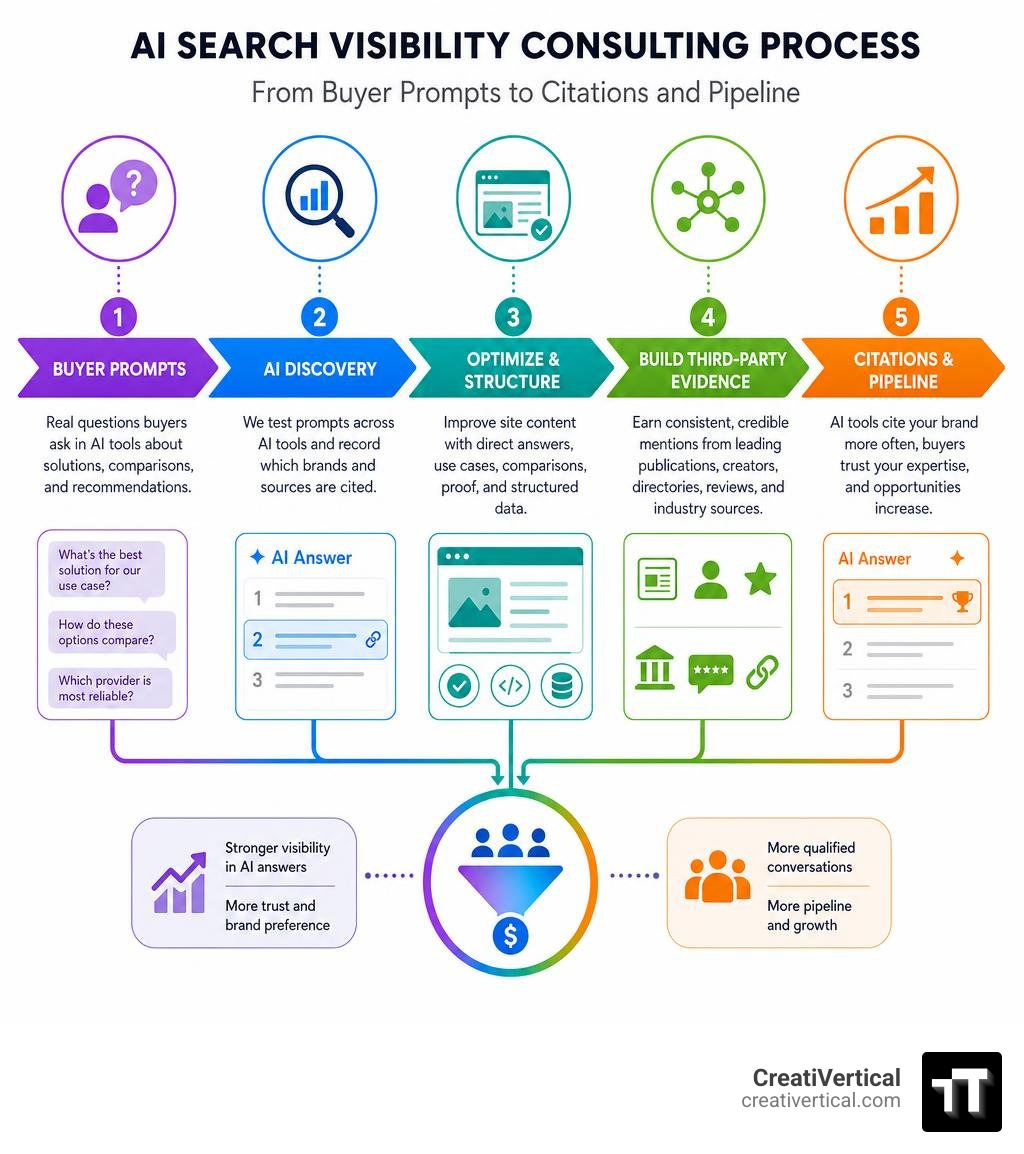
AI search visibility consulting helps your business appear accurately in AI-generated answers from tools such as ChatGPT, Google AI Overviews, Perplexity, Gemini, Claude, and Copilot. A strong program usually starts with three practical steps:
- Test the buyer questions that matter most and record which brands and sources AI tools cite.
- Fix unclear website pages with direct answers, use cases, comparisons, proof, and structured data.
- Build consistent third-party evidence through credible publications, creator content, directories, reviews, and industry sources.
Traditional SEO still matters, but ranking well in Google does not guarantee an AI citation. AI systems often synthesize information from several sources and may favor brands with clear entity details, current facts, useful comparisons, and independent validation across the web.
For a manufacturer, professional-services firm, public-sector vendor, or Kansas City business, the goal is simple: make it easy for both buyers and AI systems to understand what you do, who you serve, and why you are a credible fit.
I’m Nicholas Cunha, founder of CreatiVertical, and I bring more than 20 years of agency and project experience, including work for BVI government and institutional organizations, to AI search visibility consulting. Today, I build applied AI automations and work hands-on across web development, SEO, and paid media for Kansas City, offshore, industrial, and B2B clients; the next sections explain how AI citation decisions work and what to improve first.
What Is AI Search Visibility Consulting and Why Traditional SEO Falls Short

The search landscape is undergoing a permanent structural re-alignment. Over 56% of standard search engine queries now resolve in zero clicks because answer engines synthesize solutions directly on the results screen. With over 400 million weekly active users on ChatGPT and four in ten consumers starting product research within conversational interfaces, the discovery funnel is separating from standard search engine results pages (SERPs).
AI search visibility consulting—often grouped under Generative Engine Optimization (GEO) or Answer Engine Optimization (AEO)—is the strategic practice of structuring a brand’s technical data, owned content, and off-site web consensus so that large language models (LLMs) cite, recommend, and extract information from your business.
Traditional SEO evaluates pages based on link graphs, keyword density, and crawling infrastructure to rank ten blue links. In contrast, generative models operate probabilistically. They construct answers dynamically using neural retrieval, evaluating entity relationships, semantic consensus, and contextual extractability across the broader web.
| Evaluation Factor | Traditional SEO | Generative AI Search (GEO / AEO) |
|---|---|---|
| Primary Goal | High rankings on SERP blue links | Named citation and recommendation inside synthesized answers |
| Indexing Model | Crawler indexing and PageRank link graphs | Retrieval-Augmented Generation (RAG) and semantic embeddings |
| Source Dependency | Owned domain authority and backlink metrics | Cross-web consensus, practitioner data, and third-party validation |
| Content Evaluation | Keyword placement and search intent coverage | Structural extractability, information gain, and clear definitions |
| Output Behavior | Deterministic position lists | Probabilistic, non-deterministic answer generation |
Core Differences Between Organic SERP Rankings and AI Answer Engine Retrieval
In organic search, a search engine crawler evaluates page-level authority to determine where a URL sits in a ranked list. If an industrial engineering supplier ranks #2 for a target keyword, incoming prospects click that direct link.
Generative engines operate through Retrieval-Augmented Generation (RAG). When a user asks an AI system to evaluate precision milling partners, the model does not simply serve a link. It queries its index, extracts discrete factual passages across multiple sources, assesses factual agreement, and synthesizes a narrative summary.
If your pages rely on vague promotional copy rather than extractable data points, an LLM cannot parse your specific operational capacities. Our Adaptive SEO Services address this split by aligning foundational organic hygiene with modern semantic extraction signals.
Why High-Authority Brands Disappear From Generative Responses
Many legacy enterprises holding strong domain ratings find themselves omitted when prospective buyers ask conversational tools for vendor shortlists. Research indicates there is less than a 20% overlap between top organic SERP rankings and the brands cited by AI engines.
This omission happens because LLMs reject data fragmentation and narrative ambiguity. An authoritative website often loses generative visibility due to three common structural failures:
- Unstructured Narrative Blocks: Long corporate overviews that bury service constraints, technical specifications, or pricing models behind marketing rhetoric.
- Entity Ambiguity: Inconsistent digital footprints where company naming conventions, leadership bios, and core service offerings conflict across directories and external publications.
- Absence of Direct Comparison Data: Omitting explicit use-case boundaries, technical comparisons, and factual trade-offs that models require to determine commercial fit.
When an AI engine synthesizes a category shortlist, it references sources that state precise capabilities clearly, bypassing high-authority websites that fail to provide machine-extractable facts.
The Anatomy of an AI Citation: Signals and Content Architecture That Win Engine Trust

Large language models evaluate information based on information gain, clean semantic chunking, and verifiable source consensus. To earn consistent model citations, your web architecture must be organized for machine ingestion. Using a structured blueprint like the AI Visibility Framework – AIsearchflow helps teams map internal assets to these machine-readable formats.
Essential Content Formats and Technical Files for AI Search Visibility Consulting
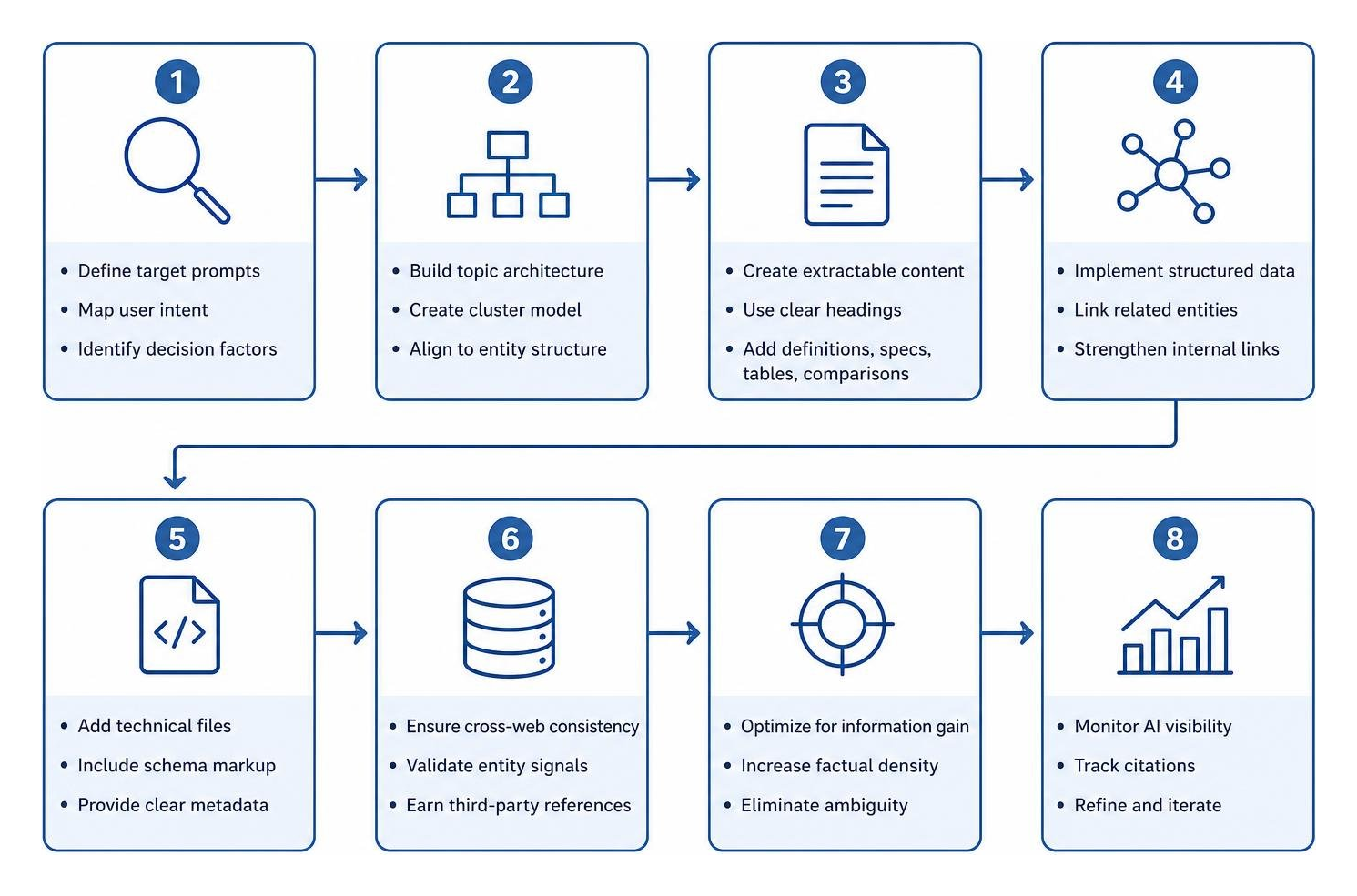
To facilitate neural retrieval, content must be formatted into clean, self-contained semantic modules. AI crawlers favor direct answers placed beneath clear headings, supported by structured tables and concise summaries.
Key structural and technical requirements include:
- Answer-First Formatting: Direct, declarative definitions placed immediately beneath descriptive H2 and H3 tags to allow retrieval models to lift complete answers without parsing surrounding copy.
- Comparison Tables and Use-Case Breakdowns: Explicit matrix formats that explain operational parameters, system trade-offs, and target applications.
- AI Crawler Directives (
robots.txt): Explicit permissions for dedicated AI search agents such asGPTBot,ClaudeBot, andPerplexityBot. - Machine Context Files (
llms.txtandllms-full.txt): Markdown-formatted text files hosted at the site root that provide plain-text directories of core brand capabilities, service scopes, and documentation. - Machine-Readable Fact Sheets (
facts.jsonld): Explicit factual schemas that define company origins, accreditations, operational jurisdictions, and core products.
Selecting The Ultimate Tools to Keep Your Brand Visible Across AI Search Platforms ensures your technical stack reliably serves these retrieval layers without inflating server overhead.
Entity Clarity, Schema Markup, and Cross-Platform Consistency
Generative models rely on knowledge bases to resolve entities and prevent model hallucinations. If an offshore legal and fiduciary firm is described inconsistently across corporate registries, legal directories, and its primary domain, an AI engine will downgrade its confidence score when recommending services.
Consulting engagements implement comprehensive Schema.org JSON-LD architectures, anchoring Organization, Service, Person, and About schemas to verified public knowledge graph nodes like Wikidata and Crunchbase. Establishing immutable entity relationships ensures models connect proprietary methodologies, executive profiles, and commercial services to the parent brand across all web-crawled surfaces.
The Source Ecosystem: Harnessing Third-Party Authority and Earned Citations
AI search engines rarely rely entirely on a brand’s owned website when generating commercial advice. Models look for independent corroboration across the web to validate claims before citing a vendor.
An analysis of 21,311 commercial-discovery brand mentions revealed that 85% of citations came from external domains, meaning brands were 6.5 times more likely to surface through third-party content than their own properties. Furthermore, evaluations of over 1 million cited links show that 94% originate from non-paid media and 82% from earned media. The good news for marketing leaders: 86% of these citations come from channels that marketing teams can actively manage or influence.
Why LLMs Prioritize Third-Party Creators and Non-Paid Media Over Owned Sites
Generative engines treat owned marketing copy with structural skepticism. When a buyer asks an AI assistant to identify reliable precision machining manufacturers or FedRAMP-authorized infrastructure, the system scans for external consensus.
Practitioner-led technical teardowns, indexable newsletter archives, and unscripted industry reviews provide the contextual depth AI models prefer. Cross-platform studies show that YouTube alone holds an average 20% citation share across sampled discovery queries due to the density of practical workflows contained in indexed transcripts.
When third-party operators discuss your brand’s real-world trade-offs, integration boundaries, and operational performance, they create the durable, unlinked entity citations that neural models use to validate vendor credibility.
Cross-Departmental Execution Across PR, Content, and Product Teams
Building visibility inside generative answer engines requires coordination across previously siloed departments:
- Public Relations: Shifting focus from vanity press releases to securing indexable mentions in trade journals, industry analyses, and practitioner publications that LLMs crawl for consensus.
- Content Marketing: Formatting owned assets into answer-first documentation and syndicating technical guides to developer and industry platforms.
- Product and Engineering: Publishing transparent workflow boundaries, technical constraints, and data governance standards that models can extract for comparison queries.
- Customer Success and Support: Ensuring public knowledge bases, community forums, and verified review networks contain accurate operational answers to common buyer questions.
Measuring Pipeline Impact and What to Expect from Professional Consulting Engagements
AI search visibility consulting departs from traditional vanity SEO reporting. Tracking overall organic traffic is insufficient when zero-click answer engines absorb informational queries; modern analytics focus on prompt visibility, citation share, and influenced commercial pipeline. Evaluating these metrics requires leveraging the Best AI Search Optimization Tools 2024 alongside native webmaster telemetry.
Auditing and Measuring KPIs in AI Search Visibility Consulting
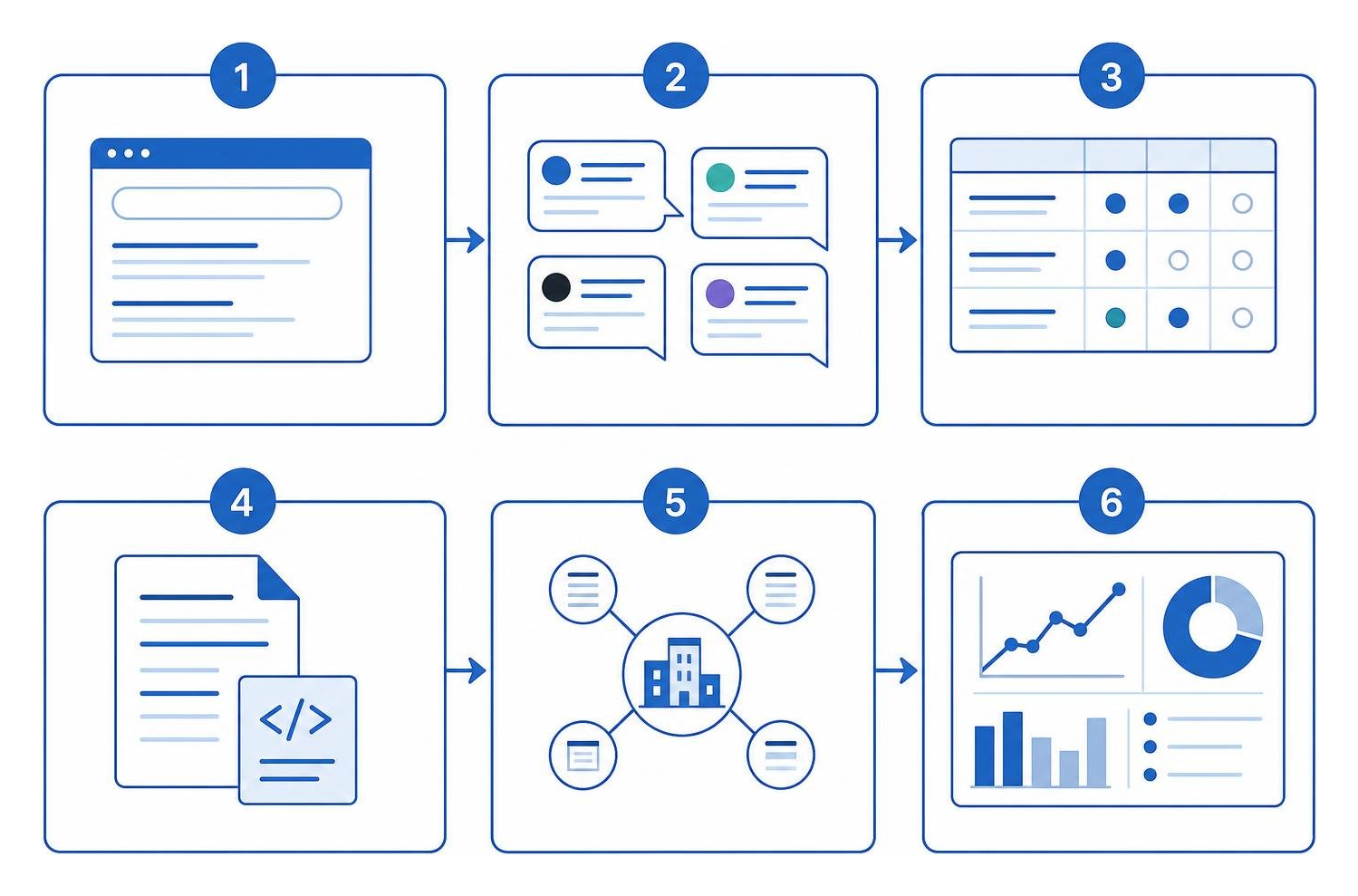
A rigorous consulting engagement audits performance across all major generative surfaces: ChatGPT, Perplexity, Google AI Overviews, Gemini, Claude, Grok, and Microsoft Copilot.
Core key performance indicators include:
- Priority Prompt Coverage: The percentage of high-intent commercial prompts in which your brand is included as a named recommendation.
- AI Citation Share: The frequency with which your domain and third-party validation assets are hyperlinked as cited sources inside generative answers.
- Category Accuracy and Sentiment: How precisely the engine describes your specific capabilities, target markets, and pricing parameters without hallucinating inaccuracies.
- Google Search Console Generative Impressions: Tracking impression volume within Google’s integrated generative AI experiences.
- Bing Webmaster Tools Copilot Citations: Monitoring direct citation counts within Microsoft’s AI engine ecosystem.
- AI Referral Conversion Rates: Measuring inbound demo requests and sales pipeline originating from AI assistant links, which frequently convert 4x to 23x higher than standard organic traffic due to pre-qualified buyer intent.
Realistic Timelines, Implementation Roadmaps, and Avoiding Common Pitfalls
Improving AI search visibility follows a compounding timeline:
- Weeks 1–4: Auditing priority buyer prompts, resolving entity ambiguities, configuring technical crawl directives, and deploying
llms.txtand Schema.org markup. Initial model pickup for updated structured pages typically surfaces within 2 to 4 weeks. - Months 2–3: Expanding extractable comparison pages, addressing missing use cases, and synchronizing third-party directory citations.
- Months 4–6: Authority compounding through earned third-party validation, creator workflows, and digital PR. Real-world implementations regularly scale from zero to over 12,000 AI citations across a six-month window as models refresh their retrieval indexes.
Regarding consulting investments, typical market rates vary by project scope, business size, and competitive landscape. As a general industry guide, specialized hourly advisory typically ranges from $400 to $500 per hour, while monthly retainers commonly span from a few hundred dollars for basic local monitoring to several thousand dollars per month for comprehensive mid-market and enterprise engagements.
A common pitfall is attempting to flood the web with low-quality, automated content. Generative search engines filter out undifferentiated copy in favor of information gain and authoritative consensus. Publishing high volumes of generic text dilutes entity clarity and degrades model trust.
Frequently Asked Questions About AI Search Visibility Consulting
How quickly can a business expect to see results from AI search visibility consulting?
Technical data adjustments, structured schema deployments, and llms.txt configurations are typically parsed by real-time AI retrieval crawlers within 2 to 4 weeks. Broader generative authority, third-party consensus validation, and citation share across static foundation models compound over a 3 to 6-month window as retrieval datasets refresh.
Can an AI search consultant guarantee a #1 citation on ChatGPT or Google AI Overviews?
No. Generative language models are probabilistic and non-deterministic, meaning they generate responses dynamically based on contextual prompt phrasing rather than fixed ranking positions. Professional consultants improve the statistical probability of inclusion by resolving entity gaps, structuring extractable data, and establishing third-party web consensus, but ethical practitioners do not make absolute ranking guarantees.
Do we need to rewrite all existing content to become visible in AI answers?
No. AI search optimization is largely additive. High-performing organic articles do not need to be rewritten from scratch; instead, they are augmented with structured summary blocks, explicit definition sections, comparison tables, FAQ schemas, and updated factual data points that allow AI retrieval engines to extract information cleanly.
Conclusion
The shift from ten blue links to synthesized generative answers has altered how business-to-business buyers, procurement officers, and institutional clients source partners. Winning inclusion on modern shortlists requires moving beyond isolated keyword strategies toward complete digital systems that integrate technical entity clarity, extractable website architecture, and verified third-party web consensus.
At CreatiVertical, we engineer performance-focused digital platforms—spanning web development, adaptive SEO, AI search visibility, and applied AI automation—acting as an ongoing growth partner for Kansas City businesses, industrial manufacturers, offshore fiduciary providers, and public-sector contractors adopting FedRAMP compliant AI services.
By clarifying your entity architecture and feeding answer engines the structured data they need, we ensure your business is accurately cited and recommended whenever prospective buyers ask AI who to trust.