The Shift From Search Rankings to AI Citations Has Already Happened
If you’re evaluating an AI search visibility optimization tool, here’s a quick-reference breakdown of the top options in 2026:
| Tool | Best For | Starting Price |
|---|---|---|
| Frase | Monitor + fix in one workflow | $39/month |
| Meev | Quality-gated content scaling | Contact for pricing |
| Foglift | Technical audits + API access | $49/month |
| AIclicks | Multi-platform tracking + action plans | $59/month |
| Amplitude AI Visibility | Revenue attribution + journey analytics | Included in Amplitude plans |
Search has quietly moved out of the results page and into the answer itself. About 68% of Google searches ended without a click in early 2026 — users got what they needed directly from an AI-generated response and never visited a single website. At the same time, ChatGPT crossed 900 million weekly active users, and Google’s Gemini-powered AI Overviews now reach an estimated 2 billion-plus people each month.
That’s not a trend worth watching. That’s a fundamental change in how buyers find brands.
If your business isn’t being cited in AI-generated answers, you’re invisible to a growing share of your market — no matter how well you rank on a traditional results page.
This is exactly why AI search visibility optimization tools exist. They track whether ChatGPT, Perplexity, Claude, Gemini, and other platforms are mentioning your brand when someone asks a relevant question. And the better ones don’t just tell you what’s missing — they help you fix it.
I’m Nicholas Cunha, founder of CreatiVertical, and I’ve spent over two decades doing hands-on digital and web work — including applied AI and agent deployments — for clients ranging from small Kansas City businesses to offshore professional-services firms and government entities. Working with AI search visibility optimization is a core part of what I do now, because it’s where brand discovery is actually happening in 2026. Below, I’ve put together a practical comparison of the tools worth your time.
What is AI Search Visibility Optimization and Why Does It Matter in 2026?
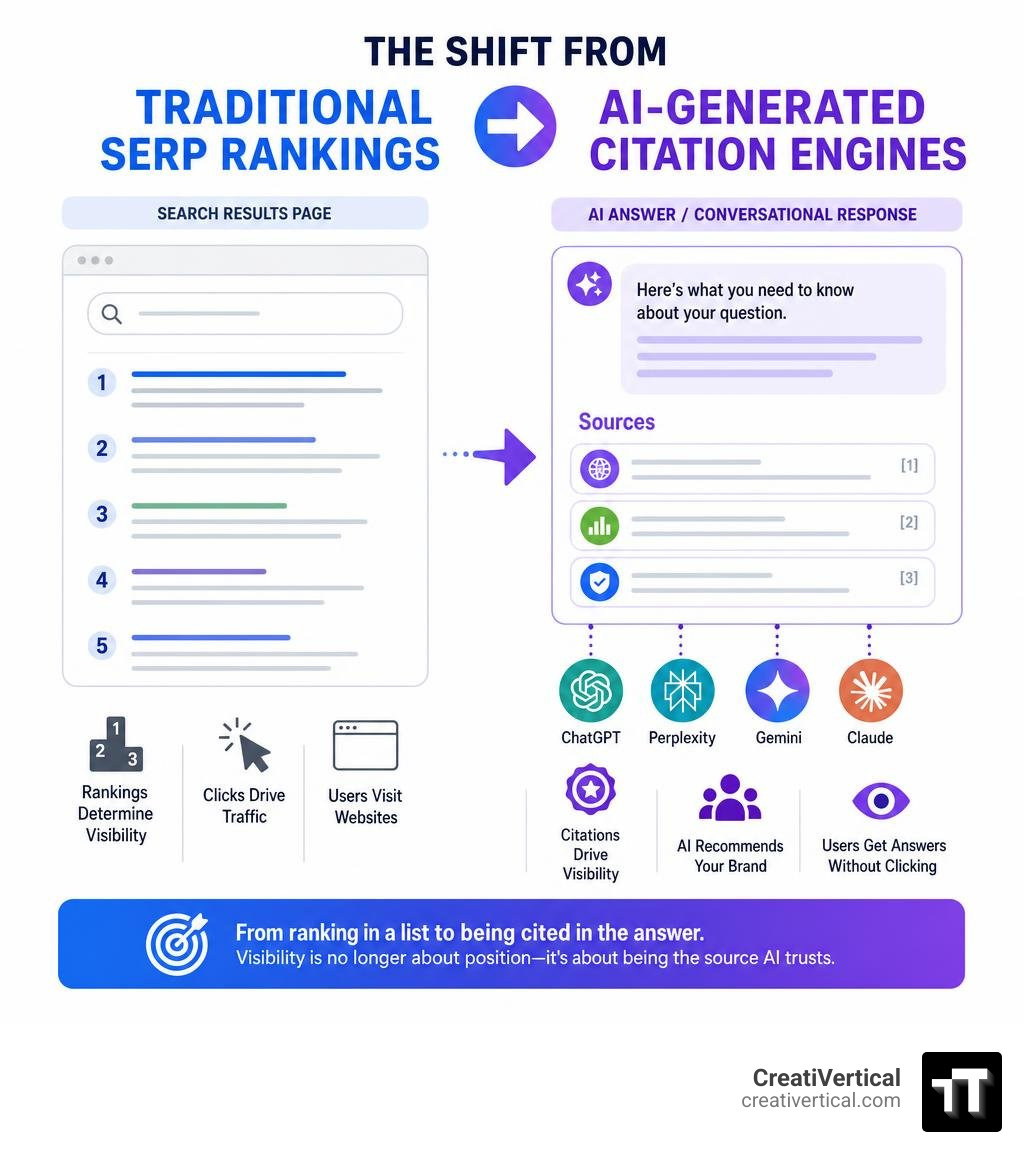
To understand why you need an ai search visibility optimization tool, we first have to look at how people behave online. In 2026, the traditional path of typing a query into Google, scanning ten blue links, and clicking a website is no longer the default. Instead, buyers ask conversational questions directly to large language models (LLMs) or search engines with integrated generative capabilities.
When a user asks Perplexity, “What are the most reliable industrial battery manufacturers for grid storage?” or asks ChatGPT, “Which law firms in the Cayman Islands handle offshore asset protection?”, the AI synthesizes an answer in real time. It doesn’t just rank websites; it recommends specific brands and cites its sources.
This shift has created a massive challenge: zero-click searches. With roughly 68% of Google searches ending without a click, traditional search engine optimization (SEO) is no longer enough to guarantee brand discovery. If your business is not one of the cited sources or recommended brands inside that synthesized AI block, you simply do not exist to that user.
This is where Generative Engine Optimization (GEO) and Answer Engine Optimization (AEO) come in. To protect and grow your market share, you must actively optimize your digital footprint so AI models recognize your brand as a trusted authority. If you want to dive deeper into how we implement these strategies, explore our broader resources in the Category: AI.
Key Criteria for Choosing an AI Search Visibility Optimization Tool
Before subscribing to a platform, you need to know what makes a tool effective. Not all software in this category is built the same. Some platforms only monitor mentions, while others actively help you rewrite and restructure your content to win citations.

When evaluating an ai search visibility optimization tool, look for these five critical capabilities:
- Multi-Engine Coverage: The tool should monitor your brand across all major LLMs and citation engines, including ChatGPT, Perplexity, Google Gemini, Claude, Grok, and DeepSeek.
- Prompt-Level Tracking: You must be able to track specific, high-intent conversational prompts that your target buyers actually type into AI engines, rather than just tracking short-tail keywords.
- Competitive Benchmarking: It should highlight which competitors are appearing alongside you, which prompts they dominate, and what sources the AI is citing to recommend them.
- Citation Source Attribution: AI engines don’t pull answers out of thin air. They crawl specific directories, authoritative blogs, Reddit threads, and press releases. Your tool must identify these trusted sources so you can target them for outreach.
- Monitoring vs. Optimization Workflows: Some platforms stop at alerts. The best tools bridge the gap between insight and action, offering optimization recommendations or built-in editors to help you update your pages immediately.
Understanding these tracking mechanics is essential for building a digital footprint that AI models consistently cite.
The Best AI Search Visibility Optimization Tool Options in 2026
The software market has adapted quickly to the demand for AI visibility. Today, we have a mix of specialized startup platforms, developer-first tools, and established SEO suites retrofitted with AI tracking features.
To help you navigate this space, we have compiled and reviewed the top five options on the market.
1. Frase: The Best AI Search Visibility Optimization Tool for Monitor-and-Fix Workflows
Frase stands out as the most practical choice for content, SEO, and marketing teams because it doesn’t just tell you where you are losing visibility — it gives you the exact environment to fix it.
Features & Capabilities
Frase tracks where and how often AI search engines cite your brand across ChatGPT, Perplexity, Claude, Gemini, and Google AI Overviews. What makes it unique is its unified workflow. Once Frase identifies a prompt where a competitor is winning the citation, you can transition directly into the Frase editor. The platform analyzes the cited competitor pages, identifies the content gaps on your site, and provides real-time scoring as you write or optimize your content.
Pricing & Use Case
- Starting Price: $39/month.
- Best For: Marketing and content teams that want to monitor and fix visibility gaps in one seamless workflow.
If you are looking for creative ways to apply these automated workflows to specific consumer-facing industries, take a look at our guide on Tips to Modernize Hospitality Marketing with AI.
2. Meev: The Best AI Search Visibility Optimization Tool for Quality-Gated Content Scaling
Meev is built for brands that need to scale their organic footprint rapidly without sacrificing the content quality that AI engines demand.
Features & Capabilities
Meev tracks brand mentions and citation gaps across ChatGPT, Claude, Gemini, Perplexity, Grok, DeepSeek, Google AI Overviews, and Google AI Mode. However, its core strength lies in its automated, quality-gated content production.
To prevent thin or low-quality content from hurting your site’s overall reputation, Meev runs every generated draft through a strict 16-point quality gate. If a draft’s Helpful Content Risk score drops below 70, the system holds it for manual review. Meev also features “Citation Path,” which identifies high-authority external sources already cited in your category and drafts personalized pitches based on your knowledge base.
Pricing & Use Case
- Starting Price: Contact for pricing (enterprise-focused).
- Best For: Enterprise teams and agencies that need to manage multi-language campaigns (offering support in English, Spanish, Chinese, French, German, Portuguese, and Japanese) and scale content safely.
For high-stakes B2B sectors like offshore legal or fiduciary services, maintaining absolute accuracy is critical. Read how specialized automation can support these areas in our article on AI Concierge for Financial Legal Services.
3. Foglift: Best for Technical Audits and Developer-Friendly API Integrations
Foglift approaches AI visibility from a technical and structural perspective, making it a favorite for developers and technical SEO specialists.
Features & Capabilities
Foglift scans your website across six critical categories: Technical SEO, AI Readiness, Content structure, Performance, Security, and Accessibility. Its standout feature is the “AI Readiness Score,” which measures how easily AI crawlers can access, parse, and understand your pages.
It checks whether your site blocks AI crawlers in its robots.txt file, evaluates your structured data (schema markup), and analyzes heading hierarchy. For technical teams, Foglift provides developer-friendly integration via a REST API, CLI, and MCP (Model Context Protocol) server, allowing you to build AI readiness checks directly into your deployment pipelines.
Pricing & Use Case
- Starting Price: Free basic technical audits; paid plans with full monitoring and API access start at $49/month.
- Best For: SaaS platforms, developers, and technical agencies who need deep programmatic access and automated site audits.
4. AIclicks: Best for Multi-Platform Tracking and Actionable Recommendations
AIclicks is a highly comprehensive tracking platform that prioritizes raw data accuracy and practical, off-page optimization strategies.
Features & Capabilities
AIclicks monitors your brand across more than ten AI platforms, including Claude, Grok, DeepSeek, and Microsoft Copilot. Rather than relying solely on official APIs — which can sometimes return different responses than what real users see — AIclicks queries these engines directly through their actual user interfaces to log real-time brand citations, competitor mentions, and sentiment.
The platform features a prioritized “Recommendations” tab that gives you a clear action list, such as building specific Reddit mentions, updating trusted directory listings, or creating comparison pages to capture competitor traffic.
Pricing & Use Case
- Starting Price: Starter plan begins at $59/month (covers 30 prompts across 3 platforms).
- Best For: Small to mid-sized marketing teams looking for clear, actionable, step-by-step instructions to improve their multi-platform visibility.
5. Amplitude AI Visibility: Best for Revenue Attribution and Customer Journey Analytics
Amplitude AI Visibility is designed for product managers and growth directors who refuse to treat brand visibility as a vanity metric.
Features & Capabilities
Unlike standalone search tools, Amplitude integrates AI visibility tracking directly into its industry-standard product analytics platform. It monitors your brand presence in ChatGPT and Google AI Overviews, but its true power is attribution.
Because it is natively connected to the rest of your organization’s behavioral data, Amplitude allows you to connect AI citations directly to downstream user actions. You can track exactly how a user who discovered your brand via a ChatGPT recommendation navigates your app, runs experiments, and ultimately drives revenue.
Pricing & Use Case
- Starting Price: Included for existing Amplitude customers across various plans; limited free version available for non-customers.
- Best For: Growth-stage companies and digital product teams that need to prove the exact ROI and revenue impact of their GEO efforts.
How to Connect AI Visibility Insights to Your Content Strategy
Once you have chosen an ai search visibility optimization tool, the real work begins. Tracking your score is only valuable if you translate those insights into a concrete content strategy.
To win citations in AI search, we recommend focusing on three core areas:
1. Optimize Your Site Structure for AI Crawlers
AI engines prefer clean, highly structured data. You can make their job easier by implementing the emerging llms.txt standard – a simple Markdown file placed at your site’s root directory that serves as an optimized directory for AI crawlers.
Additionally, apply comprehensive schema markup, including FAQ, HowTo, and Article schemas, with detailed sameAs attributes. Google’s own structured data documentation is a useful reference for making this markup clear, valid, and easier for search systems to interpret. This helps AI models map your brand to established real-world entities.
2. Format for Direct Answers
AI models are built to synthesize information. Structure your pages with clean, natural-language headings (H2s and H3s) that mirror the questions your buyers are asking.
Follow those headings immediately with concise, direct answers in the first paragraph. Use bulleted lists, structured tables, and clearly cited statistics. AI engines are highly drawn to structured data formats when building their conversational responses.
3. Build Citations Beyond Your Own Website
AI models do not just look at your website to form an opinion of your brand; they look at the consensus of the web. To improve your visibility, you must build authoritative brand mentions on third-party platforms.
Publish comparison pages, such as “Your Brand vs. Competitor,” ensure your business is listed accurately in key industry directories, and encourage natural discussions on community platforms like Reddit. If you are located in or serving the Missouri area, working with a local specialist can help you align these off-page signals and build regional authority.
As these systems grow more complex, the professionals who build them are in higher demand than ever. You can read about this shift in our article on the Rising Demand for Prompt Engineers.
Frequently Asked Questions About AI Search Visibility
How do AI visibility tools differ from traditional SEO tools?
Traditional SEO tools are designed to track keyword rankings, backlink profiles, and organic search engine results page (SERP) positions on traditional search engines. They tell you if you are in position three on Google’s blue links.
In contrast, an ai search visibility optimization tool measures whether your brand is cited and recommended inside the synthesized, conversational answer generated by an LLM. While traditional SEO focuses on driving clicks to your website, AI visibility tools focus on securing brand share of voice within zero-click environments.
To explore why human-centric, high-quality content remains vital even as search becomes highly automated, read our perspective on why Chatbots Are No Replacement for People.
What is the best free way to check my brand’s AI search visibility?
If you are not ready to invest in a paid platform, you can start with these free methods:
- Manual Querying: Open ChatGPT, Perplexity, Claude, and Gemini. Type in the core prompts your buyers use (e.g., “What are the best B2B logistics software providers in the Midwest?”) and manually note if your brand is recommended and what sources are cited.
- Visibly AI WordPress Plugin: If your site runs on WordPress, this freemium plugin analyzes your content against 10 AI optimization signals, generates an
llms.txtfile, and scores your pages directly in your editor. - Akii Claude Code Plugin: For technical teams using Claude Code, this free MCP plugin uses Llama 4 and DeepSeek V4 Pro as local LLM judges to evaluate your site’s public footprint and score your visibility without requiring paid API access.
Which AI engines should my business track in 2026?
We recommend focusing your tracking on the platforms that command the largest user bases and highest search intent:
- ChatGPT: With over 900 million weekly active users, it is the clear market leader for conversational queries.
- Perplexity: The primary dedicated AI search engine, highly valued for its real-time web indexing and deep citation structures.
- Google AI Overviews / Gemini: Reaching over 2 billion people monthly, this is crucial for capturing traditional search traffic that has transitioned to zero-click answers.
- Claude: Highly favored by technical and professional audiences for nuanced, long-form research.
Conclusion: Charting Your Course in the Age of AI Search
The search landscape has fundamentally changed. The brands that thrive in 2026 are those that recognize that search is no longer just about ranking — it is about recommendation. By selecting the right ai search visibility optimization tool, you can gain a clear view of how AI models perceive your brand, identify where your competitors are winning, and take direct action to secure your citations.
At CreatiVertical, we don’t believe in piecemeal marketing tactics or chasing short-lived algorithm hacks. We operate as an ongoing digital growth partner, building complete, performance-focused digital systems that cover everything from clean web design and secure managed hosting to advanced SEO, GEO, and custom applied AI enablement.
Whether you are a local Kansas City business looking to dominate local AI recommendations, an offshore law firm in the BVI needing precise brand representation, or an industrial manufacturer protecting your B2B market share, we are here to help you navigate this new territory.
Ready to prepare your digital presence for the future of search? Explore our comprehensive guide on the Best AI Tools for SEO 2025 or reach out to us today to evaluate your brand’s AI search readiness.