

Why Federal Agencies Can’t Ignore FedRAMP Compliant AI Services Right Now
FedRAMP compliant AI services are now a hard requirement — not a nice-to-have — for any federal agency or government contractor looking to deploy AI tools on cloud infrastructure.
Here’s the short version for decision-makers who need a quick answer:
| AI Service | FedRAMP Level | Certification Type | Package ID |
|---|---|---|---|
| ChatGPT Enterprise & API (OpenAI) | Moderate (Class C) | 20x | FR2533155773 |
| Claude in Amazon Bedrock (Anthropic) | High + DoD IL4/5 | AWS GovCloud | — |
| Perplexity Enterprise Pro | Low (Class B) | 20x | FR2604643715 |
| Gemini for Government (Google) | Moderate/High | 20x | FR2604952026 |
| Moveworks GovCloud | Moderate | Standard | — |
| Palantir PFCS-SS | High (Class D) | Standard | FR2315464863 |
As of June 2026, the FedRAMP Marketplace lists 526 total certified cloud services, including 28 certified under the newer FedRAMP 20x process — a faster authorization pathway launched to accelerate secure AI adoption across federal agencies.
That acceleration matters because demand is real and moving fast. The White House’s America’s AI Action Plan has pushed agencies to adopt AI tools quickly. But “quickly” still means compliantly — and that’s where the tension lives. Security officers need to see proper authorization. Program managers need tools that actually work. And procurement teams need a defensible paper trail.
This roundup cuts through the noise. We compare the leading authorized AI platforms, their certification levels, target use cases, and what agencies need to know before deploying any of them.
I’m Nicholas Cunha, founder of CreatiVertical — I’ve spent more than twenty years delivering digital and technology projects for government and institutional clients, including work directly for public-sector bodies in the Caribbean, and I now help government-facing technology vendors position their FedRAMP compliant AI services for public-sector buyers. If you’re a government contractor or agency evaluating your options, this guide is built for you.
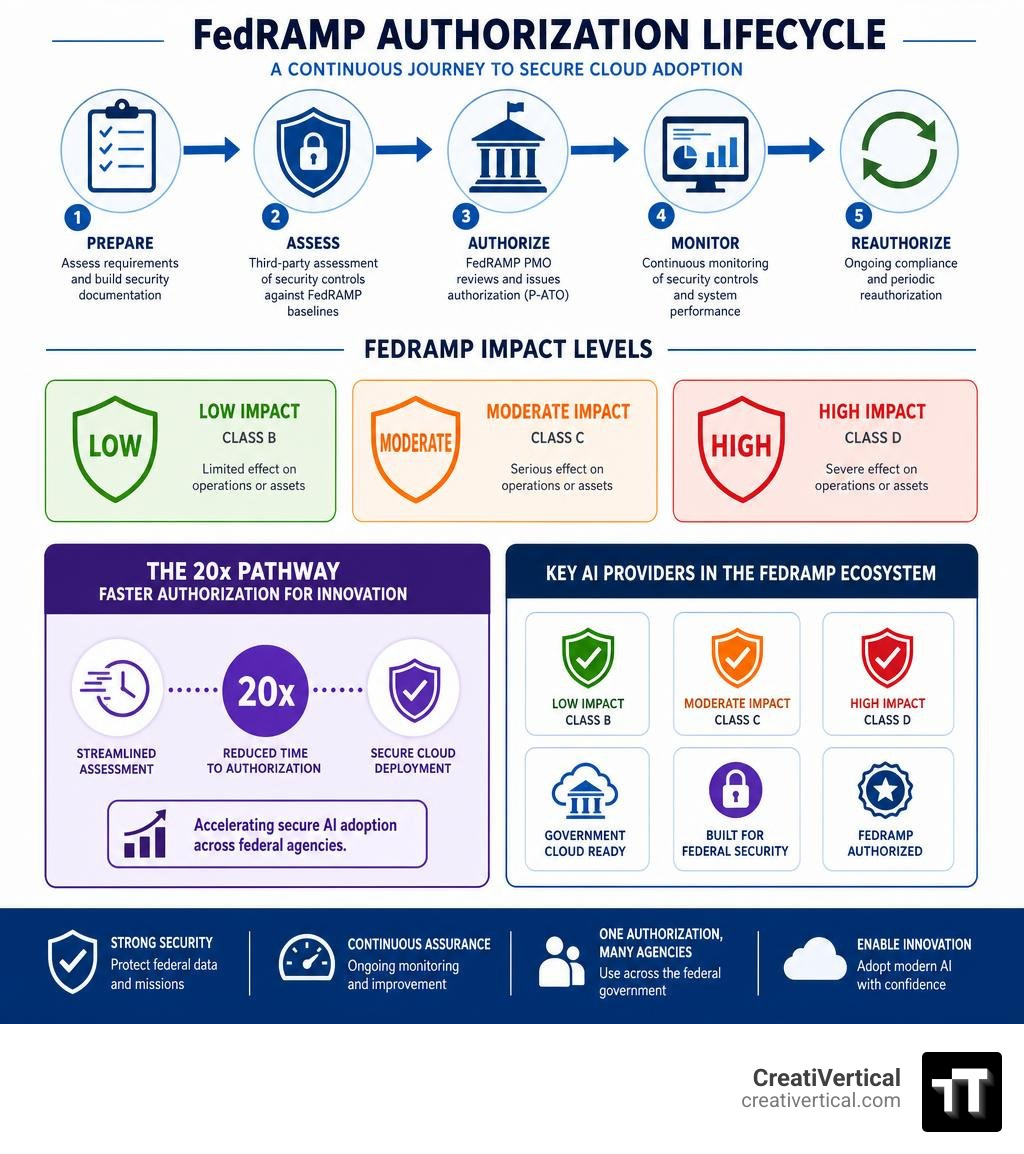
What is FedRAMP and Why Does It Matter for Federal AI Adoption?
The Federal Risk and Authorization Management Program (FedRAMP) is the gold standard for cloud security in the United States public sector. Established to provide a standardized, “do once, use many times” framework for security assessment, authorization, and continuous monitoring, FedRAMP ensures that federal data remains secure in the cloud. Codified into law by Congress in 2022, compliance is a non-negotiable statutory requirement for any cloud service provider (CSP) handling federal information.
When federal agencies look to adopt artificial intelligence, they cannot simply sign up for commercial SaaS tools. Standard commercial AI platforms often ingest user prompts to train public models, creating massive data leakage risks for Controlled Unclassified Information (CUI), Personally Identifiable Information (PII), and Protected Health Information (PHI).
To mitigate these risks, agencies must procure FedRAMP compliant AI services hosted on authorized cloud infrastructures. This compliance framework aligns closely with other robust security standards:
- DoD Impact Levels (IL4/IL5): Required for Department of Defense systems handling sensitive unclassified information and mission-critical data.
- ISO Standards: International benchmarks for information security management that often serve as foundational baselines for global cloud providers.
- GovRAMP: A parallel framework designed to bring similar cloud security rigor to state and local governments, allowing municipal agencies to leverage FedRAMP-style trust without starting security audits from scratch.
By sourcing tools directly from the FedRAMP Marketplace, agencies ensure their AI deployments respect federal boundaries, secure sensitive data, and support broader national initiatives like America’s AI Action Plan.
The Fast Track: How the FedRAMP 20x Initiative Accelerated AI Approvals
Historically, achieving a FedRAMP Authority to Operate (ATO) was a notoriously slow, multi-month (and sometimes multi-year) marathon. To break this logjam and accelerate the adoption of conversational AI engines for routine federal worker use, the General Services Administration (GSA) launched the FedRAMP 20x pilot initiative.
Announced in August 2025 and finalized in April 2026, this program aimed to fast-track 20x authorizations for high-demand AI solutions. By utilizing automated validation techniques, the GSA sought to compress the traditional authorization timeline down to a matter of weeks for qualified systems.
However, this was not a free pass. To qualify for the 20x prioritization window, AI service providers had to meet incredibly strict historical criteria, including:
- Demonstrated Demand: Backed by active interest from at least five CFO Act agencies.
- Enterprise Features: Native support for Single Sign-On (SSO), System for Cross-domain Identity Management (SCIM) provisioning, and role-based access controls.
- Absolute Data Separation: Architectures that guarantee agency data is never used to train public models.
This aggressive initiative successfully expanded the public sector’s digital arsenal. Thanks to the pilot and ongoing modernization efforts, FedRAMP surpassed its previous FY25 targets, adding 124 new authorized cloud services to the platform, bringing the marketplace to 526 total certified services—with 28 specifically leveraging the accelerated 20x pathway.
While the initial 20x prioritization window officially closed in April 2026, the program revolutionized how the GSA processes AI capabilities, establishing a permanent blueprint for rapid, automated security validation. You can review the initial guidelines on the GSA 20x Prioritization Announcement and track ongoing updates via the FedRAMP AI Guidelines page.
Top FedRAMP Compliant AI Services in 2026: A Comparative Roundup
The landscape of FedRAMP compliant AI services has matured rapidly. Agencies no longer have to choose between cutting-edge capabilities and ironclad compliance. Whether you need generative writing, semantic search, or autonomous agents, there is an authorized solution ready for procurement.
ChatGPT Enterprise and API Platform: The Pioneer in FedRAMP Compliant AI Services
In early 2026, OpenAI achieved a major milestone by securing FedRAMP Moderate (Class C) authorization under the 20x certification type for ChatGPT Enterprise and its API Platform (Package ID: FR2533155773).
This authorization allows agencies to deploy the world’s most recognizable conversational AI tool within a secure boundary. The package covers both the user-facing ChatGPT Enterprise interface and the underlying API platform, allowing developers to build custom internal applications.
To maintain compliance, federal teams must route their API calls through dedicated, secure endpoints. For example, developers configure their environments using specific commands to point to the secure government gateway:
codex config set openai_base_url https://gov.api.openai.com/v1
This ensures that all data payloads remain isolated from commercial training pipelines. For procurement details, visit the ChatGPT Enterprise on FedRAMP Marketplace listing and review implementation steps on the ChatGPT Enterprise for FedRAMP Configuration support page.
Claude in Amazon Bedrock: High-Impact FedRAMP Compliant AI Services
For workloads requiring the absolute highest level of civilian and defense compliance, Anthropic’s Claude models inside Amazon Bedrock are a dominant choice. Approved in June 2025, Claude 3.5 Sonnet v1 and Claude 3 Haiku are fully authorized for FedRAMP High and Department of Defense Impact Level 4 and 5 (DoD IL4/5) workloads.
Delivered as a fully managed service within AWS GovCloud (US) regions, Claude in Bedrock allows agencies to process highly sensitive, unclassified military data and Controlled Unclassified Information (CUI). Key highlights include:
- Massive 200K Context Window: Perfect for analyzing massive multi-page regulatory documents, legal records, or intelligence briefs in a single prompt.
- Advanced Guardrails: Agencies can leverage native Amazon Bedrock Guardrails to block toxic content, redact sensitive data, and enforce organizational safety policies.
- Agentic Frameworks: Supports Bedrock Agents and Knowledge Bases, allowing developers to build secure, autonomous workflows that execute tasks across legacy systems.
Learn more about deploying these frontier models securely by reading the Claude in Amazon Bedrock Approval announcement.
Perplexity Enterprise Pro: Secure AI Search for Government
Perplexity AI brought its popular conversational search engine to the public sector in early 2026, earning a FedRAMP Low (Class B) authorization under the 20x pilot (Package ID: FR2604643715).
Perplexity Enterprise Pro for Government shifts the paradigm of traditional search. Instead of delivering a list of blue links, it synthesizes web and database information into structured, cited answers. This tool is ideal for federal researchers, policy analysts, and administrative staff who need to parse vast amounts of public information quickly without compromising search queries to commercial trackers. You can verify their listing on the Perplexity on FedRAMP Marketplace directory.
Gemini for Government: Google’s Secure AI Ecosystem
Google’s entry into the space, Gemini for Government, obtained its FedRAMP certification in early 2026 (Package ID: FR2604952026), covering both Moderate and High baselines depending on the configuration.
Google takes a fundamentally different architectural path than many competitors. Rather than isolating government users on physically separate GovCloud hardware, Google hosts FedRAMP workloads on its commercial public cloud infrastructure. Security and compliance are maintained through Assured Workloads, a software-defined community cloud layer. This approach provides several key benefits:
- No “GovCloud Tax”: Agencies access modern AI features at commercial speeds without waiting for hardware-isolated data centers to catch up.
- Software-Defined Boundaries: Assured Workloads enforces strict logical separation, data residency controls, and personnel restrictions (such as limiting support access to US citizens).
- Google Workspace Integration: Enables secure, AI-assisted drafting, spreadsheet analysis, and slide generation directly inside the Google productivity ecosystem.
Moveworks GovCloud: Agentic AI for Public Sector Operations
Moveworks GovCloud has achieved FedRAMP Moderate authorization, introducing secure, autonomous agentic AI to the public sector. Hosted in the AWS us-gov-east-1 region, Moveworks is built specifically to streamline internal government operations.
Unlike simple chatbots, Moveworks uses a reasoning engine and pre-built integrations to act as an autonomous employee service desk. It resolves routine IT support tickets, automates HR questions, handles facilities requests, and streamlines finance workflows. The real-world impact is significant:
- 180x Support Resolution Speedup: Automates ticket triage and resolution, dropping standard wait times from hours to seconds.
- Workload Reduction: Public sector integrators like ManTech have reported up to a 50% reduction in Tier 1 support ticket workloads after deployment.
Palantir Federal Cloud Service: Supporting Services (PFCS-SS)
Palantir remains a cornerstone of federal data operations. The Palantir Federal Cloud Service – Supporting Services (PFCS-SS) operates at a FedRAMP High (Class D) baseline, certified under Revision 5 standards (Package ID: FR2315464863).
Palantir’s platform is highly trusted across the federal government, boasting 6 agency authorizations and 23 reuses across various defense and civilian departments. It serves as an enterprise operational system, integrating disparate data streams to power highly sensitive decision-making, intelligence synthesis, and predictive logistics. Check out their official status on the Palantir on FedRAMP Marketplace page.
Must-Have Security and Compliance Features for Federal AI Deployments
When evaluating FedRAMP compliant AI services, security officers look far beyond the model’s accuracy. A compliant AI architecture must feature robust, enterprise-grade security controls to safeguard data integrity and system access.
Any AI service entering a federal environment should support:
- Single Sign-On (SSO) & SAML Integration: Ensures that access is governed by the agency’s centralized identity provider, enforcing Multi-Factor Authentication (MFA) and PIV/CAC card access.
- SCIM User Provisioning: System for Cross-domain Identity Management automates the lifecycle of user accounts, ensuring that when an employee leaves an agency, their access to sensitive AI tools is instantly revoked.
- Strict Logical and Physical Data Separation: Complete assurance that prompt histories, uploaded documents, and API payloads are never written to shared commercial databases or used to retrain base models.
- Granular Role-Based Access Control (RBAC): Restricts access to specific AI models, data repositories, or custom agents based on the user’s clearance and job function.
- PII/PHI/CUI Redaction and Masking: Active data-loss prevention (DLP) layers that intercept prompts, automatically masking sensitive data points (like Social Security numbers or medical records) before they reach the LLM.
CSPs like Deloitte have met these strict requirements by offering pre-configured environments on compliant infrastructure. For instance, Deloitte’s AI Cloud for Public Sector, available via the AWS Marketplace Public Sector AI Cloud, provides a FedRAMP Moderate-ready platform on AWS designed specifically for handling PHI, PII, and CUI workloads using secure enclaves.
Frequently Asked Questions About FedRAMP Compliant AI Services
What is the difference between FedRAMP Moderate and High for AI workloads?
The primary difference lies in the impact of a potential security breach.
- FedRAMP Moderate covers roughly 80% of federal cloud deployments. It is designed for data where a loss of confidentiality, integrity, or availability would cause serious, but not catastrophic, harm to an agency’s operations or assets (e.g., standard internal office tools, public-facing portals, and general administrative work).
- FedRAMP High is reserved for highly sensitive, unclassified data where a breach could result in catastrophic harm, financial ruin, or severe threat to human life. This baseline is typical for law enforcement, emergency services, healthcare systems, and defense workloads handling Controlled Unclassified Information (CUI).
How does the FedRAMP 20x process speed up AI authorization?
The FedRAMP 20x process accelerated approvals by prioritizing high-demand conversational and generative AI services that met strict technical baselines. By leveraging automated validation tools and requiring proof of demand from at least five CFO Act agencies, the GSA was able to bypass traditional administrative bottlenecks, reducing the time to achieve an ATO from several months down to a few weeks.
Can state and local governments use FedRAMP-authorized AI services?
Yes. State and local government agencies can directly benefit from FedRAMP authorizations. Many state IT departments rely on the FedRAMP Marketplace to vet cloud vendors, saving thousands of dollars in independent security audits. Additionally, frameworks like GovRAMP allow state and local governments to easily adopt FedRAMP-certified systems by inheriting the security controls already validated at the federal level.
Conclusion: Charting Your Agency’s Secure AI Mission
Deploying AI in the public sector doesn’t have to be a choice between innovation and a security officer’s peace of mind. By focusing on FedRAMP compliant AI services, federal agencies and government contractors can safely fuel their digital transformation while maintaining compliance.
At CreatiVertical, we specialize in helping government-facing technology vendors and B2B contractors navigate this complex landscape. Based in the Kansas City area (including Lake Tapawingo and Kansas City, Missouri), we act as an ongoing growth partner. We don’t just hand over one-off projects; we build complete, performance-focused digital systems. Our expertise spans applied AI enablement—including custom agents and workflow automation—as well as web development, SEO, and AI search visibility (ensuring your brand gets cited by tools like ChatGPT and Perplexity).
If you are ready to implement secure, compliant AI systems or need to position your technology for public-sector procurement, we can help you chart a safe and successful course.
Launch your secure AI initiative with CreatiVertical today and take the panic out of your next compliance audit.