
What You Need to Know Before You Outsource Web Development Services
Businesses that decide to outsource web development services are choosing to hand some or all of their web build and maintenance work to an external team — instead of hiring and managing developers in-house.
Here is what that decision looks like in practice:
| Decision | Outsource | In-House |
|---|---|---|
| Time to start | Days to weeks | 4–8 weeks to hire |
| Fully loaded cost | Hourly or project rate | 1.3–1.5x base salary in overhead |
| Skill flexibility | Hire for the stack you need | Limited to who you hired |
| Best for | Defined projects, scaling bursts, specialized work | Core, ongoing, proprietary product work |
| Main risk | Communication gaps, IP exposure | Slow hiring, fixed overhead |
The core trade-off is simple: outsourcing converts a fixed staffing cost into a variable one. You pay for the work you need, when you need it — but you still need to manage it.
That said, not every outsourcing arrangement works out. Vague scopes, wrong engagement models, and weak contracts are the most common reasons projects go sideways — not the outsourcing itself.
This guide walks you through the decisions that actually matter: which model fits your scope, how to vet a vendor, what your contract must include, and where the real risks hide.
I’m Nicholas Cunha, founder of CreatiVertical — I’ve spent over twenty years delivering web projects for government agencies, institutional clients, and B2B businesses across the Caribbean and the US, including projects where outsource web development services were part of the delivery model. That experience shapes every recommendation in this guide.
Why B2B Leaders Outsource Web Development Services
For B2B leaders, managing a digital footprint is no longer just about keeping a basic homepage online. Whether you are a partner at an offshore law firm in the British Virgin Islands, a procurement officer for a precision machined parts manufacturer, or a government contractor navigating strict compliance frameworks, your web infrastructure is a strategic business engine.
When you choose to outsource web development services, you are not simply looking for a cheap coding shortcut. You are looking to solve three critical business challenges:
- Access to Specialized Skills: Modern web systems require deep, specialized expertise. One week you might need a front-end engineer to build a high-performance portal; the next, you need a database architect to optimize legacy integrations. Hiring full-time employees for every highly specialized technology stack is financially impractical.
- Capacity Scaling on Demand: Business demands fluctuate. A major product launch, a corporate restructuring, or a push for new compliance certifications can suddenly spike your development needs. Outsourcing allows you to scale your engineering capacity up or down instantly without the long-term commitment of permanent hires.
- Operational Efficiency: Building and maintaining a high-performance web system requires a full-cycle team, including project managers, UX/UI designers, QA testers, and DevOps engineers. Outsourcing shifts the burden of recruiting, training, and managing this cross-functional team to an external partner, allowing your internal leadership to focus on core business operations.
By working with a dedicated partner, you can access comprehensive Professional Web Design Services in Kansas City that align your technical infrastructure with your long-term growth goals.
The Real Cost of In-House Hiring vs. Outsourcing
When B2B decision-makers evaluate the financial impact of building an internal development team, they often make the mistake of comparing a developer’s base salary directly to an agency’s hourly rate. This calculation misses the massive hidden costs of recruitment and employment overhead.
In 2026, recruiting a senior in-house developer takes an average of 4 to 8 weeks. Once you account for recruitment fees (which typically range from 15% to 30% of the first-year salary), onboarding time, health benefits, retirement contributions, hardware, software licenses, and payroll taxes, the real cost of an in-house employee rises by 30% to 50% above their base salary.
Furthermore, if a project’s scope changes or a major development phase concludes, you are still responsible for that fixed overhead. When you utilize outsourced services, you convert these rigid, fixed labor costs into flexible, variable expenses. You pay strictly for productive hours delivered against your roadmap. For a detailed breakdown of how these budgeting realities impact your bottom line, explore our analysis on What Should a New Website Cost?
Accessing Specialized Tech Stacks Without the Overhead
The days of simple, monolithic web builds are largely behind us. Today’s high-performance digital ecosystems rely on modern, decoupled architectures and specialized configurations. For instance, many enterprises are migrating to a headless CMS architecture—separating the content management backend from the presentation layer to achieve blazing-fast page speeds and enhanced security.
Additionally, regulatory compliance is now a non-negotiable requirement for many B2B sectors. Government contractors and public-facing organizations must meet WCAG 2.2 accessibility standards, while healthcare and financial platforms must secure sensitive data environments. Building these features requires specialized engineers who understand secure coding practices, automated accessibility regression testing, and modern frameworks like React, Next.js, and Node.js.
Whether you are looking to optimize an enterprise platform or launch a highly secure E-commerce Web Design, outsourcing gives you instant access to these advanced capabilities without the burden of maintaining a massive, expensive internal IT department.

Navigating Outsourcing Models: Onshore, Nearshore, and Offshore
If you have decided to outsource web development services, your next step is determining where your external team should be located. The global software engineering market is divided into three primary geographical models, each offering a distinct balance of cost, communication convenience, and cultural alignment.
To find the right fit, you must look past simple hourly rates and evaluate the total cost of collaboration, which includes time zone overlap, language proficiency, and regional developer expertise. If you are looking to compare options, reviewing curated directories such as the Top Missouri Web Development Companies | 2026 can help you benchmark local onshore standards against international alternatives.
Comparing Regional Rates and Time Zone Overlap
The table below outlines the typical industry rates and structural dynamics across the major global outsourcing regions:
| Region | Typical Hourly Rates (USD) | Time Zone Overlap (US Central) | Key Strengths | Communication Dynamics |
|---|---|---|---|---|
| Onshore (US / Midwest) | $100 – $200+ | Full Overlap (0 hours) | Perfect cultural alignment, local accountability, face-to-face collaboration | Real-time, seamless integration into daily operations |
| Nearshore (Latin America) | $30 – $75 | High Overlap (0 – 2 hours) | Same-day collaboration, growing tech hubs, strong English proficiency | Excellent for real-time Agile sprints and daily standups |
| Offshore (Eastern Europe) | $50 – $100 | Moderate Overlap (2 – 4 hours) | Exceptional technical depth, strong mathematical foundations, high quality-to-cost ratio | Good for structured daily handovers and overlapping sprint reviews |
| Offshore (South Asia / India) | $15 – $50 | Low Overlap (10 – 12 hours) | Massive talent pool, highly cost-effective, round-the-clock development | Highly dependent on clear, asynchronous written documentation |
Choosing the right region is a strategic decision. For instance, Eastern Europe offers up to 4 hours of real-time overlap with North American business hours, making it highly attractive for complex system architectures that require regular collaborative code reviews. Meanwhile, local onshore teams provide the ultimate peace of mind for highly regulated industries where data security and immediate accessibility are paramount.
Choosing the Right Engagement Model for Your Project Scope
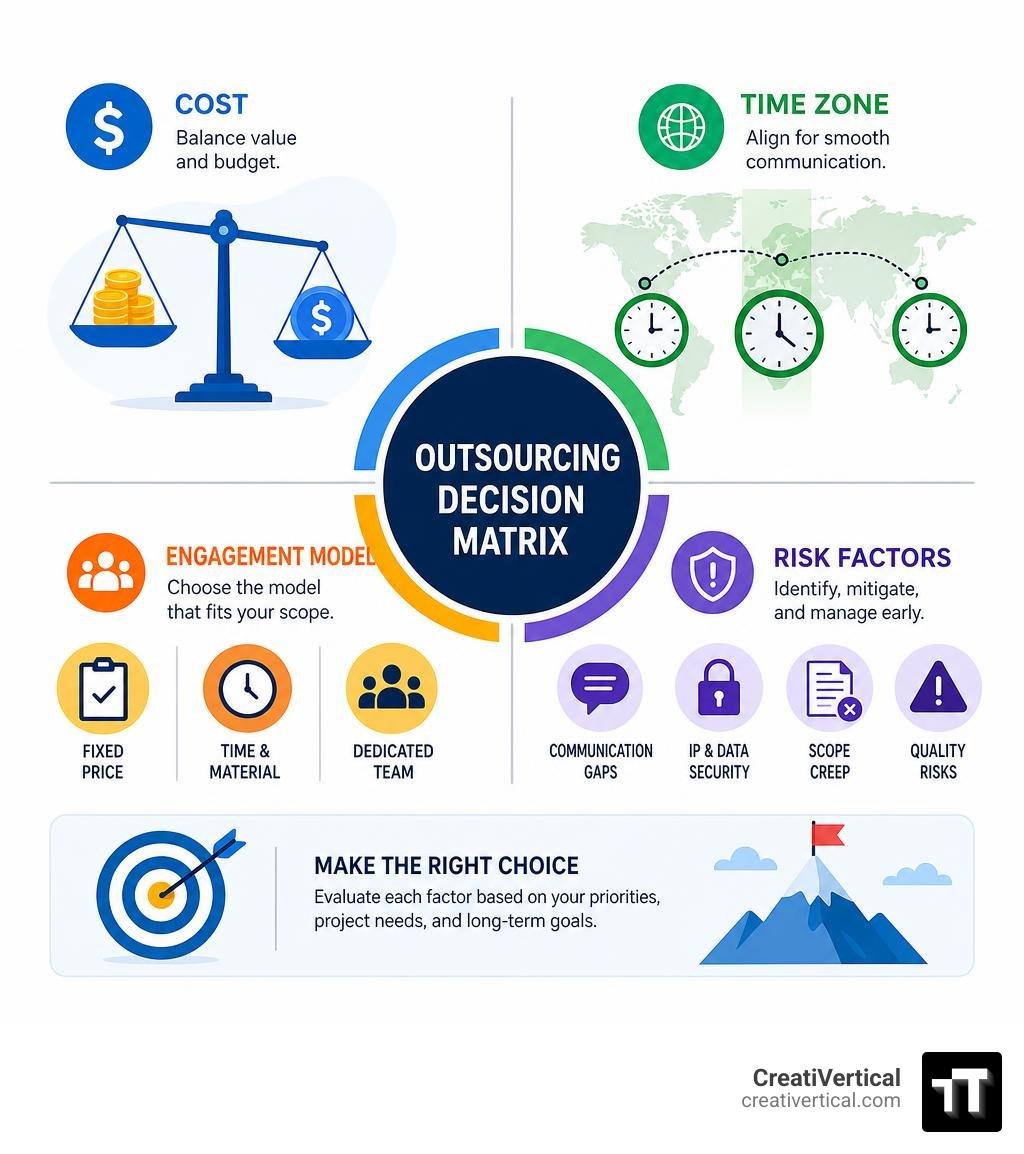
Once you select a geographical region, you must choose how your outsourced team will integrate with your business. The three most common engagement models are:
- Staff Augmentation: You drop external developers directly into your existing engineering team to fill specific skill gaps or accelerate velocity. You maintain direct management and control over their daily priorities.
- Dedicated Team: A self-managed, cross-functional squad (including a PM, designers, developers, and QA) is assigned exclusively to your business. They operate as an extension of your organization, working sprint by sprint.
- Full-Cycle Outsourcing (Project-Based): You hand over the entire project—from discovery and architecture to launch and maintenance—to the vendor. The partner owns the delivery, while you provide high-level direction and feedback.
For businesses that lack internal technical management, utilizing a dedicated, managed team can provide the infrastructure and oversight necessary to keep your digital assets running flawlessly. Discover how this approach can streamline your operations by reading about The Remote Web Admin Advantage.
When to Outsource Web Development Services with a Fixed-Price Model
A fixed-price engagement model is ideal when your project has a highly defined, locked scope, clear technical specifications, and a set timeline.
This model is best suited for:
- Launching a Minimum Viable Product (MVP) with a strict feature set.
- Straightforward corporate website builds or redesigns with pre-approved designs.
- Standard migrations where the source and target systems are fully understood.
Under a fixed-price model, the vendor absorbs the risk of minor timeline overruns, giving you budget predictability. However, this model is highly rigid. Any change to the original scope will require a formal change request, which can add costs and delay delivery. If you are a business owner in the Kansas City metro area looking for a predictable, high-quality local build, partnering with an agency that specializes in custom Website Design in KC is an excellent way to ensure your fixed-scope project is delivered successfully.
Managing Evolving Requirements with Time and Materials
For complex applications, custom software platforms, or continuous product development, a fixed-price model is rarely successful. When requirements are expected to evolve based on user testing, market feedback, or shifting business goals, the Time and Materials (T&M) model is the industry standard.
In a T&M engagement, you pay for the actual hours spent by the development team, working in Agile sprints (typically two-week cycles). This model provides the ultimate flexibility, allowing you to reprioritize features, pivot your product direction, and continuously optimize user experience.
To make a T&M model work, you must maintain active involvement, participate in sprint demos, and monitor progress against a clear product roadmap. This iterative approach is highly effective for businesses focused on continuous optimization. If you are wondering how to systematically audit and upgrade your existing digital assets, read our comprehensive guide on How to Improve a Website.
Vetting Vendors and Mitigating Risks in Outsourced Projects
The global IT services and outsourcing market reached $662 billion in 2025 and is forecast to hit $1.34 trillion by 2034. With thousands of agencies competing for your business, vetting vendors is the most critical phase of your outsourcing journey.
Successful outsourcing depends entirely on the structures, vetting processes, and communication frameworks you establish before any development begins. Vetting should go deep into technical capabilities, cultural compatibility, and operational security. To ensure you are working with a verified, highly capable partner, you can cross-reference local providers through resources like the directory of Top Web Development Companies In Kansas City – DesignRush .
Essential Clauses for Your Outsource Web Development Services Contract
Your development contract is your primary tool for mitigating risk. Never rely on a generic, one-page agreement. A professional web development contract must contain detailed clauses covering:
- Intellectual Property (IP) Assignment: The contract must state explicitly that 100% of the code, documentation, designs, and runbooks transfer to your company automatically upon payment. Ensure the vendor waives any “moral rights” to the software.
- Milestone-Based Payments: Tie payments directly to verifiable, functional deliverables (e.g., successful deployment of the database schema, completion of front-end templates, or passing user acceptance testing) rather than simple calendar dates.
- Change Request Process: Define exactly how out-of-scope work will be estimated, approved, and billed to prevent scope creep and budget overruns.
- AI Governance and Security Policies: In 2026, protecting your proprietary data is more critical than ever. Your contract must include strict policies governing how the vendor uses generative AI tools (like GitHub Copilot or Cursor). Ensure that proprietary code is never fed into public Large Language Models (LLMs) where it could be leaked or used to train public datasets.
- Post-Launch Warranty and Support: Secure a 30- to 90-day warranty period post-launch to cover bug fixes and performance issues at no additional cost.
Red Flags That Should Kill a Deal
During the sales and negotiation phase, pay close attention to how the vendor communicates and structures their proposals. Watch out for these critical red flags:
- Vague Scope in Estimates: If a vendor provides a flat, lump-sum estimate without a detailed breakdown of features, user stories, and technical requirements, they are likely to surprise you with massive change-order bills later.
- Lowest-Cost Positioning: In software engineering, you get what you pay for. A vendor offering rates significantly below market average is often sacrificing code quality, security protocols, or developer retention.
- High Staff Turnover: Ask the vendor about their developer retention rate. If their team is a revolving door, your project will suffer from constant onboarding delays and inconsistent code quality.
- Unclear Communication Norms: If a vendor takes days to respond to simple emails during the sales process, expect communication to degrade further once the contract is signed.
For businesses seeking a highly reliable, communicative, and secure onshore partner, working with an established Kansas City Web Design Company can help you bypass the typical risks associated with overseas development.
Frequently Asked Questions about Web Development Outsourcing
How much does it cost to outsource web development?
The cost to outsource web development services varies widely based on the complexity of your application, the technology stack, and the geographic location of your development partner. As a general market benchmark:
- Custom Corporate Website: Typically ranges from $20,000 to $50,000, depending on design complexity and integration requirements.
- Self-Service Customer Portal / Custom SaaS MVP: Generally starts around $70,000 to $150,000, involving custom database architectures, user authentication, and third-party payment integrations.
- Complex Enterprise Web Software: Can range from $150,000 to $400,000+, requiring advanced security protocols, legacy system migrations, and extensive API development.
How do we protect our intellectual property and data security?
Protecting your IP and securing sensitive business data requires a multi-layered approach. First, sign a comprehensive, mutual Non-Disclosure Agreement (NDA) before sharing any proprietary project details.
Second, verify that your development partner follows secure development lifecycles (SDLC), including mandatory peer code reviews, automated dependency scanning, and OWASP-based security procedures. If your business operates in a regulated sector (such as healthcare, finance, or government contracting), ensure your partner is SOC 2 compliant and utilizes encrypted repositories and secure staging environments.
How do we manage communication and quality across different time zones?
Successful cross-border collaboration relies on structured communication protocols rather than constant real-time supervision. Establish a clear meeting cadence, including bi-weekly sprint planning sessions, weekly demos, and asynchronous daily updates via Slack or Microsoft Teams.
Use project management tools like Jira or Linear to maintain full visibility over task ownership, sprint velocity, and bug tracking. Finally, ensure your outsourced team integrates directly into your version control system (like GitHub or GitLab), allowing your internal team to monitor code commits in real time. To maintain your platform’s health and security post-launch, consider securing dedicated Website Maintenance Support in Kansas City to handle updates, backups, and security patches.
Conclusion: Partnering for Long-Term Digital Growth
Outsourcing your web development is not just about finding someone to write code; it is about choosing a strategic partner who can help you navigate the complexities of modern technology. At CreatiVertical, we believe in moving past transactional, one-off projects. We operate as an ongoing growth partner, delivering complete, performance-focused digital systems that encompass design, promotion, and long-term maintenance.
From our offices in Kansas City, Missouri, and Lake Tapawingo, we specialize in serving high-stakes B2B sectors that require absolute precision, security, and compliance:
- Offshore & Caribbean Professional Services: We build highly secure, professional web systems and client portals for law firms and fiduciary providers operating in jurisdictions like the BVI and Cayman. Discover how we tailor our services for these markets by exploring our work with Websites for Caribbean Companies.
- Industrial & B2B Manufacturers: We design high-performance platforms that streamline complex product catalogs, generate high-quality leads, and integrate seamlessly with legacy ERP systems.
- Government Contractors: We develop web solutions that meet strict compliance frameworks, including WCAG 2.2 accessibility, and support secure public-sector workflows.
If you are ready to stop managing development headaches and start building a secure, scalable digital system, explore our full suite of Website Development services or contact us today to chart your course toward sustainable digital growth.