

How to Choose a Website Development Company That Actually Grows Your Business
Choosing the right website development company is one of the most consequential decisions a business makes — and one of the easiest to get wrong.
Here’s what you need to know at a glance:
| What to look for | Why it matters |
|---|---|
| Services aligned to your goals | A site that looks good but doesn’t generate leads is a liability |
| Proven technical expertise | The stack and skills determine what your site can actually do |
| Verified portfolio and case studies | Past results are the clearest signal of future performance |
| Transparent pricing | Total cost of ownership matters more than the initial quote |
| Post-launch support | The work doesn’t end at launch — it starts there |
There are roughly 120,000 web development companies operating in the United States, with the industry growing at about 7% annually through 2034. That’s a lot of options — and a lot of noise to cut through.
Most businesses don’t struggle to find a web development agency. They struggle to find the right one. The wrong hire costs more than money. It costs months of rebuilding work that should have been done right the first time. Over 75% of new website projects are reportedly rescue projects — complete do-overs of recently built sites that failed to deliver.
Whether you’re a Kansas City business owner with a site that isn’t generating leads, a Caribbean professional-services firm that needs credible international visibility, a B2B manufacturer selling to procurement teams, or a government-facing technology vendor, the stakes are real and the decision deserves a clear framework.
I’m Nicholas Cunha, founder of CreatiVertical — I’ve spent over twenty years running agencies, including fifteen years in the British Virgin Islands delivering projects for government bodies and institutional clients, and I work hands-on with website development daily across WordPress, AI enablement, and SEO. This guide gives you the five questions that actually separate a strong web development partner from one you’ll regret.
1. Align the Agency’s Services with Your Business Outcomes
A beautiful website that sits empty in the vast digital desert is a waste of capital. When evaluating a website development company, the conversation should never begin with color palettes or parallax scrolling. It must begin with your business outcomes.
For a local business near our home base in Lake Tapawingo or the wider Kansas City metro, the outcome might be a steady stream of local service inquiries. For an industrial manufacturer of precision equipment, lubricants, or custom batteries, the outcome is educating highly technical procurement engineers and capturing qualified RFQs. For an offshore law firm or fiduciary provider in the British Virgin Islands or Cayman Islands, the outcome is conveying institutional trust, security, and compliance to international clients.
When you look at how to structure your project, you must ensure the agency understands the mechanics of how your specific business makes money. A standard “digital brochure” will not suffice. You need a partner capable of building custom web applications and lead-generation funnels that align with your long-term strategy.
If you are wondering How to Improve a Website, the answer is rarely just cosmetic; it involves optimizing user journeys, speed, and backend workflows to serve your bottom line.

What Services Does a Leading Website Development Company Offer?
A comprehensive website development company does not merely write code; they design complete digital systems. Leading agencies in the United States typically offer a spectrum of integrated services, including:
- Full-Stack Development: The architectural engineering of both the frontend (what your users see) and backend (the databases, servers, and business logic that power the site).
- Experience Design (UI/UX): Crafting intuitive, frictionless interfaces based on user data and behavior, rather than design whims.
- Search Engine Optimization (SEO) & AI Search Visibility: Ensuring your site is built from the first line of code to rank on Google and be cited by modern AI search engines like ChatGPT and Perplexity.
- Paid Traffic Optimization: Preparing your landing pages to convert high-intent clicks when you are Website for Paid Traffic Gearing Up.
- Workflow Automation & Applied AI: Integrating custom agents and automated workflows that eliminate manual bottlenecks, turning your website into an active employee that works while you sleep.
2. Evaluate Technical Expertise, AI Integration, and Accessibility
The modern web is highly complex. A reputable agency must be platform-agnostic, recommending technology stacks based on your requirements rather than their comfort zones.
If your agency only knows how to install pre-made themes, they are a design vendor, not a development company. For content-rich, highly scalable, and marketing-friendly systems, custom WordPress Web Design in Kansas City remains an industry standard, powering over 43% of the web. For complex, custom web applications requiring rapid rendering and dynamic data, modern frameworks like React and Next.js are often the ideal choice.
| Feature | Custom-Coded Site (React, Next.js, Custom WordPress) | Pre-made Template / Theme |
|---|---|---|
| Page Speed & Core Web Vitals | Optimized from scratch, often loading in under 1 second | Heavy, bloated with unnecessary code and plugins |
| Security & Vulnerabilities | Minimal footprint, highly secure, custom permissions | High risk of third-party plugin conflicts and security leaks |
| Scalability | Unlimited; grows with custom databases and API integrations | Highly restricted by the template’s hardcoded layout |
| SEO & AI Discovery | Clean markup designed for modern search crawlers and LLMs | Bloated HTML that can confuse crawlers and slow down indexing |
Modern Technologies: AI, Accessibility, and Scalability
In July 2026, a website is no longer just a static document. It is an interactive node in a highly automated ecosystem. Reputable US agencies must demonstrate experience in three critical technical areas:
- Applied AI and Workflow Automation: With 83% of Gen Z developers utilizing AI tools to build smarter, faster solutions, your agency should know how to integrate Large Language Models (LLMs), build retrieval-augmented generation (RAG) pipelines, and orchestrate custom AI agents that automate customer service or lead scoring.
- Digital Accessibility (ADA & WCAG Compliance): Web accessibility is not optional. It is a legal necessity, especially for government-facing technology vendors operating under FISMA or FedRAMP frameworks, and professional firms. Your development partner must design for WCAG 2.1/2.2 standards, providing regular accessibility audits, remediation, and semantic HTML that works seamlessly with screen readers.
- Performance and Scalability: Slow websites kill conversions. A top-tier agency optimizes Core Web Vitals, implements edge caching via CDNs like Cloudflare, and structures database schemas (using PostgreSQL, Supabase, or enterprise CMS architectures) to handle millions of transactions without breaking a sweat.
3. Analyze Portfolios, Case Studies, and Regional Expertise
Anyone can buy a sleek agency template and claim to be an expert. To protect your investment, you must verify their track record through real, documented work.
Look for deep, industry-specific experience. A B2B manufacturer needs an agency that understands complex catalogs, technical specifications, and procurement cycles. An offshore legal or financial provider needs an agency that understands the visual language of high-end corporate trust and strict compliance.
When searching for a partner, check verified listings like the Top Missouri Web Development Companies | 2026 directory to find firms with established local roots and national capabilities.

How Do You Verify the Credibility of a Website Development Company?
Do not rely on the agency’s self-reported testimonials on their homepage. Dig deeper:
- Verified Review Platforms: Look at third-party platforms like Clutch, SelectedFirms, or GoodFirms. Read both the high and low reviews, paying close attention to how the agency handles project management, timelines, and communication.
- Dribbble and Portfolio Quality: Examine their design standards on creative networks. Are their designs custom, cohesive, and balanced, or do they feel repetitive and template-derived?
- Live Production Testing: Do not just look at static screenshots. Ask for links to live, production-ready sites they have built. Run those sites through Google PageSpeed Insights and accessibility checkers. If their own clients’ sites load slowly or fail basic accessibility checks, yours will too.
- State-Level Registrations: Ensure they are a legally registered, stable business. You can look up verified regional listings, such as a certified Web Development Company in Missouri, USA , to ensure you are dealing with a legitimate corporate entity subject to US business and intellectual property laws.
4. Understand Pricing Models and the Total Cost of Ownership
Let’s address the elephant in the room: cost. Website development pricing in the United States varies widely based on scope, complexity, and custom functionality.
According to industry benchmarks, the average cost of a full, custom web development project in the U.S. lands around $66,500, with total project budgets typically ranging from $10,000 to over $100,000. Top-rated US web agencies generally bill hourly rates between $75 and $200 per hour.
To help frame your budget, it is useful to read our detailed analysis on What Should a New Website Cost? to understand where these numbers come from and how they are calculated.
Custom Development vs Template Costs
When evaluating proposals, you will generally encounter two primary pricing models:
- Fixed-Price Contracts: Best for projects with highly defined, unchanging scopes. The agency estimates the total hours and provides a single, flat fee.
- Time and Materials (Retainers / Sprints): Ideal for complex, evolving custom web applications or ongoing growth partnerships. You pay for the actual development hours spent, usually organized in two-week sprint cycles.
Beware of incredibly low, flat-rate quotes. If an agency offers a custom website for $1,500, they are almost certainly installing a pre-made template, changing the logo, and leaving you with bloated code, zero SEO optimization, and a site that will fail to scale.
During economic shifts, businesses realize that cutting corners on digital infrastructure is highly costly; as we saw when Ecommerce Websites Are Helping Businesses During COVID-19, companies with robust, custom digital foundations were able to pivot and survive, while those on fragile, cheap templates struggled to adapt.
5. Assess Post-Launch Support and Maintenance Retainers
A website is not a print brochure. It is a living, breathing software application. The day your site launches is not the end of the project — it is the beginning of its operational life.
Before signing a contract, you must ask: What happens after the site goes live?
Without ongoing maintenance, plugins will break, security vulnerabilities will emerge, and your site speed will degrade. A professional website development company should offer robust post-launch support, including secure, managed hosting, uptime monitoring, automated backups, and routine security patches.
To understand why this matters, consider The Remote Web Admin Advantage. Having an expert, dedicated team managing your technical infrastructure means you do not have to hire an expensive, in-house systems administrator just to keep your digital doors open.
Furthermore, integrating your hosting with structured lead management, as outlined in our guide on Website Hosting Lead Management, ensures that every contact form submission, API call, and customer inquiry is securely captured, backed up, and routed to your CRM without interruption.
Frequently Asked Questions about Hiring a Website Development Company
Why should businesses hire a US-based web development agency?
While offshore development in distant time zones can seem financially attractive at first glance, it often introduces significant hidden costs.
Hiring a US-based agency — particularly one with local roots in Missouri — ensures real-time communication, strict alignment with US accessibility laws (ADA), and robust legal protections for your intellectual property.
For international firms, such as those seeking Websites for Caribbean Companies in jurisdictions like the BVI or Cayman, partnering with a US-based agency offers a bridge of premium credibility, high-performance edge infrastructure, and deep familiarity with corporate trust standards that overseas discount agencies simply cannot replicate.
How long does it typically take to build a custom website?
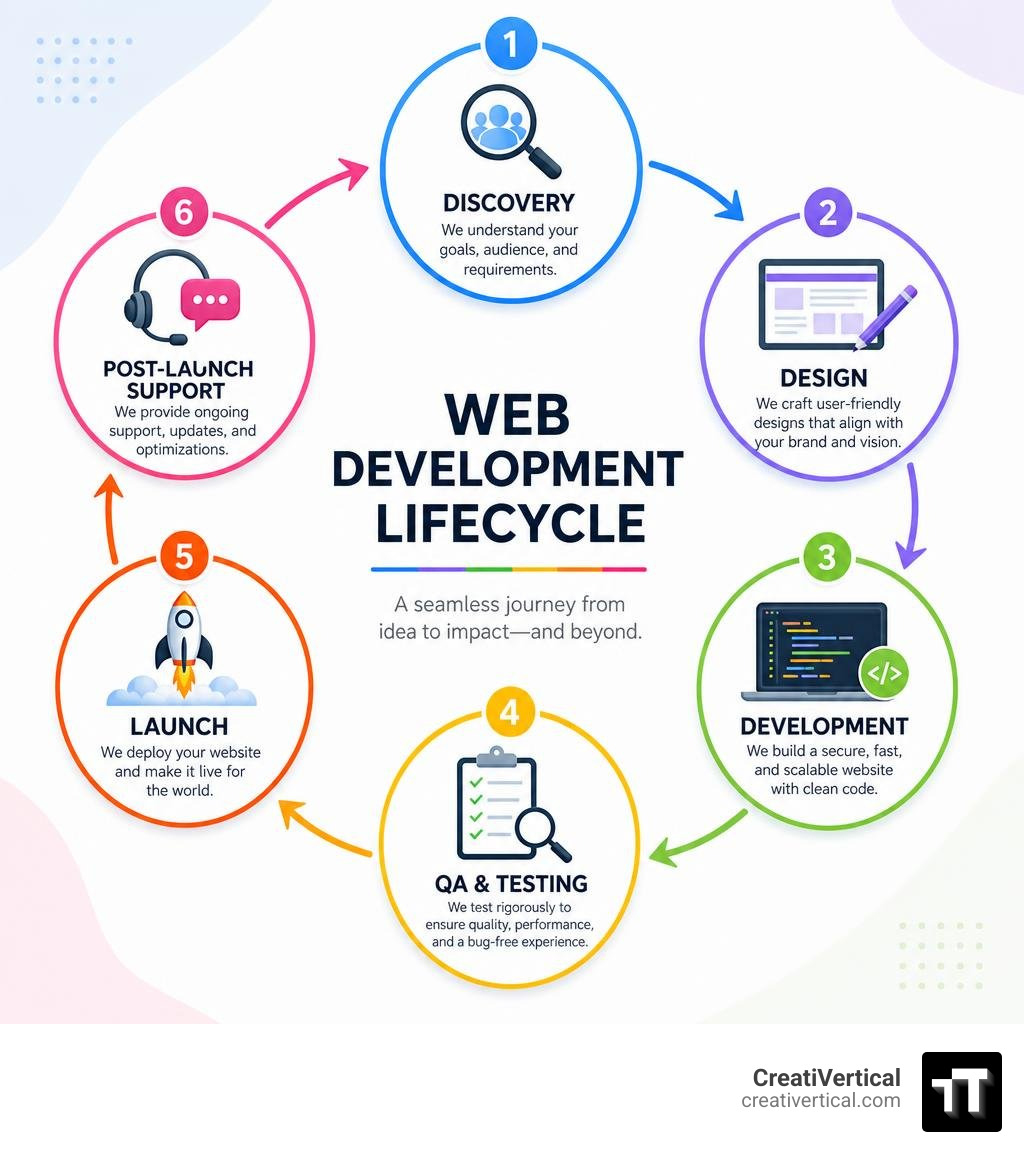
A standard, custom 5-to-10-page business website typically takes 4 to 8 weeks from discovery to launch.
More complex projects, such as custom e-commerce platforms or enterprise-grade web applications, can take 3 to 6 months.
A reliable agency breaks this timeline down into structured, two-week design and development sprints, keeping you involved in the feedback loop through continuous deployment and staging environments.
What are the red flags to watch out for when hiring?
Watch out for these warning signs during your initial consultations:
- Vague or Hidden Pricing: If they cannot explain what drives their costs or what is included in their post-launch support, walk away.
- Over-Reliance on Templates: If they try to force your unique business model into a pre-packaged WordPress theme without explaining the performance trade-offs.
- No SEO Strategy: If they treat SEO as an “add-on” to be done after the site is built. SEO must be baked into the site’s architecture from the first line of code.
- Poor Communication: If they take days to respond to simple emails during the sales process, their project management during development will likely be worse.
Conclusion
Your website is your most valuable digital asset. It should be a high-performing lead-generation system that works tirelessly to grow your business, not a constant source of technical headaches.
At CreatiVertical, we do not believe in one-off, transactional web projects. We operate as an ongoing growth partner for our clients. Based in the Kansas City metro, we combine premium Professional Web Design Services in Kansas City with deep technical expertise in custom Website Development, SEO, AI search visibility, and applied AI automation.
We specialize in building secure, compliant, and conversion-focused systems for three distinct B2B audiences:
- Offshore Professional Services: Delivering elite, highly credible web platforms for law firms and fiduciary providers in the Caribbean and other international jurisdictions.
- Industrial & B2B Manufacturers: Translating complex technical catalogs and engineering specifications into clear, lead-generating digital systems.
- Government-Facing Tech Vendors: Building secure, highly accessible websites and applications that align with rigorous regulatory compliance frameworks.
If you are ready to stop guessing and start building a digital system engineered for long-term growth, we are ready to chart that course with you.
Get started with CreatiVertical today to elevate your digital presence.