
Why PPC and SEO Work Better as a Team
PPC and SEO are the two most powerful levers in search marketing — and most businesses treat them as an either/or choice. That’s a costly mistake.
Here’s the short answer for anyone who wants it fast:
| Question | Quick Answer |
|---|---|
| Does PPC directly improve SEO rankings? | No — Google keeps them separate |
| Does SEO help PPC performance? | Yes — better pages raise Quality Score and lower CPC |
| Does PPC data help SEO strategy? | Yes — search term reports reveal what actually converts |
| Should you run both at once? | Yes, for most businesses with a real growth goal |
| What’s the biggest benefit of combining them? | SERP double-exposure — brands appearing in both paid and organic results can capture up to 46% of total clicks for a keyword |
The question isn’t really which one to choose. It’s how to run them together so each channel makes the other stronger.
Most businesses silo their paid and organic search. Their PPC team tests headlines, finds high-converting keywords, and builds audience data — then none of it reaches the SEO team. Meanwhile, the SEO team builds content and optimizes landing pages, but the paid team never sees it. Both channels end up working harder than they need to, at a higher cost per lead.
The data backs this up. A private university that integrated its SEO and PPC efforts saw a 138% increase in paid conversions and a 159% increase in organic traffic — not by spending more, but by making both channels work from the same playbook.
And the search landscape in 2026 makes integration more important, not less. With 68% of U.S. Google searches now ending without a click, and AI Overviews pushing both paid and organic results further down the page, relying on a single channel is a genuine business risk.
I’m Nicholas Cunha, founder of CreatiVertical — I’ve spent over twenty years managing PPC and SEO campaigns across Kansas City small businesses, offshore professional-services firms, and B2B manufacturers, and I’ll walk you through exactly how to make both channels compound rather than compete.
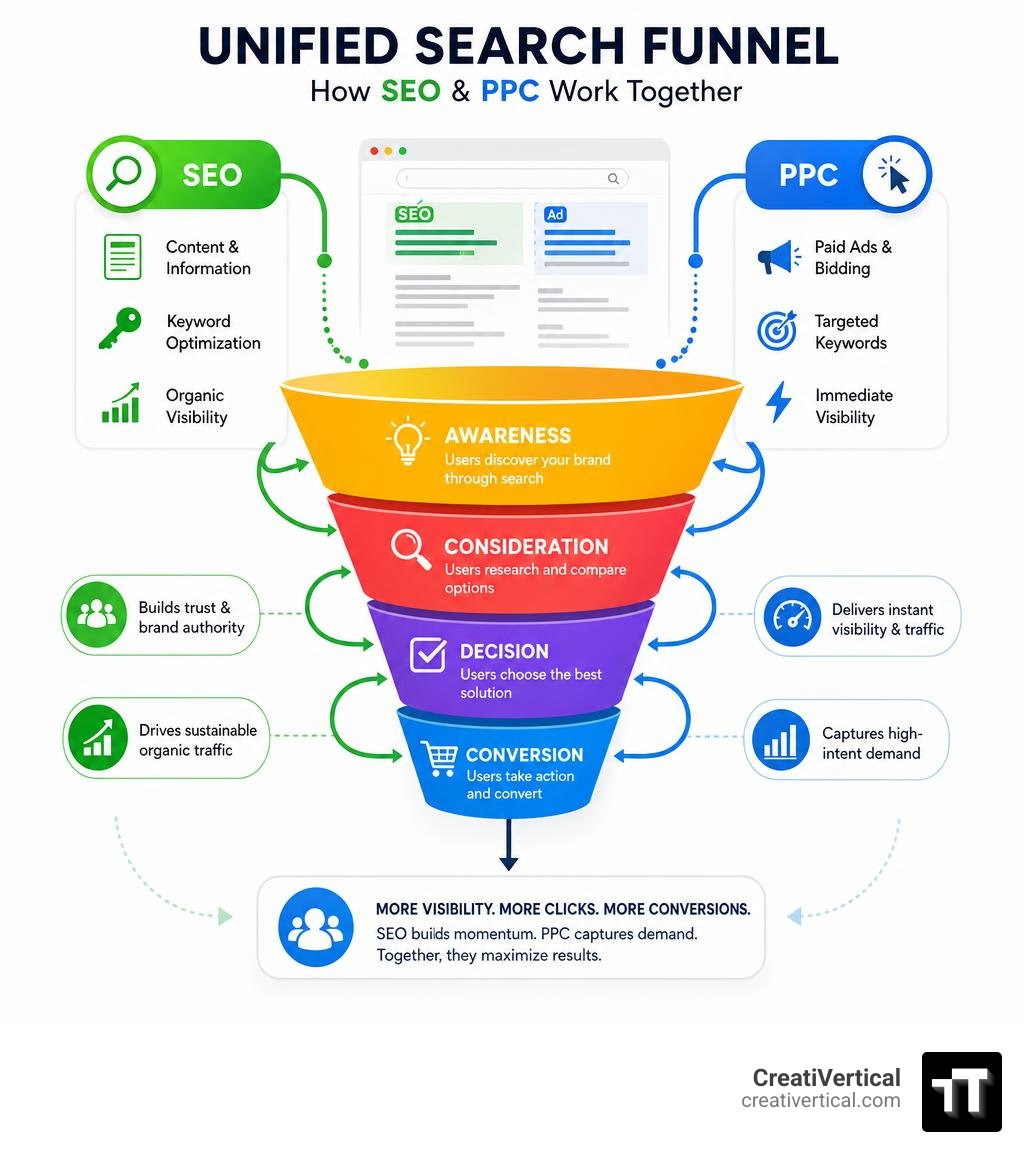
Easy ppc and seo word list:
The Core Differences: Cost, Speed, and Sustainability
To build an integrated search system, you must first understand the fundamental mechanics of each engine. SEO and pay-per-click (PPC) operate on different timelines, cost structures, and equity models.
SEO is an investment in digital infrastructure. When you optimize your website’s technical architecture, refine your on-page targeting, and earn high-authority citations, you are building long-term equity. The traffic you generate from organic listings is free in terms of direct cost-per-click (CPC). However, SEO takes time—typically three to six months to show meaningful momentum.
PPC, on the other hand, is a direct transaction. You bid on specific keywords through platforms like Google Ads or Microsoft Ads, and you pay every time a user clicks your ad. The primary benefit of PPC is speed and control; you can launch a campaign in the morning and appear at the top of search engine results pages (SERPs) by afternoon. But the moment you stop paying, your visibility drops to zero.
A healthy search strategy balances these two dynamics. In the agency playbook, we look at the blended search scorecard to measure the true efficiency of your search spend.
| Metric | Search Engine Optimization (SEO) | Pay-Per-Click (PPC) |
|---|---|---|
| Time to Results | Slow (3 to 6 months to mature) | Instant (Visible within hours of launch) |
| Direct Click Cost | $0 (No charge per visitor) | Variable (Average 2026 CPC is $5.42) |
| Sustainability | High (Continues to drive traffic post-optimization) | Low (Traffic stops when budget is exhausted) |
| Control & Targeting | Low (Search engines decide how to display results) | High (Target by location, time, and device) |
| Trust & Credibility | High (94% of users skip paid search results) | Low (Marked with “Sponsored” labels) |
| Primary Risk | Algorithm volatility | Rising ad costs and budget exhaustion |
For B2B industrial manufacturers in Missouri, or offshore legal providers in the Caribbean, relying solely on one channel introduces high systemic risk. If Google rolls out a major core algorithm update, an organic-only business can see its lead flow evaporate overnight. Conversely, a business relying strictly on paid ads will eventually plateau as rising CPCs erode profit margins.
By analyzing these metrics together through a blended model—as detailed in SEO vs PPC — The Agency Playbook for a Blended Search Strategy – Swydo —we can shift budgets dynamically. This ensures you maintain a stable baseline of leads while building long-term, compounding organic value.
The Strategic Reality of PPC, SEO, AI, and GEO in 2026
There is a common, persistent question in our industry: Does spending money on Google Ads directly improve your organic search rankings?
The short answer is no. Google keeps organic rankings and paid advertising separate. But PPC and SEO still influence each other in practical ways: PPC reveals which queries convert, while SEO improves the pages that paid traffic lands on.
AI tools now make that coordination faster. They can cluster keywords, summarize search term reports, draft PPC ad variants, identify content gaps, compare landing pages, and surface patterns humans might miss. For small teams, that speed is a real advantage: you can test messaging in paid search, turn winning themes into SEO content, and use performance data to refine both channels.
But AI should not run PPC and SEO on autopilot. AI tools can misread intent, over-prioritize vanity metrics, generate generic content, miss brand nuance, or recommend budget shifts without understanding profit margins and sales quality. In PPC, that can waste spend quickly. In SEO, it can produce thin, repetitive content that fails to build authority. The best approach is human-led strategy with AI-assisted execution.
Using PPC Data to Build a Better Keyword List
PPC search term data is one of the fastest ways to validate SEO priorities. Instead of waiting months to see whether a keyword drives revenue, you can run focused paid campaigns and identify the queries that actually lead to form fills, calls, booked demos, or purchases.
AI can help by grouping those search terms by intent, spotting negative keyword opportunities, and highlighting phrases worth turning into long-term content. If a keyword converts in PPC, your SEO team can build stronger pages around it through Adaptive SEO Services.

This same testing loop applies to headlines, descriptions, landing page copy, and calls-to-action. PPC lets you test messaging quickly; SEO lets you turn proven messaging into durable organic visibility.
How SEO Principles Improve PPC Quality Scores
The relationship between PPC and SEO is a two-way street. Just as paid data informs your organic strategy, SEO principles can lower paid advertising costs.
Google Ads Quality Score is influenced by expected click-through rate, ad relevance, and landing page experience. That third factor is where SEO matters most.

A fast, mobile-friendly landing page with clear headings, relevant copy, and strong technical performance gives paid visitors a better experience. That can improve ad efficiency and reduce wasted spend.
GEO: Earning Citations in AI Answer Tools
Generative Engine Optimization (GEO) extends this same integrated strategy into AI answer engines such as ChatGPT, Perplexity, Gemini, and AI Overviews. The goal is not just to rank in search results, but to become a source AI systems can confidently cite.
To improve your chances of AI citations, build content that includes clear definitions, concise answers, original expertise, structured headings, schema markup, cited sources, and entity-rich explanations of your services, locations, and proof points. AI tools tend to favor content that is easy to parse, factually specific, and consistent across your website and third-party profiles.
For CreatiVertical, that means connecting PPC, SEO, and GEO into one system: use PPC to test demand, SEO to build durable authority, and GEO to make the brand easier for AI-powered search tools to understand, trust, and cite.
SERP Ownership: The Power of Double Exposure
What happens when a user searches for your core industry terms and sees your brand in both the sponsored section and the top organic results?
This is called SERP double exposure, and its impact is multiplicative, not just additive. Some business owners assume that if they rank first organically, they should pause their paid ads for that keyword to save money. However, Google’s own incrementality research reveals that 89% of visits generated by search ads are not replaced by organic clicks when those ads are paused.
When you appear in both paid and organic positions, you build immediate psychological trust. The user sees your brand as the dominant authority for that query. According to industry data, businesses that secure both paid and organic listings on a SERP capture up to 46% of total clicks for that keyword.
To make sure you aren’t wasting budget on cannibalized clicks, you can run structured incrementality tests. By selectively pausing brand ads in specific geographic regions (such as a geo-split test across Missouri USA) and measuring the organic recovery rate, you can determine exactly where paid ads are driving unique, incremental leads.
For highly competitive B2B spaces, defending your search real estate is critical. Competitors will often bid on your brand name to steal high-intent traffic. By maintaining a defensive paid ad alongside a strong organic presence, you create an impenetrable barrier at the top of the SERP. To learn more about structuring these multi-channel campaigns, explore our guide on the Best Marketing Strategies in 2024.
For a deeper dive into why the historical division between paid and organic teams has collapsed, read Why the SEO vs. PPC debate is finally over .
Search in the AI Era: AI Overviews and Zero-Click Realities
The search landscape in 2026 is fundamentally different than it was even two years ago. AI Overviews and generative answer engines now shape how people discover brands before they ever click a result.
In early 2026, 68.01% of U.S. Google searches ended without a click. AI answers have compressed traditional click-through rates for both organic listings and paid ads, making single-channel search strategies riskier.
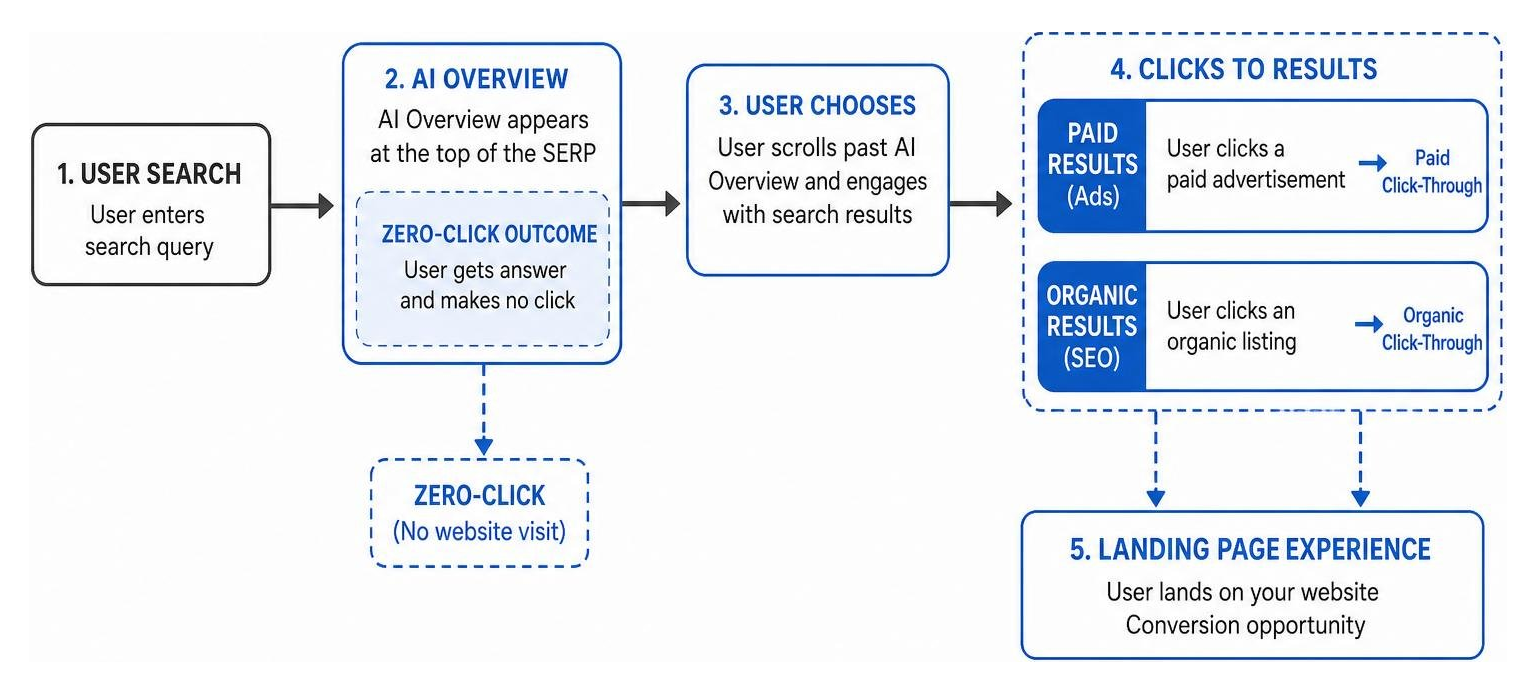
This shift means ranking “blue links” is no longer enough. Businesses also need Generative Engine Optimization (GEO): content and authority signals designed to help AI systems understand, trust, and cite the brand.
GEO is especially important when AI tools summarize buying options, service providers, local expertise, or complex B2B topics. To earn citations, your content should answer specific questions directly, include expert commentary, use schema markup, cite credible sources, and maintain consistent brand information across your site and external profiles.
AI tools can help with GEO research by identifying citation gaps, competitor mentions, missing entities, and unanswered buyer questions. But they still need human review. A model can suggest what to write; it cannot replace real expertise, customer insight, or proof that your company can deliver.
To understand how these algorithm shifts impact your digital footprint, read Everything You Need to Know About Google’s New Algorithm Update.
Budget Allocation: Balancing Short-Term Wins and Long-Term Growth
How should a business divide its marketing budget between paid ads and organic optimization?
The answer depends on your business stage, industry, and immediate cash flow requirements. If you are a new business or launching a new service line in Kansas City MO, you need immediate leads to fuel your operations. In this initial phase, we recommend allocating a larger portion of your budget to PPC to secure immediate visibility and gather critical search data.
As your organic SEO campaign matures—which typically takes three to six months—you will begin ranking for high-value commercial terms. As this organic traffic grows, you can systematically reduce your PPC spend on those specific keywords, reallocating those ad dollars to target new keyword groups or support seasonal promotions.
To help visualize this phased transition, we use a structured budget allocation matrix:
For specialized B2B markets, such as precision industrial manufacturing or offshore fiduciary services, search volume is often low but the cost-per-click is exceptionally high. In these niches, a blended strategy is essential. You cannot afford to waste thousands of dollars on broad, non-converting PPC keywords, nor can you wait six months for organic leads if your sales pipeline is empty.
To protect your marketing budget from common industry pitfalls and hidden fees, review our guide on How to Not Get Ripped Off by a Monthly SEO Retainer. For a complete technical walkthrough on managing a blended search budget, consult the PPC Search Engine Optimization: Complete 2026 Guide .
Common Mistakes When Integrating Paid and Organic Search
Despite the clear benefits of a unified search strategy, many organizations continue to run their campaigns in isolation. Here are the most common mistakes we see when auditing campaigns in Missouri, and how you can avoid them:
- Operating in Silos: The most common point of failure is a lack of communication between teams. If your PPC team is bidding on high-volume keywords without checking if your website already ranks #1 organically for those terms, you are likely wasting budget on clicks you could have earned for free.
- Sending Paid Traffic to Weak Landing Pages: Driving expensive, high-intent PPC traffic to a generic homepage or an unoptimized service page is a fast way to drain your budget. Every paid ad should point to a dedicated, fast-loading landing page optimized with clear headlines and a single, obvious call-to-action.
- Keyword Stuffing: In an attempt to align landing pages with both SEO and PPC goals, some businesses resort to repeating keywords unnaturally. This violates search engine spam policies, harms your Quality Score, and ruins the user experience. Keep keyword density between 2% and 5% and write for humans first.
- Ignoring Negative Keywords: If you don’t actively build and maintain a list of negative keywords in your PPC campaigns, your ads will trigger for irrelevant queries, wasting your budget on low-intent searchers.
To keep your digital marketing strategy aligned with modern best practices, review our detailed guide on Digital Marketing Tips for 2025 Trends and Predictions.
Frequently Asked Questions about Search Marketing
Does running PPC ads directly improve organic SEO rankings?
No. Google keeps its organic search rankings and paid ad platforms completely separate. Spending money on Google Ads will not directly boost your organic positions. However, PPC campaigns indirectly support SEO by providing immediate keyword conversion data, testing headlines for click-through rate optimization, and driving initial user engagement to your landing pages.
For a business with a limited budget, which approach is better?
If you have immediate lead generation needs and a tight timeline, PPC is the best way to kickstart your visibility. However, if you are looking for long-term, sustainable growth with a compounding return on investment, SEO is the superior choice. For most small businesses in Kansas City MO, we recommend a phased approach: start with a small, highly targeted PPC campaign to generate immediate cash flow, and reinvest those profits into building a long-term organic SEO foundation.
How can businesses use PPC to test headlines before committing to SEO?
Because SEO changes can take weeks for search engines to index and display, testing title tags organically is a slow process. With PPC, you can run A/B split tests on your ad headlines and descriptions simultaneously. By analyzing which ad variations achieve the highest click-through and conversion rates over a one-to-two-week period, you can identify the exact messaging that resonates with your audience and apply those proven headlines to your organic meta titles and H1 tags.
Conclusion
The traditional debate between SEO and PPC is over. In the modern search landscape of 2026, successful businesses understand that paid, organic, and AI search visibility are not competing channels—they are connected parts of a single digital ecosystem.
At CreatiVertical, we don’t build isolated marketing campaigns. We design, deploy, and maintain complete, performance-focused digital systems that act as an ongoing growth partner for your business. Whether you are a local Kansas City business looking to dominate the regional market, an offshore professional services firm in the Caribbean protecting your brand, or an industrial B2B manufacturer navigating complex procurement cycles, we build search systems that deliver measurable, compounding results.
Ready to stop guessing and start dominating search? Explore our Adaptive SEO Services or connect with our team in Lake Tapawingo, Missouri today to design a search strategy built for the future.