Why Organic Traffic Growth Is the Highest-ROI Channel Most Businesses Underinvest In
Organic traffic growth is the process of increasing the number of visitors who find your website through unpaid search results — and it compounds over time in a way paid advertising simply cannot match.
Here’s the short answer if you need it fast:
How to grow organic traffic — the core playbook:
- Publish content targeting real search demand, organized into topic clusters
- Fix technical SEO first — speed, mobile usability, crawlability
- Build topical authority by covering your niche deeply, not broadly
- Earn quality backlinks from relevant, credible sources
- Optimize for AI search — structure content so tools like ChatGPT and Perplexity can cite it
- Measure and refresh — update what ranks, drop what doesn’t
Results typically appear in 3–6 months. Meaningful compounding begins around month 6–12. The ROI curve keeps improving from there.
Now, the harder truth most competitors won’t tell you: organic isn’t slow because it’s weak. It’s slow at the start — and then it becomes your lowest-cost, highest-converting acquisition channel by a wide margin.
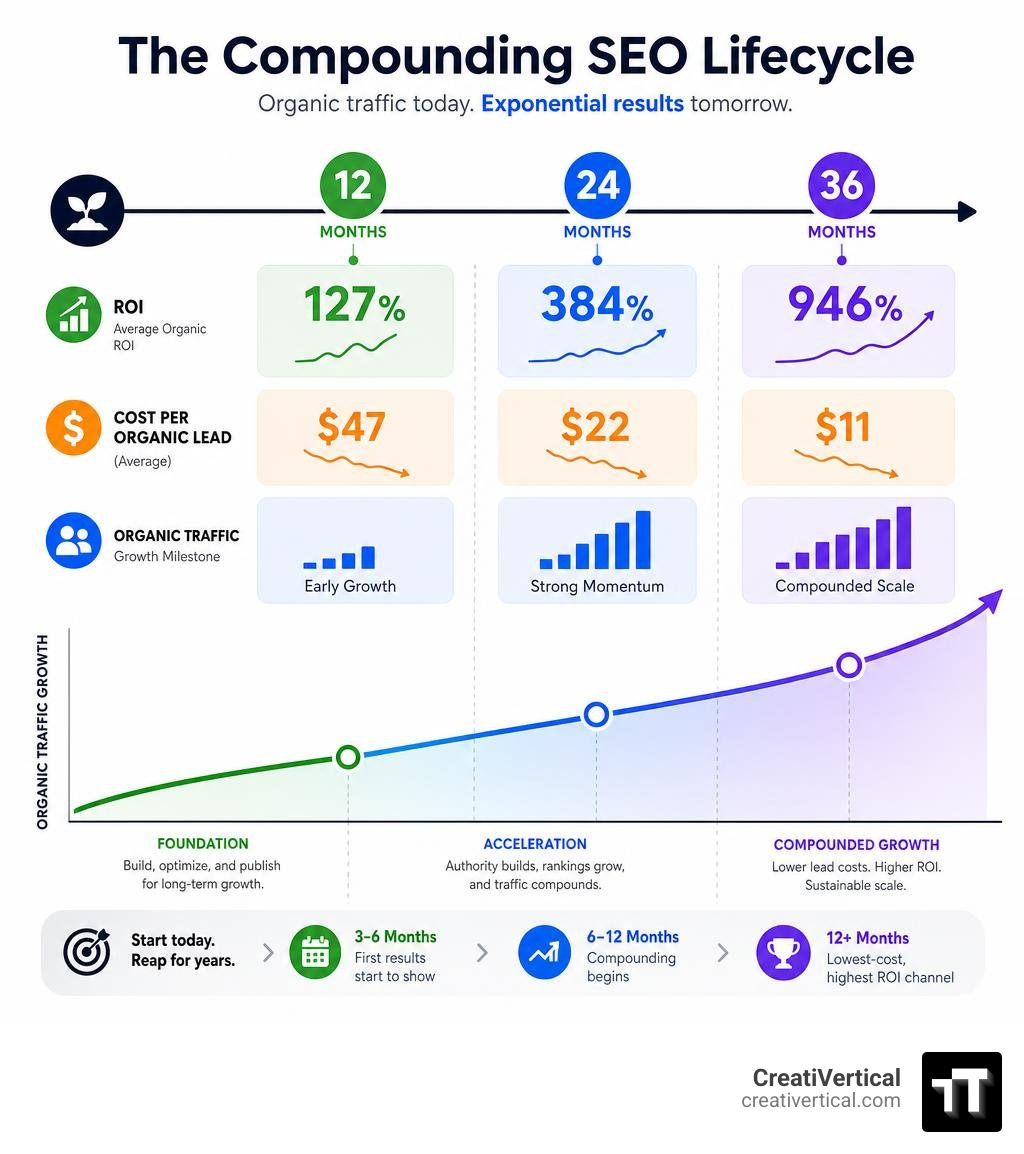
Data analyzed across dozens of client programs shows average organic ROI hitting 127% at month 12, 384% at month 24, and 946% at month 36. Meanwhile, average cost per organic lead dropped from $47 at month 12 to $11 at month 36 — while paid lead costs stayed flat between $163 and $178 over the same period.
Paid traffic is a rental. Organic is an asset you build.
Most businesses quit SEO somewhere between months 3 and 5 — right before the curve bends. This guide is about making sure you don’t.
I’m Nicholas Cunha, founder of CreatiVertical, and I’ve spent over twenty years doing hands-on SEO, web strategy, and applied AI work for clients ranging from Kansas City small businesses to offshore professional-services firms and B2B manufacturers — all contexts where organic traffic growth has to translate directly into qualified leads, not just vanity metrics. Everything in this guide comes from real programs, real data, and real decisions.
1. The Compounding Math of Organic Traffic Growth
Most executive teams look at marketing channels through a single, flat lens: How much did we spend this month, and how many leads did we get?
While that math works perfectly for paid search or social ads, applying it to organic search is a fundamental strategic mistake. Paid acquisition acts like a rental property. The day you stop paying the landlord (Google or Meta), your traffic drops to zero.
Organic traffic, on the other hand, behaves like a capital asset. The content you publish and the technical infrastructure you build today continue to generate qualified visitors next month, next year, and even three years down the road. In fact, analytical tracking shows that up to 68% of organic sessions at month 36 are driven by content published during the first 12 months of the program.
To understand why this happens, we have to look closely at the 36-month ROI curve. In the first three months, your investment goes entirely into building the foundation: fixing structural crawl errors, cleaning up slow page loads, and mapping out a high-intent keyword framework. At this stage, the ROI looks negative because the algorithm hasn’t indexed or trusted your updates yet.
By months 6 to 12, the first clear signals emerge. Your site begins to win rankings for long-tail keywords, your cost per acquisition starts to fall, and you reach a financial break-even point.
By year two and three, the math changes completely. Because your monthly retainer or content production costs remain relatively flat while your organic search footprint expands exponentially, your cost per lead plummets.
To help visualize this compounding effect, consider the following data comparing organic and paid lead costs over a three-year horizon:
| Metric | Month 12 | Month 24 | Month 36 |
|---|---|---|---|
| Average Organic ROI | 127% | 384% | 946% |
| Average Cost Per Organic Lead | $47 | $22 | $11 |
| Average Cost Per Paid Lead | $163 – $178 | $163 – $178 | $163 – $178 |
| Average Traffic Growth Rate | 13.8% | 52.6% | 34.2% |
This dramatic divergence is why treating SEO as a short-term campaign is highly inefficient. If you pull the plug at month four because you haven’t seen a massive influx of sales, you are essentially paying the upfront construction costs of a building and walking away right before the tenants move in.
To dig deeper into how to plan your budget without getting burned by hidden agency fees, read our strategic guide on How to Not Get Ripped Off by a Monthly SEO Retainer.
2. Building Topical Authority with Content Clusters
Google long ago moved past the era of simple keyword matching. In June 2026, search engines rank websites based on topical authority—which refers to how comprehensively your site covers a specific subject area.
If you publish ten disconnected blog posts about random industry topics, search engines will struggle to understand your site’s core expertise. However, if you organize your content into a structured hub-and-spoke model (known as a content cluster), you signal to search crawlers that you possess deep, structured knowledge on the subject.
A content cluster consists of three main elements:
- The Pillar Page: A comprehensive, high-level guide covering an entire topic in depth (typically 3,000 to 5,000 words).
- Cluster Articles: Highly focused supporting articles that dive deep into specific subtopics, answering long-tail queries.
- Bidirectional Internal Linking: Strategic internal links that connect every cluster article back to the main pillar page, and vice versa. This distributes page authority and guides users naturally through their buying journey.

This systematic approach is incredibly powerful. By structuring content into clear topical hubs, businesses can scale their monthly organic visitors and establish a dominant search footprint in under 12 months.
To build your first cluster, start by mapping your core topics using a visual Keyword Research Strategy. This ensures your team is building content that answers real user questions, rather than guessing what might rank.
Mapping Search Intent for High-Value Organic Traffic Growth
To turn organic traffic into actual business revenue, you must align your content with the exact stage of the buyer’s journey. Not all search volume is created equal. A high-volume informational keyword like “what is a fiduciary” might bring in thousands of curious readers, but a low-volume transactional keyword like “Cayman Islands corporate formation attorney” is infinitely more valuable for a professional services firm because the searcher is ready to buy.
When planning your content calendar, categorize your targeted keywords into four distinct intent buckets:
- Informational (Awareness Stage): The user wants to learn or solve a problem (e.g., “how to store industrial lubricants safely”).
- Commercial (Consideration Stage): The user is comparing options (e.g., “best custom battery manufacturers for material handling”).
- Transactional (Decision Stage): The user is ready to make a purchase or contact a provider (e.g., “hire offshore trust services BVI”).
- Navigational: The user is looking for a specific brand or login page.
If you are building a brand-new website or expanding into a highly competitive market, target the transactional and commercial intent terms first. These keywords have lower search volumes, but they carry much lower keyword difficulty and boast significantly higher conversion rates.
Once you establish a foothold with these high-intent terms, you can expand your reach into informational clusters to capture prospects earlier in their decision-making process, building a comprehensive playbook for sustained growth.
3. Technical SEO and Core Web Vitals as a Competitive Moat
You can write the most brilliant, authoritative content in your industry, but if search engines cannot crawl your pages—or if your users bounce because your site takes five seconds to load on a mobile device—your organic growth will stall.
Technical SEO is the foundation that allows your content to rank. It ensures that search engine bots can easily access, render, and index your pages without running into roadblocks like broken redirect loops, duplicate content issues, or crawl budget waste.
Furthermore, user experience signals are now explicit ranking factors. Google’s search algorithms are designed to reward websites that provide a fast, secure, and seamless browsing experience.
If your website fails to meet basic technical standards, faster competitors will routinely outrank you, even if their content is less comprehensive. To keep your site aligned with the latest search engine requirements, review our detailed breakdown of Everything You Need to Know About Google’s New Algorithm Update.

Optimizing Technical Infrastructure for Sustained Organic Traffic Growth
To build a highly resilient technical moat, your development and marketing teams must prioritize the following core infrastructure areas:
- Core Web Vitals: These are Google’s standardized metrics for measuring real-world user experience. You can learn more about these standards directly from Google’s Web Developer Guidelines. Focus on three primary areas:
- Largest Contentful Paint (LCP): Measures loading performance. Your page’s main content should load within 2.5 seconds.
- Interaction to Next Paint (INP): Measures page responsiveness. Interactive elements should respond to user clicks in under 200 milliseconds.
- Cumulative Layout Shift (CLS): Measures visual stability. Pages should avoid unexpected layout shifts, keeping CLS scores under 0.1.
- Mobile-First Indexing: Google indexes and ranks the mobile version of your website first. Ensure your site features a fully responsive design, with identical content and structured data markup across both desktop and mobile layouts.
- Crawlability and Indexation: Submit clean XML sitemaps through Google Search Console. Use canonical tags to prevent self-cannibalization and duplicate content issues, and monitor your crawl logs to resolve 404 errors or broken internal redirects.
- Security (HTTPS): A secure connection is a baseline requirement. Ensure your SSL certificates are active and configured correctly across all subdomains.
4. Optimizing for AI Search Visibility and Answer Engines
The search landscape in June 2026 is vastly different than it was just a few years ago. While traditional “blue-link” search results still drive a substantial portion of web traffic, over 60% of organic discovery now occurs through AI-driven Answer Engines—including Google’s Gemini-powered AI Overviews, ChatGPT, and Perplexity.
This shift does not mean SEO is dead. It means the rules of engagement have evolved into what we call Generative Engine Optimization (GEO). These advanced AI models do not generate answers out of thin air; they scan the web in real-time to find high-authority, well-structured content that they can synthesize and cite.
If your website is structured correctly, your brand will be recommended directly within these conversational AI responses.
To optimize your site for AI search visibility, you must move beyond standard keyword placement and focus on semantic completeness and structured data:
- Direct Answer Formatting: AI engines look for clear, concise answers to specific questions. To capture these citations, structure your content with a direct, one-sentence answer at the very beginning of your pages or sections (under 50 words), followed by bulleted steps, data, and deeper analysis.
- Structured Schema Markup: Implement advanced JSON-LD schema markup (such as Product, Article, FAQ, or LocalBusiness schema). This provides clear, machine-readable context that helps large language models (LLMs) parse your site’s data accurately.
- First-Hand Experience Signals (E-E-A-T): AI search tools prioritize content that demonstrates real-world experience and authority. Incorporate original research, proprietary data, case studies, and clear author bios that highlight your team’s professional credentials.
To see which tools can help you analyze your site’s readiness for this new era of search, read our evaluation of the Best AI Tools for SEO 2025.
5. Local and Jurisdictional Authority for Specialized B2B Niches
For highly specialized B2B organizations, broad national search terms are often a waste of resources. If you are an industrial manufacturer in Missouri, or an offshore law firm serving clients in the British Virgin Islands and Cayman Islands, your SEO strategy must be built around local and jurisdictional authority.
In these niche spaces, buyers aren’t searching for generic advice. They are looking for highly specialized partners who understand their specific regulatory frameworks, geographic constraints, and technical requirements.
For local businesses operating in regions like Kansas City, MO or Lake Tapawingo, MO, establishing local search dominance is critical. This involves optimizing your Google Business Profile, earning local citations, and building location-specific landing pages that demonstrate your active involvement in the community.
To help you get started, we have compiled our top recommendations in this guide on 7 Tips to Improve Local Visibility Online.
For offshore professional services and industrial manufacturers, authority is built by publishing deep, compliance-focused content that addresses complex regulatory environments (such as FedRAMP, FISMA, or regional corporate tax laws).
To execute this effectively, you need a partner who understands both your business model and the local competitive landscape. You can learn more about our tailored regional approach by visiting our dedicated page on SEO Services in Kansas City or exploring our broader Digital Marketing Services in Kansas City.
Frequently Asked Questions About Organic Traffic
How long does it take to see organic traffic growth?
For a brand-new website with low domain authority, you can expect to see early movement and indexing within 3 to 6 weeks for low-competition, long-tail keywords. However, achieving meaningful, high-volume organic growth typically takes 3 to 6 months of consistent publishing and technical optimization.
The true compounding effect—where your site begins to win highly competitive transactional rankings and your cost per lead drops significantly—usually occurs between months 6 and 12. Most businesses that fail at SEO quit during the linear phase (months 3 to 5), right before the growth curve bends upward.
Is organic traffic really free compared to paid ads?
While organic traffic does not carry a direct “cost-per-click” charge like paid search or social media ads, it is not entirely free. Generating sustained organic growth requires an upfront investment in high-quality content creation, link building, technical website development, and analytical tracking.
The critical difference lies in the financial model: paid traffic is a rental that stops the moment your budget runs dry, whereas organic search is a compounding business asset. Once your content ranks, it continues to drive highly qualified leads to your website for months or years at zero incremental cost.
How does AI search impact traditional organic SEO?
AI search engines (like ChatGPT, Perplexity, and Google’s AI Overviews) have changed how users find information, but they rely heavily on traditional SEO fundamentals. These engines crawl the web to find structured, authoritative, and clear information to cite in their responses.
By optimizing your website with proper schema markup, direct answer formatting, and deep topical authority, you ensure your business is cited and recommended by these AI tools. Traditional SEO and AI search visibility are two sides of the same coin: strong optimization drives both search engine clicks and AI-generated mentions.
Conclusion
Building a sustainable engine for organic traffic growth is not about chasing algorithm hacks or trying to trick search engines with thin, automated content. It is about creating a high-performance digital system that aligns your technical infrastructure, content strategy, and user experience with the exact needs of your target audience.
Whether you are a local Kansas City business looking to dominate your regional market, an industrial manufacturer targeting highly specific procurement buyers, or an offshore professional services firm navigating complex compliance landscapes, your organic presence is the most valuable digital asset you can build.
At CreatiVertical, we don’t believe in transactional, one-off marketing projects. We operate as an ongoing growth partner, designing and maintaining complete digital systems that translate search visibility directly into business revenue.
If you are ready to stop renting your traffic and start building a compounding asset, let’s discuss how we can map out a customized strategy for your business. Explore our performance-focused Adaptive SEO Services today.