
Core Standards: Understanding Federal Cloud Security Requirements
When federal procurement teams evaluate cloud services or web applications, security isn’t a feature on a roadmap—it’s the ticket to the launching pad. Established in 2011 through an Office of Management and Budget (OMB) directive rooted in FISMA and the E-Government Act of 2002, the Federal Risk and Authorization Management Program (FedRAMP) sets the gold standard for public sector cloud security.
Working with a FedRAMP compliant digital agency ensures that your digital presence—whether it’s an agency web portal, a custom software application, or an AI-enabled service—is architected from day one to satisfy rigorous government mandates.
What Defines a True FedRAMP Compliant Digital Agency?
A true FedRAMP compliant digital agency does far more than apply pretty stylesheets to an existing CMS. They design, build, and maintain digital environments according to the strict security controls defined by NIST SP 800-53.
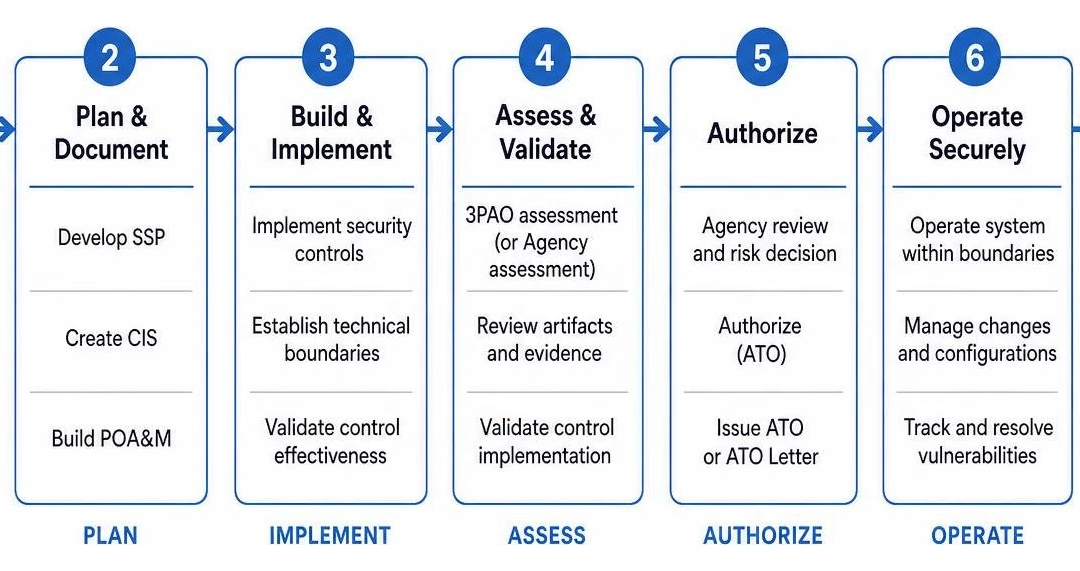
To deliver a compliant digital platform, an agency must understand how to navigate the complete authorization lifecycle. This involves authoring essential documentation—most notably a comprehensive System Security Plan (SSP), a Control Implementation Summary (CIS), and a Plan of Action & Milestones (POA&M)—that maps out every control and technical boundary.
When building public-sector digital infrastructure, a compliant agency works within established authorization pathways, whether securing an Agency Authority to Operate (ATO) or engaging with Third-Party Assessment Organizations (3PAOs) to validate security postures. To understand the baseline standards that govern these environments, you can learn about official FedRAMP program standards directly from the federal management office.
An agency worth its salt understands that securing an ATO is not a one-and-done event. It requires establishing continuous monitoring (ConMon) workflows, automated flaw remediation, and clear operational boundaries across the entire technology stack.
FedRAMP vs. ISO 27001, SOC 2, and NIST Frameworks
One of the most frequent points of confusion in federal procurement is assuming that general commercial compliance translates into federal readiness. Vendors often tell buyers, “We’re SOC 2 Type II certified and follow ISO 27001, so we are essentially FedRAMP ready.”
In reality, FedRAMP takes foundational controls—such as those found in NIST SP 800-53—and applies strict, non-negotiable parameterization, mandatory independent testing, and required agency sponsorship. SOC 2 and ISO 27001 allow organizations to define their own audit boundaries and accept residual risk. FedRAMP does not.
| Compliance Framework | Primary Focus | Audit & Validation | Continuous Monitoring Requirement | Federal ATO Applicability |
|---|---|---|---|---|
| FedRAMP | Mandatory cloud security for U.S. federal agencies | Independent assessment by an accredited 3PAO | Required monthly vulnerability scans & annual audits | Direct path to federal agency authorization |
| ISO 27001 | Global baseline for Information Security Management Systems (ISMS) | Independent accredited registrar audit | Periodic surveillance audits (typically annual) | Voluntary international standard; insufficient alone |
| SOC 2 (Type II) | Commercial trust principles (Security, Availability, Privacy) | CPA firm examination | Annual point-in-time or window evaluation | Commercial standard; does not satisfy federal ATO rules |
| NIST SP 800-53 | Catalog of security and privacy controls for federal systems | Self-assessment or internal federal assessment | Varies by agency implementation | Foundation of FedRAMP controls, but lacks standardized ATO reuse |
While ISO 27001 and SOC 2 provide excellent enterprise discipline, FedRAMP enforces a standardized “assess once, use many” paradigm. Once a cloud service achieves FedRAMP certification, other federal agencies can reuse the existing security package, saving millions in duplicate assessment costs.
Impact Levels, Terminology Updates, and Technical Capabilities
Navigating federal compliance requires staying current with evolving standards and operational terminology. As the government modernizes its framework, technology teams must adjust both their vocabulary and technical baselines.
Low, Moderate, High Controls and the Transition to Classes A-D
Traditionally, FedRAMP categorized systems into three distinct baseline impact levels, determined by the potential severity of impact if a system’s confidentiality, integrity, or availability were compromised:
- Low Impact (125 controls): Intended for service environments where loss of operational data would have a limited adverse effect on agency operations or assets.
- Moderate Impact (325 controls): The standard baseline covering roughly 80% of federal cloud applications. Intended for systems where loss would cause serious adverse impact, such as exposed Controlled Unclassified Information (CUI) or personally identifiable information (PII).
- High Impact (421 controls): Reserved for mission-critical, high-value assets such as emergency communication systems, law enforcement networks, and healthcare systems handling sensitive records.
Important Terminology Update for 2026: Under recent governance updates (specifically aligned with RFC-0020 guidelines), official terminology is changing. The term “FedRAMP Authorization” is being formally replaced by “FedRAMP Certification.”
Furthermore, traditional Impact Levels (Low, Moderate, High) are transitioning to a streamlined Class A through D specification structure. During the official transition period ending December 31, 2026, legacy impact levels are displayed in parentheses alongside Class designations. Beginning in January 2027, the legacy “Low, Moderate, High” labels will be fully retired across all FedRAMP Marketplace listings and federal procurement solicitations.
Top Capabilities to Require from a FedRAMP Compliant Digital Agency
When selecting a digital agency to design or engineer your government portal, abstract cybersecurity knowledge isn’t enough. You need concrete execution capabilities built around government-grade technology stacks:
- GovCloud Architecture Expertise: Hands-on experience engineering environments on Microsoft Azure Government or AWS GovCloud (US), leveraging isolated regions built for ITAR, CJIS, and federal compliance workloads.
- U.S. Web Design System (USWDS) Integration: Ability to build frontend user interfaces using USWDS component libraries, ensuring a accessible, consistent citizen experience across federal web properties.
- Section 508 & WCAG 2.1 AA Accessibility: Deep technical mastery of accessible markup, combining automated CI/CD pipeline scans (like axe or Pa11y) with screen reader validation (NVDA, JAWS, VoiceOver).
- Identity & Access Management: Seamless integration with federal identity solutions, including Login.gov, ID.me, and PIV/CAC smart card authentication.
To understand how secure infrastructure and modern interface engineering intersect, you can explore secure-by-design web development strategies tailored for government digital design.
Key Criteria for Selecting a FedRAMP Compliant Digital Agency
Evaluating a potential agency partner requires looking past marketing claims and asking direct questions about their technical execution and assessment history.

3PAO Assessment Experience and FedRAMP 20x Readiness
A critical milestone when choosing an agency is verifying their practical experience working with accredited Third-Party Assessment Organizations (3PAOs). A 3PAO is an independent testing body designated by FedRAMP to inspect security controls, perform penetration testing, and generate the formal Security Assessment Report (SAR).
Agencies with strong 3PAO assessment track records understand how to assemble audit-ready evidence artifacts without triggering costly resubmission cycles. Experienced assessors, such as those providing 3PAO assessment insights, emphasize that proactively fixing technical flaws before audit entry cuts total authorization time by 20% to 30%.
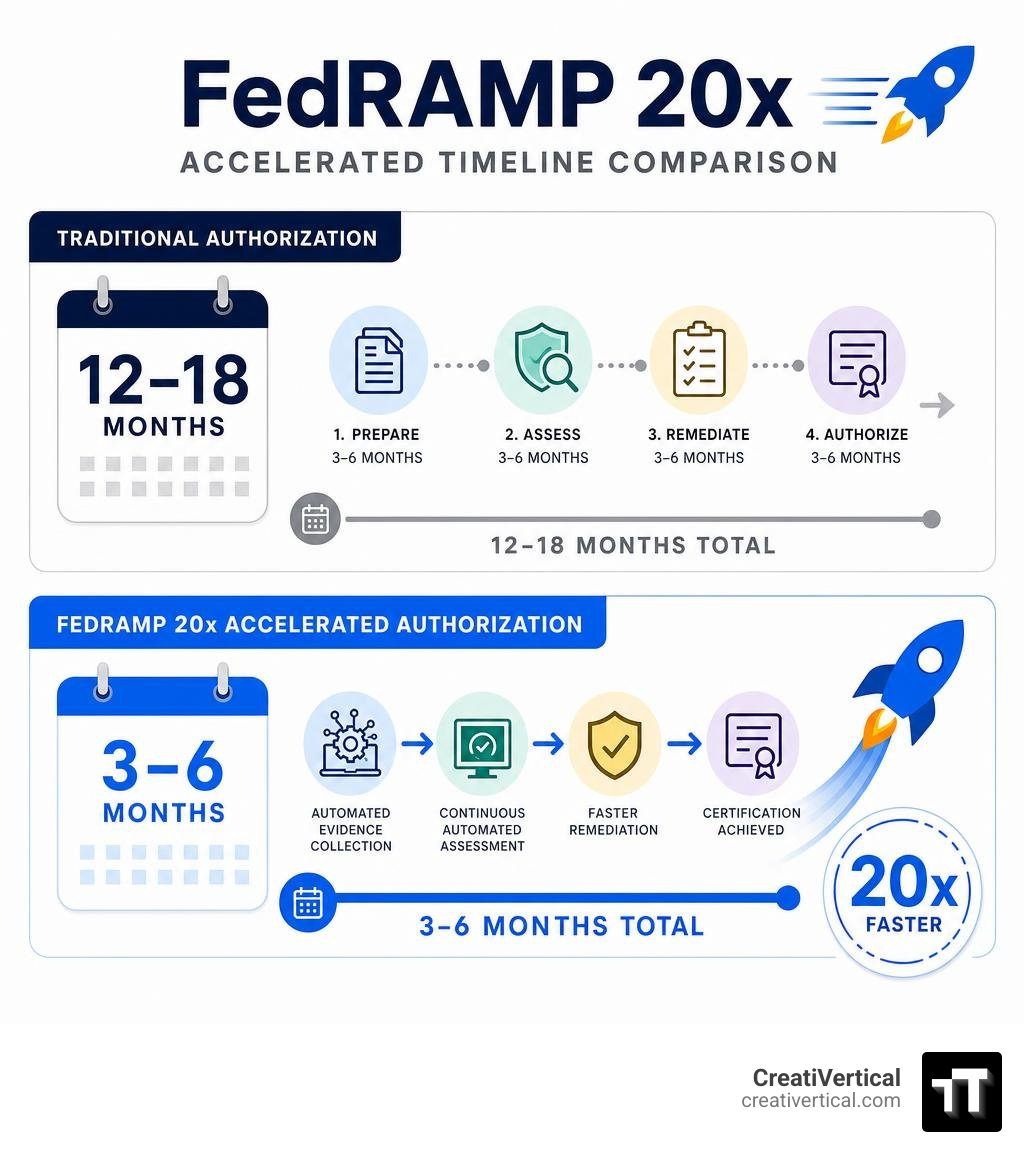
Forward-thinking digital agencies are also embracing FedRAMP 20x, an accelerated authorization initiative launched to streamline compliance for cloud-native architectures. By replacing traditional, thousands-of-pages manual documentation with Open Security Controls Assessment Language (OSCAL) standard data and automated evidence collection, FedRAMP 20x compresses the authorization timeline from the traditional 12–18 months down to just 3–6 months.
Continuous Monitoring, DevSecOps, and AI Integration
Building a compliant website or application is only the first phase. Maintaining your operational posture requires continuous monitoring (ConMon) discipline.
Your digital agency must integrate DevSecOps workflows that embed security testing directly into software development pipelines. This includes:
- Automated Vulnerability Scanning: Running SCAP-compliant container and virtual machine scans monthly to identify and remediate operating system or application vulnerabilities.
- Infrastructure as Code (IaC): Using tools like Terraform or Open Policy Agent (OPA) to manage infrastructure configurations as auditable, version-controlled code.
- Zero Trust Architecture: Implementing granular access controls, ephemeral credentials, and continuous authentication aligned with NIST SP 800-207 standards.
- Safe AI Enablement: Safely adopting generative AI tools and custom automation agents within federal guidelines. If you are exploring machine learning or automated content tools, review our guide on managing compliant AI integration to maintain strict data protection boundaries.
Common Misconceptions and Selection Pitfalls to Avoid
When public sector tech providers and prime contractors evaluate agency partners, falling for common compliance myths can derail project budgets and schedules.
- The “Project” vs. “Program” Misconception: Treating FedRAMP certification as a one-time web design project with a final completion date is a recipe for failure. FedRAMP is a continuous operational program requiring ongoing monthly reporting, annual 3PAO assessments, and continuous vulnerability management.
- Assuming Commercial Cloud Covers Everything: Hosting your application on Azure Government or AWS GovCloud does not automatically make your web application FedRAMP compliant. Under the shared responsibility model, the cloud provider manages infrastructure security (IaaS/PaaS), but your digital agency remains responsible for securing the application layer, user authentication, content management workflows, and custom code.
- Underestimating POA&M Maintenance: Any unaddressed security vulnerability must be documented in a Plan of Action & Milestones (POA&M) with strict remediation timelines (often 30 days for high-severity findings). Agencies lacking dedicated sustainment teams often struggle under the burden of POA&M tracking.
- Overlooking Agency Sponsorship Requirements: Obtaining a FedRAMP Agency Certification requires an active federal agency willing to review your package and grant an ATO. Working with an agency experienced in federal business development helps bridge the gap between technical readiness and agency sponsorship.
Frequently Asked Questions About Agency FedRAMP Compliance
What is the difference between FedRAMP Ready and FedRAMP Authorized?
FedRAMP Ready indicates that a Third-Party Assessment Organization (3PAO) has evaluated a cloud service provider’s system documentation and verified that the system possesses the core technical capabilities required for federal authorization. This status is documented in a Readiness Assessment Report (RAR) submitted to the FedRAMP Program Management Office (PMO).
FedRAMP Authorized (now transitioning to “FedRAMP Certified”) means a sponsoring federal agency—or formerly the Joint Authorization Board (JAB)—has conducted a full security evaluation, reviewed the complete 3PAO assessment package, and issued a formal Authority to Operate (ATO).
How does FedRAMP 20x speed up digital agency web hosting compliance?
FedRAMP 20x accelerates compliance by replacing static Word and PDF documentation with machine-readable OSCAL (Open Security Controls Assessment Language) data formats. Coupled with automated evidence collection tools, FedRAMP 20x allows 3PAOs and agency security officers to continuously review security baselines in real time.
For digital agencies delivering cloud-native web portals or SaaS applications, eligible FedRAMP 20x pilot pathways reduce assessment timelines from 12–18 months down to an agile 3–6 month window.
Can commercial cloud hosting providers cover full website compliance?
No. Commercial cloud infrastructure providers follow a shared responsibility model. While cloud vendors like AWS or Microsoft handle physical data center security, hardware maintenance, and hypervisor isolation, your team and digital agency are entirely responsible for security in the cloud.
This includes frontend codebase security, plugin patch management, Section 508 web accessibility, custom database encryption, identity management, and application-level monitoring.
Conclusion
Choosing the right FedRAMP compliant digital agency is not about finding an offshore shop to paint user interface mockups—it’s about choosing an architectural partner capable of guiding your mission-critical systems through strict federal compliance frameworks.
At CreatiVertical, we view federal growth as charting a well-fueled trajectory. Based in the Kansas City metro area, we act as an ongoing growth partner rather than a one-off project vendor. We design complete, performance-focused digital systems—combining custom web development, SEO, performance analytics, managed hosting, and applied AI workflows.
Whether you are a government technology vendor seeking to modernize your digital footprint or a prime contractor looking for specialized public sector web development, explore our dedicated federal tech and public sector solutions to see how we align custom digital platforms with government standards.
Ready to secure your digital infrastructure for the long haul? Ensure your application remains hardened, updated, and fully compliant by partnering with us to maintain compliant infrastructure with hosting support.