

Why Marketing for Financial Services Requires Specialized Expertise
To find and select the right digital marketing agency for financial services, institutions must evaluate prospective partners across three core areas: documented regulatory compliance and pre-clearance protocols, high-intent bottom-of-funnel (BOFU) and Generative Engine Optimization (GEO) search capabilities, and precise alignment with internal channel gaps. Prioritizing these criteria ensures marketing initiatives generate qualified pipeline while maintaining complete regulatory integrity.
Marketing financial products requires a fundamentally different approach than selling standard consumer goods or traditional software. When an individual or enterprise entrusts their capital, asset protection, or lending infrastructure to a financial firm, the transaction involves substantial fiduciary, legal, and operational consequences.
Consequently, marketing teams cannot simply deploy generic growth playbooks. Effective marketing requires establishing credibility early, structuring messaging around institutional trust, and aligning promotional activities with regulatory frameworks. Understanding how to approach financial services marketing means recognizing that trust velocity—the speed at which a prospect moves from initial discovery to complete institutional confidence—is your most valuable performance asset.
High-Stakes Trust and Extended B2B Buying Committees
In commercial finance, wealth advisory, and financial technology, transactions rarely occur on impulse. In institutional and B2B financial services, buying committees typically encompass multiple senior stakeholders, including Chief Risk Officers, General Counsel, Chief Information Security Officers, and Chief Financial Officers.
Because financial sales cycles often span 6 to 18 months, marketing initiatives must support extended due diligence. Every piece of content, technical whitepaper, and digital touchpoint must withstand rigorous evaluation from risk-averse professionals. A digital marketing agency for financial services must understand how to develop positioning that addresses risk mitigation, technical architecture, and long-term stability rather than relying on surface-level promotional messaging.
Navigating Strict Advertising and Disclosures Regulations
Financial services marketing operates within rigorous regulatory oversight. Depending on your specific vertical and jurisdiction, campaigns may fall under the supervision of authorities such as the SEC, FINRA, the CFPB, or offshore regulatory bodies.
Regulations such as FINRA Rule 2210 (governing communications with the public) and the Truth in Savings Act establish explicit requirements regarding performance representations, fee disclosures, and risk acknowledgments. Non-compliant marketing assets can result in regulatory penalties, delayed campaign rollouts, and reputational damage.
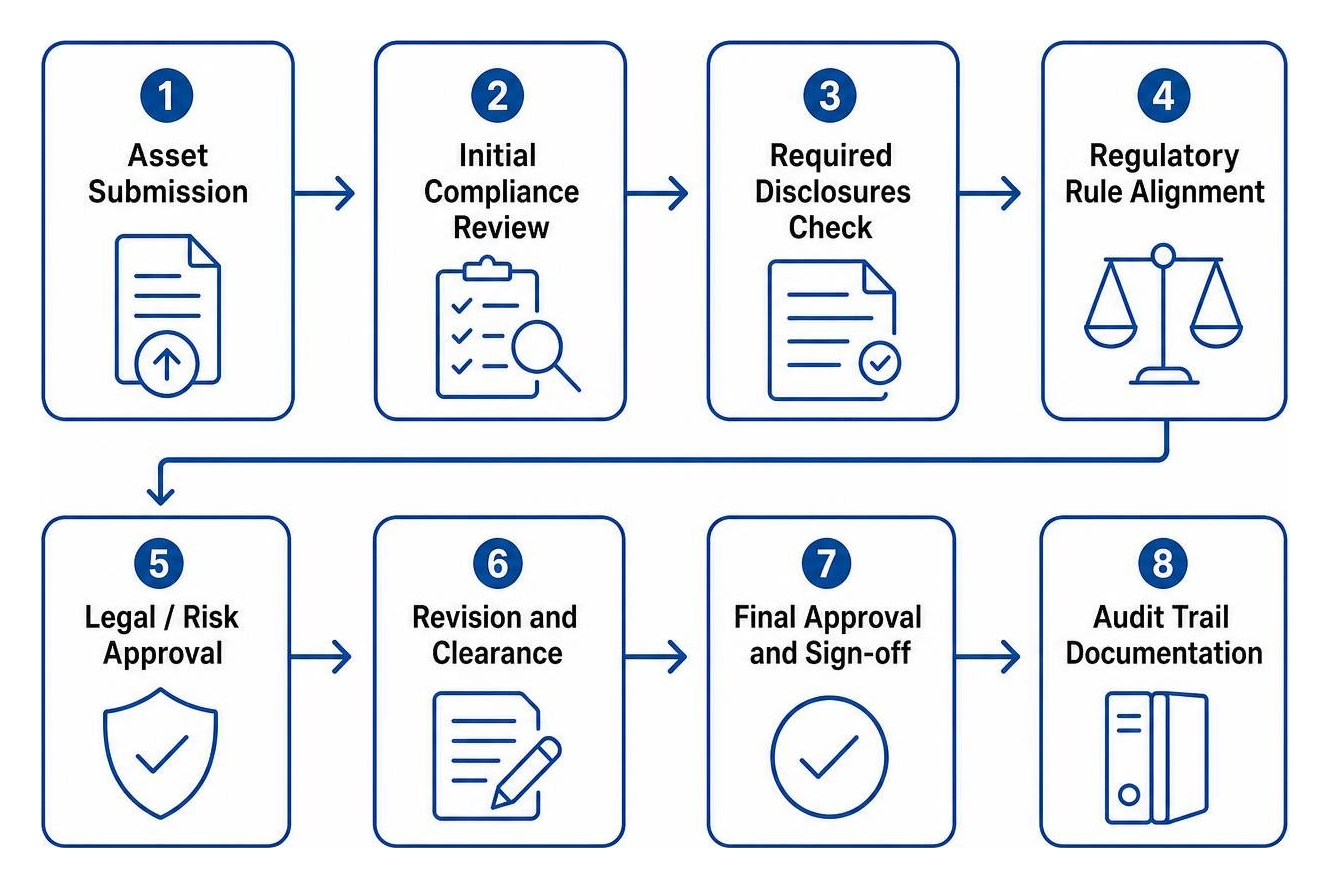
A qualified agency implements structured pre-clearance workflows, maintains verifiable audit trails for creative iterations, and systematically embeds necessary disclosures directly into the production pipeline.
Core Services Every Digital Marketing Agency for Financial Services Must Deliver
To drive sustainable pipeline growth in regulated markets, an agency must deliver integrated digital systems rather than fragmented point solutions. Media buying alone cannot overcome poor positioning, and organic visibility provides little value if post-click user flows fail to convert.
Specialized agencies synchronize technical search visibility, authoritative content development, compliant paid media, conversion rate optimization, and brand governance into a unified growth engine.
| Capability / Focus | Generalist Marketing Agency | Specialized Financial Marketing Agency |
|---|---|---|
| Regulatory Workflow | Treats compliance as an ad-hoc edit after creative is built. | Integrates legal pre-clearance and disclosure frameworks upfront. |
| Search Engine Strategy | Focuses heavily on high-volume, top-of-funnel informational terms. | Targets high-intent bottom-of-funnel (BOFU) and comparison queries. |
| Search Landscape (GEO) | Restricts optimization to traditional search engine result pages. | Optimizes for generative AI discovery (ChatGPT, Perplexity, Claude). |
| Reporting & Attribution | Reports on impressions, traffic volume, and generic form submissions. | Tracks CAC, payback periods, funded accounts, and pipeline contribution. |
| Conversion Architecture | Relies on generic landing pages and standard SaaS forms. | Optimizes multi-step onboarding, KYC requirements, and trust friction. |
Bottom-of-Funnel Content and High-Intent Search Architecture
Generic educational content often generates broad traffic that fails to produce commercial outcomes. Specialized financial agencies prioritize bottom-of-funnel (BOFU) search architecture. This involves structuring campaigns around high-intent decision terms, such as service-specific comparisons, platform evaluations, fee structures, and technical capability queries.
By applying structured editorial authority and executing the ultimate guide to buyer journey SEO, agencies capture prospective buyers at the specific moment they are actively evaluating service providers and preparing to commit capital.
Generative Engine Optimization and AI Visibility
The process of vendor and service discovery is transforming. Prospective clients and enterprise procurement teams increasingly query Large Language Models (LLMs) like ChatGPT, Claude, and Perplexity to analyze financial options, evaluate vendor security, and compare fee schedules.
Research indicates that 68% of banking-related AI citations originate from established third-party publishers (such as Bankrate and Investopedia), whereas bank-owned domains account for less than 7% of direct citations. Specialized agencies deploy Generative Engine Optimization (GEO) strategies—combining structured digital PR, authoritative third-party coverage, and indexable schema—to ensure your brand is accurately represented and recommended in generative AI search environments. Managing this presence requires utilizing the ultimate tools to keep your brand visible across AI search platforms.
Conversion Optimization and Lifecycle Retention Systems
Customer acquisition in financial services does not conclude at an initial click or lead capture. In applications requiring Know Your Customer (KYC) identity verification, anti-money laundering (AML) screening, or complex onboarding documentation, drop-off rates can exceed 60% without dedicated conversion optimization.
A proficient financial agency optimizes post-click infrastructure, streamlines digital onboarding flows, and builds automated lifecycle messaging across email and CRM channels to maximize account activation, retention, and lifetime customer value.
Pre-Hiring Blueprint: Preparing Your Infrastructure for Scale
Before hiring an external agency to scale client acquisition, your internal team must establish foundational technical and commercial prerequisites. Directing high-intent traffic into an unprepared digital infrastructure results in inefficient capital deployment and distorted performance data.

Establishing Conversion-Ready Funnels and Data Hygiene
Before initiating paid media or comprehensive organic campaigns, audit your digital conversion paths. Ensure your positioning clearly defines your niche and that your web properties feature responsive, clear architectures.
Review how you level up landing pages and ensure your website for paid traffic gearing up has server-side analytics, closed-loop CRM tracking, and clear attribution pipelines active. When data hygiene is properly maintained, both your internal team and your agency partner can trace signed contracts and funded deposits directly back to specific acquisition channels.
Defining Budgets, Milestones, and Ramp-Up Windows
Financial marketing campaigns require realistic timelines to reach maturity. While targeted paid search campaigns can yield initial intent signals within 30 to 60 days, organic search authority and Generative Engine Optimization typically require 4 to 9 months to establish robust market presence.
When planning resources, establish distinct milestones:
- Days 1–30: Technical audits, compliance workflow mapping, positioning refinement, and tracking infrastructure integration.
- Days 31–90: Launch of high-intent search campaigns, initial conversion rate testing, and pilot content distribution.
- Days 91–180: Systematic scaling of top-performing channels, multi-channel remarketing, and end-to-end CAC optimization.
In terms of market benchmarks, typical monthly retainers across the industry range from a few hundred to several thousand dollars per month depending on scope, regulatory complexity, and competitive intensity. Ensure your capital allocation accounts for the initial ramp-up window before evaluating overall customer acquisition cost (CAC) payback.
How to Evaluate and Match Agency Specialties to Your Growth Goals
Not every agency excels across all marketing disciplines. Selecting the right partner requires auditing your existing internal capabilities and identifying your specific channel gap. A team struggling with partner distribution may need an affiliate specialist, whereas a firm launching a new institutional platform may require an agency specializing in positioning, search visibility, and fintech marketing.
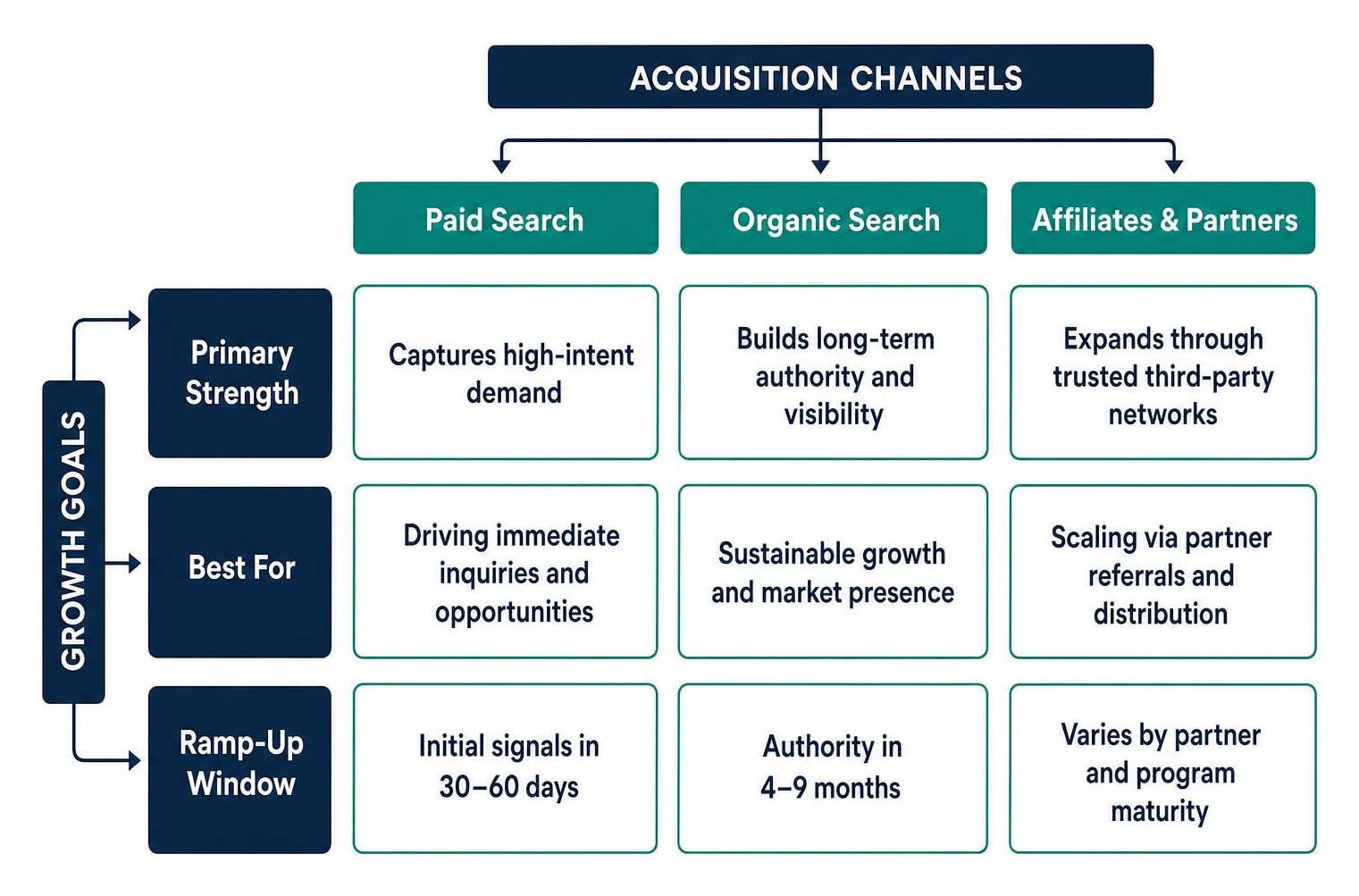
When reviewing prospective agencies, determine what you should consider hiring a digital marketing agency by evaluating these core selection criteria:
- Documented Regulatory Experience: The agency demonstrates a clear understanding of your specific regulatory environment and has established processes for legal review.
- Revenue-Focused Reporting: The agency measures success using commercial metrics (SQLs, account activations, CAC) rather than vanity engagement metrics.
- Channel-Specific Alignment: The agency’s verified strengths directly address your primary acquisition bottleneck.
- Technical & AI Fluency: The agency possesses modern capabilities in technical SEO, workflow automation, and generative search optimization.
- Collaborative Operating Model: The agency acts as an extension of your team, providing transparent communication and audit-ready reporting.
How to Vet a Digital Marketing Agency for Financial Services on Compliance
During agency interviews, evaluate how the team manages regulatory constraints:
- What specific compliance frameworks (e.g., FINRA, SEC, CFPB, state laws) have you operated under in recent engagements?
- What is your standard workflow for handling creative approvals, legal revisions, and disclosure version control?
- How do your content writers research technical financial subjects to prevent misleading performance claims?
- Do you maintain centralized audit logs of past ad variants, disclaimers, and landing page modifications?
An agency well-versed in financial services will readily explain its verification protocols, whereas generalist providers often treat compliance as an afterthought.
Matching a Digital Marketing Agency for Financial Services to Channel Gaps
If your internal leadership already has a validated market strategy but lacks execution capacity, finding a digital marketing consultant or specialized channel agency can fill the specific functional deficit.
For example, specialized affiliate networks provide established distribution for consumer banking products, whereas full-stack digital partners excel at developing end-to-end search architectures, web platforms, and automated workflow systems for institutional providers and B2B finance platforms.
Measuring Real ROI: Metrics Beyond Vanity Traffic in 2026
Modern financial brands must avoid optimizing solely for top-of-funnel vanity metrics like gross impressions, pageviews, and unverified form fills. CFO-grade marketing performance requires tracking commercial milestones through the complete customer lifecycle.
Leveraging the best performance SEO reporting tools to impress your clients allows growth leaders to demonstrate tangible business impact to executive boards and investment committees.
Bottom-Line Outcomes: MQLs, SQLs, and Account Funding
Evaluate your marketing partner on concrete financial metrics:
- Cost Per Acquisition (CPA) / CAC: Total media and agency spend divided by fully onboarded, paying clients.
- Onboarding Activation Rate: The percentage of prospects who successfully complete identity verification and KYC onboarding after initial registration.
- Origination and Deposit Volume: Total funded capital, loan values, or Assets Under Management (AUM) influenced by specific marketing channels.
- CAC Payback Window: The operational timeframe required for a customer to generate sufficient margin to recover their initial acquisition cost.
Tracking AI Citation Growth and Share of Voice
In addition to standard Google Search Console metrics, track your brand’s presence across generative AI platforms. Monitor how frequently your institution is cited by LLMs during conversational search queries regarding your core product categories.
Measuring citation frequency across models like ChatGPT and Perplexity provides early insight into how shifting search behavior influences your incoming pipeline.
Frequently Asked Questions About Financial Marketing Agencies
Why Can Generic Marketing Agencies Fail in the Financial Sector?
Generic marketing agencies often rely on consumer-oriented playbooks centered on quick emotional hooks and high-volume top-of-funnel traffic. In financial services, this approach frequently leads to regulatory non-compliance, high ad-rejection rates by ad networks, and unqualified lead volume. Furthermore, generalist teams often struggle to grasp the technical language required to establish authority with sophisticated B2B buyers and risk officers.
How Long Does It Take to See Measurable Pipeline Results?
Timelines depend on the acquisition channel and the complexity of the financial product:
- Paid Search & Targeted Performance Media: Initial intent signals and conversion testing data generally emerge within 4 to 8 weeks.
- SEO & Content Architecture: High-intent bottom-of-funnel organic search visibility typically matures within 4 to 6 months.
- Generative Engine Optimization & Topical Authority: Building comprehensive institutional authority that consistently drives AI citations and qualified pipeline requires sustained execution over 6 to 12 months.
What Role Does Generative Engine Optimization Play in Financial Marketing?
Generative Engine Optimization (GEO) ensures your financial institution is accurately represented and cited within AI-generated responses. Because users increasingly turn to AI engines for product comparisons and financial due diligence, optimizing structured data, publishing authoritative research, and securing credible third-party editorial coverage are essential strategies for remaining visible throughout modern discovery journeys.
Conclusion
Selecting a digital marketing agency for financial services is an operational decision that directly affects your firm’s compliance standing, market reputation, and commercial revenue. The right partner combines technical execution with regulatory discipline, turning marketing into a predictable, auditable growth system.
At CreatiVertical, we operate as an ongoing digital growth partner rather than a transactional vendor. We build and manage integrated digital systems—including custom web development, search engine optimization, Generative Engine Optimization, paid advertising, and applied AI workflow automation. Whether supporting offshore professional service providers, institutional B2B brands, or regulated entities, we design resilient marketing infrastructure built for measurable, long-term performance.