
Aligning Paid Search with Complex Capital Equipment Buying Cycles
An effective industrial equipment manufacturer PPC framework starts with engineering-specific technical queries, aggressive negative match filtering, and landing pages tied to CRM pipeline tracking. That combination captures commercial intent from plant engineers and procurement teams while filtering out consumer, educational, and secondary-market traffic.
Selling capital machinery differs fundamentally from consumer e-commerce. When a facility manager needs an electrostatic precipitator or an automated partition assembler, they do not make an impulse purchase. Capital equipment purchases involve capital expenditure committees, process engineers, maintenance supervisors, and procurement officers.
A successful campaign acknowledges these extended cycles and focuses paid acquisition on commercial intent rather than casual research.
Engineering-Driven Intent vs. Consumer Search Habits
Plant engineers search with technical precision. They rarely search for broad phrases like “factory air cleaner.” Instead, they query specific operational challenges, flow rates, particulate sizes, and regulatory benchmarks. They look for terms like “wet ESP for sub-micron particulate” or “regenerative thermal oxidizer VOC abatement.”
When targeting engineering-driven intent, your PPC Ads must speak their language. If an ad contains vague marketing slogans instead of design tolerances, capacity ranges, or material specifications, an engineer will click away. You must validate your technical capabilities immediately in both ad copy and extensions.
Engineers search to solve an operational bottleneck or meet an environmental compliance deadline. Procurement teams search later to vet vendor reliability, lead times, and warranty terms. Aligning your paid search structure to these distinct motivations prevents wasted ad spend on unqualified clicks.
Structuring Industrial Equipment Manufacturer PPC Campaigns for Specifiers and Buyers
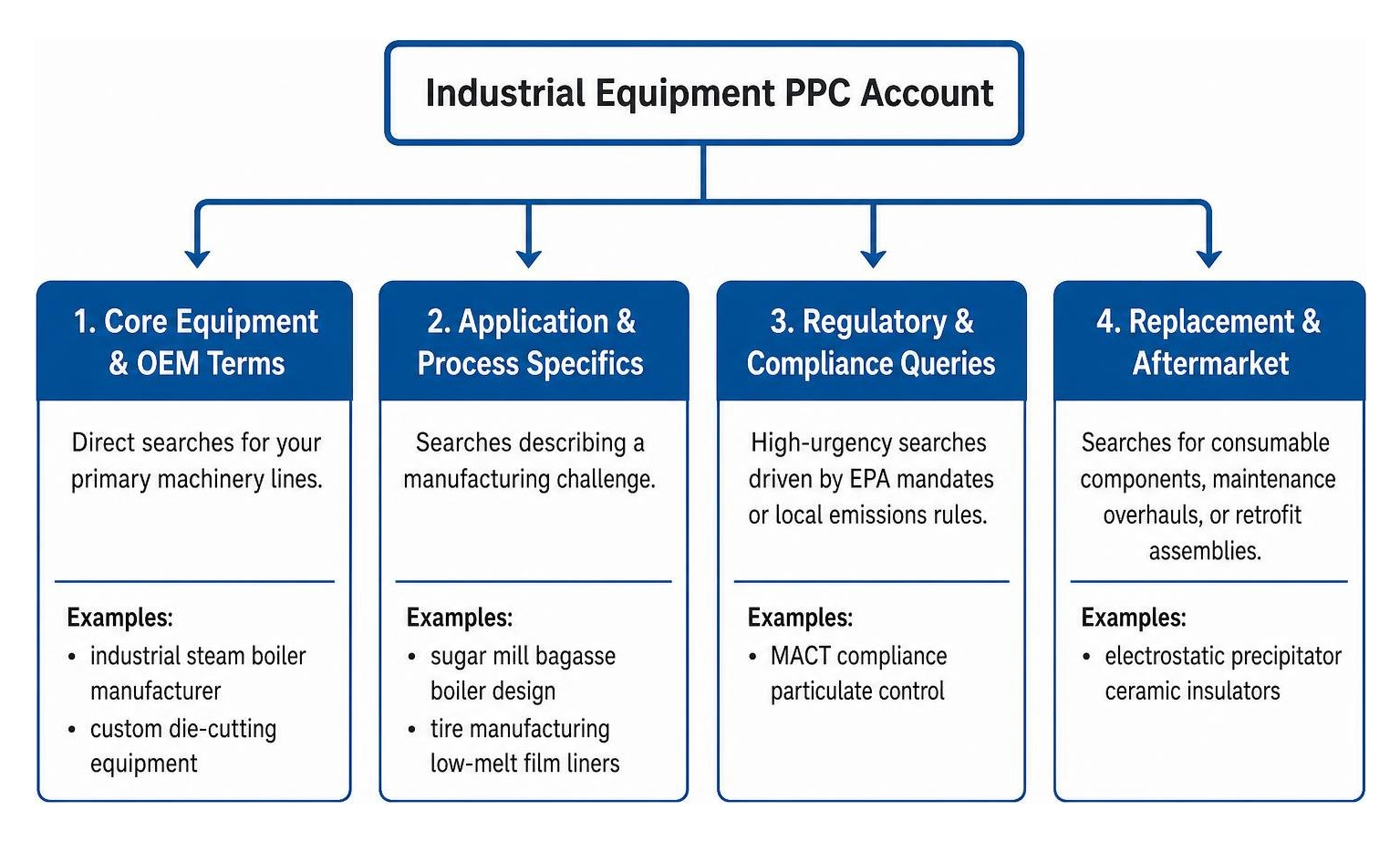
To capture qualified buyers at different stages of decision-making, separate your campaigns into clear functional buckets:
- Core Equipment & OEM Terms: Direct searches for your primary machinery lines (e.g., “industrial steam boiler manufacturer,” “custom die-cutting equipment”).
- Application & Process Specifics: Searches describing a manufacturing challenge (e.g., “sugar mill bagasse boiler design,” “tire manufacturing low-melt film liners”).
- Regulatory & Compliance Queries: High-urgency searches driven by EPA mandates or local emissions rules (e.g., “MACT compliance particulate control”).
- Replacement & Aftermarket: Searches for consumable components, maintenance overhauls, or retrofit assemblies (e.g., “electrostatic precipitator ceramic insulators”).
By segmenting ad groups this way, you can tailor your messaging precisely. Using structured Paid Advertising PPC ensures that when a plant manager searches for high-capacity particulate removal solutions—such as those engineered by PPC AIR—the ad serves a focused message addressing operating temperature, pressure drop, and collection efficiency.

Core Campaign Strategies for the Industrial Equipment Manufacturer PPC Ecosystem
Managing industrial ad campaigns requires continuous refinement. Because average cost-per-click in industrial sectors can be substantial, loose targeting can deplete budgets quickly without yielding viable sales conversations.
High-Precision Keyword Architecture and Negative Match Filtering
High-precision targeting begins with aggressive negative match filtering. For every commercial keyword in manufacturing, there are dozens of consumer, educational, or low-value queries that trigger ads if left unmanaged.
When engineering teams evaluate complex systems like industrial air pollution control systems, their queries include phrases such as “ASME certified,” “turnkey installation,” or “custom process engineering.” Adding terms like “used,” “hobby,” “clearance,” and “definition” to your negative keyword lists prevents consumer traffic from draining your daily ad budget.
Value-Driven Ad Messaging Highlighting Operational Efficiency and Compliance
Industrial buyers care about three core metrics: uptime reliability, regulatory compliance, and Total Cost of Ownership (TCO). Highlight these factors in your ad headlines and descriptions rather than using generic promotional copy.
- Highlight Environmental Compliance: Mention specific standards such as MACT compliance, PM2.5 capture rates, or regional air quality board rules.
- Emphasize Operational Reliability: Feature predictive maintenance integration, low parasitic power loads, and heavy-duty alloy construction.
- Demonstrate Domain Experience: Include proven engineering milestones, such as decades of manufacturing history or hundreds of successful industrial installations.
Connecting your paid ads to systematic Lead Generation Nurturing workflows ensures that when an engineer requests a spec sheet or white paper, your sales team can follow up with relevant technical details throughout their multi-month approval cycle.

Multi-Channel Synergy Across Search, Technical Content, and SEO
Paid search should not operate in a silo. By integrating organic search and paid acquisition, industrial manufacturers can dominate page-one real estate for critical commercial keywords.
| Search Dimension | Single-Channel PPC Strategy | Integrated Search Strategy (PPC + SEO) |
|---|---|---|
| Keyword Coverage | High-cost bidding on broad terms | Organic capture of technical queries; PPC focus on high-intent RFQ terms |
| Audience Retargeting | Limited to initial search clicks | Retargeting organic technical readers with dedicated RFQ search ads |
| Search Result Presence | Single paid placement | Top paid placement paired with organic technical documentation ranking |
| Acquisition Efficiency | Vulnerable to rising auction costs | Blended CAC decreases as organic authority builds over time |
Manufacturers in the Midwest—whether operating in Kansas City, Missouri or across the greater region—often produce specialized equipment like petroleum processing units, custom packaging lines, or heavy-duty boilers. Using PPC to validate which keyword themes generate qualified inquiries helps direct your long-term organic content and technical documentation efforts.
Technical Landing Page Optimization and Conversion Architecture
Driving clicks to a general homepage is one of the most common causes of wasted ad spend in B2B manufacturing. Engineers and procurement personnel require immediate access to specifications, engineering schematics, and clear contact channels.
Designing High-Converting Landing Pages for Engineering Decision-Makers
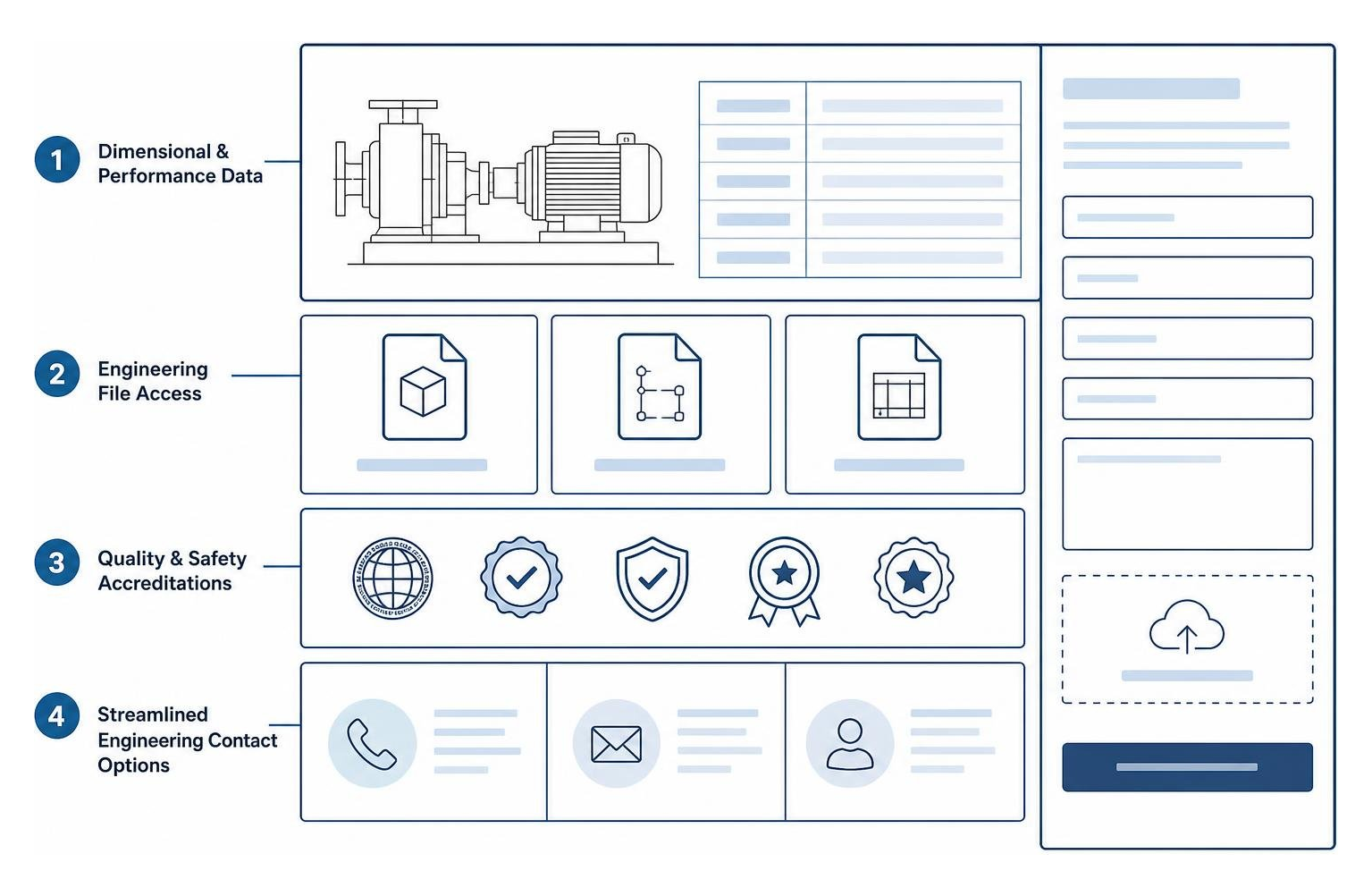
An effective industrial landing page acts as a digital technical data sheet. When visitors land on your page, they should immediately see:
- Dimensional & Performance Data: Operating pressures, CFM ratings, temperature limits, and materials of construction.
- Engineering File Access: Direct access to downloadable CAD models, dimensional PDFs, and system schematics.
- Quality & Safety Accreditations: Visible displays of ISO certifications, ASME stamps, or industry-specific quality seals.
- Streamlined Engineering Contact Options: RFQ forms that allow document uploads (e.g., process flow diagrams, requirement sheets) alongside phone numbers connected directly to technical sales engineers.
Applying proven Conversion Rate Optimization CRO principles ensures your layout remains clear, uncluttered, and focused on facilitating technical evaluations.

Before launching paid traffic, ensure your digital infrastructure is ready. Learn more about optimizing website structure for paid traffic to ensure fast load times, clear navigation, and straightforward lead routing.
Integrating Industrial Equipment Manufacturer PPC with CRM and Pipeline Tracking
Because industrial equipment deals can take six to eighteen months to close, evaluating campaigns solely on initial cost-per-click or raw form submissions is insufficient. You need closed-loop reporting to connect ad spend directly to pipeline value.
- Capture Click Identifiers: Pass Google Click IDs (GCLID) into hidden fields on your RFQ forms.
- Sync with CRM Pipelines: Store tracking parameters inside your CRM alongside opportunity records.
- Import Offline Conversions: Upload sales stage milestones (e.g., “Engineering Review Passed,” “Quote Issued,” “Contract Signed”) back into Google Ads to train bidding algorithms on high-value buyer profiles.
Building dedicated high-converting landing pages tailored to specific machinery lines allows you to track exactly which campaigns generate genuine revenue rather than low-value inquiries.
Frequently Asked Questions about Industrial PPC Strategy
How do industrial equipment manufacturers handle long sales cycles in Google Ads?
To manage extended sales cycles, configure multi-tier conversion tracking within Google Ads. Track initial micro-conversions (such as CAD file downloads, specification sheet views, and design guide requests) alongside primary macro-conversions (like formal RFQ submissions).
Use CRM offline conversion tracking to send milestone updates back into your ad account when a prospect moves from an initial inquiry to an engineering review or formal proposal. This data helps automated bidding strategies optimize for high-value decision-makers rather than casual researchers.
What negative keywords are critical for capital machinery campaigns?
Industrial campaigns require strict negative keyword lists to prevent budget waste. Critical negative match categories include:
- Consumer & DIY: “home,” “small,” “residential,” “homemade,” “how to build.”
- Career & Academic: “jobs,” “salary,” “internship,” “course,” “certification class,” “pdf download.”
- Secondary Market & Rental: “cheap,” “used equipment,” “auction,” “salvage,” “rental rates.”
- Irrelevant Media: “video,” “diagram vector,” “clipart,” “schematic diagram free.”
How should paid search messaging address regulatory compliance like MACT and EPA standards?
Compliance messaging should be factual, prominent, and specific. State exact standards in your ad headlines and extensions—such as “Meets EPA MACT Standards” or “Certified PM2.5 Removal Efficiency.”
On the corresponding landing page, provide downloadable test reports, third-party certification documentation, and case studies detailing how the equipment performs under regulatory review. Demonstrating compliance upfront helps eliminate regulatory risk for plant engineers and environmental health managers.
Conclusion: Building an End-to-End Growth Engine for Industrial Manufacturers
Generating a steady pipeline of qualified industrial buyer leads requires more than turning on basic search ads. It demands a coordinated system: technical keyword targeting, ad messaging that highlights operational efficiency and compliance, purpose-built landing pages, and closed-loop CRM tracking.
At CreatiVertical, we help industrial manufacturers, government-facing technology vendors, and specialized B2B organizations build and run these digital systems. Rather than delivering disconnected marketing tasks, we work as an ongoing growth partner to build, maintain, and refine your entire digital footprint.
Explore our custom high-performance industrial web development services to see how we build fast, technically focused websites that turn search traffic into measurable sales pipeline.