

Why Most SEO Strategies Fail Before a Single Sale Is Made
Buyer journey SEO is the practice of mapping your keyword strategy, content, and site architecture to the specific stage a prospect is at — awareness, consideration, or decision — so that organic search drives revenue, not just traffic.
Here’s the fast answer if that’s all you need:
| Funnel Stage | Search Intent | Buyer Mindset | Content Goal |
|---|---|---|---|
| Awareness (TOFU) | Informational | “I have a problem” | Educate and be found |
| Consideration (MOFU) | Commercial investigation | “What are my options?” | Build trust and guide evaluation |
| Decision (BOFU) | Transactional | “Which one do I buy?” | Remove friction and convert |
The core idea: match what you publish to what your buyer is actually thinking at each stage — not just what has high search volume.
Here’s a number that puts this in perspective: 74% of business buyers complete more than half of their research online before they ever contact a vendor. By the time someone reaches out, they’ve already formed a shortlist — often without you on it.
That’s the real problem with traffic-first SEO. You can rank, pull in thousands of visitors, and still watch revenue flatline. The content attracted the right people at the wrong moment, or the right moment with no clear next step.
The buyer journey isn’t a straight line either. Real prospects loop back, jump between devices, consult AI tools, read reviews, and resurface weeks later. A keyword strategy that ignores those loops doesn’t guide anyone — it just produces pageviews.
This guide walks you through how to fix that: stage by stage, from keyword research to technical architecture to AI search visibility.
I’m Nicholas Cunha, founder of CreatiVertical — I’ve spent over twenty years building web and SEO strategies for clients ranging from BVI government bodies to Kansas City small businesses, and buyer journey SEO is the lens I apply to every organic search engagement we run. That hands-on experience across long B2B sales cycles and regulated markets is what shapes the practical framework you’ll find here.
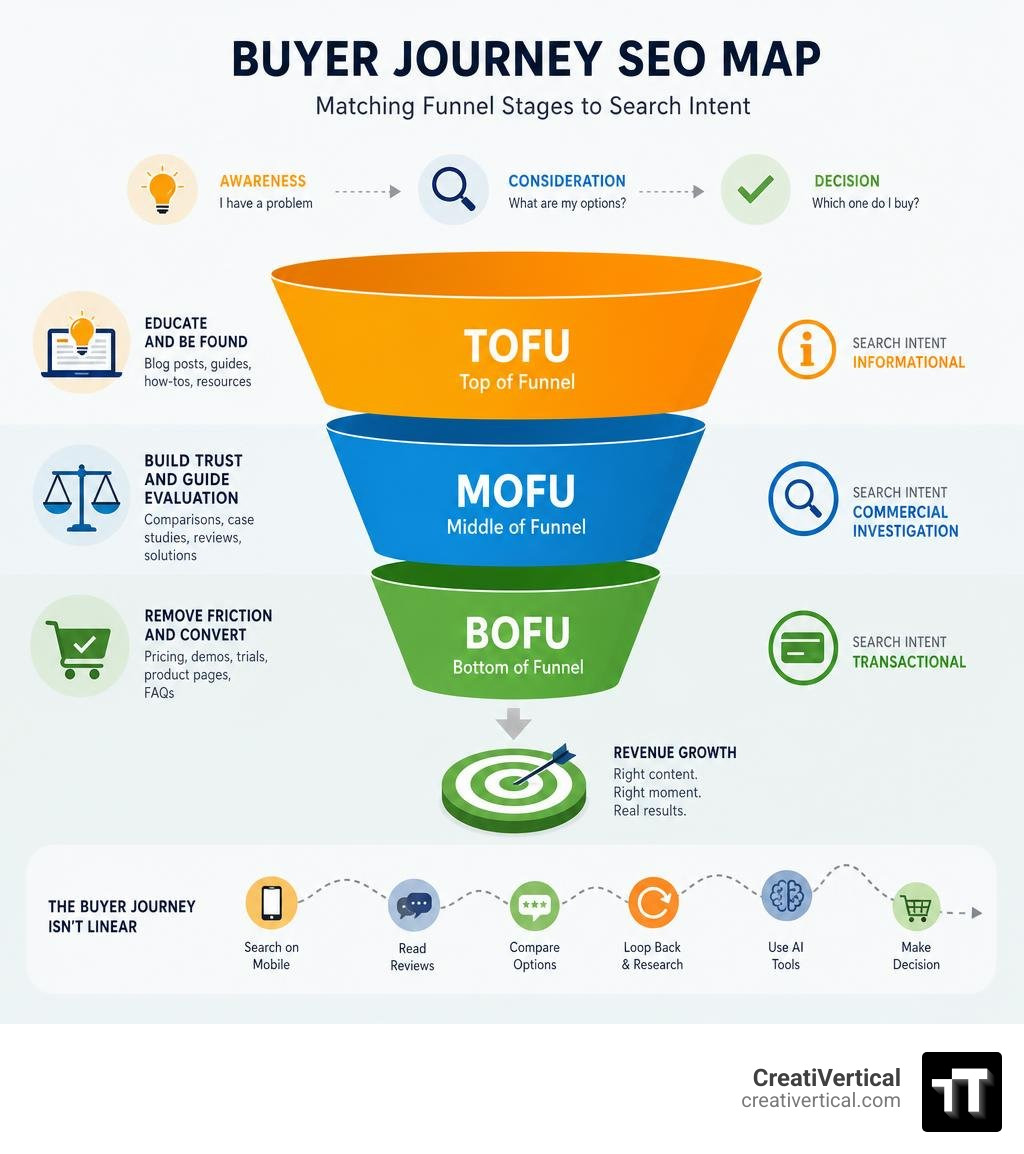
Buyer journey seo terms simplified:
Demystifying Buyer Journey SEO: Why Traffic is a Vanity Metric
Most SEO campaigns suffer from the “traffic-first trap.” It’s an easy trap to fall into: you write articles on high-volume informational terms, watch your search traffic climb in Google Analytics, and celebrate. But if that traffic doesn’t move down the funnel, you are building a passive encyclopedia, not a high-converting revenue engine.
When you chase raw traffic volume without aligning content to user intent, you generate what we call “conversion debt.” This is the gap between the visitors you attract and those who actually have a commercial need. For example, if an industrial manufacturing firm ranks for a broad term like “what is a lubricant,” they will attract thousands of high school physics students. If they instead target “synthetic gear lubricant selection criteria,” the search volume will be microscopic in comparison, but every single visitor is a potential procurement buyer.
According to a detailed analysis by How Customer Journey SEO Turns Clicks Into Conversions, organic search drives a massive share of competitive traffic, but only when it meets specific buyer needs. Trust is built when searchers find exact answers to their questions, not generic overviews.
Furthermore, as explored in How SEO Impacts Each Stage of the Customer Journey – Lumar, your website’s technical health and architectural relevance act as the foundation for this journey. If a site is slow or hard to navigate, you lose the buyer before they can even evaluate your solution. 66% of customers expect companies to understand their unique needs, which means your content must reflect their exact stage of mind from the moment they land on your page.
Mapping the Three Funnel Stages to Search Intent
To build a search strategy that converts, you must map your keyword architecture to the buyer’s psychological state. Buyers don’t search the same way when they are diagnosing a problem as they do when they are ready to sign a contract.
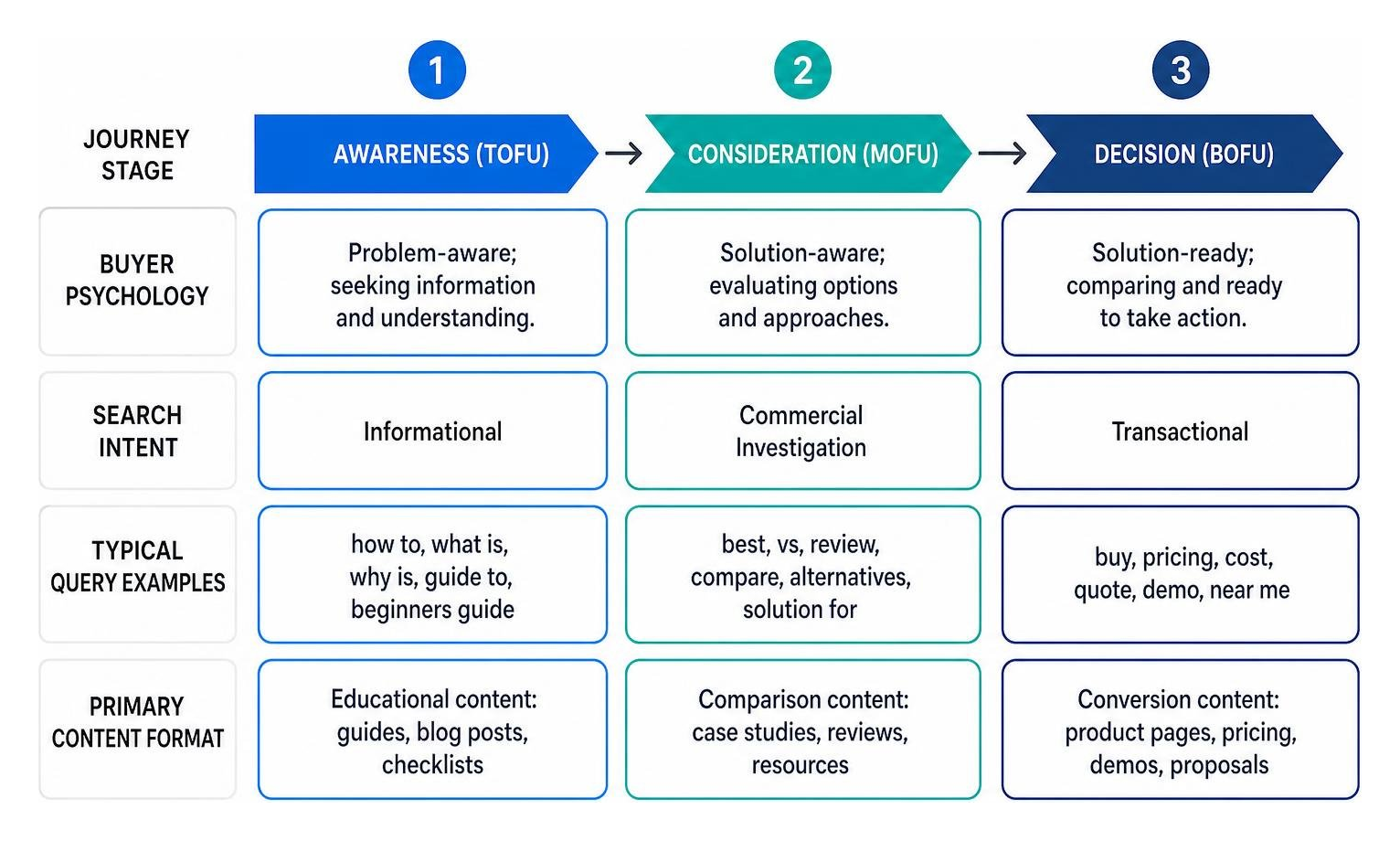
Let’s break down the three primary stages of the funnel and look at how search intent transitions from informational to commercial, and finally to transactional.
| Funnel Stage | Buyer Psychology | Search Intent | Typical Keyword Modifiers | Primary Content Format |
|---|---|---|---|---|
| Awareness (TOFU) | Problem-aware; looking for root causes and definitions. | Informational | “How to,” “Why is,” “What is,” “Guide to” | Diagnostic explainers, comprehensive guides, checklists |
| Consideration (MOFU) | Solution-aware; comparing methodologies, tools, or vendors. | Commercial Investigation | “Best,” “Vs,” “Review,” “Alternatives,” “Pros and cons” | Criteria-led buyer’s guides, comparison tables, comparison articles |
| Decision (BOFU) | Provider-aware; validating choices, checking pricing, removing friction. | Transactional | “Pricing,” “Buy,” “Trial,” “Contract,” “Service in [City]” | Transparent comparison pages, detailed service specs, case studies |
Awareness Stage: Capturing Early-Stage Interest with Buyer Journey SEO
At the Top of the Funnel (TOFU), your buyer is experiencing a symptom but might not know the name of the solution yet. For instance, a partner at a Caribbean law firm might search, “Why are our internal document filing systems slow?” They aren’t looking for a software vendor yet; they are diagnosing a headache.
Informational queries make up roughly 80% of all online search volume. Your goal here is to establish early authority by publishing diagnostic explainers. These explainers should name the problem, break down its root causes, outline potential solution categories, and point to a logical next step.
As highlighted in How to Align Your SEO Strategy & Buyer Journey, one of the biggest mistakes brands make at this stage is using internal jargon. If you optimize for terms your target audience doesn’t actually use, you become invisible. Instead, focus on real pain points. Never try to hard-sell your product in TOFU content. Your only goal is to build deep trust by answering their questions completely.
Consideration Stage: Guiding Evaluation with Buyer Journey SEO
In the Middle of the Funnel (MOFU), the buyer has defined their problem and is actively researching solutions. They are comparing different approaches, tools, or service providers. Our law firm partner now knows they need a “cloud document management system” and is searching for “best cloud document management software for law firms” or “on-premise vs cloud legal document storage.”
This is the commercial investigation phase. Buyers at this stage are highly research-heavy and analytical; according to industry data, 60% of buyers rely heavily on peer reviews and comparison content during the consideration phase.
To win this stage, you need to publish criteria-led buyer’s guides and objective comparison articles. According to Mapping Keywords to the Buyer’s Journey (Awareness to Decision) | Orwellix Blog, if you fail to provide this transition content, you create an “intent dead end.” Your reader will consume your educational blog post, realize they need a tool, and then leave your site to search Google for comparisons—likely landing on a competitor’s page. We prevent this by building a logical content bridge that guides them from the problem to the evaluation of solutions.
Decision Stage: Converting High-Intent Buyers
At the Bottom of the Funnel (BOFU), the buyer is ready to make a purchase. They have narrowed down their options to a shortlist and are looking for validating information to remove final-moment friction. Our law firm partner is now searching for your brand name alongside terms like “pricing,” “demo,” or comparing you directly against your main competitor (“Your Brand vs Competitor Brand”).
These are transactional intent keywords. While they have significantly lower search volume than TOFU keywords, they convert at 10 to 15 times the rate.
According to How To Map Keywords To The Buyer Journey: 6 Proven Strategies That Maximize Conversions In 2026, decision-stage pages fail most often because of what they interrupt rather than what they say. At this point, the buyer does not want more education. They want to see transparent pricing, robust case studies, security compliance documents (like FedRAMP or FISMA frameworks for government vendors), and a clear, simple path to book a consultation or start a trial.
How to Perform Keyword Research and Map Intent
To build a high-converting search funnel, we recommend reversing the traditional keyword research process. Instead of starting with high-volume, top-of-funnel broad terms, start at the bottom of the funnel (BOFU) and work your way backward.
Starting with conversion-driven keywords keeps your strategy tightly focused on revenue and prevents your team from getting overwhelmed by top-of-funnel content production. Here is a step-by-step process to execute this:
- Mine Your Conversion Data: If you run Google Ads, look at your search terms report and filter by the highest conversions. These are the exact phrases buyers use when they are ready to spend money.
- Consult Your Frontline Teams: Talk to your sales reps and customer support team. What exact questions do prospects ask right before they sign a contract? What are their final objections? Translate those objections into keywords.
- Analyze Google Search Console (GSC): Look for pages that already have high impressions but low click-through rates (CTR). Often, these are middle-of-funnel pages that are ranking for commercial terms but need better intent optimization.
- Apply Intent Modifiers: Take your core product or service and pair it with high-intent modifiers.
Here is a list of bottom-funnel keyword modifiers to use during your research:
- [Product/Service] vs [Competitor]
- [Product/Service] pricing
- Best [Product/Service] for [Specific Industry/Use Case]
- [Service] in [City] (e.g., SEO services in Kansas City)
- [Product/Service] reviews
- [Product/Service] implementation cost
By targeting these high-intent phrases first, you capture the buyers who are already standing at the cash register. Once those pages are built and converting, you can systematically build out middle-of-funnel and top-of-funnel content to feed the pipeline. To discover more advanced strategies on how to uncover these hidden search terms, check out our guide on organic traffic growth.
Technical SEO and On-Page Architecture: Building the Conversion Pipeline
You can write the most brilliant, persuasive content in the world, but if your website’s technical health is poor, your buyer journey will stall before it starts. Technical SEO is the pipework that allows your content funnel to flow.
First, let’s talk about site speed. Data shows that nearly 70% of consumers admit page speed impacts their willingness to buy from an online retailer. While the average mobile page load time for shopping sites hovers around 15.3 seconds, a load time of 0 to 4 seconds is the optimal window for maximizing conversion rates. Every second of delay past that window drastically increases your bounce rate, particularly for busy B2B buyers.
On-page architecture must also support the user’s progression. This is done through strategic, internal linking.
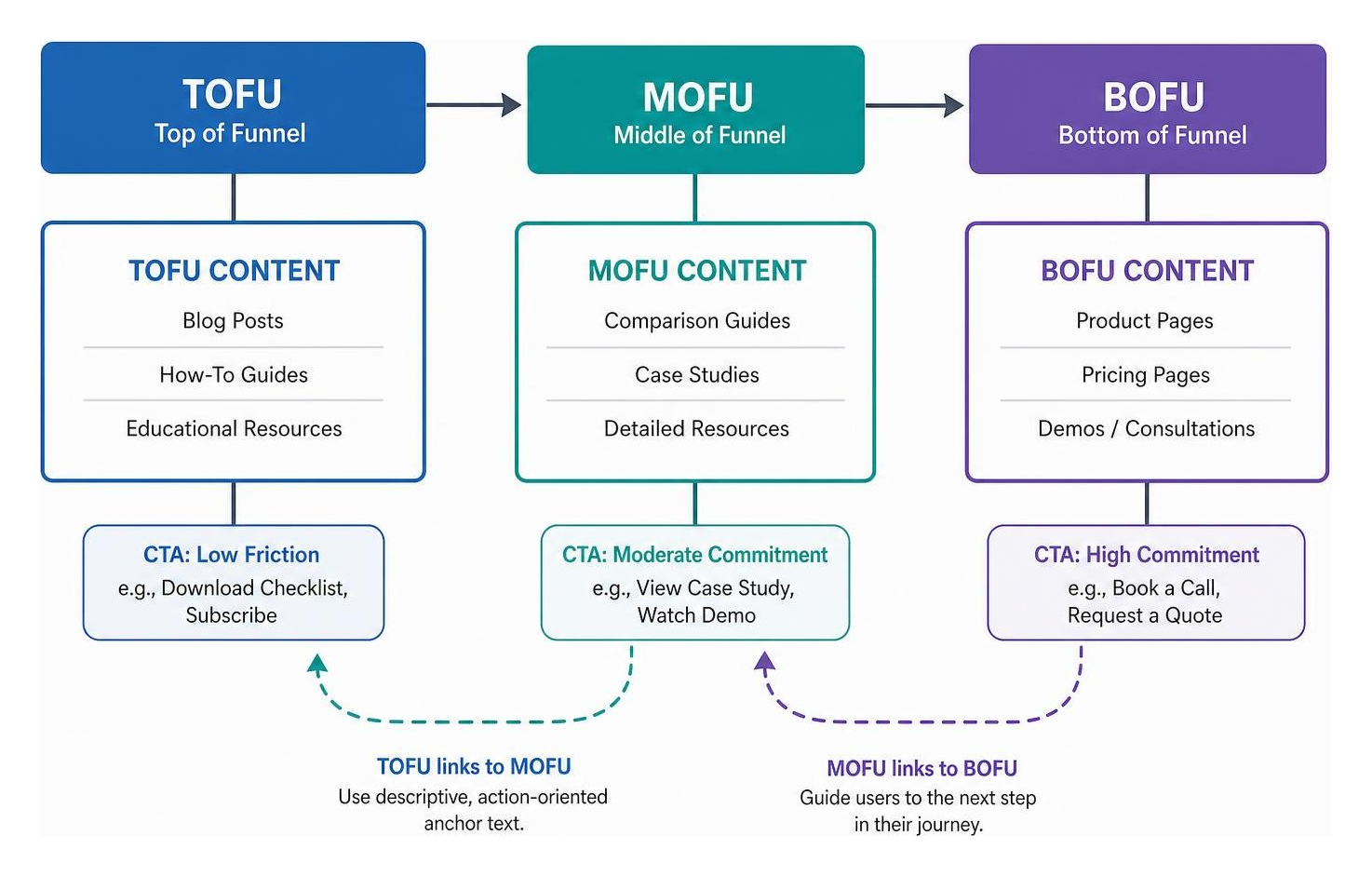
To prevent “intent dead ends,” your site architecture should guide users naturally through the funnel:
- Your TOFU blog posts should link to relevant MOFU comparison guides using descriptive, action-oriented anchor text (e.g., “read our complete comparison of industrial lubricants”).
- Your MOFU guides should link directly to your BOFU product or service landing pages.
- Every page must contain a clear, contextually relevant Call to Action (CTA). A TOFU page should have a low-friction CTA (like downloading a checklist), while a BOFU page should have a direct CTA (like booking a call).
If you are planning a website update or redesign, maintaining this internal link equity is critical. To ensure you don’t break these conversion paths during a transition, refer to our comprehensive guide on maintaining SEO rankings during a site redesign. For local businesses in Missouri, ensuring your site structure is optimized for local search intent is equally vital, as detailed in our no-nonsense local business SEO strategy.
The 2026 Reality: Optimizing for AI Search and the “Messy Middle”
The search landscape in July 2026 is fundamentally different than it was just a few years ago. The buyer journey is no longer a neat, linear progression through a search engine results page (SERP). Instead, buyers navigate a “messy middle” of exploration and evaluation, heavily assisted by AI search engines like ChatGPT, Perplexity, and Google’s AI Overviews.
Recent industry data reveals the scale of this shift:
- 51% of B2B software buyers now begin their research in an AI chatbot more often than in Google (a massive jump from just 29% in early 2025).
- 84% of B2B SaaS CMOs utilize AI tools for vendor discovery.
- AI Overviews now appear in roughly 47% of traditional search results.
This means a modern buyer might first discover your brand through a ChatGPT citation (TOFU), search your brand name on Google to read reviews (MOFU), and then go directly to your pricing page (BOFU). The modern search funnel is one unified pipeline running across two major surfaces: traditional search engines and AI answer engines.
To ensure your business is recommended by these AI engines, you must optimize for Generative Engine Optimization (GEO). This requires:
- Entity Disambiguation: Ensuring search engines and LLMs understand exactly who you are, what products you offer, and who you serve. This is achieved by maintaining consistent messaging across your website, social profiles, and third-party directories.
- Passage Extractability: Structuring your content with clear, descriptive H2 and H3 headings followed immediately by direct, declarative answers. AI engines extract standalone passages to answer user queries; hedging or using overly complex language makes your content harder for AI to parse.
- Structured Data: Implementing robust schema markup to give AI engines a clear, machine-readable map of your services, reviews, and authors.
For a deeper look into the tools shaping this landscape, read our analysis of the best AI tools for SEO. To understand how search engines have adapted their ranking systems to accommodate this new reality, explore our breakdown of Google’s algorithm updates.
Measuring Success and Avoiding Common Funnel Pitfalls
Building an SEO strategy aligned with the buyer journey is highly effective, but it requires a shift in how you measure marketing performance. If you continue to judge your SEO success solely by organic traffic volume, you will fall victim to common funnel failures.
The most common failure is the Dead Funnel. This occurs when a site has healthy top-of-funnel traffic but zero downstream content. If more than 60% of your organic sessions arrive through informational blog posts, but your consideration and decision pages account for less than 20% of your traffic (or aren’t indexed properly), your funnel is dead. You are warming up leads for your competitors to convert.
Another common pitfall is Stage Mismatch. This happens when you optimize a page designed for one buyer stage with keywords that signal a completely different stage—such as trying to optimize a highly commercial product page for a broad informational query. This confuses both search engines and users, leading to high bounce rates.
To measure your funnel correctly:
- Track Pipeline Movement, Not Just Clicks: Use GA4 to measure how many users land on a TOFU page and subsequently click through to a MOFU or BOFU page.
- Monitor AI Mention Rates: Track how often your brand is cited or recommended in AI search tool responses for your core category terms.
- Audit Your Content Balance: Ensure your content library isn’t heavily skewed toward top-of-funnel topics. A healthy B2B site should maintain a solid balance of comparison, evaluation, and product-specific content.
If you are tracking these metrics, a custom dashboard is invaluable for visualizing how organic search contributes directly to your bottom line. Check out our local SEO reporting dashboard guide to learn how to build a data system that tracks real pipeline business metrics.
When partnering with an outside agency to build this system, transparency is key. To ensure your investment is tied to real growth rather than vanity metrics, read our guide on how to evaluate monthly SEO retainers. In the general market, monthly SEO retainers typically range from a few hundred to several thousand dollars per month depending on your industry’s competitiveness and project scope.
Frequently Asked Questions about Buyer Journey SEO
What is an intent dead end in SEO?
An intent dead end occurs when a piece of content answers a user’s search query completely but fails to provide a logical next step, internal link, or call to action. This causes the reader to exit your website once they have their answer, rather than moving forward into the evaluation or decision stage of their buying journey.
Why does my site get high traffic but zero conversions?
This is usually caused by a “Dead Funnel” or “Stage Mismatch.” Your site is likely ranking well for broad, informational top-of-funnel keywords, but you lack the middle-of-funnel comparison guides and bottom-of-funnel transactional pages needed to guide those visitors toward a purchase.
How does AI search impact traditional keyword mapping?
AI search engines (like ChatGPT and Perplexity) act as new entry points for the buyer journey. Instead of searching Google for a list of vendors, buyers ask AI chatbots to recommend the best solutions for their specific problems. To stay visible, your content must be structured clearly so these LLMs can easily extract, cite, and recommend your brand.
Conclusion
Maximizing conversions from organic search isn’t about writing the longest articles or chasing the highest search volumes. It is about meeting your buyers exactly where they are—psychologically and technically—at every step of their decision-making process. By aligning your keyword research, technical site health, and internal architecture with the buyer’s journey, you transform your website from a passive digital brochure into a highly active pipeline.
At CreatiVertical, we don’t believe in one-off SEO projects or raw traffic vanity metrics. We operate as an ongoing growth partner, designing and maintaining complete, performance-focused digital systems for local businesses in Kansas City, B2B manufacturers, and specialized professional firms. If you are ready to align your search strategy with how modern buyers actually make decisions in 2026, explore our Adaptive SEO Services and let’s chart a clear course forward.