

What Is a Backlink Profile Audit (and Do You Actually Need One)?
A backlink profile audit is a structured review of every external link pointing to your website — evaluating which links help your rankings, which ones are neutral, and which ones could be quietly dragging you down.
Here’s the short version of what it involves:
- Collect your backlink data from Google Search Console, Ahrefs, or Semrush
- Evaluate each referring domain for quality, relevance, and authority
- Analyze your anchor text distribution for unnatural patterns
- Flag toxic or manipulative links for removal or disavowal
- Compare your profile against competitors to find link-building gaps
- Monitor on a recurring schedule — quarterly at minimum
That’s the process. The rest of this guide walks through each step in plain language, with specific benchmarks and decision rules so you’re not guessing.
Most site owners focus on building new links. Few take the time to look at what’s already pointing at them — which is a problem, because a single cluster of spammy links can cap your rankings no matter how much good content you publish. According to Ahrefs data, 95% of all web pages have zero backlinks. If your site has even a handful of real links, you’re already ahead. But quality matters far more than quantity, and a messy profile can do real damage.
Search engines don’t just count links. They evaluate patterns — velocity, anchor text, domain relevance, and link type. Google’s SpamBrain system is designed specifically to detect and devalue manipulative link patterns across entire networks, not just individual pages. An audit gives you a clear picture of where you stand before an algorithm update does it for you.
I’m Nicholas Cunha, founder of CreatiVertical, and over more than two decades of agency work — including years serving government and institutional clients in the British Virgin Islands — I’ve run backlink profile audits across industries ranging from offshore professional services to industrial manufacturing. That cross-sector experience shapes how I approach this: practically, without paranoia, and always focused on what actually moves rankings.
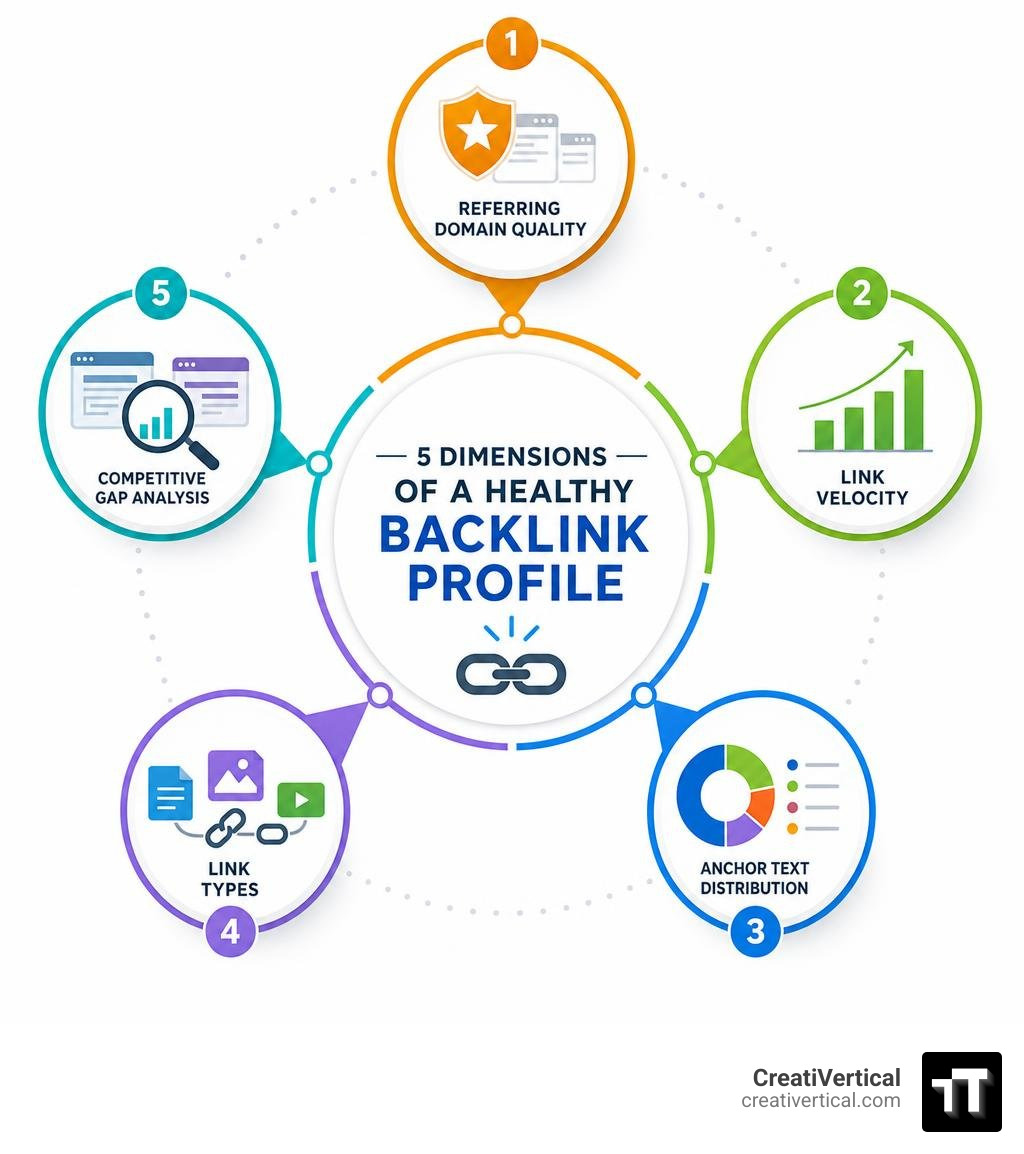
Why a Backlink Profile Audit is Essential for SEO Health

Think of your backlink profile as the root system of your website’s search engine visibility. If the roots are healthy and diverse, your site stands strong through search engine ranking fluctuations. If they are tangled in link farms or artificial networks, a single algorithmic storm can knock you down.
Google’s search engine rankings rely heavily on off-page signals to establish trust and authority. However, Google’s SpamBrain AI and successive core algorithm updates have fundamentally changed how search engines evaluate these signals. In 2026, search engines are incredibly sophisticated at identifying manipulative behaviors. Rather than simply ignoring spam, a highly artificial link profile can trigger manual penalties or algorithmic suppression that caps your traffic. To stay ahead of these changes, we recommend keeping up with Everything You Need to Know About Google’s New Algorithm Update to understand how search engines evaluate site quality.
The Strategic Value of Link Equity
Link equity is not just a vanity metric. It represents real digital trust passed from referring domains to your pages. Earning high-quality links is an investment; the average cost of a single high-quality editorial backlink hovers around $508 in the current B2B market. With 80% of SEO professionals reporting that a new backlink impacts rankings within two to six weeks, protecting and maximizing this equity is a commercial priority.
By performing a thorough audit, you accomplish three major strategic tasks:
- Protecting search visibility: You ensure your hard-earned authority isn’t diluted by automated spam or legacy negative SEO attacks.
- Optimizing crawl budget: Search engines crawl trusted sites more frequently. Cleaning up broken incoming links ensures bots spend time indexing your high-value pages.
- Directing link building efforts: You identify exactly what types of authoritative sites are already willing to link to you, allowing you to build an outreach strategy rooted in real-world data.
For a comprehensive strategic look at how this fits into your broader digital system, refer to this Step-by-Step Link Audit Guide.
Step-by-Step: How to Conduct a Painless Backlink Profile Audit

Many site owners put off an audit because they assume it requires weeks of manual spreadsheet work. It doesn’t. By using a structured SEO Backlink Audit Framework, you can diagnose your link profile’s health efficiently.
Consolidating Data for Your Backlink Profile Audit
No single SEO tool has a complete map of the entire internet. To get an accurate picture, you must combine data from multiple sources. We recommend pulling data from three primary hubs:
- Google Search Console (GSC): This is essential because it shows the exact links Google’s crawlers have indexed and are actively associating with your site.
- Ahrefs: Known for having the second most active web crawler after Google, Ahrefs boasts a massive index of 35 trillion external links, updated every 15 minutes.
- Semrush: Offering an index of 43 trillion links as of early 2026, this tool provides excellent toxicity markers and integration options.
To begin, export your raw backlink and referring domain lists from each platform into CSV files. Import these datasets into a master spreadsheet (such as Google Sheets or Microsoft Excel). Use the “Remove Duplicates” function based on the source URL to clean up overlapping rows. This consolidated sheet is your single source of truth. For automated assistance in flagging suspicious domains during this stage, you can integrate the Semrush Backlink Audit Tool directly with your GSC account to import fresh data automatically.
Evaluating Core Metrics and Link Quality
Once your data is clean, it is time to evaluate quality using a balance of quantitative scores and qualitative context. A common mistake is relying solely on proprietary scores like Domain Rating (DR) or Domain Authority (DA). These metrics are helpful benchmarks, but they can be easily manipulated by artificial link networks.
Instead, evaluate your referring domains using three distinct pillars:
- Authority vs. Real Traffic: A link from a DR 30 site that receives 5,000 monthly organic visitors is often far more valuable than a link from a DR 70 “zombie” site that has zero organic search traffic.
- Niche and Topical Relevance: If you are a specialized industrial manufacturing firm in Kansas City, a link from a modest local engineering blog is infinitely more valuable than a high-authority link from an unrelated lifestyle or fashion site.
- Link Attributes (Dofollow vs. Nofollow): A healthy profile contains a natural mix of both. While dofollow links pass authority directly, nofollow and sponsored links provide natural balance and referral traffic.
For a deeper dive into classifying these metrics systematically, see this detailed Link Profile Audit Methodology.
Analyzing Anchor Text Distribution and Link Velocity
Your anchor text (the clickable text of a link) and link velocity (the speed at which you acquire new links) are the primary indicators search engines use to determine if your link profile is growing organically or artificially.
| Profile Element | Healthy Patterns (Low Risk) | Risky Patterns (High Risk) |
|---|---|---|
| Anchor Text Distribution | Dominance of brand names, naked URLs, and generic phrases (e.g., “click here,” “website”). | Heavy concentration of exact-match commercial keywords (over 5-10% of total profile). |
| Link Velocity | Steady, incremental growth over time, scaling naturally with your content publication. | Sudden, unexplained spikes in referring domains, often followed by massive drops. |
| Referring Domain Variety | High ratio of unique domains to total links (ideally averaging 2 to 3 links per domain). | Thousands of links coming from a handful of low-quality forums, sidebars, or footer templates. |
Analyzing these patterns manually is much easier when your overall search strategy is supported by modern tools. You can explore the Best AI Tools for SEO 2025 to see how automated platforms streamline pattern recognition.
Spotting Unnatural Anchor Text Patterns
In an organic ecosystem, different websites will link to you using different words. Some will use your company name, some will paste your raw URL, and others will use generic phrases.
A healthy anchor text distribution typically follows these guidelines:
- Branded Anchors (40% to 60%): e.g., “CreatiVertical”, “creativertical.com”
- Naked URLs (10% to 20%): e.g., “https://creativertical.com”
- Generic / Natural Anchors (10% to 20%): e.g., “read more”, “this article”, “source”
- Exact-Match & Partial-Match Keywords (1% to 5%): e.g., “Kansas City web design”, “B2B SEO agency”
If exact-match commercial keywords make up more than 10% of your total anchor text, search engine spam filters are highly likely to flag your site for manual review or algorithmic devaluation. You can cross-reference your findings against the BetterLinks Audit Checklist to ensure your distribution remains safe.
Understanding Link Velocity Spikes and Drops
Link velocity measures the rate at which your site gains or loses links. A natural link growth timeline looks like a gentle, upward slope.
Sudden spikes in link acquisition are usually caused by three scenarios:
- A highly successful PR or content campaign: This is natural and usually accompanied by a corresponding spike in organic search traffic and brand mentions.
- A coordinated link-buying campaign: This is risky and often uses repetitive anchor text across low-quality domains.
- A negative SEO attack: A competitor or malicious actor points thousands of low-quality, spammy links at your site overnight to trigger a search penalty.
Conversely, sudden drops in referring domains often signal technical issues, such as broken redirects, deleted content, or linking websites going offline. Monitoring these trends allows you to step in before search engines take notice.
Identifying and Handling Toxic Backlinks Safely
Not all low-quality links are dangerous. In fact, Google’s webmaster trends analysts have repeatedly stated that their algorithms are excellent at simply ignoring random, low-quality web spam without penalizing your site. However, when spammy links are manipulative, paid for, or part of private blog networks (PBNs), action must be taken.
We define toxic links using several clear criteria:
- PBNs and Link Farms: Sites created solely to link out to other sites, often characterized by duplicate content, missing contact pages, and high outbound link ratios.
- Thematic Irrelevance: A sudden influx of links from foreign gambling, adult, or pharmaceutical sites pointing to an industrial manufacturing or legal website.
- Malicious Footprints: Hundreds of domains sharing the same IP block, server location, or Google Analytics tracking ID.
To clean up these risks, you can handle the process internally or work with professional services like the Loganix Link Audit Service to manage the heavy lifting.
When to Use the Google Disavow Tool vs. Manual Removal
If you discover toxic backlinks, you have two primary recovery paths: manual removal or disavowing.
We strongly recommend attempting manual removal first. This involves finding the contact information for the linking site’s webmaster and politely asking them to remove or add a rel="nofollow" attribute to the link. While response rates for these requests are typically low (often between 1% and 5%), it shows search engines that you are acting in good faith.
The Google Disavow tool should be treated as a last resort. Only use the disavow tool if:
- You have received a formal Manual Action notification in Google Search Console.
- You are experiencing a major, documented negative SEO attack.
- You have a historic backlog of paid, manipulative links that you cannot manually remove.
Over-disavowing is a common mistake that can accidentally strip your site of legitimate link equity and damage your rankings. For professional guidance on navigating this delicate process safely, you can consult with specialized Click Intelligence Backlink Analysis services.
Uncovering Opportunities with Competitive Gap Analysis
A backlink audit isn’t just about playing defense. It is also one of the most effective ways to build a high-performing link acquisition roadmap. By running a competitive gap analysis, you can see exactly which authoritative domains link to your top competitors but not to you.
Here is how to do it in three steps:
- Identify your top 3 to 5 true search competitors (not just business competitors, but the sites actively ranking for your target keywords).
- Use Ahrefs’ Link Intersect or Semrush’s Backlink Gap tool to compare your domain against theirs.
- Filter the results to find highly relevant websites that link to multiple competitors.
If a industry publication links to three of your competitors, they are highly likely to link to you as well if you present them with superior content or an interesting local angle. This is particularly valuable for businesses looking to improve their local presence. For example, if you are a local service business in Missouri, combining this gap analysis with our 7 Tips to Improve Local Visibility Online can help you secure high-value local citations and editorial mentions that move the needle.
If you are looking for a dedicated local growth partner in Missouri, working with an established SEO Services in Kansas City provider can help you execute these local campaigns flawlessly. You can also benchmark local competitors by reviewing established local agencies listed under Kansas City SEO Company | Missouri SEO Agency or look into technical site health through a professional Website & SEO Audit in Kansas City | Prodjex.
Common Mistakes to Avoid in Your Backlink Profile Audit
Over the years, we have seen businesses make critical errors during their audits that actually hurt their search performance. To keep your audit painless and effective, avoid these four common pitfalls:
- Over-Disavowing Legitimate Links: Many automated tools flag domains as “toxic” simply because they have low domain authority. A new, legitimate local blog in Lake Tapawingo, MO, might have a low authority score, but its link is entirely natural and helpful. Disavowing it damages your rankings.
- Relying on a Single Metric: Never base your decisions entirely on DR, DA, or automated Toxicity Scores. Always open the site and look at it. If it looks like a real website written by a real human, keep the link.
- Ignoring the Context of the Link: A link placed inside a high-quality, editorial paragraph is highly valuable. A link stuffed into a spammy footer alongside fifty unrelated keywords is a liability. Context is everything.
- Treating Audits as a One-Time Project: Your backlink profile is dynamic. New links are created and lost every day. Treating an audit as a one-off task leaves you vulnerable to negative SEO and algorithm shifts.
Working with an experienced partner ensures you avoid these costly mistakes. To make sure your marketing budget is spent on real, strategic growth rather than automated busywork, read our guide on How to Not Get Ripped Off by a Monthly SEO Retainer.
For a visual guide on planning your overall keyword and link acquisition strategy, you can review our Keyword Research Strategy diagram to see how off-page authority matches up with on-page content optimization.

Frequently Asked Questions about Backlink Audits
How long does a thorough backlink profile audit take?
For a typical mid-sized business website with 1,000 to 5,000 backlinks, a comprehensive audit takes between 4 and 8 hours. This includes data consolidation, filtering, manual review of flagged domains, and creating an action plan. Larger enterprise sites or industrial manufacturers with legacy domains can take several days of deep manual review to ensure no valuable link equity is lost.
Will disavowing links immediately improve my rankings?
No. Disavowing is not a magic ranking boost. If your site was actively suppressed by a manual penalty or a severe algorithmic filter, you will typically see a gradual recovery over several weeks to months as Google’s crawlers re-index the disavowed URLs. If your site was not suffering from a penalty, disavowing links will not change your rankings — and if you accidentally disavow good links, your rankings may actually drop.
How often should I perform a backlink profile audit?
We recommend a tiered monitoring schedule:
- Monthly: Run a quick check of your new referring domains to spot any sudden, unnatural spikes in link velocity or obvious spam.
- Quarterly: Conduct a full export and review of your consolidated backlink profile to clean up toxic links and update your disavow file if necessary.
- Annually: Run a deep competitive gap analysis to re-align your link-building and content acquisition strategies with current market opportunities.
Conclusion: Fueling Your Long-Term Search Authority
Maintaining a clean, authoritative link profile is not about chasing algorithmic loopholes or obsessing over automated scores. It is about building a digital footprint that search engines trust implicitly. By auditing your backlink profile on a regular schedule, you protect your digital assets, optimize your crawl budget, and build a strategic roadmap for future growth.
At CreatiVertical, we don’t believe in one-off, transactional SEO tactics. We function as an ongoing growth partner, designing and maintaining complete, performance-focused digital systems for local businesses in Kansas City and highly specialized B2B sectors worldwide. Whether you are a precision industrial manufacturer, an offshore professional service firm, or a government-facing technology vendor, we build custom SEO structures that protect your authority and drive real business outcomes.
Ready to secure your search presence and build a clean, resilient path to growth? Let’s chart your course with our Adaptive SEO Services.