

A B2B Website Redesign Roadmap That Supports Real Buying Decisions
A successful B2B website redesign is not a visual refresh. It is a planned rebuild of how buyers find, understand, trust, and contact your company.
Start by:
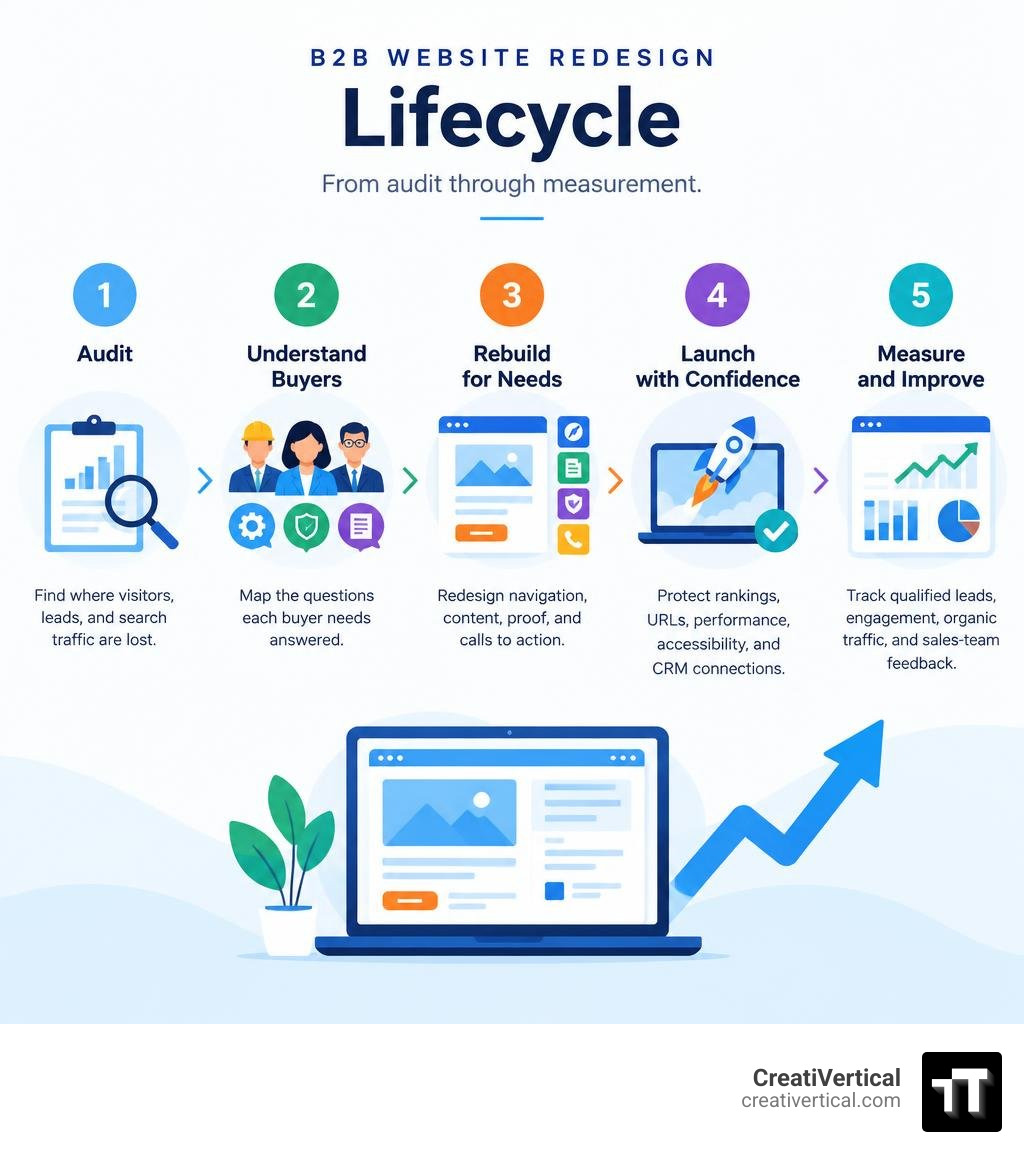
- Auditing where visitors, leads, and search traffic are being lost.
- Mapping the questions each buyer needs answered, from engineers and procurement teams to executives and compliance reviewers.
- Rebuilding navigation, content, proof, and calls to action around those needs.
- Protecting rankings, URLs, performance, accessibility, and CRM connections during launch.
- Measuring qualified leads, engagement, organic traffic, and sales-team feedback after launch.
For product companies, manufacturers, professional-service firms, and public-sector vendors, the website often must support a long and complex decision process. Buyers need clear product information, practical use cases, technical details, security or compliance context, and proof that your company can deliver. A redesign should make each of those answers easier to find without turning the site into a maze.
I’m Nicholas Cunha, founder of CreatiVertical, with more than 20 years of agency and project experience across web development, SEO, government and institutional work, and technical B2B clients. In the roadmap ahead, I will show how to approach a B2B website redesign as a durable sales and search asset, not just a new coat of paint.
B2b website redesign terms explained:
For broader context on how redesigns fit into modern web practice, see Wikipedia’s overview of web design.
Evaluating the Need for an Overhaul: Strategic Triggers and Growth Barriers
A digital overhaul becomes necessary when your existing platform actively creates friction for prospective buyers. For fast-growing product companies, industrial manufacturers, and professional services firms, websites age faster than internal roadmaps. Products evolve, new compliance standards emerge, and legacy architectures struggle to keep up.
When high-intent visitors reach a landing page and cannot quickly determine whether your product fits their technical environment, they leave. This creates conversion bottlenecks across the entire pipeline. If marketing brings in traffic but qualified inquiries remain flat, your positioning is likely fragmented. When internal teams need an engineer just to update product documentation or publish a case study, technical debt in your legacy CMS is stalling your growth. Our detailed guide to the website redesign process covers how to run a root-cause discovery to identify these structural limits before writing a single line of code.
Diagnostic Signs of Digital Underperformance
Digital underperformance leaves a distinct paper trail across analytics tools and sales calls. A B2B website that needs an overhaul typically displays these operational indicators:
- High bounce rates on primary product overview and solution pages.
- Stagnant or dropping average engagement times as users fail to locate relevant technical specs.
- Outdated technical messaging that forces your sales team to spend early discovery calls correcting basic misconceptions.
- Inconsistent visual positioning across product lines, confusing prospective buyers who are comparing complex offerings.
- A platform that fails modern Core Web Vitals or accessibility baselines, suppressing organic reach.

When your sales team regularly avoids sending prospects to your website because the collateral is out of date, the site is no longer functioning as an asset. Addressing these signs directly allows companies to achieve meaningful gains in engagement and lead quality when a B2B website redesign focuses on clearer messaging and navigation.
Aligning Buyer Personas with B2B Website Redesign Goals
Enterprise purchasing decisions are rarely made by an individual. They involve multi-stakeholder buying committees where each persona looks for specific validation points:
- Technical Evaluators & Engineers: Require clear technical specifications, integration requirements, raw performance capabilities, and clear architectural documentation.
- Operations & Procurement Leads: Focus on total cost of ownership, implementation timelines, supply chain stability, and vendor reliability.
- Executive Leadership: Needs high-level business impact, strategic risk reduction, and straightforward return on investment metrics.
- Compliance & Security Officers: Check for frameworks such as SOC 2, ISO, FISMA, or FedRAMP standards before allowing proof-of-concept testing.
A successful redesign connects each persona’s intent directly to relevant answers. Presenting industrial machinery through clear buyer-focused architecture turns technical complexity into understandable value.
Core Phases of a Modern B2B Website Redesign
Executing an enterprise overhaul requires a disciplined, phase-driven methodology. Moving directly into visual mockups without structured discovery creates an attractive website that still fails commercial objectives.

- Strategic Discovery & Technical Audit: Assess legacy content performance, map buyer journeys, evaluate CRM and marketing automation integrations, and conduct stakeholder interviews.
- Information Architecture & Wireframing: Define navigational taxonomy, establish content hierarchies, map user flows, and plan URL redirect logic.
- Visual Identity & Design Systems: Construct reusable UI components, set typographic hierarchies, and develop data visualizations in Figma.
- Platform Engineering & Integration: Build responsive front-end components, integrate headless or modern CMS architectures, and configure analytics hooks.
- Quality Assurance, SEO Migration & Launch: Run cross-browser testing, validate accessibility (WCAG), deploy 301 redirects, and verify search engine indexing directives.
Organizations must also choose whether a complete overhaul or an incremental strategy fits their risk profile:
| Dimension | Complete Platform Rebuild | Evolutionary Site Redesign |
|---|---|---|
| Primary Scope | Full architecture, design system, CMS, and tech-stack replacement | Systematic, iterative updates to existing high-impact templates and flows |
| Typical Timeline | 3 to 6 months depending on technical complexity | Ongoing sprints over multiple quarters |
| Best Used For | Rebranding, legacy CMS migration, or structural positioning failure | Optimizing established platforms with solid underlying architecture |
| Traffic Impact | High initial shift requiring strict SEO migration safeguards | Gradual, lower-risk baseline adjustments |
For organizations evaluating these paths, exploring evolutionary site redesign principles provides a framework for deciding between continuous iteration and full rebuilds.
Wireframing and Strategy-Led Visual Direction
Wireframing acts as the blueprint for user flow and clarity. We strip away colors, photography, and decorative elements to focus entirely on layout logic, visual weight, and content structure.
Creating a modular design system with standardized tokens ensures that future product lines or regional service expansions maintain cohesive aesthetics. For technical organizations, translating deep subject-matter expertise into a clean visual framework is critical. Our guide to B2B technical brand development explores how engineering-led firms can build credible, authoritative visual identities without diluting technical depth.
Integrating Proof Points: Video, Case Studies, and Social Proof
B2B buyers are risk-averse. Assertions about product performance mean little without third-party proof and clear visual evidence. Incorporating rich proof points into the user journey directly reduces friction:
- Hero Product Demonstrations: Concise, high-production video clips placed directly in the hero section show the product in action, answering foundational questions immediately.
- Narrative Customer Stories: Moving beyond basic quotes to structured case studies that detail the original problem, the implementation hurdles, and the verifiable outcome.
- Interactive Calculators: Letting buyers model estimates or efficiency improvements based on their operational metrics.
- Structured Data Visualizations: Replacing unformatted dashboard screenshots with clean vector diagrams to highlight capability without UI clutter.
A strategic approach to user journeys and visual clarity delivers real impact. When a redesign is structured around clear user journeys and conversion-focused CTAs, organizations commonly see meaningful improvements in conversion rates and time on site.
Information Architecture, Content Hierarchy, and Buyer Experience
Information architecture (IA) dictates how easily visitors find answers. If navigating your product lines feels like searching a warehouse without signs, buyers will seek alternatives.
Structuring catalogs requires clear taxonomic hierarchy and faceted navigation, especially for manufacturers offering hundreds of SKUs with narrow variations. Reviewing real-world industrial website design examples helps illustrate how complex industrial equipment catalogs can be organized intuitively.

B2B vs B2C User Experience Differences
Consumer websites prioritize impulsive, transactional interactions: immediate checkout paths, limited product research, and emotionally driven buying triggers. B2B web environments operate under entirely different dynamics:
- Buying Committees vs. Single Shoppers: Content must speak simultaneously to end users, department heads, and legal departments.
- Extended Evaluation Cycles: Users visit repeatedly over weeks or months, downloading technical assets and sharing links internally before initiating direct contact.
- High Transaction Values & Risk: Mistakes in enterprise procurement impact operational stability, making trust, clarity, and documented compliance essential.
- Educational Self-Service: Decision-makers conduct extensive independent research before contacting sales; your platform must provide detailed answers upfront.
Structuring Intent-Driven CTAs and Conversion Paths
Forcing every site visitor immediately into a high-friction “Book a 30-Minute Demo” form ignores where prospects actually sit within their evaluation process. High-performing architectures provide conversion paths matched to user intent:
- Top-of-Funnel Intent: Researching industry benchmarks or architectural approaches. Appropriate CTA: Ungated whitepaper reading, technical overview guides, or interactive assessment tools.
- Mid-Funnel Intent: Evaluating compatibility and functional capabilities. Appropriate CTA: Detailed technical specification downloads, compliance checklists, or recorded modular feature walkthroughs.
- High Intent: Ready for direct procurement discussions. Appropriate CTA: Direct sandbox access, custom scope requests, or engineering consultation scheduling.
Implementing intentional, contextual touchpoints is fundamental to long-term performance. A well-structured B2B website can generate a meaningful increase in qualified leads through optimized CTAs and user journeys. You can explore further tactical methods in our overview on how to improve a website for commercial conversions.
Technical Architecture: CMS, Performance, and SEO Preservation
Selecting the right content management system dictates how well your marketing team can scale content without engineering bottlenecks. Modern B2B organizations typically choose between flexible platforms like Webflow for rapid marketing agility, structured WordPress architectures for extensive content ecosystems, or HubSpot CMS for native CRM integration. Migrating to a modular digital ecosystem gives global marketing teams the autonomy to update regional assets quickly.
Technical performance also underpins modern search indexing and user retention. Prioritizing Core Web Vitals—Largest Contentful Paint (LCP), Interaction to Next Paint (INP), and Cumulative Layout Shift (CLS)—ensures low latency across all devices. Paired with strict WCAG 2.1 AA accessibility compliance, strong technical foundations expand reach and prevent compliance liabilities.
Technical SEO Audits to Protect Rankings in a B2B Website Redesign
A redesign must never sacrifice established organic search equity. Migrations without structured technical oversight frequently trigger prolonged ranking drops. Protecting search visibility requires a meticulous migration plan:
Key operational steps include:
- Complete URL Auditing: Crawl the legacy site to map all indexed, traffic-generating, and backlinked pages.
- 1:1 301 Redirect Mapping: Avoid redirecting all legacy URLs to the homepage; map each old URL directly to its most relevant new equivalent.
- Preserving Meta Directives: Keep heading hierarchies, title tags, and structured metadata aligned during content transfers.
- Robots.txt and Crawl Directive Auditing: Ensure staging directives (such as
noindexor blanket crawl disallows) are removed upon public launch.
For an exhaustive step-by-step migration blueprint, review our guide to maintaining SEO rankings during a site redesign.
Optimizing for AI Search Visibility and Structured Data
As discovery expands beyond traditional search engines into generative platforms like ChatGPT and Perplexity, technical optimization requires clear semantic structure. Generative engines look for well-defined entities, factual consistency, and structured data schema.
Implementing complete Schema.org vocabularies (Organization, Product, TechArticle, FAQPage) helps large language models and search engines accurately parse your service capabilities, target industries, and proprietary technologies. Clear, unambiguous entity definitions ensure your company is cited reliably when buyers query AI tools for top-tier enterprise solutions.
Measuring Redesign Success and Long-Term Value
Evaluating the commercial return of a website overhaul requires looking beyond simple vanity metrics. Total pageviews matter far less than pipeline velocity, lead quality, and account engagement across key target segments.

B2B websites that prioritize clear navigation and user experience consistently see improvements in engagement time and lead quality. When budgeting for an overhaul, costs vary based on custom feature requirements, CMS complexity, and catalog scale. Typical industry web design engagements range from entry-level template configurations to fully custom enterprise platform builds; for broader market pricing context, see our breakdown of what a new website should cost.
Key Performance Indicators and Tracking Dashboards
To accurately measure post-launch performance, focus your monitoring dashboards on these operational metrics:
- Qualified Pipeline Generation: The volume of inquiries matching your ideal customer profile (ICP) versus raw form submissions.
- Engagement Duration on Core Product Pages: Time spent evaluating deep technical documentation, data sheets, and use-case pages.
- Scroll Depth & Interaction Rates: Buyer progression through interactive product modules, spec tabs, and case study overviews.
- Assisted Conversion Touchpoints: Multi-touch attribution data showing how organic content guides prospects throughout extended buying cycles.
Continuous Optimization Post-Launch
A modern website is never truly “finished” on launch day. Treating the platform as an evolving sales system involves continuous, iterative optimization:
- Reviewing session recordings and heatmaps to identify where users hesitate or abandon key funnels.
- Running controlled A/B split tests on high-impact value propositions, form layouts, and CTA framing.
- Gathering direct qualitative feedback from sales engineering on common questions prospects still ask during calls.
- Performing routine technical audits to maintain Core Web Vitals performance as new assets are added.
Frequently Asked Questions About B2B Site Overhauls
How long does a complex B2B website overhaul typically take?
A comprehensive B2B overhaul generally spans 12 to 24 weeks depending on organizational scale and technical complexity. The discovery and strategy phase typically takes 3 to 4 weeks, followed by 4 to 6 weeks for information architecture and UI design systems. Platform engineering, CMS implementation, and third-party integrations generally require 4 to 8 weeks, leaving 2 to 4 weeks for thorough content migration, accessibility audits, technical SEO validation, and stakeholder review before public launch.
How can we prevent organic traffic loss during a platform migration?
Preventing post-launch organic traffic drops requires executing an exact 1:1 redirect map from legacy URLs to new pages, ensuring high-value keyword targets maintain dedicated page equivalents. Metadata, heading hierarchies, and internal linking structures must be preserved or systematically improved. Before launch, verify that the staging site’s noindex tags and robots.txt disallow rules are cleanly removed, then submit the updated XML sitemap directly to Google Search Console to prompt immediate recrawling.
What is the difference between a website revamp and a full redesign?
A website revamp is primarily a cosmetic or surface-level update that refreshes visual styling, typography, and color schemes without altering underlying information architecture, CMS infrastructure, or positioning. A full redesign is a structural overhaul that rethinks navigation taxonomy, core technical architecture, content strategy, buyer journey mapping, and conversion pathways to fix fundamental commercial and technical bottlenecks.
Conclusion
A B2B platform overhaul is a strategic initiative that unifies brand credibility, technical performance, and commercial pipeline growth. By aligning your digital presence with the expectations of modern multi-stakeholder buying committees, you remove friction from the sales cycle and create a durable engine for organic discovery.
At CreatiVertical, we engineer complete digital systems—combining custom web architecture, technical search optimization, and AI enablement—to help industrial manufacturers, professional services firms, and enterprise organizations scale with clarity. If your current platform no longer reflects your operational capabilities, explore our approach to custom website development and digital platform engineering to map out your next stage of growth.