
Industrial Website Design That Helps Technical Buyers Evaluate You
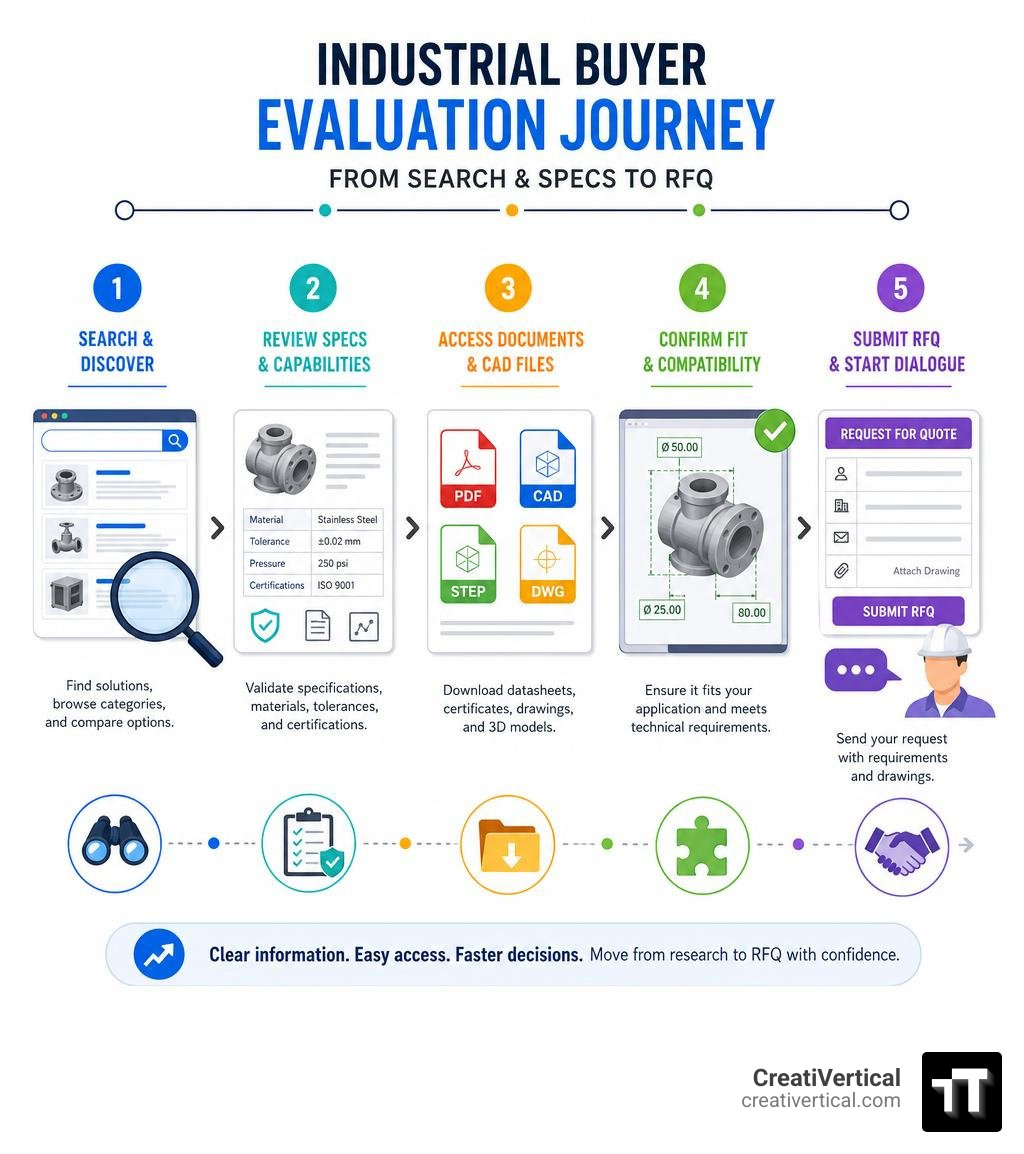
The most useful industrial website design examples do more than look modern. They help engineers, procurement teams, OEMs, and distributors answer practical questions fast:
- Can this company make or supply what I need?
- Do its specs, materials, tolerances, and certifications meet our requirements?
- Can I download the documents or CAD files needed to evaluate the product?
- How do I request a quote without a long back-and-forth?
That is the key difference between an industrial site and a typical B2B brochure site. Technical buyers are often researching several suppliers at once. Clear product categories, searchable specifications, visible compliance credentials, real process imagery, and well-designed RFQ paths make it easier to move from early research to a qualified conversation.
The strongest examples balance clarity and credibility. They may use restrained motion, 3D product views, or factory video to show how equipment works, but those visuals should support the job at hand: finding a part, verifying a capability, checking a certification, or sending a drawing to the right team.
I’m Nicholas Cunha, founder of CreatiVertical, with more than 20 years of agency and project experience across web development, SEO, government and institutional work, and B2B clients. I approach industrial website design as a practical sales and research tool, including the structured content and AI search visibility that help technical buyers find trustworthy answers.
What Distinguishes B2B Manufacturing Sites from Standard Web Platforms
Industrial buyers approach digital research with a practical mindset. When design engineers, supply chain directors, and procurement teams land on a digital platform, they are not browsing on impulse. They are mid-funnel decision-makers operating under stringent operational requirements, tight delivery schedules, and complex procurement rules. Over 70% of industrial buyers research suppliers online before initiating direct contact, with more than 60% conducting this research on mobile devices.
A corporate brochure site often relies on high-level taglines, generic imagery, and broad calls to action. In contrast, an industrial platform serves as an operational interface. It must provide instant technical verification, confirming ISO accreditations, raw material grades, standard tolerances, and production volume limits within a brief evaluation window. If a vendor cannot supply these parameters immediately, the procurement lead moves on to the next supplier tab.
| Feature / Objective | Standard Corporate Website | Industrial Manufacturing Platform |
|---|---|---|
| Primary Audience | General consumers, casual prospects, single buyers | Design engineers, procurement officers, multi-stakeholder committees |
| Buying Cycle | Minutes to weeks; low friction | 3 to 18 months; rigorous supplier qualification and testing |
| Core Conversion Asset | Newsletter signup, simple contact form, direct checkout | Technical RFQ form with CAD/drawing uploads and scope parameters |
| Information Priority | Brand narrative, lifestyle photography, broad benefits | Tolerances, material grades, datasheets, ISO/AS9100 certifications |
| Backend Architecture | Basic CRM or standalone e-commerce gateway | Deep integration with ERPs (Epicor, NetSuite), custom PIM, and CRM routing |
| Content Verification | Testimonials, client logos, case studies | Traceable quality manuals, test reports, material certs, compliance badges |
Because manufacturing sales involve buying committees—from shop-floor production managers to Chief Technology Officers—the site must serve multiple agendas without adding unnecessary steps. Technical users need immediate access to technical drawings and material matrices, while executive buyers need capacity data and supply chain reliability metrics. Knowing how to improve a website in this sector means turning every page into a functional vetting tool that shortens these long qualification cycles.
Core Principles of High-Performing Industrial Website Design
Effective industrial website design relies on layout clarity, strong visual hierarchy, and intuitive information architecture. Visual elements should serve an engineering purpose: clarifying complex machinery, illustrating multi-step processes, and reducing risk for the buyer.
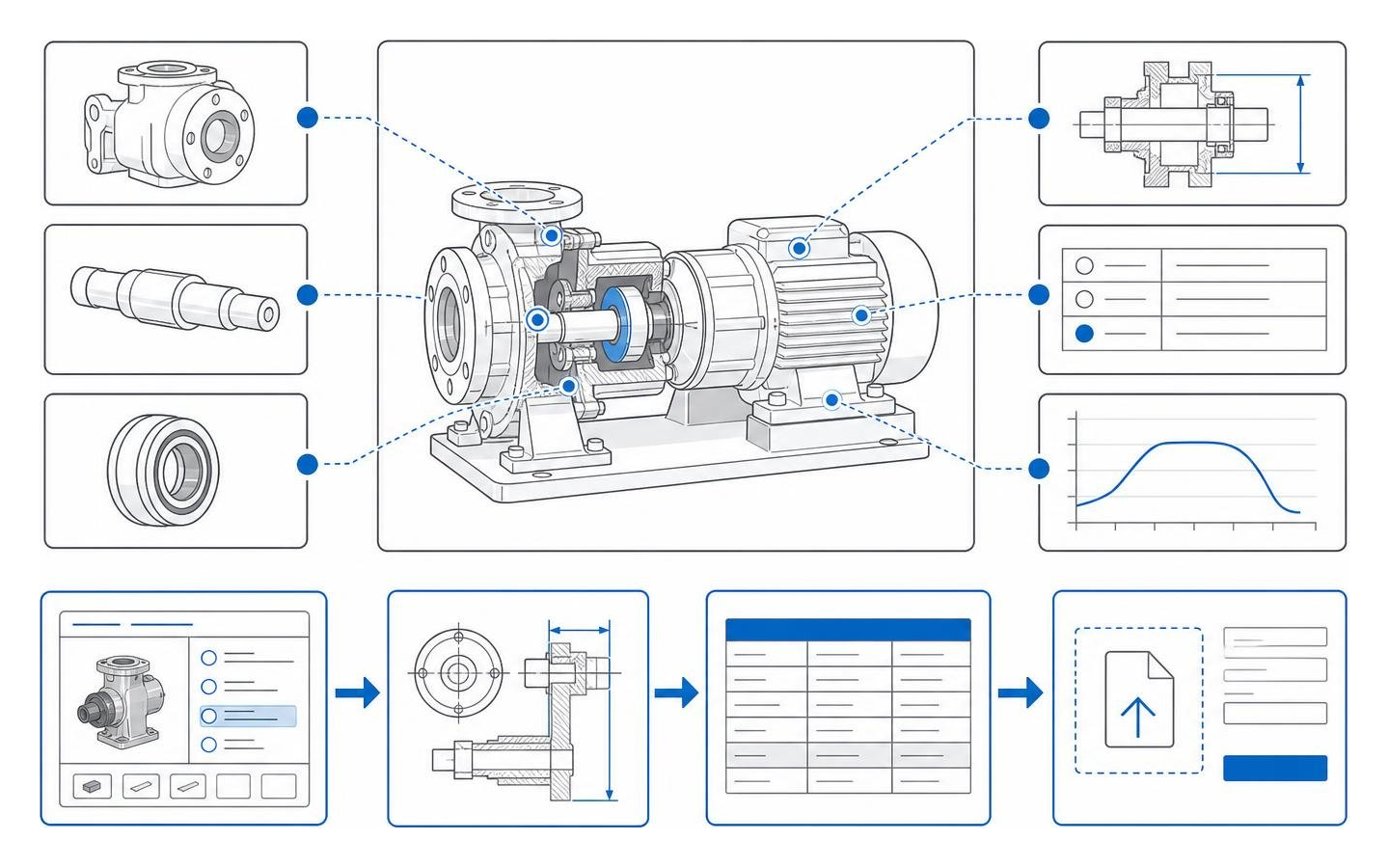
Using generous whitespace around isolated product photography highlights machining precision, while dark-mode accents and clear industrial typography communicate modern operational capability. Restrained micro-animations and interactive component diagrams help explain multi-stage manufacturing workflows—such as automated assembly or chemical processing—without cluttering the user interface.
At the same time, platforms must maintain strict web standards. Accessibility matters: enterprise procurement mandates increasingly require WCAG compliance. When evaluating what should a new website cost, industrial manufacturers typically find that professional builds range across standard market tiers based on catalog complexity, API integrations, and custom configurators. A modern industrial build must combine visual refinement with fast, reliable performance.
Essential Technical Features for Industrial Website Design
To convert technical evaluators, an industrial platform must include specific structural capabilities:
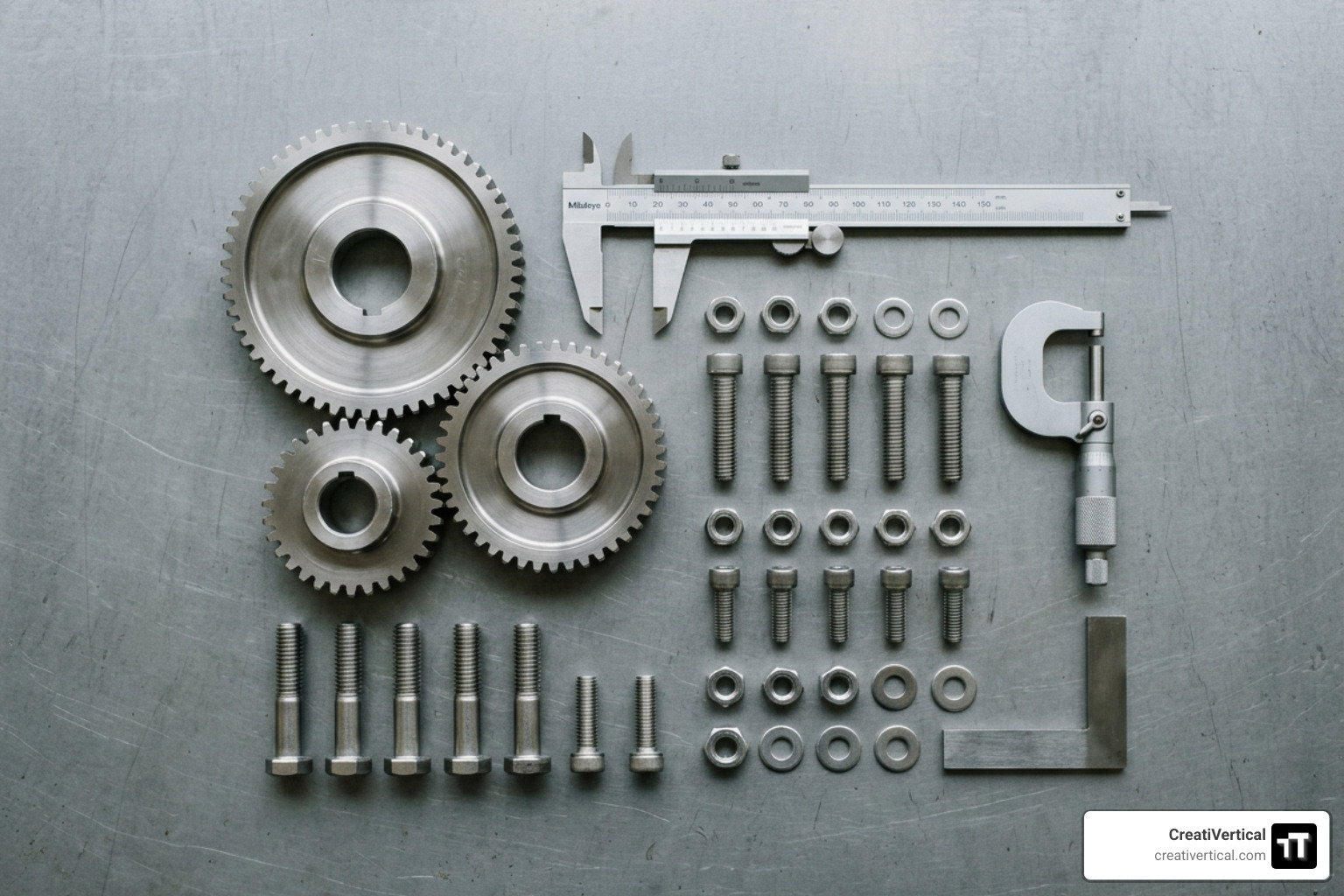
- Faceted Catalog Filtering: Enables engineers to filter thousands of parts by critical engineering attributes, including dimensional ranges, thread pitch, operating temperature, and material composition (e.g., 316 stainless steel vs. 6061-T6 aluminum).
- Prominent Quality Accreditations: Displays verifiable compliance badges directly in the header or hero space, including ISO 9001, AS9100 for aerospace, IATF 16949 for automotive, ITAR registration, and NIST cybersecurity compliance.
- Interactive Capability Matrices: Outlines specific machinery footprints, spindle counts, tonnage limits, and precision tolerances across custom fabrication and machining services.
- Distributor and Stockist Locators: Provides interactive mapping and contact details for regional distributor networks and authorized sales representatives.
- Multi-Language Infrastructure: Delivers localized navigation and specification sheets across international export markets without breaking catalog logic.
Spec Sheets, CAD Files, and Ungated Technical Catalogs
Design engineers evaluate components by testing CAD models directly within their assemblies. If an engineer cannot download a STEP, IGES, or DWG file, or access a PDF datasheet containing critical wiring schematics and performance curves, they will likely choose a competitor who makes those files easily accessible.
Gating routine technical documentation behind complex contact forms introduces unnecessary friction during component specification. Instead, technical documentation centers should offer direct access, backed by a high-performance Content Delivery Network (CDN) to ensure fast downloads across corporate firewalls.
Behind the scenes, structuring product catalogs with modular CMS post types and custom fields allows non-technical marketing teams to update dimensional tolerances, finishes, and revision-controlled PDF manuals without risking layout errors.
RFQ Architecture, Quoting Workflows, and Lead Routing
The Request for Quote (RFQ) form is the primary conversion asset of any industrial website. A generic “Contact Us” form asking for a name and an open-ended message does not capture the operational data needed to quote an engineering project.
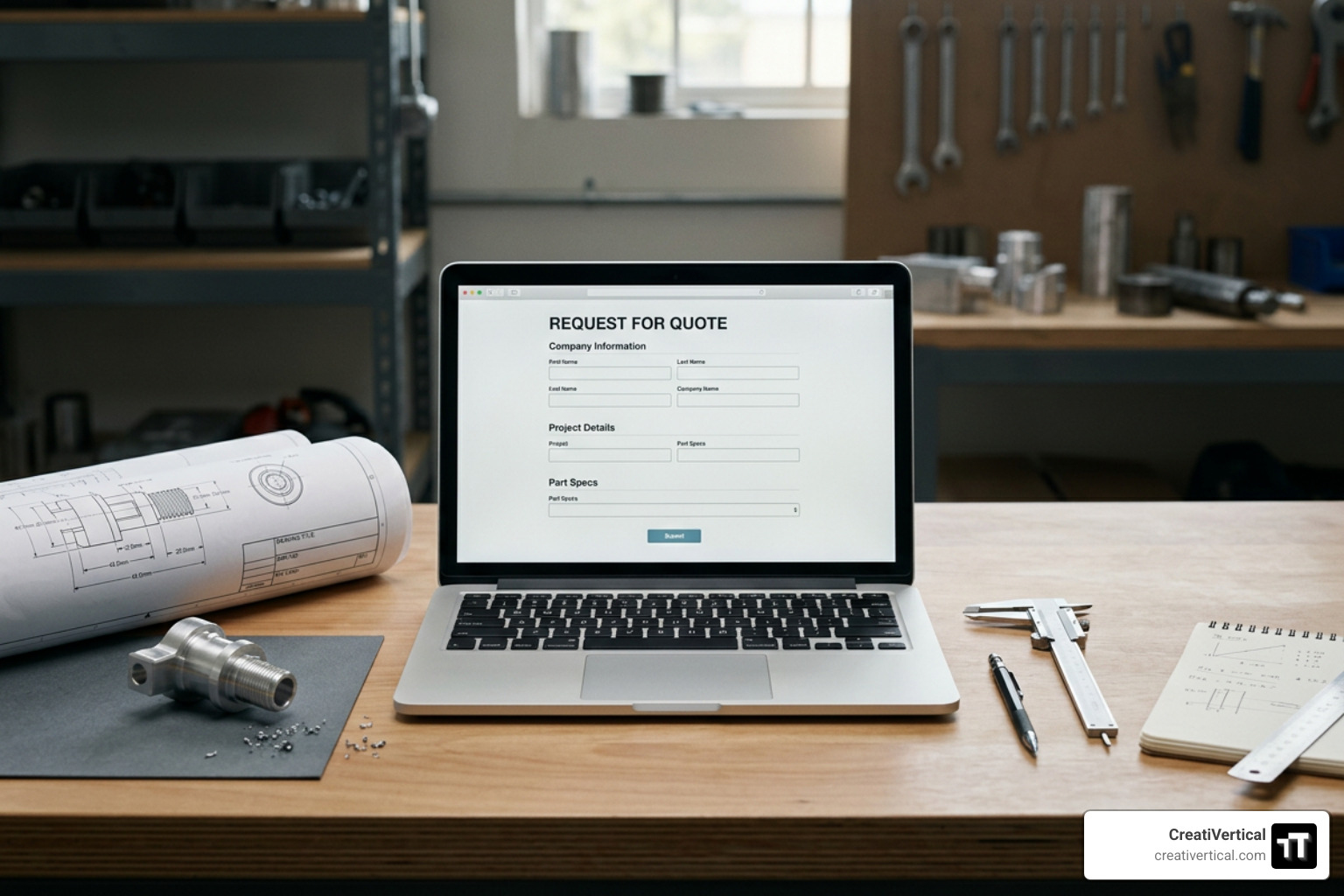
A high-converting industrial RFQ system collects practical engineering parameters upfront:
- Target production volume and annual usage estimates
- Specific material grade and secondary finishing options
- Required dimensional tolerances and testing standards
- Multi-file drag-and-drop uploads for technical drawings, CAD files, and quality requirements
- Secure, encrypted file transfer protocols to protect proprietary designs
Integrating these forms with your internal CRM (such as HubSpot or Salesforce) and ERP platforms ensures that incoming quote requests are automatically categorized, enriched, and routed directly to the appropriate estimating engineer. When website for paid traffic gearing up is deployed, this structured capture ensures paid search visitors convert into actionable, pre-qualified sales leads.
High-Converting Industrial Website Examples and Case Studies
Looking at successful industrial platforms reveals consistent patterns: they focus on clear communication, straightforward technical filtering, and explicit conversion steps. From major Fortune 1000 enterprises to specialized manufacturers, well-structured platforms consistently outperform dense, outdated digital brochures. Companies investing in professional web design services in Kansas City and beyond recognize that practical utility drives engagement.
Standout Industrial Website Design Examples Across Manufacturing Sectors
Enterprise leaders and specialized producers demonstrate how distinct UX strategies solve complex buyer challenges:
- **Caterpillar:** Manages massive equipment lines by combining regional geo-targeting with isolated product cutouts surrounded by clean whitespace, keeping the focus squarely on machinery specifications.
- **Grainger:** Organizes more than 1.5 million SKUs using faceted left-hand navigation, bulk SKU input pads, and quick-reorder features tailored for repeat commercial procurement.
- American Alloy Fabricators: Highlights ASME and ISO certifications above the fold, pairing them with straightforward RFQ buttons to capture custom metal fabrication inquiries quickly.
- Penske & Lear Corporation: Use interactive exploded component diagrams and vehicle wireframes, allowing tier-1 automotive buyers to click specific sub-assemblies to reveal technical specs.
- Martin Marietta: Employs an interactive material volume calculator that estimates tonnage requirements and routes users directly into a localized quote request.
Teardown: Turning Complex Robotics into Clear Buyer Journeys
Industrial innovation often involves complex automation that can be difficult to explain with static text alone. A strong example of solving this challenge is seen in Rayhawk’s railcar automation platform. Rayhawk developed an autonomous system using computer vision and a robotic gantry to open, seal, and inspect railcar lids without human intervention.
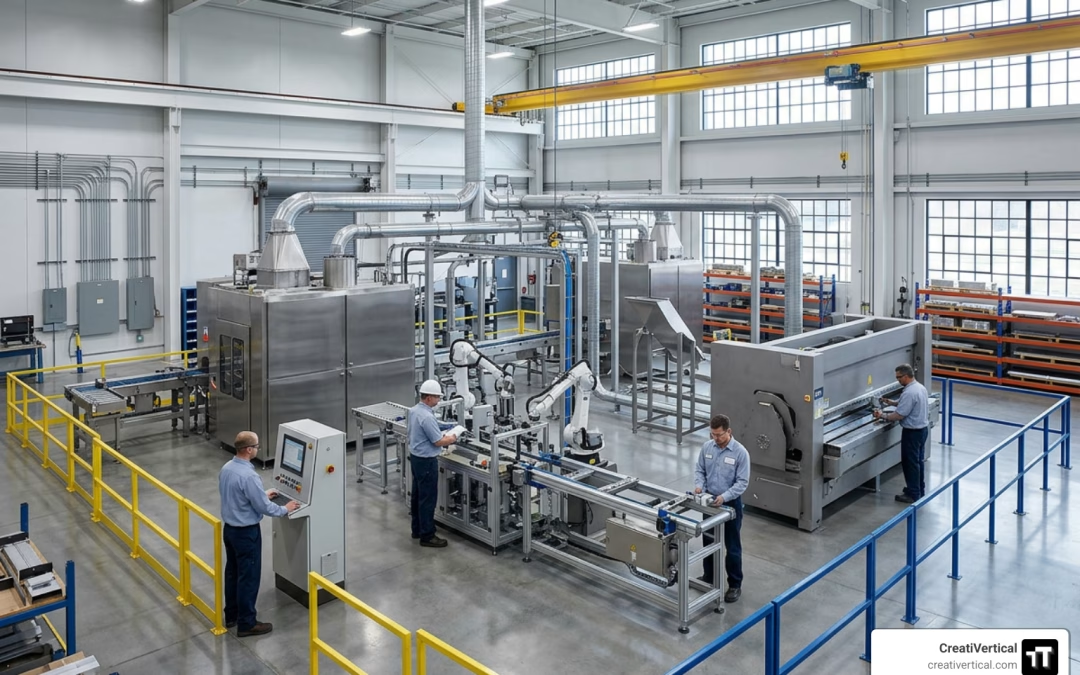
Their original website did not clearly communicate this physical capability. By restructuring the platform around dedicated “How It Works” evaluation pages and placing authentic operational video of the robotic gantry directly below the hero section, the new design removed buyer uncertainty. Showing the physical equipment operating in real conditions eliminated the single largest trust hurdle for risk-averse logistics operators.
Optimizing Industrial Web Architecture for Generative AI and Search
Industrial SEO requires targeting precise, long-tail technical search queries rather than broad consumer keywords. Procurement teams and maintenance managers search using specific part numbers, raw material callouts (e.g., AMS 4928 titanium bar), industry manufacturing standards (e.g., ASME B16.5 flanges), and specialized production methods like multi-axis Swiss machining.
Alongside traditional organic indexing, industrial websites must now optimize for Generative Engine Optimization (GEO). AI answer engines—including ChatGPT, Perplexity, and Google AI Overviews—evaluate structured technical specifications to answer direct supplier sourcing questions. If your website presents technical capabilities in clean, machine-readable formats, AI discovery tools can accurately extract and cite your company when buyers ask for specialized manufacturers.
Structuring Data and Machine-Readable Schema for Generative Search
To help both search engine crawlers and large language models interpret your catalog, platforms should implement structured Schema.org markup across every technical asset:
- Product Schema: Defines part numbers, dimensions, materials, and availability.
- Organization & Factory Schema: Clarifies manufacturing facility locations, operating parent entities, and verified industry accreditations.
- Capability Specification Markup: Organizes machine tolerances, finishing capabilities, and raw material classifications into semantic tables that AI models can easily parse.
Conducting regular AI discoverability audits helps identify content architecture gaps, ensuring your facility’s core capabilities remain visible in automated vendor shortlists.
Balancing Performance, High-Load CAD Files, and Mobile Core Web Vitals
Industrial websites often handle heavy visual assets, including 3D model viewers, comprehensive PDF libraries, and high-resolution process videos. However, performance remains a key technical factor: pages must load in under three seconds to pass Google’s Core Web Vitals and accommodate plant engineers researching on mobile devices in low-connectivity factory environments.
Maintaining fast load speeds requires:
- Serving compressed media assets using modern WebP and AVIF formats
- Implementing lazy loading for inner-catalog imagery and technical diagrams
- Offloading downloadable CAD models and PDF spec sheets to secure cloud storage backed by a global CDN
- Utilizing continuous server uptime monitoring and SSL encryption to maintain uninterrupted enterprise access
Frequently Asked Questions About Industrial Web Platforms
How is an industrial website different from a standard B2B corporate site?
An industrial website targets technical evaluators—such as design engineers, quality assurance managers, and procurement officers—who require granular engineering data before contacting sales. Unlike standard B2B sites that focus primarily on high-level value propositions, industrial platforms must provide searchable specification sheets, downloadable CAD models, compliance accreditations, and multi-variable RFQ forms tailored to custom manufacturing workflows.
Should technical spec sheets and CAD models be gated behind lead capture forms?
In most cases, technical spec sheets and CAD models should remain ungated. Design engineers often work under tight deadlines and evaluate multiple component options simultaneously. Forcing users to fill out forms or wait for a sales representative to access basic technical files creates friction, frequently causing engineers to leave the site and specify a competitor’s part instead.
What backend integrations are critical for modern manufacturing websites?
Modern industrial websites benefit from integrating with Enterprise Resource Planning (ERP) systems (such as Microsoft Dynamics, Epicor, or NetSuite) and Customer Relationship Management (CRM) platforms like HubSpot or Salesforce. These connections automate quote distribution, synchronize product data across custom Product Information Management (PIM) databases, and allow distributor networks to access real-time inventory and pricing through secure portals.
Conclusion
A successful industrial website serves as an active component of your sales and engineering pipeline. By prioritizing clear information architecture, ungated technical documentation, visible quality accreditations, and structured RFQ workflows, manufacturers can turn routine digital searches into qualified business opportunities.
At CreatiVertical, we deliver complete, performance-focused digital systems—combining custom web architecture, search engine optimization, and applied AI search visibility to help industrial and B2B manufacturers build credibility and capture demand. Explore our approach to scalable Website Development to align your digital presence with the practical needs of modern technical buyers.