

What Is Evolutionary Site Redesign — and Why It Matters
Evolutionary site redesign is the practice of improving your website through small, tested, data-driven changes over time — rather than scrapping everything and launching a brand-new site all at once.
Quick answer:
| Question | Answer |
|---|---|
| What is it? | An ongoing process of incremental, tested website improvements |
| How is it different from a full redesign? | Changes are made one at a time, measured, and kept only if they improve performance |
| Who is it for? | Any site with existing traffic, returning visitors, and working infrastructure |
| What’s the main benefit? | Lower risk, lower cost, no conversion or SEO “reset” |
| When do you need a full redesign instead? | Outdated technology, brand repositioning, near-zero traffic, or fundamental structural failure |
Most website redesigns don’t go as planned. A business spends months — sometimes years — and significant budget rebuilding its site from scratch, only to watch conversions drop and organic rankings slip after launch. The frustrating part? Nobody can tell you which change caused the problem, because everything changed at once.
That’s the core flaw in the traditional “big bang” redesign approach. And it’s exactly the problem that evolutionary site redesign is built to solve.
Instead of treating your website as a product you rebuild every few years, evolutionary redesign treats it as a living system — one you improve continuously, based on real user behavior and measurable results.
I’m Nicholas Cunha, founder of CreatiVertical, and over more than twenty years running digital agencies — first in the British Virgin Islands, now in Kansas City — I’ve seen how businesses lose momentum chasing costly full rebuilds when a disciplined evolutionary site redesign strategy would have delivered better results with far less risk. That experience shapes everything we do for clients across B2B, industrial, offshore, and local Kansas City markets.
Radical Redesign vs. Evolutionary Site Redesign
The core difference between a radical redesign and an evolutionary site redesign (ESR) is how they handle risk, data, and change management.
A radical redesign is a “clean slate” approach. You throw away the old design, rewrite the code, restructure the navigation, and launch a completely new visual identity all at once. An evolutionary redesign, by contrast, is a continuous process of optimization. You keep the underlying structure of the site intact and systematically test and update individual elements — such as headers, call-to-action (CTA) buttons, layout components, and copy — based on actual user data.
| Metric / Feature | Radical Redesign | Evolutionary Site Redesign (ESR) |
|---|---|---|
| Risk Profile | High. Many variables change at once, making it hard to isolate conversion drops. | Low. Changes are introduced incrementally and rolled back if they underperform. |
| Cost Structure | High upfront capital expense (CapEx), often leading to budget overruns. | Predictable, ongoing operational expense (OpEx) spread over time. |
| Time to Value | Slow. Takes months or years of development before the new site goes live. | Fast. Improvements are launched and measured in weekly or monthly cycles. |
| SEO Impact | High risk of temporary or permanent drops in organic traffic and crawl budget. | Minimal risk. URL structures, internal links, and content are updated gradually. |
| Conversion Impact | Unpredictable. Can result in immediate conversion drops due to user friction. | Consistently positive. Only changes that prove their value in testing are kept. |
| Data Dependency | Heavily reliant on designer intuition and subjective stakeholder opinions. | Driven entirely by quantitative analytics, A/B testing, and user research. |
For most businesses, the evolutionary path is the safer and more profitable choice. It treats website improvement as a scientific process rather than a creative gamble. If you are looking to systematically upgrade your digital presence, learning How to Improve a Website starts with understanding how to preserve what is already working while fixing what isn’t.
The High Cost of Starting Over: Risks of the “Big Bang” Approach
The traditional website redesign is often treated as an aesthetic rite of passage. Every three to five years, stakeholders decide the site looks “dated,” a budget is approved, and a creative agency is hired to build a replacement.
This approach carries massive financial and operational risks. Across the industry, traditional website redesigns can cost anywhere from $150,000 to over $5 million, depending on the scale of the organization. Yet, despite these significant investments, many companies experience immediate conversion drops of 10% to 25% post-launch.
Why does this happen? When you change your site’s layout, navigation, copy, and checkout flow all at once, you create an untestable “black box.” If sales plummet, you cannot isolate the cause. Did the new navigation confuse returning customers? Did the rewritten value proposition fall flat? Or did a subtle change in button color reduce click-through rates?
Real-World Failures of Radical Redesigns
The history of web design is filled with cautionary tales of radical overhauls that backfired:
- Marks & Spencer (2014): The retail giant spent £150 million on a massive, two-year website redesign. Within three months of launch, online sales plummeted by 8.1% as customers struggled with a confusing new interface and technical glitches. The drop in revenue directly impacted the company’s stock price, demonstrating how a poorly executed redesign can damage a brand’s bottom line.
- Digg (2010): In an attempt to compete with newer social platforms, Digg launched a radical redesign (v4) that completely altered its core user interface and removed popular features without user testing. The backlash was immediate. Digg lost 26% of its traffic almost overnight, and users migrated in droves to Reddit, effectively ending Digg’s dominance in the social bookmarking space.
- Wal-Mart: In a well-known offline parallel that mirrors digital user behavior, Wal-Mart acted on customer surveys asking for less cluttered aisles. They launched a massive store redesign, removing inventory and clearing space. While customers said they wanted cleaner stores, their actual purchasing behavior changed; the redesign resulted in an estimated loss of nearly $2 billion in sales because the items customers wanted were harder to find or out of stock.
Stated Preferences vs. Actual Behavior
The Wal-Mart example highlights a fundamental truth in user experience design: what people say they want rarely matches how they actually behave.
This is why relying on focus groups, surveys, or stakeholder intuition during a redesign is highly risky. For example, when the team at Domino’s wanted to update their online menu, user research suggested switching from a vertical scroll to a horizontal scroll layout. However, when they ran a controlled test on the change, the horizontal scroll resulted in a 3.13% loss in overall revenue. For a company of Domino’s scale, implementing that single untested design change globally would have equated to over $100 million in lost revenue annually.
By contrast, companies like Amazon avoid these catastrophic mistakes through continuous experimentation. Amazon runs thousands of A/B tests every year, gradually evolving its interface. The layout you see on Amazon today is the result of millions of tiny, successful mutations — not a single creative brainstorm.
When evaluating your own digital strategy, it is critical to understand the true cost of starting over. For a detailed breakdown of industry pricing models and what goes into building a high-performing site, read our guide on What Should a New Website Cost?. For a deeper dive into how leading brands balance risk and reward through iterative updates, you can explore the insights in Evolutionary Design: Crafting Websites That Adapt and Thrive | Conversion.
When to Break the Mold: Choosing a Radical Redesign
While an evolutionary site redesign should be your default strategy, there are specific scenarios where a radical redesign is the correct business decision. You cannot evolve a system that is fundamentally broken or obsolete.

A radical, clean-slate redesign is generally required when:
- Your Technology is Obsolete: If your website is built on an outdated platform, an unsupported content management system (CMS), or relies on obsolete code libraries, incremental updates will only delay the inevitable. For example, when Adobe Flash was replaced by HTML5, websites built entirely on Flash had to be completely rebuilt from scratch to remain functional and mobile-compatible.
- You Have Severe Technical Debt: When a website has been patched together by different developers over many years, the underlying codebase can become so fragile that making a simple layout change breaks other parts of the site. In these cases, the cost of maintaining the legacy system exceeds the cost of a complete rebuild.
- Your Brand is Repositioning: If your business is undergoing a complete rebranding, entering an entirely new market, or changing its core product offering, your existing site structure may no longer fit your business model. A radical redesign allows you to align your digital presence with your new corporate identity.
- You Have Extremely Low Traffic: Evolutionary design relies on statistical data from A/B testing to validate changes. If your website receives very little traffic (e.g., fewer than a few thousand visitors per month), running statistically significant tests can take months or years. In this scenario, a radical redesign based on established usability heuristics and modern design best practices is a faster way to establish a high-performing baseline.
A real-world example of modernizing a legacy digital asset is the ongoing modernization of the TalkOrigins Archive. This long-standing science education resource had been maintained with minimal updates since the early 2000s, relying on outdated 1990s-style HTML and CSS. To make the archive mobile-friendly, secure, and accessible for modern users, the team had to pursue a structural overhaul, migrating the content to a responsive design and containerized hosting environment. You can read more about this technical transition in the article TalkOrigins Archive Modernization Underway – The Austringer.
If your business is located in the Kansas City metro area and you are trying to determine whether your current site can be saved through evolutionary optimization or if it requires a complete rebuild, our team at CreatiVertical can help you evaluate your options. Explore our specialized services for Website Design in KC to learn how we align design decisions with measurable business outcomes.
To see how other organizations in our region approach digital updates, you can review the community guidelines and layout of Lake Tapawingo or look at local service providers featured on the Business Profile | SMB registry. For businesses operating throughout the state, working with a specialized Missouri Website Redesign Agency | Scale Your Business can provide the local market insights needed to make an informed decision between radical and evolutionary paths.
A Practical Blueprint for Evolutionary Site Redesign
Implementing an evolutionary site redesign requires moving away from subjective design debates and embracing a structured, data-driven workflow. Instead of asking, “Do we like this color?” your team must ask, “What does the data tell us about how our users interact with this page?”

Integrating CRO into Your Evolutionary Site Redesign
Conversion Rate Optimization (CRO) is the engine that drives evolutionary redesign. By continuously researching, testing, and refining individual elements of your website, you ensure that every change you make actively contributes to your business goals.
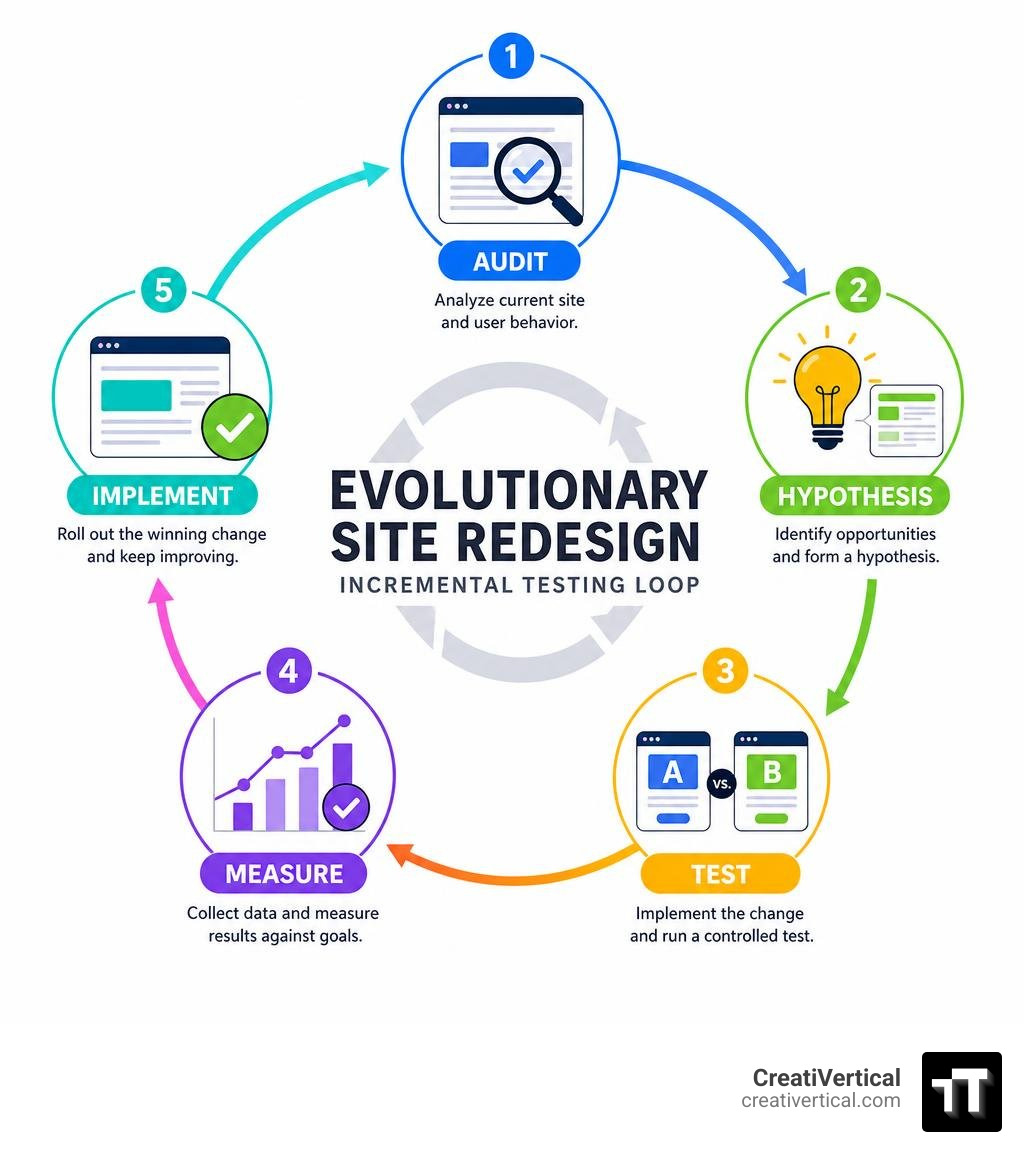
To integrate CRO into your website planning process, follow this continuous optimization loop:
- Step 1: Quantitative Research (The “What”): Analyze your web analytics to identify where users are dropping off. Look at high bounce rates, exit rates on key landing pages, and cart abandonment rates.
- Step 2: Qualitative Research (The “Why”): Use tools like heatmaps, session recordings, and user testing to understand why users are leaving. For example, are they missing your primary CTA because it is buried below the fold?
- Step 3: Formulate a Hypothesis: Based on your research, state a clear hypothesis. For example: “Moving our primary product benefits above the fold and clarifying our call-to-action will increase inquiries by 15%.”
- Step 4: Run an Isolated Test: Use A/B or A/B/n testing to pit your proposed change against the current design.
By isolating your changes, you can measure their exact impact. For example, BuildDirect achieved a 16.9% conversion uplift by testing individual homepage components separately rather than implementing multiple changes simultaneously.
Similarly, the team at WeBoost ran an experiment where they isolated and tested specific above-the-fold changes on their product pages. This targeted optimization led to a 27% increase in completed orders.
Crucially, evolutionary testing also protects you from implementing harmful changes. During their optimization process, WeBoost tested a tabbed information layout that had strong internal stakeholder support. However, when tested in isolation, the tabbed design caused an 8% decrease in orders and a 27.6% reduction in sales. Because they were using an evolutionary approach, they were able to immediately discard the underperforming variation without damaging their overall business performance.
If you are running a WordPress site and want to build a highly flexible, scalable testing environment, choosing a framework that supports modular layouts is essential. Learn how we build adaptable, high-converting WordPress sites by visiting our page on WordPress Web Design Kansas City.
Mitigating SEO and Conversion Risks During an Evolutionary Site Redesign
One of the greatest dangers of a radical website redesign is the “SEO reset.” When you launch a completely new site, search engines like Google must recrawl and reindex your entire domain. If your URL structures change, your internal link equity is disrupted, or your page load speeds decline, you can suffer severe, long-lasting drops in organic search visibility.
An evolutionary site redesign mitigates these risks by maintaining zero downtime and preserving your existing search equity. Because you are updating your site incrementally, your core URL structure, page templates, and internal linking paths remain stable.
To maintain and improve your SEO performance during an evolutionary update, ensure your team implements these best practices:
- Maintain URL Stability: Avoid changing URLs unless absolutely necessary. If you must restructure a directory, implement permanent 301 redirects immediately and update all internal links to point directly to the new URL.
- Protect Your Crawl Budget: Keep your site’s information architecture clean and organized. Avoid creating duplicate pages or thin content during testing cycles.
- Optimize Core Web Vitals: Ensure that any new design elements, scripts, or images you add do not degrade your page load speed or visual stability. Google directly factors user experience metrics into its ranking algorithms.
- Implement Structured Data: Use Schema markup to help search engines understand the context of your content. This is increasingly critical for Generative Engine Optimization (GEO) to ensure your business is cited as a top recommendation by AI search tools like ChatGPT and Google Gemini.
For an example of how structural design choices impact organic visibility, the architectural firm Evolution Design worked with Netgen to update their digital presence. By focusing on a human-centered, responsive layout and a clean content management structure, they achieved a 170% increase in organic traffic and a 750% increase in mobile engagement. You can read the full case study at Fresh Look for Evolution Design – Netgen.
Similarly, when the Field Museum overhauled its digital platform, they focused heavily on user-centered navigation and WCAG accessibility standards. By restructuring their information architecture based on user testing, they saw an 87% increase in desktop ticketing clicks and a 360% increase in mobile ticketing clicks. Read about their scalable component system in the Field Museum Case Study by Purple Rock Scissors (referencing their award-winning digital transformation).
For local organizations looking to update their brand identity without losing search equity, even a simple update requires careful execution. Read about the strategic approach used in Giving the Kansas City Zoo’s logo a facelift to see how visual heritage can be preserved during a modern update.
Managing these technical details requires ongoing, professional oversight. To ensure your website remains secure, fast, and fully optimized for search engines during your evolutionary updates, explore our Website Maintenance Support in Kansas City.
Frequently Asked Questions about Website Redesign
What is the concept of ‘local maxima’ in website optimization?
The concept of the “local maxima” is a fundamental principle in conversion rate optimization and website design. Imagine you are climbing a hill in a dense fog. By taking step-by-step, incremental improvements (evolutionary design), you will eventually reach the peak of that specific hill.
However, once you reach the top of that hill, no further incremental steps can take you any higher. This peak is your local maxima — the absolute limit of what your current website layout and design structure can achieve.
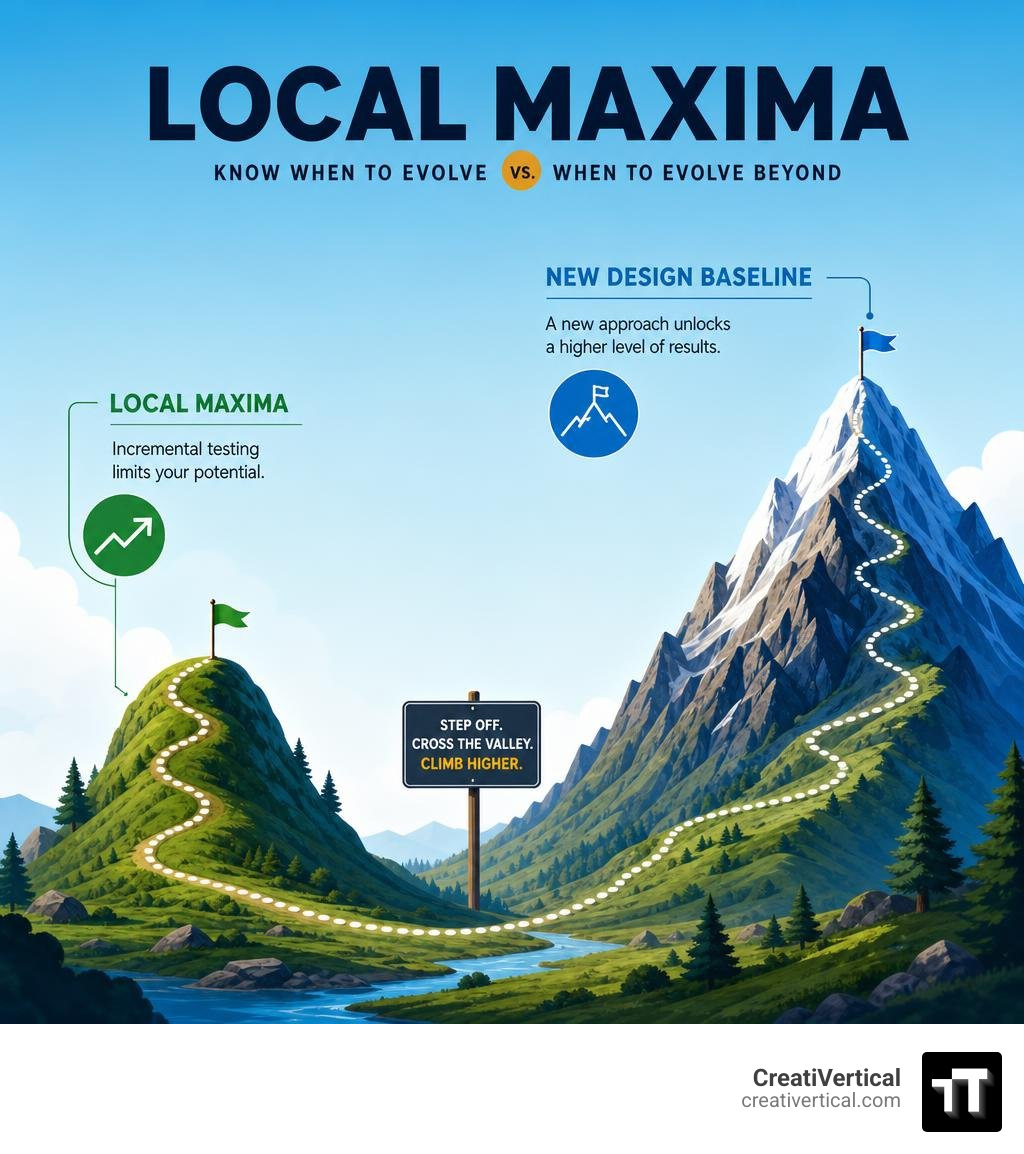
When your A/B tests stop yielding meaningful performance improvements, you have likely hit your local maxima. To reach a higher peak (the global maximum), you must step off your current hill, cross the valley, and climb a different, taller mountain. In website terms, this is when you transition from evolutionary optimization to a radical redesign, establishing a completely new design baseline that you can then begin optimizing all over again.
How does evolutionary site redesign protect search engine rankings?
An evolutionary site redesign protects your search engine rankings by eliminating the sudden, sweeping structural changes that trigger search engine ranking drops.
When you perform a traditional radical redesign, you often change your sitemap, alter page headings, rewrite copy, and update URLs all at the same time. To Google’s crawlers, your website looks like an entirely different entity, forcing the algorithm to re-evaluate your site’s authority and relevance from scratch.
With an evolutionary approach, you preserve your site’s established SEO equity because:
- URLs remain identical, preventing broken links and redirect loops.
- The internal linking structure is preserved, maintaining the flow of PageRank throughout your site.
- High-performing content is kept intact rather than being deleted or rewritten during a creative overhaul.
- Changes are introduced gradually, allowing search engines to crawl and index updates incrementally without disrupting your crawl budget.
Is an evolutionary approach cheaper than a traditional redesign?
Yes, an evolutionary approach is generally much more cost-effective than a traditional redesign, primarily because of how the budget is structured and how risk is mitigated.
A traditional radical redesign is a major capital expense (CapEx). You pay a large, upfront sum (often tens or hundreds of thousands of dollars) to design and build a site that won’t go live for six to twelve months. During this development period, you receive zero return on your investment. If the new site launches and suffers a conversion drop, you must spend even more money to diagnose and fix the issues.
An evolutionary redesign treats website improvement as an ongoing operational expense (OpEx). Instead of a massive one-time payout, you invest a predictable, monthly budget into continuous testing and development.
Because every change is tested before it is permanently implemented, you only keep updates that actively increase your conversions and revenue. This creates a continuous, compounding return on investment, ensuring that your website always functions as an active lead-generation system rather than a depreciating asset.
Conclusion
Your website is not a static brochure; it is the digital core of your business. Treating it as a project that you rebuild from scratch every few years is a high-risk, high-cost strategy that often leaves money on the table.
By embracing an evolutionary site redesign strategy, you treat your digital presence as a living, breathing system that adapts to your users’ actual behavior. You eliminate the guesswork, protect your hard-earned search visibility, and ensure that every dollar you invest in your website directly drives conversions and revenue.
At CreatiVertical, we don’t just build websites and walk away. We operate as your ongoing growth partner, delivering complete, performance-focused digital systems that encompass web development, search engine optimization, AI search visibility (GEO), and continuous optimization. Whether you are a local Kansas City business, an offshore professional services provider, an industrial manufacturer, or a government-facing technology vendor, we design, promote, and maintain your digital assets to ensure your business thrives over the long term.
Ready to stop guessing and start growing? Explore our complete Website Development services, or reach out to our team today to schedule a performance audit of your current website.