

Why a Website Redesign Is Essential for Business Growth
A website redesign is a comprehensive overhaul of your site’s information architecture, user experience (UX), visual presentation, and backend code to align with evolving business goals.
Executing an effective website redesign follows a structured five-step framework:
- Audit and Discovery: Review analytics, user friction points, search performance, and technical debt.
- Strategy and Wireframing: Map user journeys, streamline page structures, and define conversion goals.
- UI/UX Design and Prototyping: Build accessible, responsive interface layouts and test user flows.
- Development and SEO Migration: Code clean templates, optimize site speed, and map 1-to-1 301 redirects to protect existing rankings.
- Quality Assurance and Launch: Validate forms, accessibility, and cross-browser responsiveness on a staging server before going live.
Websites are operational tools, not static brochures. Research shows that 81% of users think less of a brand with an outdated website, and 38% will abandon an obsolete layout entirely. Strategic UX updates eliminate friction, with industry studies showing an average return of $100 for every $1 invested in user experience.
I’m Nicholas Cunha, founder of CreatiVertical, with over twenty years of experience managing digital infrastructure, applied AI, and web strategy for government entities, regulated firms, and growing businesses. Throughout my career, I have guided organizations through the website redesign process to protect search traffic, modernize architecture, and turn underperforming sites into measurable assets.

Website redesign word list:
Strategic Planning: Refresh vs. Full Website Redesign
Before committing capital or engineering hours, decision-makers must distinguish between cosmetic updates and architectural transformations. A visual refresh adjusts typography, brand colors, photography, and styling within an existing CMS framework. In contrast, a comprehensive website redesign fundamentally re-engineers information architecture, database schemas, responsive performance, conversion pathways, and technical infrastructure.
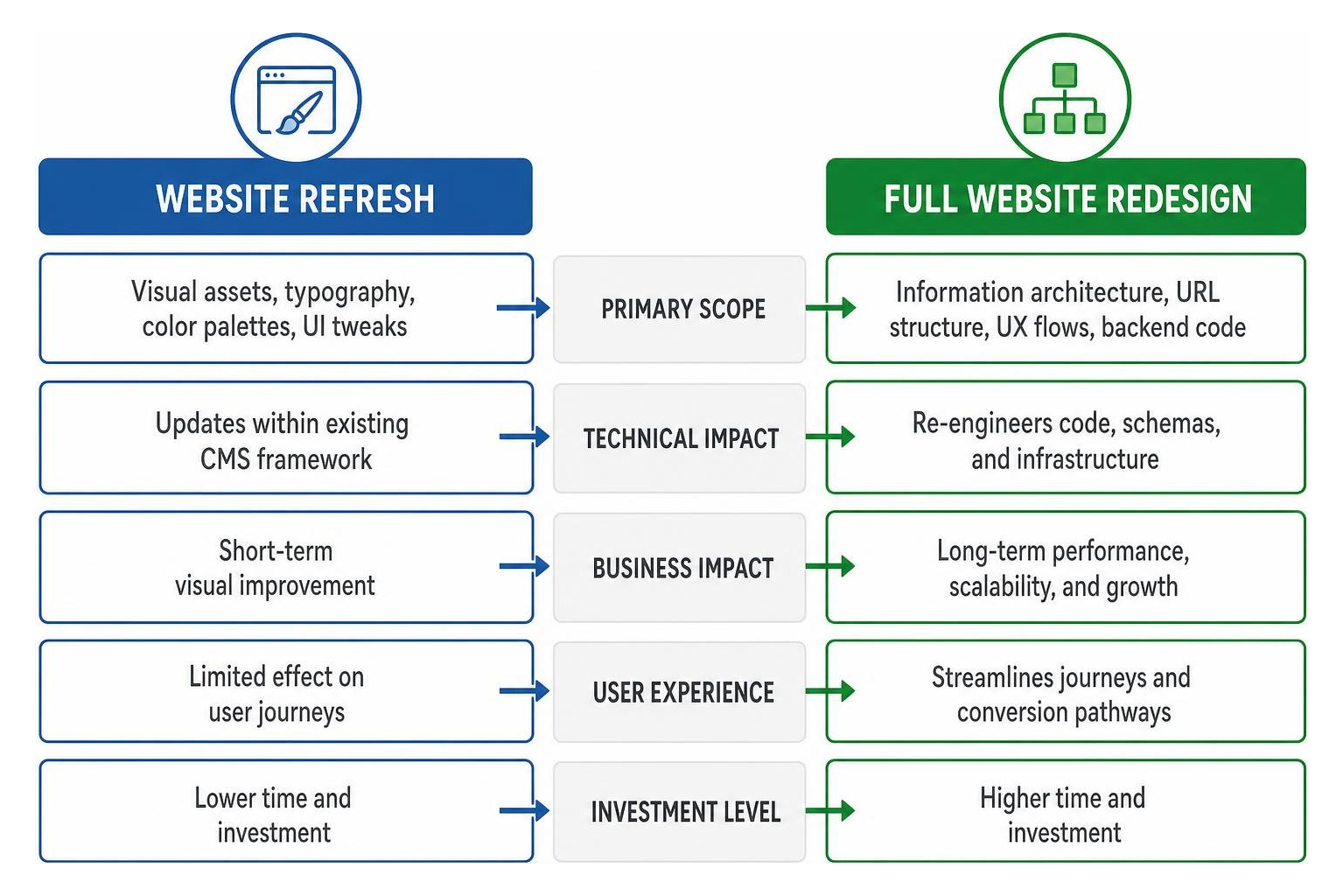
Attempting to solve deep structural friction with a superficial refresh is like repainting a commercial building that has a shifting foundation. If your analytics reveal climbing bounce rates, broken customer journeys, or unmaintainable custom code, minor aesthetic edits will not move the needle. When organizations ask how to improve a website, the answer depends on whether the underlying platform still supports their strategic direction.
| Evaluation Metric | Website Refresh | Full Website Redesign |
|---|---|---|
| Primary Scope | Visual assets, typography, color palettes, UI tweaks | Information architecture, URL structure, UX flows, backend code |
| Typical Cadence | Every 12 to 18 months | Every 18 to 30 months (or upon major business shifts) |
| SEO Impact | Minimal risk; URL paths and page hierarchies stay intact | High risk/reward; requires strict 1-to-1 redirect mapping |
| CMS & Tech Stack | Retains existing engine and database setup | Migrates or refactors CMS, clean framework exports, headless APIs |
| User Flow Changes | Minor component polish | Complete overhaul of navigation, onboarding, and checkouts |
| Resource Demand | Light design support and minor CSS updates | Cross-functional team: architects, UX researchers, developers, SEOs |
Industry leaders typically refresh their visual design every 18 to 30 months to prevent brand decay and address evolving browsing standards. With roughly 38% of visitors leaving outdated websites, keeping technical infrastructure aligned with user expectations is essential for sustained revenue generation.
Evaluating Triggers and Benchmarks for a Website Redesign
A redesign should be triggered by clear operational bottlenecks rather than subjective aesthetic preferences. Key indicators that your organization requires a structural overhaul include:
- Subpar Mobile Usability: Over 50% of global web traffic originates from mobile viewports. If desktop interfaces fail to adapt gracefully without horizontal scrolling, conversion metrics suffer.
- CMS and Plugin Fragility: Older systems weighed down by dozens of unmaintained plugins create severe technical debt and security exposures. If your marketing department hesitates to publish new pages out of fear of breaking legacy scripts, read our guide on how to stop settling for bad code: your guide to KC’s top web developers.
- Misaligned Go-To-Market Strategy: As companies introduce new capabilities, enterprise divisions, or international subsidiaries, legacy navigation menus become cluttered, obscuring core value propositions within nested dropdowns.
- Performance and Accessibility Deficits: Pages requiring more than three seconds to load face severe visitor drop-offs, directly damaging search visibility and user trust.
Establishing SMART benchmarks prior to project kickoff ensures measurable evaluation:
Choosing the Right Execution Model: In-House, Freelancers, or Agency
Selecting the appropriate execution model requires balancing internal bandwidth against technical complexity. For organizations evaluating their options, our 5 tips for choosing a website development company provides a clear framework for vetting vendor capabilities.
- In-House Teams: Internal designers and developers possess unmatched institutional knowledge. However, routine operational demands often pull them away from the intensive focus required for a major redesign, and internal groups may lack specialized technical SEO migration experience.
- Independent Freelancers: Freelancers offer cost flexibility for smaller, narrowly defined scopes. The trade-off lies in capacity constraints: a single contractor rarely possesses senior-level expertise across user research, interface design, backend systems, and search infrastructure simultaneously.
- Specialized Agencies: Full-service partners mitigate delivery risk on complex enterprise platforms. An agency provides cross-functional units (UX researchers, solution architects, systems engineers, and technical SEO specialists) who execute against strict milestones without draining your internal resources. For a complete breakdown of procurement trade-offs, consult our outsource web development comparison survival guide.
The Step-by-Step Architectural and UX Execution Framework

A successful redesign begins long before interface mockups are created. It demands a systematic discovery phase that audits user paths, uncovers drop-off points, and organizes information logically.
- Audience and User Journey Mapping: We map distinct buyer personas to concrete conversion paths. For complex organizations, high-intent prospects should reach core service details or contact pathways within two clicks.
- Information Architecture and Sitemaps: Content should be grouped into clear parent-child hierarchies. We recommend capping top-level navigation at five to seven primary categories to avoid decision fatigue.
- Wireframing and Layout Prototyping: Low-fidelity wireframes focus on visual hierarchy, message clarity, and component placement without the distraction of colors or photography. This structural phase is where teams learn to level up landing pages for maximum conversion impact.
Integrating Modern AI Acceleration into the Website Redesign Workflow
Modern development workflows incorporate applied AI to accelerate early exploration and scaffolding without sacrificing engineering rigor. Specialized platforms like ResetUI – AI Website Redesign Tool and Revamp.dev showcase how generative tools can ingest live URLs, extract existing content structures, and explore alternative layout patterns in parallel.
Rather than starting from a blank canvas, engineering teams use multi-model prompt workflows to generate functional front-end scaffolding, design tokens, and structured component specifications (such as agentic DESIGN.md documentation). Industry benchmarks show up to 60% less routine front-end boilerplate work when using AI-assisted layout scaffolding. This efficiency allows senior engineers to dedicate their attention to custom backend integrations, accessibility validation, and conversion architecture.
For regional entities and municipal organizations—such as the civic portals serving the City Of Lake Tapawingo, MO: Home—leveraging structured digital workflows ensures public information remains accessible, mobile-responsive, and easy for non-technical staff to maintain.
Prototyping, Usability Testing, and Component-Based Development
Once wireframes are approved, high-fidelity prototypes simulate live user interactions. Usability testing with external participants uncovers unexpected navigation friction, confusing forms, and layout ambiguities before developers write production code.
Modern digital properties rely on component-driven architectures. Building modular design systems with tools like Tailwind CSS, Next.js, or customized WordPress environments ensures brand consistency across every viewport. If your team relies on enterprise CMS frameworks, working with a specialized team for WordPress web design Kansas City ensures your templates remain lightweight, modular, and fully compliant with WCAG AA accessibility standards.
Organizations in communities across Jackson County, including local enterprises near Lake Tapawingo, benefit from clean code foundations that load rapidly and deliver straightforward user experiences on any device.
Protecting Organic Equity: SEO, Technical Migration, and Governance
The greatest hidden risk of a redesign is the accidental loss of search engine visibility. When site structure, internal links, or URL strings change without careful planning, search engines lose track of historical authority, causing organic traffic to drop abruptly. For structured guidance on mitigating these risks, see our manual on the ultimate guide to maintaining SEO rankings during a site redesign.
To safeguard your search visibility during a major overhaul, our team adheres to strict technical migration standards:
- Comprehensive URL Inventories: We crawl the staging and live environments to account for every indexed page carrying backlinks or search traffic.
- Strict 1-to-1 301 Redirect Mapping: Every retired or modified URL must point directly to its most relevant new equivalent. Broadly redirecting legacy URLs to the homepage dilutes page-level relevance and frustrates users.
- Metadata and Heading Preservation: Proven title tags, meta descriptions, and semantic heading structures (H1, H2) must carry over to prevent loss of topical relevance.
- Staging Validation: Staging environments must be kept private via HTTP authentication or non-indexed configurations, then thoroughly verified before DNS cutover to ensure no residual
noindextags reach production.
For organizations interested in iterative improvements over disruptive overhauls, our methodology on survival of the fittest: web design with evolutionary site redesign explains how to upgrade high-value assets progressively without introducing site-wide volatility.
Information Architecture, Content Pruning, and Search Alignment
A redesign offers an ideal opportunity to audit underperforming content. Rather than blindly migrating every legacy page, conduct a content inventory to make deliberate decisions:
- Consolidate: Merge thin, overlapping, or competing articles into authoritative resources.
- Prune: Retire obsolete notices, expired campaigns, and duplicate assets using clean 410 or 301 server responses.
- Enhance: Upgrade high-performing pages with structured data, clear author entities, and concise answers to maintain visibility in modern AI search platforms (including ChatGPT and Perplexity).
For complex backend architectures, reviewing the complete guide to outsourcing web application development can help prevent common data-structuring oversights during large migrations. Experienced engineering teams emphasize the importance of treating structural migrations as equity-preservation projects rather than simple cosmetic refreshes.
Enterprise Infrastructure, Security, and Compliance Considerations
Enterprise organizations operating in regulated sectors must account for specialized security and governance frameworks during an architectural redesign:
- Government-Facing Standards (FedRAMP / FISMA): Public sector technology providers require hardened hosting stacks, strict identity access management, and automated logging across all endpoints.
- Offshore Professional Services: Cross-border corporate providers, trust administrators, and legal firms operating in international jurisdictions need privacy-first architectures, encrypted forms, and secure client portals. To learn more about structuring international firm platforms, read our guides on the ultimate guide to BVI company formation website design and developing compliant websites for Caribbean companies.
- Automated Infrastructure: Modern deployments should integrate automated SSL renewal, strict Content Security Policies (CSP), and enterprise CDN delivery to protect data integrity and reduce latency worldwide.
Project Economics: Budgeting, Timelines, and Risk Management
Redesign costs and timelines depend directly on structural complexity, data volume, third-party integrations, and compliance requirements. For an honest evaluation of cost drivers across varying scopes, read our analysis on what should a new website cost?.
When custom server logic, CRM synchronizations, or database migrations are required, bringing in specialized engineering talent is essential. If your stack relies on legacy backend code, our detailed guide to hiring a PHP website developer covers key vetting considerations.
Realistic Timeline Expectations Across Project Scopes
Project timelines depend primarily on page volume, integration depth, and the speed of content approvals:
- Small Business Redesigns (Under 15 Pages): Typically completed in 4 to 6 weeks, focusing on clear messaging, local SEO foundations, and conversion-focused contact funnels.
- Mid-Market Corporate Platforms (15 to 50 Pages): Generally span 8 to 12 weeks, accommodating deep customer journey mapping, custom component libraries, CRM integrations, and multi-step forms.
- Enterprise & Regulated Deployments (50+ Pages, Complex APIs): Often require 3 to 6 months (or up to 12 months for phased rollouts), covering custom security reviews, database migrations, multi-department reviews, and rigorous accessibility testing.
For teams navigating contractor or vendor procurement, our outsourcing web development services: a step-by-step survival guide outlines clear milestone management strategies.
Deployment Protocol, QA Validation, and Post-Launch Monitoring
The final deployment should follow a methodical checklist to ensure continuity:
- Schedule Off-Peak Deployment: Execute DNS updates during low-traffic hours (typically late evening or weekends) to minimize disruption.
- Verify Production Indexing: Immediately confirm that staging-level
noindexdirectives have been removed and submit updated XML sitemaps to Google Search Console. - Validate Interactive Touchpoints: Test lead forms, phone click triggers, checkout funnels, and CRM data flows on live production URLs.
- Execute 30-to-60 Day Post-Launch Monitoring: Track 404 error logs, crawl statistics, page load performance, and keyword rankings weekly. Ongoing technical care is essential, as detailed in our guide to website maintenance & support in Kansas City.
Frequently Asked Questions
How often should a business invest in a redesign?
Most organizations evaluate a major redesign every 18 to 30 months. This timeframe allows companies to adapt to changing user behavior, prevent technical debt from accumulating, and keep their brand presentation aligned with market positioning.
Will a redesign hurt existing Google search rankings?
A redesign will not damage your rankings if technical migration protocols are properly planned and executed. Ranking drops typically happen when URLs are changed without 1-to-1 301 redirects, high-ranking content is stripped out, or noindex tags are left on production code. Following a strict migration checklist protects your historical search authority.
How much does a typical redesign cost in 2026?
Market pricing varies based on scope, technical complexity, and regulatory requirements. As a general industry reference:
- Small business sites: Typically range from $2,000 to $10,000.
- Mid-sized B2B and corporate platforms: Commonly run between $10,000 and $30,000.
- Complex enterprise, e-commerce, or regulated systems: Frequently range from $30,000 to $50,000+.
Ongoing SEO, AI visibility, and marketing retainers across the industry typically range from several hundred to several thousand dollars per month, depending on competitive landscape and target goals.
Conclusion
A successful website redesign is an investment in your company’s digital infrastructure. It eliminates operational friction, preserves and grows hard-won search equity, and delivers an intuitive, accessible experience for every visitor.
At CreatiVertical, we operate as an ongoing growth partner rather than a one-and-done project shop. Based in Missouri and serving clients nationwide—from local Kansas City businesses to government-facing contractors and international professional services firms—we build scalable, high-performance systems that combine brand clarity, technical SEO, and applied AI enablement.
Explore our custom website development services to start planning an architectural redesign that supports your long-term business goals.