
What a PHP Website Developer Does for Your Business
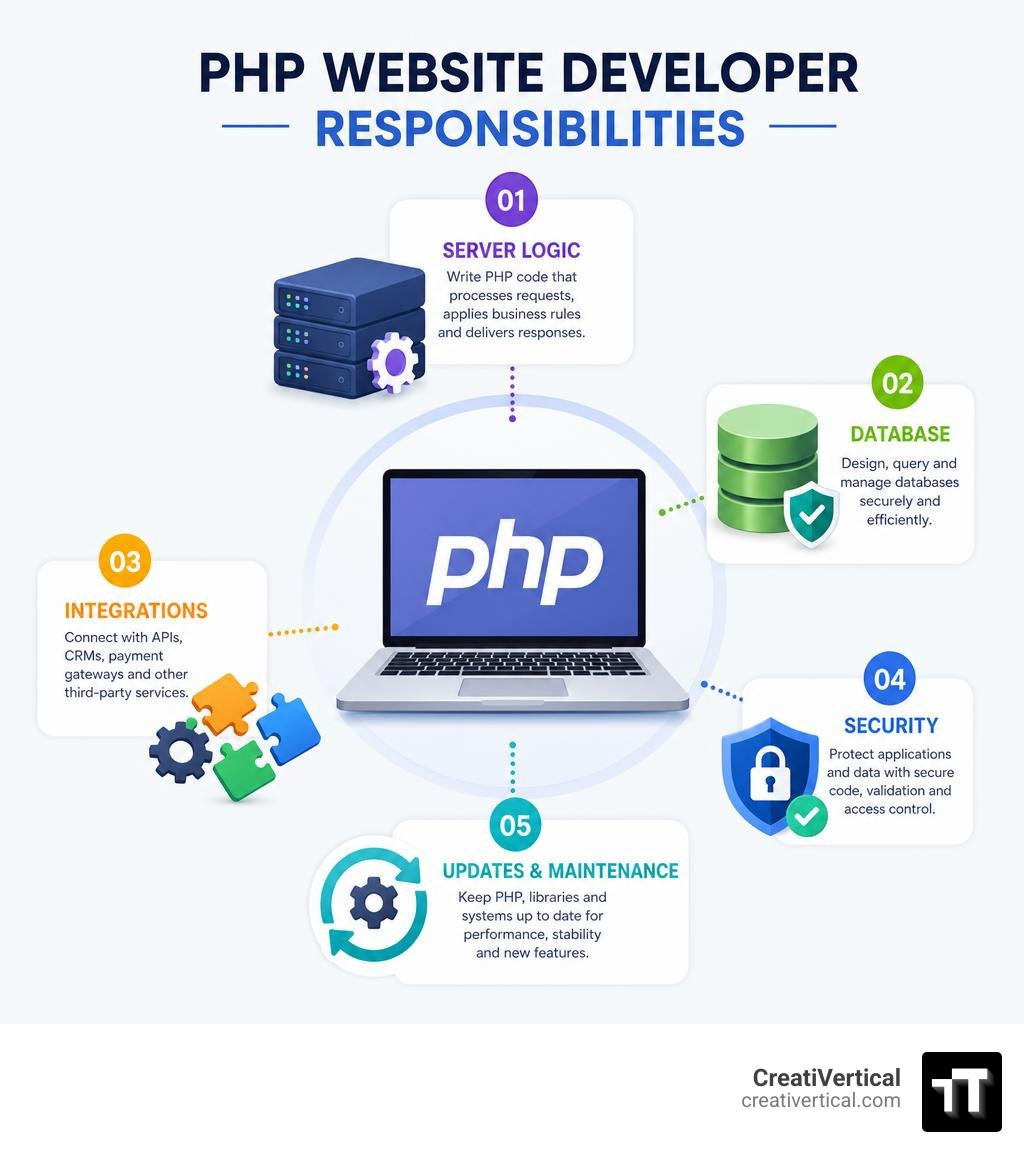
A php website developer builds and maintains the server-side parts of a website or web application. They write the code that receives form submissions, reads and updates databases, connects to CRM or payment systems, manages user accounts, and sends the finished page or data response to a visitor’s browser.
In short, a PHP developer is responsible for the parts of a site your customers rarely see but your business depends on:
- Dynamic website features, such as portals, calculators, directories, and e-commerce
- Database design and secure data handling
- WordPress themes, plugins, and custom CMS features
- Integrations with CRMs, payment gateways, APIs, and internal tools
- PHP version updates, security patches, testing, and performance work
PHP is an open-source, general-purpose scripting language designed especially for web development. It remains the technology behind many content-driven websites and platforms, including WordPress-based sites, as well as custom applications that need practical server-side logic.
For a business with an outdated site, the hiring question is not simply, “Can this person write PHP?” It is whether they can understand the existing system, improve it without breaking essential workflows, and create a codebase your team can maintain. Modern PHP work often includes frameworks such as Laravel or Symfony, database tools such as MySQL or PostgreSQL, and front-end systems such as React or Vue where the project calls for them.
I am Nicholas Cunha, founder of CreatiVertical, with more than 20 years of agency and project work across web development, including institutional and government-facing digital projects. As a php website developer partner, I look at the code, the business workflow, search visibility, and the integrations that need to work after launch – not just the page design.
Quick php website developer terms:
What Does a Modern PHP Website Developer Do?
When we think about modern web applications, it helps to imagine a well-oiled control room operating behind a polished glass interface. While front-end developers craft the interactive visual layout using HTML, CSS, and JavaScript, the PHP engineer powers the mechanical engines, data valves, and secure authentication channels running underneath.
PHP operates as a server-side language. This means when a client requests a page, the web server executes the underlying PHP script, gathers data from relational databases or remote software interfaces, converts that information into plain HTML or JSON responses, and streams it back to the user’s browser. Because the processing happens on the server before reaching the client, sensitive database credentials and business logic remain hidden from external view.

A professional php website developer bridges technical database architecture with user-facing features. Whether you are running a regional manufacturing portal in Missouri or managing complex digital services across multiple continents, custom PHP engineering keeps your platform responsive, structured, and resilient. To explore broader strategy on full-scale digital infrastructure, see our dedicated guide to Website Development.
Core Responsibilities of a Dedicated PHP Website Developer
The everyday workload of a dedicated backend developer goes well beyond typing basic script tags into flat web pages. Standard technical responsibilities include:
- Backend Architecture: Designing scalable software patterns (such as Model-View-Controller) that keep business logic clean, testable, and separate from visual design templates.
- Relational Database Management: Structuring MySQL, MariaDB, or PostgreSQL databases with clean indexing, efficient query execution, and reliable data relationships.
- API Development and Integration: Constructing custom RESTful endpoints or GraphQL interfaces, alongside connecting third-party platforms such as Stripe for billing or HubSpot for lead management.
- Security Hardening: Protecting forms and database queries against malicious intrusions, cross-site scripting (XSS), SQL injection, and unauthorized data access.
- Code Refactoring and Maintenance: Updating legacy procedural scripts into modern object-oriented PHP to ensure future maintenance stays simple and cost-effective.
When evaluating skilled engineers, you will encounter professionals with diverse backgrounds, such as full-stack website developers specializing in structured software testing, or specialized contractors focused on server hardening.
Types of PHP Development Services
Because PHP is adaptable, development services fall into several distinct disciplines based on operational requirements:
- Custom Web Application Development: Ground-up construction of SaaS web tools, membership dashboards, customer portals, and internal workflows.
- CMS Customization and Extension: Writing custom plugins, shortcodes, and tailored admin panels for CMS environments like WordPress without modifying core system software.
- Framework Engineering: Building high-throughput applications using structured PHP frameworks such as Laravel, Symfony, or CodeIgniter.
- Legacy Code Rescue and Upgrades: Refactoring outdated PHP 5.x or 7.x scripts to active PHP 8.x standards, eliminating security debt while preserving historical data.
- API and Automation Enablement: Linking web forms with internal enterprise resource planning systems, custom AI tools, or external distribution tracking networks.
Businesses considering external technical support can review our resource on The Complete Guide to Outsourcing Web Application Development to weigh project scoping strategies.
Essential Qualifications and Technical Skills to Evaluate
Finding the right php website developer requires looking past surface-level claims and evaluating actual technical engineering habits. Modern PHP is vastly different from the lightweight scripting language launched back in 1995.

With active updates across the PHP 8.x family, modern PHP is a strongly typed, highly performant object-oriented language equipped with Just-In-Time (JIT) compilation, union types, attributes, and explicit error handling. An experienced developer should display deep familiarity with these updated paradigms rather than relying on outdated procedural patterns.
Evaluating Technical Proficiency in a PHP Website Developer
To separate qualified web application engineers from casual site builders, evaluate candidate capability across these technical pillars:
- PHP 8.x Feature Mastery: Look for experience with typed properties, named arguments, match expressions, and constructor property promotion.
- Database Access Security: Proficiency using PHP Data Objects (PDO) or object-relational mappers (ORMs) like Eloquent or Doctrine to enforce prepared statements.
- Package Management via Composer: Ability to integrate third-party libraries cleanly while maintaining lean, light dependencies to minimize security risks.
- Automated Testing & Static Analysis: Experience running PHPUnit for unit testing and static analysis tools like PHPStan or Psalm to uncover code errors before release.
- Framework Ecosystems: Deep operational familiarity with frameworks like Laravel or Symfony, or specialized tools highlightable by expert PHP developers and full-stack engineers.
Security Standards and Release Version Management
Security in PHP development is not an afterthought; it must be built directly into the codebase architecture from day one. Many historical security complaints associated with PHP stem from poor coding standards or unmaintained third-party code rather than flaws in the language itself.
A qualified developer follows strict Open Web Application Security Project (OWASP) guidelines. Key practices include:
- Input Sanitization & Parameterized Queries: Eliminating SQL injection vectors by separating SQL code from dynamic user inputs.
- Cross-Site Request Forgery (CSRF) Mitigation: Implementing cryptographic tokens on forms and data transmission endpoints.
- Access Control: Enforcing strict Role-Based Access Control (RBAC) to restrict administrative functionality to verified accounts.
- Active PHP Version Maintenance: Keeping servers running actively supported releases. PHP core branches receive security updates over structured multi-year lifecycles, with release branches like PHP 8.2, 8.3, 8.4, and 8.5 maintained regularly, while upcoming branches like PHP 8.6 undergo active testing.
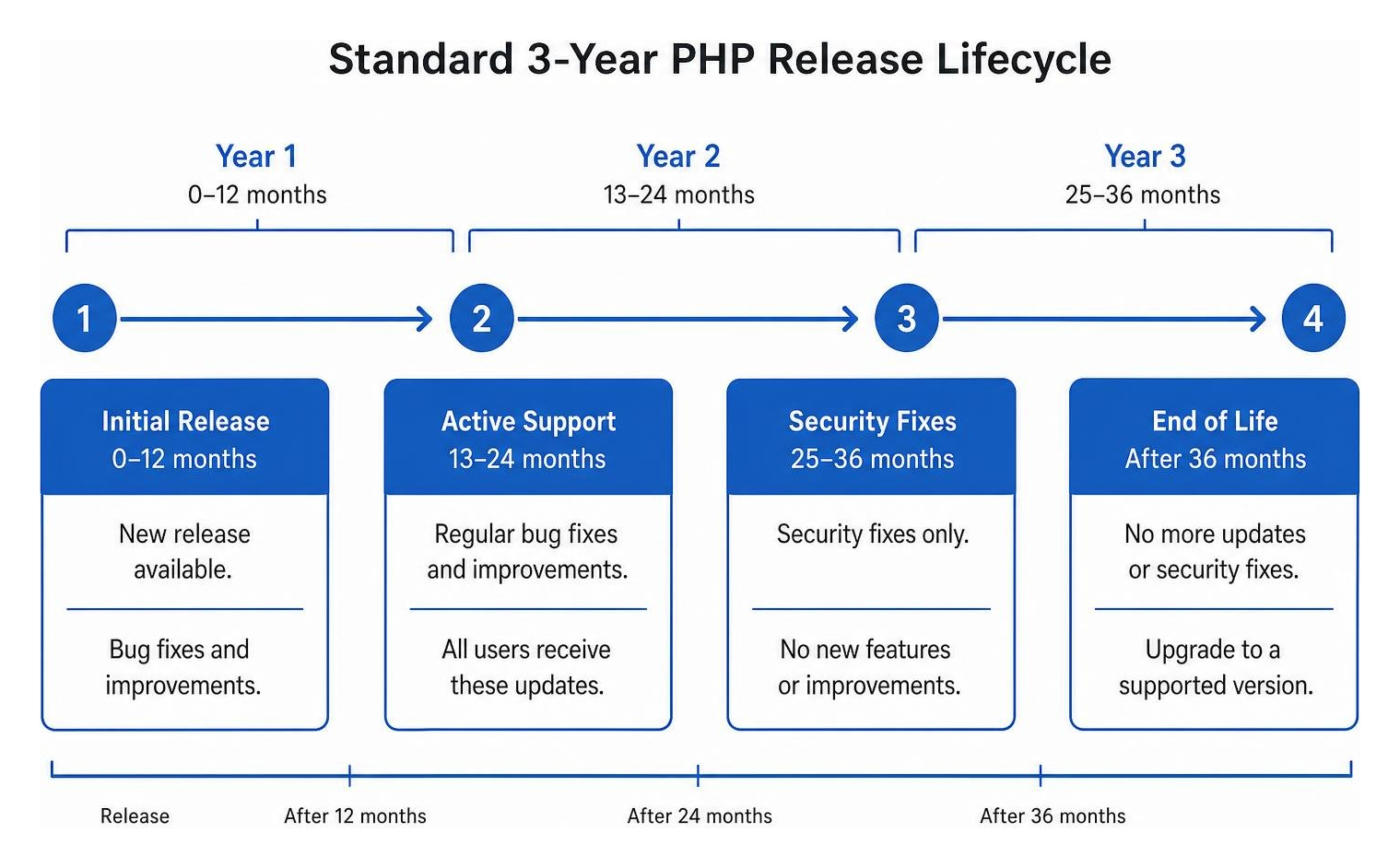
Deploying applications on EOL (End-of-Life) versions leaves systems vulnerable to known exploits. For a detailed breakdown of secure hosting infrastructure, review our In Depth Guide to Managed Hosting.
How to Hire and Cost Considerations for PHP Development
Selecting the proper engagement model depends on project complexity, overall timeline, internal technical capacity, and long-term support plans.
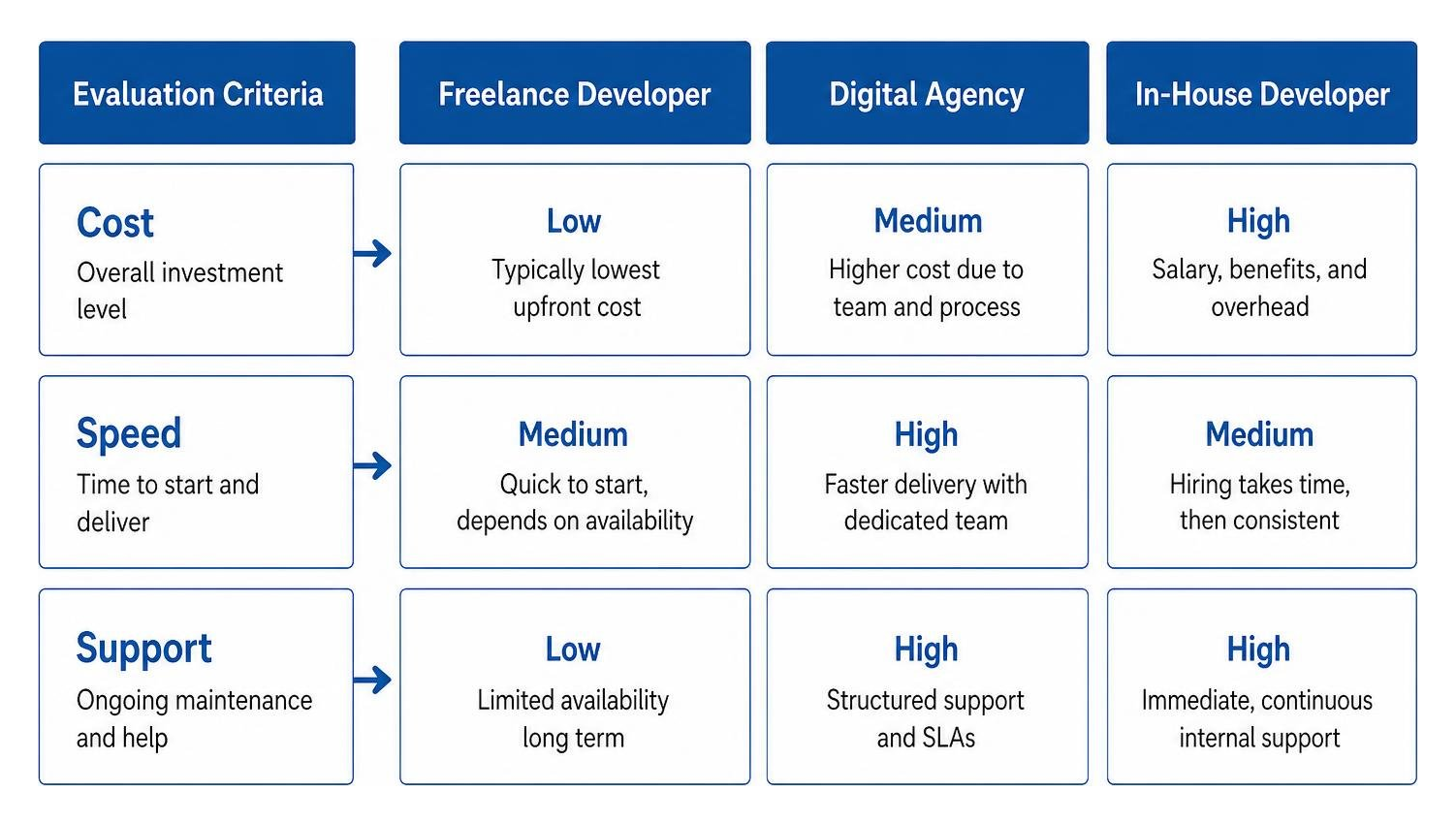
| Engagement Model | Typical Cost Structure | Primary Advantages | Best Suited For |
|---|---|---|---|
| Freelance Developer | $18 – $200 / hour | Direct communication, flexible scope, lean overhead | Small feature updates, bug fixes, niche custom scripts |
| Digital Agency | Project quote or retainer | Turnkey team (design, dev, QA), long-term stability | End-to-end web applications, compliance, multi-system builds |
| In-House Staff | Annual salary + benefits | Full operational focus, immediate internal availability | Core platform products needing daily continuous development |
When searching online marketplace portals, you will find vast numbers of independent candidates; for instance, platforms like Upwork feature over 74,000 client reviews for PHP freelancers, while Fiverr lists thousands of individual PHP development gig packages. Alternatively, localized job boards can assist if you are targeting full-time regional positions, such as looking for PHP Developer Jobs in Missouri.
For organizational guidance on selecting external technical teams, explore our practical steps on how to Find Reliable Website Development Agency Tips.
Breakdown of Rates and Project Costs
Rates for hiring a php website developer vary significantly based on developer location, specialized expertise, and project scope. General industry pricing benchmarks break down as follows:
- Freelance Rate Tiers: Budget-tier developers typically charge $18 to $50 per hour for basic customization work. Mid-tier engineers range from $50 to $100 per hour for reliable framework development. Senior full-stack engineers and backend architects charge $100 to $200+ per hour for mission-critical software.
- Starter Web Systems: Basic custom dynamic sites or custom CMS builds usually range from $500 to $2,500.
- Custom Web Applications & SaaS Platforms: Dedicated web applications, complex portals, and custom SaaS tools typically run from $4,000 to $50,000+, with major enterprise platform overhauls extending beyond that range based on overall scale.
To evaluate project budgeting considerations in depth, read our guide on What Should a New Website Cost.
Common Development Challenges and Performance Tuning
Even well-built web applications encounter technical performance friction as user traffic and database size grow.

Common backend hurdles and their engineering solutions include:
- Upgrading Legacy Codebases: Older applications running on obsolete PHP 5.x or 7.x software face performance loss and security threats. A senior engineer systematically refactors code, updates deprecated functions, and upgrades database calls to modern standards.
- Database Query Bottlenecks: Unindexed database tables or inefficient ORM queries create server latency. Optimization involves adding composite indexes, leveraging query caching, and implementing Redis for rapid memory storage.
- High-Throughput Execution: Utilizing bytecode caching through OPcache and deploying modern application runtimes like FrankenPHP or Nginx configurations speeds up response times significantly.
- Software Hardening and System Recovery: Experienced developers maintain clean, version-controlled systems equipped with automated backups and security monitors, ensuring reliable production standards.
Frequently Asked Questions About PHP Web Development
Why is PHP still a relevant choice for web application development?
PHP powers over 75% of dynamic websites across the web. Modern PHP 8.x is fast, memory-efficient, strongly typed, and backed by established frameworks like Laravel and Symfony. Its widespread adoption ensures hosting infrastructure remains cost-effective, while developer talent is widely accessible.
How do I choose between Laravel, Symfony, and custom core PHP?
Custom core PHP is ideal for small, self-contained scripts or lightweight microservices where minimal dependencies are preferred. Laravel excels for rapid application development, offering elegant syntax, rich package ecosystems, and fast time-to-market. Symfony provides modular enterprise architecture preferred for complex, highly customized business applications that require long-term stability.
What are the risks of running end-of-life PHP versions?
Running unsupported versions (such as PHP 7.4 or earlier) leaves your web server exposed to unpatched security vulnerabilities. In addition, legacy releases lack performance enhancements found in PHP 8.x, fail compliance audits (such as PCI-DSS or FedRAMP benchmarks), and prevent your application from utilizing modern third-party libraries.
Conclusion
Selecting the right php website developer comes down to looking beyond simple template assembly and choosing a engineering partner focused on code quality, security, and long-term system stability. Whether you need to rescue a legacy application, integrate enterprise APIs, or launch a custom web platform, investing in clean backend development ensures your digital assets remain stable as your business grows.
At CreatiVertical, we deliver performance-focused digital systems designed to support your broader operational goals. From custom backend programming and managed cloud hosting to search engine visibility and AI workflow enablement, we work alongside you as an ongoing growth partner.
If you are ready to evaluate your current web software or plan your next custom application build, explore our dedicated Website Development solutions or contact our team to discuss your project.