
Strategic Options to Outsource Web Development: Comparing In-House, Agency, and Offshore Models
When you evaluate how to outsource web development, comparing models requires looking past simple hourly rates. The true financial impact involves recruitment costs, onboarding delays, equipment, management overhead, and post-launch maintenance.
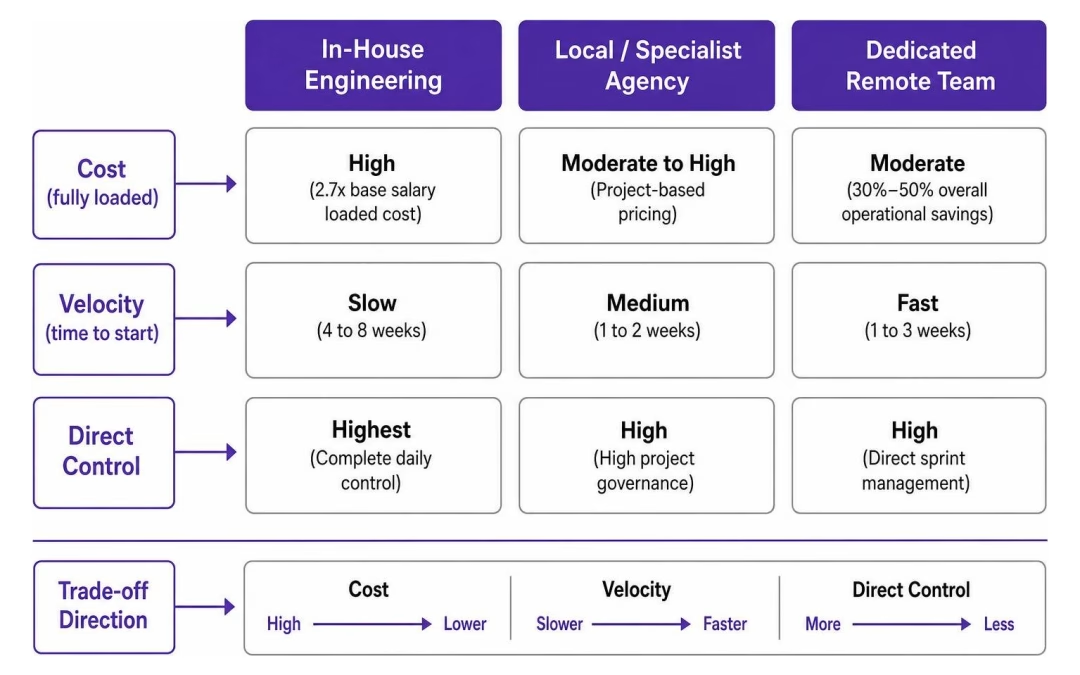
Building an internal engineering department requires significant resources. Global data shows that hiring a full-time senior developer takes 4 to 8 weeks on average, with recruitment agency fees running 15% to 30% of the candidate’s first-year base salary. Beyond salary, employee benefits, hardware, software licenses, and office overhead push the fully loaded cost multiplier to approximately 2.7 times base salary—meaning a $120,000 developer actually costs closer to $324,000 annually to maintain.
When you outsource web development, you trade fixed overhead for flexible capacity. However, different outsourcing models carry distinct trade-offs regarding project control, technical depth, and accountability.
| Delivery Model | Typical Timeline to Start | Fully Loaded Cost Impact | Direct Strategic Control | Best Use Case |
|---|---|---|---|---|
| In-House Engineering | 4 to 8 weeks | High (2.7x base salary loaded cost) | Complete daily control | Core IP product development and continuous internal iteration |
| Local / Specialist Agency | 1 to 2 weeks | Moderate to High (Project-based pricing) | High project governance | Strategic builds, complex integrations, and compliance-heavy sites |
| Dedicated Remote Team | 1 to 3 weeks | Moderate (30%–50% overall operational savings) | Direct sprint management | Ongoing feature rollouts, app maintenance, and scaling backlogs |
| Offshore Project Outsourcing | 1 to 2 weeks | Low to Moderate (Hourly rates from $25–$60) | Vendor-managed delivery | Well-defined standalone web builds or fixed-scope conversions |
Understanding these structures helps you decide whether to retain architectural oversight internally while relying on external engineering teams for execution, as detailed in The Complete Guide To Outsourcing Web Application Development.
Evaluating In-House Engineering vs Remote Agencies
Choosing between internal hires and remote agencies depends on whether web engineering serves as your core business product or as an operational foundation that powers sales, marketing, and client administration.
In-house developers offer deep institutional context and immediate availability for daily iterations. However, managing specialized tech stacks solely in-house often leads to resource bottlenecks. If your primary focus is running an offshore fiduciary firm, manufacturing precision components, or managing industrial logistics, maintaining a full team of front-end, back-end, DevOps, and QA engineers in-house rarely makes financial sense.
Partnering with an external agency provides immediate access to a cross-functional team without ongoing payroll liabilities. Remote agencies handle modern stack execution, routine updates, and infrastructure scaling, allowing your internal leadership to focus on high-value business goals. To assess your current digital setup before deciding on a partner, read our guide on How To Improve A Website.
Key Engagement Models to Outsource Web Development Projects
Selecting the right contractual model ensures project expectations match delivery mechanisms:
- Fixed-Price Contracts: Ideal for well-defined, short-term builds (such as a 5-page marketing site or a straightforward portal) where specifications are locked. The vendor absorbs scope risk, but any deviation requires a formal change request.
- Time and Materials (T&M): Best for evolving products, initial MVPs, or complex web applications where requirements shift based on user feedback. You pay for actual engineering hours worked, providing flexibility to pivot features without contract renegotiation.
- Dedicated Development Teams: A fully embedded squad (developers, UI/UX designers, and QA testers) working exclusively on your project sprint by sprint. This model suits engagements lasting 3 months or longer, providing team continuity and direct oversight.
- Outcome-Based Milestones: Structured payment triggers tied directly to verified technical deliverables—such as passing automated security scans, meeting Core Web Vitals performance benchmarks, or achieving WCAG accessibility standards—rather than simple calendar dates.
When seeking senior developers for full-time or hourly engagements, specialized global hiring networks offer options to hire pre-vetted specialists.
Regional Tech Hub Comparison: Evaluating Global Outsourcing Destinations

Geographic location impacts developer rates, time zone overlap, communication dynamics, and regional expertise when you outsource web development.
Asia-Pacific Tech Hubs: India, Vietnam, and the Philippines
The Asia-Pacific region remains a major hub for technical staff augmentation, offering massive talent pools and substantial cost efficiency:
- India: Represents one of the largest IT talent pools globally and ranks as the second-largest English-speaking population in the world. Indian dev centers offer deep engineering capability across enterprise cloud stacks, microservices, and AI integrations, with rates typically spanning $25 to $60 per hour.
- Vietnam: A rapidly emerging technology hub with over 560,000 tech professionals and roughly 60,000 new IT graduates entering the workforce annually. Vietnam offers 30% to 50% overall cost savings compared to Western markets, backed by strong government investment in STEM education and tech infrastructure.
- The Philippines: Recognized for exceptional English fluency, strong cultural alignment with Western business environments, and customer support capabilities. Philippine software engineering teams excel in front-end development, custom CMS management, e-commerce builds, and ongoing site maintenance.
Eastern European Hubs: Poland and Ukraine
Eastern European technology hubs offer strong engineering fundamentals, complex software development capabilities, and convenient time zone overlap with Western Europe and North American morning business hours:
- Poland: Consistently ranks among the top countries globally for software engineering skill. Around 30% of the population speaks English fluently, and developers excel in complex backend architecture, Java, Python, and compliance-heavy fintech buildouts. Rates generally range from $50 to $100 per hour.
- Ukraine: Ukrainian developers demonstrate high technical proficiency, holding an average challenge score of 88.7% on global HackerRank assessments. Regional dev centers deliver high-grade engineering across cloud infrastructure, custom web portals, and advanced Web API developments at competitive rates ($45–$85/hr).
Financial Planning, Contract Structure, and Governance Risks

Industry benchmark costs to outsource web development generally range from $20,000 for a custom corporate website up to $70,000 for an interactive customer portal, and $400,000+ for enterprise software systems. Preventing budget creep requires clear contract governance.
To plan your initial investment accurately, consult our step-by-step guide on Outsourcing Web Development Services A Step By Step Survival Guide alongside our market pricing framework covering What Should A New Website Cost.
Critical Red Flags When You Outsource Web Development Services
Spotting potential warning signs during vendor selection protects your budget and project timeline:
- Artificially Low Bids: Offers priced far below market averages inevitably force compromises in code quality, security protocols, automated testing, or project documentation. Fixing substandard code can cost two to three times the original budget.
- Vague Scope Agreements: Estimates lacking explicit deliverable lists, wireframes, or clear functional acceptance criteria lead to scope creep and contractual friction later.
- Unregulated AI Usage (“Shadow AI”): Developers pasting proprietary business logic or source code into public LLMs for debugging introduces security and compliance risks. Ensure your vendor adheres to a formal AI governance policy.
- Communication Gaps: Unclear daily communication, missing project management tools, or extended response delays signal future execution bottlenecks.
Intellectual Property Rights and SLA Frameworks
A legally sound software development agreement must include explicit safeguards:
- Unambiguous IP Assignment: The contract must state that 100% of the custom source code, design files, database architectures, and documentation belong exclusively to your business upon payment.
- Warranty and Bug-Fix Coverage: Mandate a post-launch warranty period (typically 30 to 90 days) where the vendor remediates critical code errors at zero additional charge.
- Regulatory and Accessibility Compliance: For regulated sectors—such as legal services, industrial manufacturing, or public-sector tech—ensure your vendor complies with relevant standards, including WCAG 2.2 AA accessibility rules, GDPR, and ISO 27001 security protocols.
Learn more about evaluating prospective agency qualifications in our guide to Find Reliable Website Development Agency Tips.
Operational Execution: Managing Remote Engineering Teams Effectively

Successfully managing an outsourced team requires clear communication channels, defined sprint cadences, and continuous progress visibility.
Technical Communication Protocols and Code Governance
To maintain accountability across remote development teams, establish standard developer management workflows:
- Adopt Agile Sprint Cycles: Divide project work into two-week sprints managed through tracking platforms like Jira, Trello, or Asana.
- Require Peer Code Reviews: Enforce mandatory code pull requests (PRs) reviewed by a senior engineer prior to merging updates into production environments.
- Automate CI/CD Pipelines: Implement continuous integration and deployment pipelines with automated linting, security vulnerability checks, and regression testing.
- Schedule Regular Standups: Conduct daily or tri-weekly asynchronous check-ins to identify blockers early and keep work moving forward across time zones.
Optimizing International Payments and FX Expense Controls
Paying overseas development agencies through traditional commercial bank wire transfers can introduce hidden overhead. Banks frequently apply a 2% to 6% foreign exchange markup on exchange rates alongside high international wire transfer fees.
Using multi-currency payment platforms can reduce currency conversion markup costs by up to 40% compared to traditional bank transfers. Establishing milestone-based payment schedules tied to verified sprint deliverables keeps project incentives aligned while protecting working capital.
Frequently Asked Questions About Web Development Outsourcing
What are the main benefits and cost savings of outsourcing web development?
Outsourcing offers access to specialized engineering skills without the overhead of full-time hiring. Businesses avoid recruitment fees, benefit packages, and software licenses, achieving overall operational savings of 30% to 50% compared to equivalent in-house builds.
How do you prevent data leaks and code exposure when working with remote teams?
Protect your assets by signing Mutual Non-Disclosure Agreements (NDAs) and Master Services Agreements (MSAs) before sharing documentation. Restrict repository access using secure permission controls, mandate multi-factor authentication, ensure code rests on encrypted cloud environments, and require strict adherence to ISO 27001 or SOC 2 security protocols.
Should early-stage startups choose fixed-price or dedicated team contracts?
Startups launching a basic, fully defined website benefit from fixed-price contracts to lock in costs. However, early-stage startups developing evolving digital products or MVPs generally achieve better results using time-and-materials or dedicated team models, which allow rapid feature iteration based on real user feedback.
Conclusion
Choosing to outsource web development is strategic. Success depends on selecting a model that balances speed, cost efficiency, code quality, and long-term maintainability. Whether you choose a fixed-price project or an embedded remote team, clear scope definition, robust IP contracts, and disciplined code governance protect your investment.
At CreatiVertical, we operate as a complete digital growth partner. Based in Kansas City, our family-run agency works alongside local businesses, offshore professional services providers, industrial manufacturers, and government-facing technology vendors. We deliver performance-focused digital systems—combining custom web engineering, SEO, AI search visibility (GEO), and applied workflow automation into maintainable growth foundations.
Ready to build a secure, high-performing web application without losing control of your roadmap? Explore our custom Website Development services today to start your project with confidence.