

How Medical Clinics Can Improve Local Online Visibility
Medical clinics can improve local online visibility by keeping their Google Business Profile complete and accurate, building consistent listings across trusted healthcare directories, earning recent reviews through a privacy-safe process, and creating useful pages for each service, provider, and physical location.
Start with these priorities:
- Make every clinic location easy to verify. Use the same name, address, phone number, hours, appointment link, insurance details, and services on your website, Google Maps, Apple Maps, and healthcare directories.
- Treat Google Business Profile as a patient-facing landing page. Choose the most specific category available, add real clinic and team photos, list services clearly, and keep hours and holiday closures current.
- Build pages around real patient intent. A patient looking for “dermatologist near me” needs clear service, location, provider, scheduling, and insurance information – not a thin city page stuffed with keywords.
- Earn reviews without exposing private information. Ask consistently after visits, never buy or filter reviews, and use neutral replies that do not confirm someone was a patient.
- Make the site clear for both search engines and AI tools. Fast mobile pages, medical schema, provider credentials, and direct answers to common questions help Google and AI search systems understand your clinic.
For clinics, local visibility is not just traffic. It is whether a nearby person can quickly decide to call, request directions, check insurance, or book an appointment. Google Maps and the Local Pack often appear before standard website results, while directory portals can take attention away from a clinic’s own booking path.
The practical goal is to create one consistent version of the truth across your profile, website, directories, and patient communications. That foundation supports traditional local SEO as well as AI-driven results such as Google AI Overviews, where clear, well-structured medical information is easier to surface.
I am Nicholas Cunha, founder of CreatiVertical, a Kansas City family-run agency focused on web development, SEO, AI search visibility, and practical AI enablement. With more than two decades of agency and digital project experience, I help organizations understand how medical clinics can improve local online visibility with clearer websites, stronger search foundations, and useful automation.
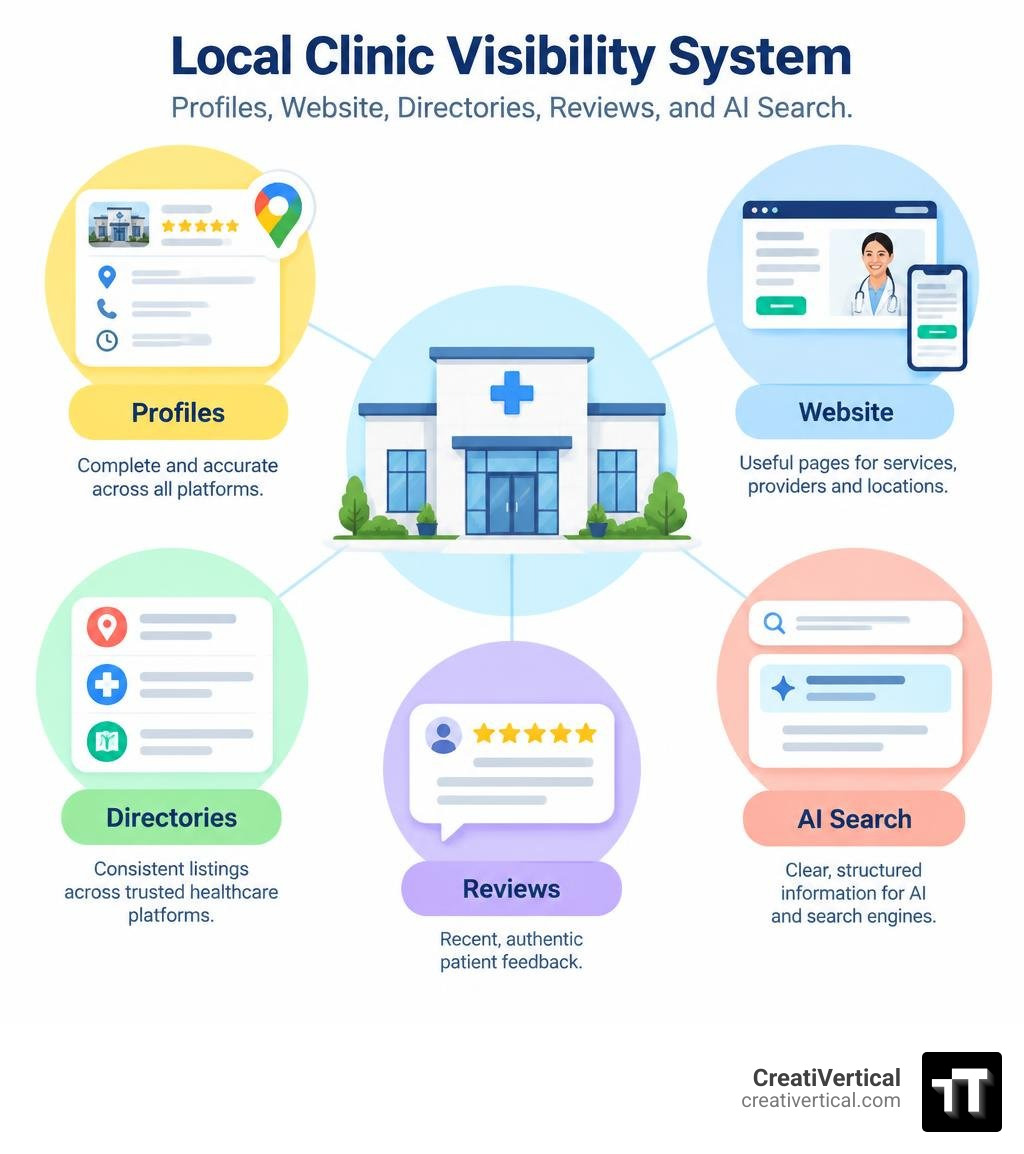
Common how medical clinics can improve local online visibility vocab:
Why Local Search and Maps Dominate Healthcare Patient Acquisition
When someone experiences acute back pain or needs an annual screening, they rarely browse beyond the first screen of results. Most patients search online before scheduling an appointment, and a large majority turn directly to digital map services for local healthcare discovery. The Google Maps Local Pack captures a major share of local clicks, with many searchers never clicking past map listings at all. In practice, clinics featured inside the Local Pack secure significantly more bookings than those positioned below it.
Google determines Local Pack placement using three core signals:
- Relevance: How accurately a clinic’s profile, categories, and service content match the clinical intent of the user.
- Distance: The physical proximity between the searcher’s device location and the verified clinic address.
- Prominence: The online authority and reputation of the practice, established through review volume, citation consistency, and website domain trust.
For medical practices, prominence functions as a direct proxy for clinical trust. While distance remains a fixed physical constraint, relevance and prominence can be systematically improved. As outlined in Google’s guidance on local ranking, treating map listings as high-conversion landing pages rather than static phonebook entries is essential for long-term patient acquisition.
| Channel / Source | Patient Intent Level | Long-Term Acquisition Cost | Retention & Conversion Control | Data & Booking Ownership |
|---|---|---|---|---|
| Google Maps Local Pack | High (Immediate need) | Low (Organic asset) | High (Direct clinic funnel) | 100% Owned by clinic |
| Owned Website Organic Search | Moderate to High | Low to Moderate | High (Custom patient flow) | 100% Owned by clinic |
| Third-Party Aggregator Portals | Moderate to High | High (Per-lead or subscription fees) | Low (Competitors shown alongside) | Shared / Owned by platform |
| Paid Local Search Ads (PPC) | High (Immediate need) | High (Ongoing cost per click) | Moderate (Landing page dependent) | 100% Owned by clinic |
The 2026 Shift: From Traditional Search to Local AI Overviews
Search behavior continues to evolve rapidly. In 2026, AI Overviews and answer engines like Perplexity and ChatGPT increasingly appear for symptom-related queries. Rather than simply serving ten blue links, these generative interfaces synthesize answers directly, extracting data from structured websites and local directories.
Winning local discovery now requires maintaining a machine-readable digital footprint. When search engines can extract exact clinical capabilities, accepted insurance networks, provider credentials, and clinic hours from structured schema, they cite that practice within conversational answer cards. Applying proven steps for local online visibility ensures that your medical practice remains visible across both traditional map packs and conversational AI interfaces.
Competing Against Aggregator Portals Like Zocdoc and Healthgrades
Commercial aggregators such as Healthgrades, Zocdoc, and WebMD collectively capture a large share of clicks for generic “doctor near me” searches. These platforms invest heavily in broad directory SEO, monetizing patient clicks by charging clinics ongoing listing fees or per-booking commissions.
Independent and group practices do not need to outspend these massive directories to outrank them locally. Aggregators struggle with hyper-local prominence and real-time operational accuracy. By establishing a robust Google Business Profile, accumulating localized patient reviews, and developing service pages rich in clinical depth, medical clinics can outrank third-party aggregators in localized Map Packs. This shifts patient acquisition away from rented third-party portals back toward owned, commission-free booking channels.
Step-by-Step Guide: How Medical Clinics Can Improve Local Online Visibility

A comprehensive local SEO strategy connects map profiles, citation directories, on-site website architecture, and compliant reputation management into a single operational system. By systematically connecting these core components, medical practices can build durable geographic authority.
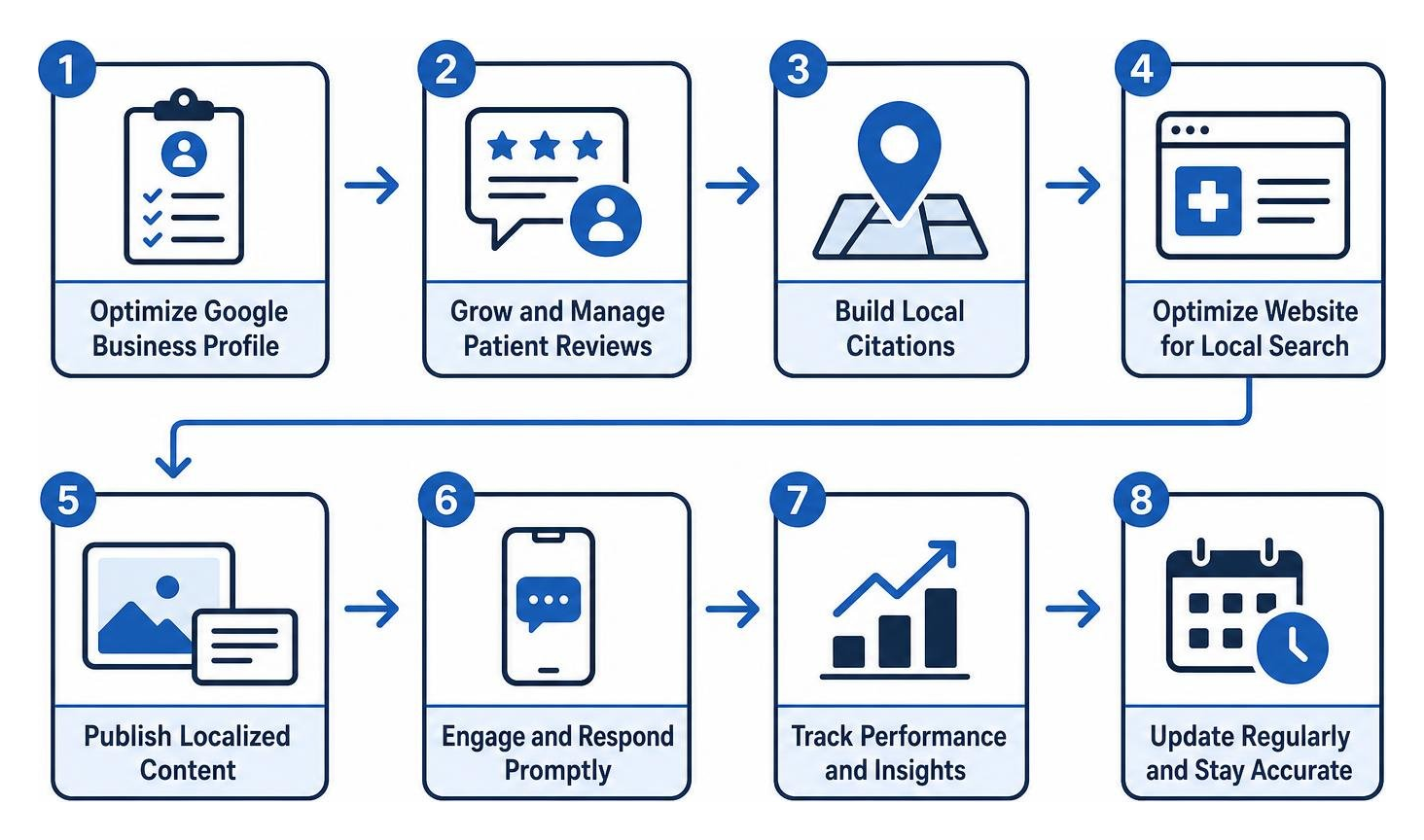
Optimizing Google Business Profiles: How Medical Clinics Can Improve Local Online Visibility
Your Google Business Profile (GBP) functions as the primary digital front door for prospective patients. Incomplete listings undermine search engine trust and reduce conversion rates. Healthcare listings that complete all primary GBP attribute categories and publish regular updates earn substantially more “get directions” clicks and profile views than less thorough listings.
To maximize GBP performance:
- Select Specific Primary Categories: Never use a generic “Medical Clinic” or “Health” classification if a specialized option exists. A pediatric group should select Pediatrician, a skin center should select Dermatologist, and a musculoskeletal group should select Orthopedic Clinic.
- Utilize Secondary Categories: Add secondary categories to capture supporting service lines, such as Sports Medicine Clinic, Physical Therapy Clinic, or Urgent Care Center.
- Complete All Service Attributes: Populate every relevant field, including wheelchair accessibility, language assistance, accepted payment methods, and insurance carriers.
- Activate Telehealth Attributes: Explicitly flag virtual care options and link them to dedicated scheduling pages on your website.
- Maintain High-Quality Photography: Profiles with a substantial gallery of authentic photos perform significantly better than sparse listings. Include exterior building signage, accessible parking zones, waiting areas, diagnostic equipment, and professional staff portraits. Avoid generic stock images of clipboards or stethoscope models, which decrease patient trust.
Proactively managing and optimizing your Business Profile ensures accurate operational details and prevents unintended profile suspensions.
Multi-Practitioner and Multi-Location Setup Protocols
Practices with multiple providers or facilities require structured listing governance. Google allows both Practice listings (the physical location) and Practitioner listings (individual credentialed doctors).
- Location Profiles: Each physical facility must maintain its own distinct GBP, verified via its individual street address (never a shared suite or P.O. Box). The listing name must match official legal signage.
- Practitioner Profiles: Individual physicians can maintain separate listings linked to the clinic. The practitioner’s primary category should reflect their specific medical specialty (e.g., Cardiologist), while the clinic listing targets broader facility queries.
- Department Listings: Large facilities offering specialized walk-in services (such as an on-site laboratory, imaging suite, or urgent care wing) can set up separate department profiles with unique operational hours.
Healthcare Citation Ecosystems and Directory Alignment
Search engines evaluate listing consistency across data aggregators to verify a clinic’s physical legitimacy. A discrepancy as minor as an outdated suite number or a mismatched phone line can fragment your local prominence signals.
Clinics must maintain identical Name, Address, and Phone (NAP) details across three primary citation tiers:
- Core Local Directories: Google Business Profile, Apple Maps, Bing Places, and Yelp.
- Healthcare-Specific Portals: Healthgrades, Vitals, Zocdoc, WebMD, Doximity, and state medical licensing boards.
- Insurance Payer Directories: Blue Cross Blue Shield, UnitedHealthcare, Aetna, Cigna, and regional Medicaid/Medicare provider registries.
Technical Architecture, Medical Schema, and Generative Engine Optimization (GEO)
A well-optimized Google Business Profile requires an equally structured website foundation to capture patient searches. To successfully target high-intent patient queries, clinics should focus on capturing high-intent near me searches by aligning technical website structure with clinical intent.
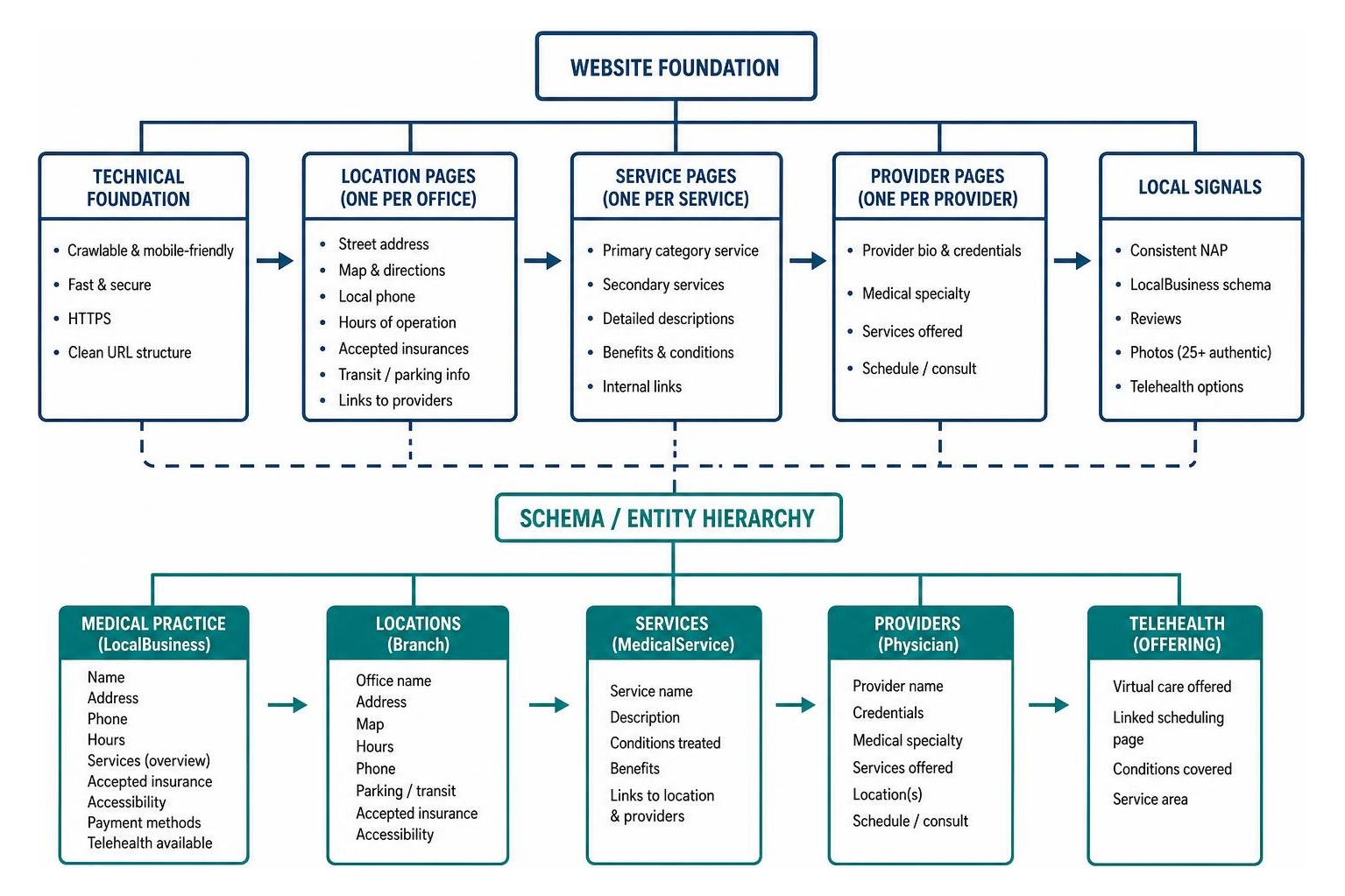
Structuring Local Pages and Schema: How Medical Clinics Can Improve Local Online Visibility
Avoid consolidating all treatments onto a single, thin overview page. Modern local search algorithms evaluate entity depth, requiring a clear, hierarchical page architecture:
- Dedicated Location Pages: Each physical office needs a dedicated page detailing its street address, embedded Google Map, local phone number, transit/parking instructions, hours of operation, accepted insurances, and links to practicing providers.
- Condition and Service Pages: Build 600- to 1,000-word clinical service pages addressing specific symptoms, diagnostic procedures, treatment options, and preparation protocols written in accessible patient language.
- Credentialed Provider Pages: Individual bio pages should highlight board certifications, medical training, hospital affiliations, professional memberships, and direct appointment booking links.
To help search crawlers and AI models interpret this content accurately, embed structured JSON-LD schema across your site:
MedicalOrganization/MedicalClinic: Identifies the overarching clinical business, parent organization, legal name, tax identifiers, and official contact endpoints.Physician: Marks up individual doctor credentials, medical specialties, accepted insurances, and clinic affiliations.MedicalSpecialtyandMedicalProcedure: Defines specific treatments, associated risks, and clinical categories.FAQPage: Structures common patient questions regarding insurance coverage, recovery times, and scheduling policies.AggregateRating: Communicates verified review ratings to search engines to earn rich snippet stars in organic results.
Generative Engine Optimization for Clinical Symptom Queries
Generative Engine Optimization (GEO) focuses on structuring content so AI engines can easily extract, cite, and recommend your clinic. Unlike traditional keyword targeting, GEO rewards clarity, clinical authority, and clear entity relationships.
To optimize for local AI answer engines:
- Answer Questions Directly: Structure headings as clear clinical inquiries (e.g., “When should a sprained ankle be evaluated at an urgent care clinic?”) followed by concise, factual answers in the opening two sentences.
- Emphasize Local Experience: Reference local community health trends, seasonal patterns, and regional health network affiliations to ground your expertise in a specific geographic area.
- Demonstrate E-E-A-T: Clearly display author credentials, medical review stamps, publication dates, and clinical citations on all educational pages.
Systematic Review Generation and HIPAA-Compliant Reputation Management
Patient reviews directly impact local search visibility and conversion rates. A majority of patients read online reviews before scheduling an appointment, and practices maintaining strong positive ratings earn significantly higher click-through rates. Furthermore, healthcare providers who respond consistently to their Google reviews see substantially more profile views and engagement compared to practices that leave feedback unaddressed.
However, healthcare reputation management requires strict adherence to privacy regulations. Under the Health Insurance Portability and Accountability Act, confirming that an individual is or was a patient at your facility constitutes an unlawful disclosure of Protected Health Information (PHI).

HIPAA-Safe Patient Feedback Acquisition
A compliant review acquisition workflow relies on automation and clear consent protocols:
- Automated Review Invitations: Send automated SMS or email review invitations promptly after visit completion, while the clinical experience is fresh in the patient’s mind, as delayed requests see a noticeable drop in response rates.
- Business Associate Agreements (BAAs): Ensure any third-party reputation software vendor executes a formal BAA if their platform connects to your Electronic Health Record (EHR) or handles patient contact information.
- No Review Gating: Never screen or filter patients before requesting a review. Google’s terms of service and federal regulations prohibit surveying patients to direct only positive reviewers to public profiles.
- Neutral Outreach Messaging: Keep review invitation language neutral and general. Avoid referencing specific clinical procedures, diagnoses, or provider names in the invitation text.
Handling Negative Feedback Without Violating PHI
When addressing critical reviews, staff must never disclose details about a patient’s care or confirm that treatment occurred. Standardize your response protocol using these compliant guidelines:
- Acknowledge Without Confirming: Never state “Thank you for being our patient” or “We reviewed your chart.” Use neutral, universal language: “Thank you for your feedback. We hold our patient care and service standards to the highest level.”
- Reiterate Operational Standards: Describe general clinic policies: “Our clinic strives to maintain timely appointments and clear communication for every visitor.”
- Move the Conversation Offline: Provide a direct, non-digital contact method: “Please contact our practice manager directly at our main clinic office so we can discuss your experience confidentially.”
- Maintain Timely Responses: Address all reviews promptly to demonstrate active patient care management to search engines and prospective patients alike.
Tracking KPIs, Timelines, and Avoiding Critical Clinic SEO Mistakes
Establishing strong local visibility is an ongoing operational commitment rather than a one-time technical setup. Understanding implementation timelines and tracking meaningful metrics helps practices allocate resources effectively. By following a quick start guide to local SEO performance tracking, practice administrators can focus on key conversion data rather than vanity metrics.
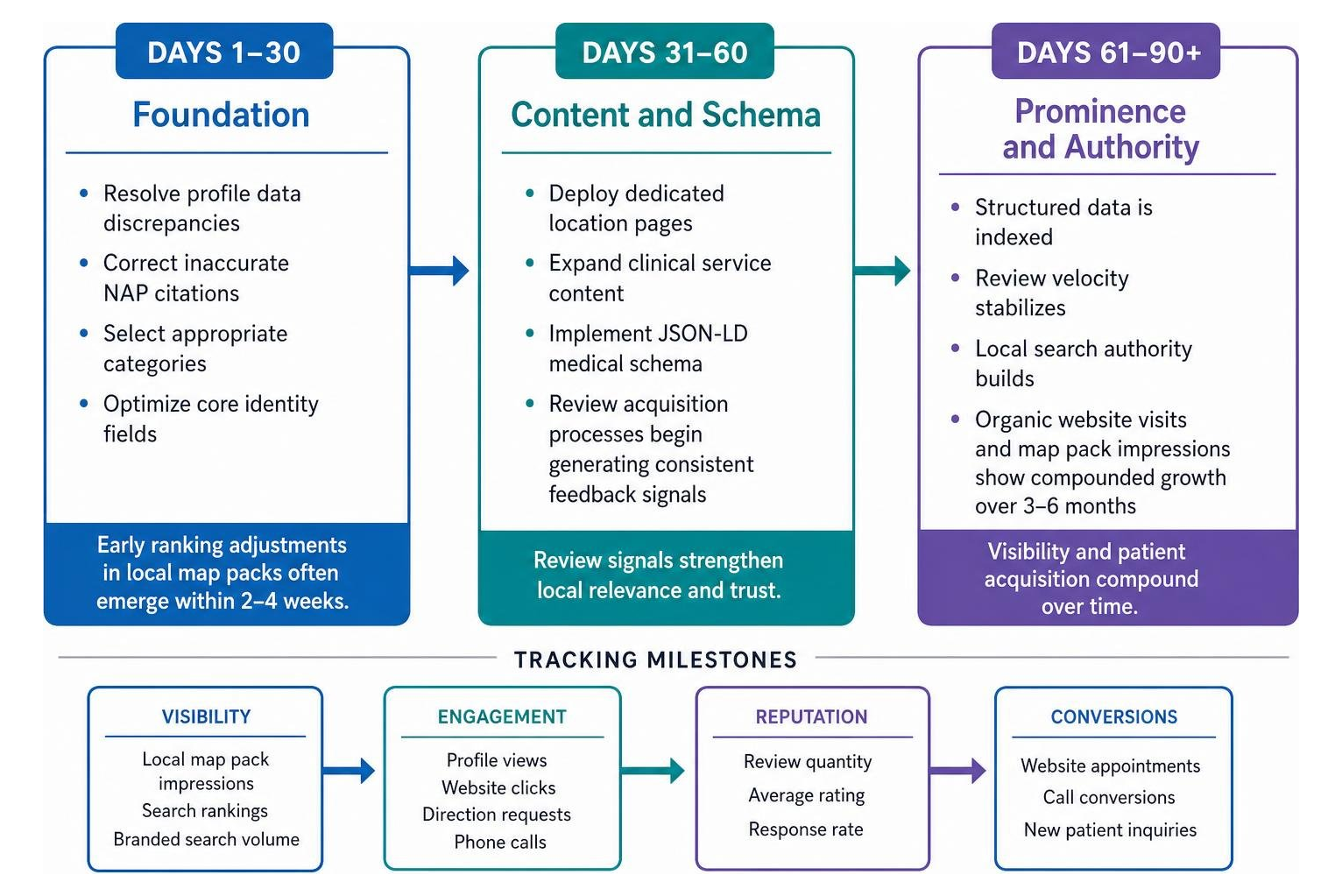
Local search performance typically develops across defined phases:
- Days 1 to 30 (Foundation): Resolve profile data discrepancies, correct inaccurate NAP citations, select appropriate categories, and optimize core identity fields. Early ranking adjustments in local map packs often emerge within 2 to 4 weeks.
- Days 31 to 60 (Content and Schema): Deploy dedicated location pages, expand clinical service content, and implement JSON-LD medical schema. Review acquisition processes begin generating consistent feedback signals.
- Days 61 to 90+ (Prominence and Authority): Structured data is indexed, review velocity stabilizes, and local search authority builds. Organic website visits and map pack impressions show compounded growth over 3 to 6 months.
When tracking campaign health, focus on business metrics over raw impressions:
- High-Intent Actions: Google Business Profile click-to-call volume, appointment link clicks, and “get directions” route requests.
- Website Conversions: Online scheduling completions, click-to-call mobile events, and insurance verification downloads tracked in GA4.
- Local Pack Positioning: Tracking Local Pack rankings for core specialty terms across target geographic coordinates.
Critical Local SEO Mistakes to Avoid
- Keyword Stuffing the Business Name: Adding unapproved geographical descriptors or service keywords to your official GBP name (e.g., “Family Health Clinic – Best Doctor Near Me”) violates Google policies and risks listing suspension. Use your exact legal business entity name.
- Ignoring Service Line Cannibalization: Avoid creating multiple overlapping pages targeting identical intents (such as “Physical Therapy Clinic” and “Physiotherapy Services” for the same neighborhood). Consolidate related treatments into one comprehensive, authoritative resource.
- Inconsistent Operational Data: Failing to update holiday hours, emergency closures, or changing provider rosters across directories frustrates patients and degrades local search trust signals.
Frequently Asked Questions About Local Healthcare SEO
How long does it take for a medical clinic to rank in the Google Local Pack?
Initial ranking improvements from Google Business Profile optimization often appear within 30 to 45 days. Establishing sustainable top-three rankings for competitive specialty terms in dense markets typically takes 90 to 180 days. This timeline depends on review generation consistency, on-site schema implementation, and local competitor density.
Can medical practices respond to online reviews without violating HIPAA?
Yes, medical practices can safely respond to reviews by using neutral, non-specific templates. Responses must never confirm that the reviewer received medical care, reference appointment dates, or discuss clinical details. Acknowledge the feedback broadly, describe standard practice policies, and invite the reviewer to resolve the matter offline with the clinic manager.
Should individual physicians have their own Google Business Profiles?
Yes, credentialed doctors can maintain individual Practitioner listings linked to the clinic’s physical address. This allows the primary clinic profile to target broad organizational terms (e.g., Urgent Care Clinic or Pediatric Center) while practitioner profiles rank for individual physician name searches and niche clinical subspecialties.
Conclusion
Improving local online visibility is one of the most reliable strategies for medical practices to build steady patient volume. When clinics maintain accurate directory data, build informative service pages, and manage their online reputation responsibly, they establish a durable digital asset that outlasts paid advertising campaigns.
Applying these essential tips to improve local visibility online allows your clinic to build sustainable search prominence. Rather than relying entirely on rented third-party portals, a well-structured local SEO foundation ensures nearby patients can easily find, trust, and choose your practice when they need care.