

How to Enhance Local Search Presence for Your Small Business
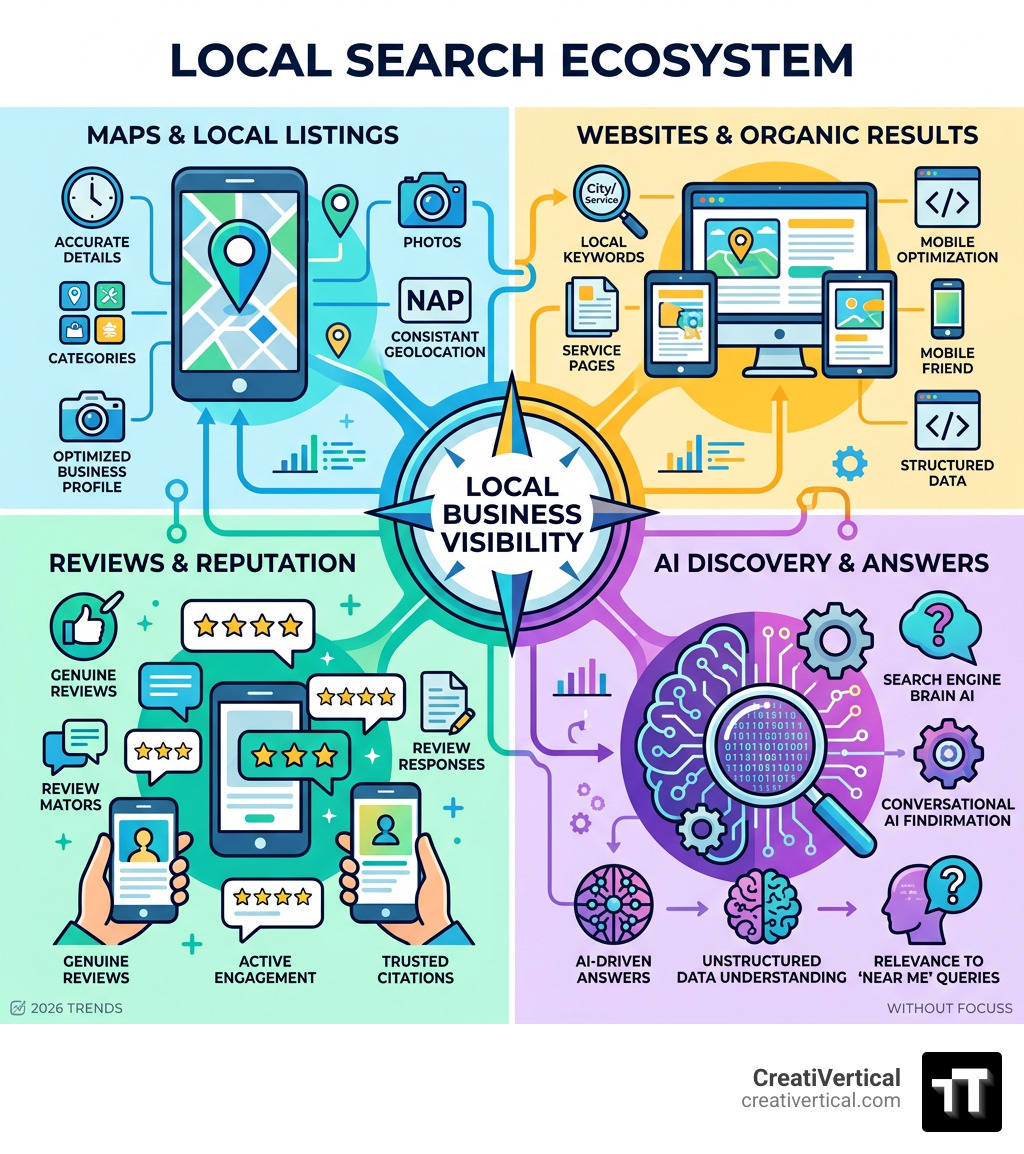
Enhancing online visibility for local businesses starts with three practical moves:
- Complete and regularly update your Google Business Profile with accurate hours, services, categories, photos, and contact details.
- Make your website easy to find and use on mobile, with clear service pages, local keywords, and consistent name, address, and phone details.
- Earn genuine reviews, respond to them, and build trusted mentions from relevant local directories, partners, and community organizations.
These basics help Google understand what you offer, where you operate, and why nearby customers should consider you. They also support visibility in Google Maps, local organic results, and AI-driven answers. Local search matters because 46% of Google searches have local intent, and Google reports that 76% of people who search for something nearby on a phone visit a related business within a day.
Local visibility is no longer just about appearing in the map pack. Customers may find answers without clicking a website, through Google AI Overviews or tools such as ChatGPT, Gemini, and Perplexity. A well-maintained business profile, useful local content, structured business data, and a credible review presence give search engines and AI tools clearer information to reference.
I’m Nicholas Cunha, founder of CreatiVertical, and I bring more than 20 years of agency, web development, SEO, paid media, and applied AI work to enhancing online visibility for local businesses, professional firms, and B2B organizations. The next sections break these foundations into a practical plan for building a stronger local search presence.
Enhancing online visibility for local businesses vocabulary:
Core Tactics for Enhancing Online Visibility for Local Businesses
Local discovery operates across three foundational pillars documented by search engines: relevance, distance, and prominence. Relevance measures how well a local profile matches what a searcher needs. Distance calculates the physical proximity between the user and the verified business location. Prominence reflects how well-known, credible, and established the business appears across the wider web.
According to search industry data, roughly 32% of local ranking signals stem directly from Google Business Profile (GBP) signals, with on-page website elements and review profiles following closely behind. Aligning your profile, technical website foundation, and community reputation builds visibility across traditional organic search listings and the local 3-pack, as outlined in Google’s local ranking guidance.
Enhancing Online Visibility for Local Businesses Through Profile Optimization
A complete profile acts as the primary data node for map algorithms. Research shows that businesses with complete, actively managed profiles earn 2.7 times more visibility and 70% more direction requests than incomplete listings.
To maintain profile health:
- Select Exact Categories: Choose a precise primary category that defines your core offering. Add relevant secondary categories without diluting your main business identity.
- Maintain Visual Assets: Listings with original photos receive 42% more direction requests and 35% more click-throughs. Upload clear images of your building exterior, interior workspaces, staff, and completed projects.
- Publish Weekly Updates: Post regular announcements, seasonal offers, and updates to keep your listing active.
- Populate Service Catalogs: List every predefined and custom service with direct descriptions and clear pricing indicators where appropriate.
- Manage Profile Q&A: Seed and answer frequently asked questions proactively to ensure accurate operational details display directly on your profile.
Active profile upkeep prevents data rot and algorithmic downgrades, as outlined in our walkthrough on optimizing your Google Business Profile.
Review Generation Systems and Sentiment Management
Customer reviews represent one of the most prominent trust signals for both prospective buyers and search algorithms. Industry surveys indicate that 97% of consumers read online reviews for local businesses, with 41% stating they always check reviews before engaging. Furthermore, 68% of consumers require a rating of 4.0 stars or higher before choosing a local company.
Building a steady stream of feedback requires structured workflows:
- Automate Post-Service Requests: Send direct review invitations via email or SMS within 24 to 48 hours of completing a job.
- Collect Service-Specific Feedback: Encourage customers to mention specific services and locations in their commentary, providing natural context for search engines.
- Execute a 24-Hour Response Protocol: Respond to all reviews—positive or critical—professionally and promptly. Prompt responses indicate operational reliability to search algorithms.
Consistent review velocity supports tactics to capture high-intent searches, giving both humans and algorithmic crawlers proof of quality service.
NAP Consistency Across Authoritative Local Directories
NAP consistency refers to the exact alignment of your business Name, Address, and Phone number across every public directory, map aggregator, and web property. Inaccurate citations dilute geographic trust signals, with listing discrepancies causing drops in local ranking visibility.
Focus citation management on major authoritative data hubs:
- Primary Mapping Services: Google Maps, Apple Maps, Bing Places.
- Major Business Directories: Yelp, Better Business Bureau, YellowPages, industry-specific portals.
- Data Aggregators: Data platforms that distribute verified business information across automotive navigation systems and local apps.
Conduct quarterly audits to remove duplicate listings, correct outdated suite numbers, and align tracking phone numbers. Maintaining clean directory data is an essential part of streamlined local SEO fundamentals.
Technical and Hyperlocal On-Page Optimization
Your website provides the verifiable context that validates your map listings. Search engines cross-reference structured website data with directory citations to confirm operational legitimacy.
Technical performance directly impacts user engagement and rankings. Mobile devices account for roughly 84% of local searches. Local websites must meet established Core Web Vitals thresholds: Largest Contentful Paint (LCP) under 2.5 seconds, Interaction to Next Paint (INP) under 200 milliseconds, and Cumulative Layout Shift (CLS) under 0.1.
Technical Schema and On-Page Factors for Enhancing Online Visibility for Local Businesses
Structured data (schema markup) provides explicit code that search engine spiders and machine-learning models use to parse business data without ambiguity.
Essential on-page technical elements include:
- LocalBusiness Structured Data: Embed JSON-LD schema on your homepage and contact pages containing opening hours, exact geographic coordinates, accepted payment methods, and your official NAP details.
- FAQPage Schema: Mark up frequently asked questions on core service pages to increase eligibility for rich search snippets and AI answer indexing.
- Geo-Targeted Metadata: Craft title tags and meta descriptions using primary service terms combined with your target city or service region.
- Clean Heading Hierarchies: Organize page content logically with a single H1 defining the primary service and location, supported by descriptive H2 and H3 subheadings.
For comprehensive architectural strategies, review our comprehensive local visibility guide.
Building Hyperlocal Service Area Pages
Templated, thin location pages with swapped city names fail modern quality filters. Research from BrightLocal shows a 107% lift in local rankings when businesses publish authentic, hyperlocal content rather than thin duplicate templates.
High-performing location landing pages require:
- Substantive Content Depth: Provide 1,000 to 1,500 words of unique, useful copy per service area page.
- Geographic Reference Points: Naturally integrate nearby landmarks, major intersections, local building codes, or regional service considerations.
- Embedded Proof Assets: Feature customer reviews, project summaries, and visual galleries specific to that service area.
- Direct Navigation Elements: Implement tap-to-call buttons, embedded Google Maps directions, and straightforward contact forms.
Structuring unique service-area assets follows the principles in our step-by-step local growth roadmap.
Local Link Building and Community Authority
Local link equity relies on community relevance rather than raw global domain authority. A backlink from a regional business association carries significant geographic weight for local search indexing.
Effective approaches for acquiring geo-relevant backlinks:
- Chamber of Commerce Memberships: Secure active profile links from local and regional chambers of commerce.
- Civic and Event Sponsorships: Sponsor local youth sports, community fundraisers, or business expos that provide verified outbound partner links.
- Strategic B2B Partnerships: Establish referral links with non-competing, complementary service providers within your immediate market.
- Regional News Features: Provide expert commentary to local journalists regarding regional industry trends, safety advice, or economic developments.
Navigating AI-Driven Discovery and Generative Engine Optimization
The search landscape is undergoing a structural transition. Between 30% and 40% of search queries now occur across AI platforms such as ChatGPT, Perplexity, and Gemini, while Google AI Overviews appear on approximately 48% of tracked search queries. Furthermore, 45% of consumers report using conversational AI tools for local business and service discovery—a major increase from previous years.
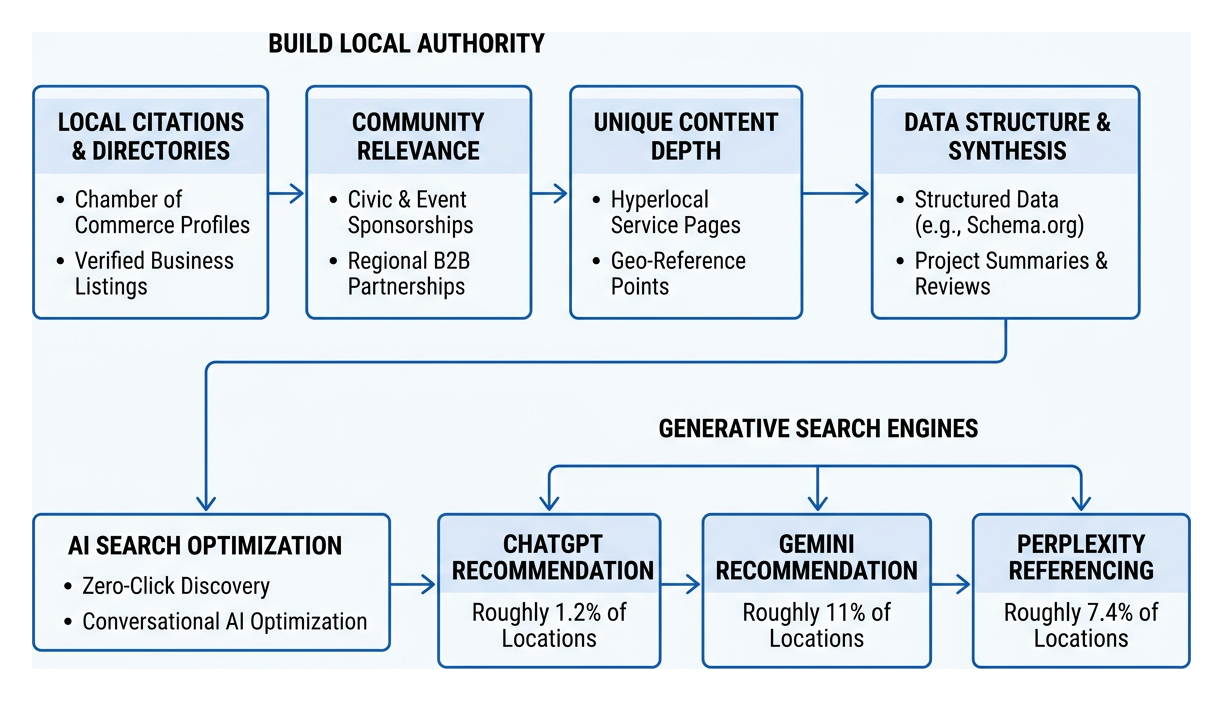
According to recent conversion studies, consumers recommended by AI engines demonstrate call conversion rates four to twenty-three times higher than traditional organic links. However, gaining visibility inside large language models follows distinct rules: ChatGPT recommends roughly 1.2% of local business locations, Gemini includes 11%, and Perplexity references 7.4%. Traditional rank dominance in the local pack does not automatically translate into AI visibility; studies indicate only 45% of top traditional ranking brands lead in AI recommendations across conversational platforms.
Optimizing for Conversational AI Queries and Zero-Click Discovery
Generative engines synthesize recommendations from structured knowledge graphs, verified third-party directory listings, brand sentiment, and indexable website text.
To optimize for generative engine discovery:
- Write Direct Answer Capsules: Structure FAQ answers and definitions in concise, factual 40- to 60-word summaries that AI crawlers can lift directly.
- Enhance Entity Authority: Ensure brand descriptions, executive bios, and core capabilities remain consistent across authoritative knowledge bases, including Wikipedia, Wikidata, and regional registries.
- Demonstrate Clear E-E-A-T: Feature verifiable staff credentials, licensing numbers, physical facility details, and case histories demonstrating Experience, Expertise, Authoritativeness, and Trustworthiness.
- Maintain Content Freshness: Regularly update service documentation, operational hours, and project archives to prevent algorithmic obsolescence.
Multi-Location Scaling and AI Entity Consistency
Multi-location organizations face complex data management challenges. Research indicates that 94% of top-performing multi-location brands execute a dedicated local marketing strategy, compared to 60% of average performers.
Managing multi-location entities effectively requires:
- Centralized Technical Architecture: Standardize URL naming conventions (e.g.,
/locations/city-name), schema templates, and NAP formatting across all properties. - Localized Content Execution: Enable local branch managers or regional teams to contribute authentic photography, local case studies, and distinct project details.
- Independent Profile Management: Maintain separate, fully verified Google Business Profiles for every distinct storefront or licensed service hub.
Implementation Roadmap, Measurement, and Performance Tracking
Systematic execution prevents operational bottlenecks. A structured 90-day implementation plan balances core technical foundations with content creation and authority expansion.
| Phase | Core Objectives & Focus Areas | Primary Success Metrics |
|---|---|---|
| Month 1: Foundation & Data Audit | Verify and fully optimize GBP; complete NAP directory audit; deploy LocalBusiness JSON-LD schema; configure call tracking. | Profile completeness score; initial geo-grid baseline rankings; indexation of structured data. |
| Month 2: Content & Hyperlocal Expansion | Publish dedicated hyperlocal service pages; launch automated review request workflows; resolve Core Web Vitals issues. | Organic landing page clicks; review acquisition velocity; page load speed scores (<2.5s LCP). |
| Month 3: Authority Building & Scaling | Secure local chamber/partner backlinks; deploy FAQ schema capsules; conduct conversational AI prompt audits. | Local 3-pack impression share; inbound phone call volume; AI engine brand recommendations. |
Measuring Local Visibility and AI Referral Metrics
Accurate measurement requires monitoring both map coordinates and emerging generative channels:
- Geo-Grid Tracking Platforms: Track local map rankings across specific geographic coordinates to measure visibility radius around your physical address.
- Local Pack Impression Share: Monitor Google Business Profile performance insights, specifically tracking direction requests, website clicks, and inbound phone calls.
- AI Recommendation Testing: Run structured prompt queries across ChatGPT, Gemini, and Perplexity monthly to assess whether your brand surfaces for core service prompts.
For a deeper dive into measurement frameworks, consult our local SEO performance tracking framework and guide to building custom reporting dashboards.
Conducting Ongoing Local Competitor Audits
Local search competition is dynamic. Performing quarterly competitor analysis ensures your business maintains authority parity within its market:
- Review Gap Benchmarking: Track competitor review counts, average star ratings, and review acquisition velocity to adjust monthly generation targets.
- Category and Attribute Audits: Identify secondary categories or new GBP attributes adopted by top-ranking competitors in your zip code.
- Backlink Profiling: Analyze regional competitor link profiles to uncover new local sponsorship, directory, or partnership opportunities.
Learn how to structure your competitive analysis using our local competitor analysis workflow.
Frequently Asked Questions About Local Search Presence
How long does it take to see results from local SEO and GEO?
Initial ranking adjustments from profile optimization and NAP corrections typically appear within 60 to 90 days. Establishing substantial review authority and ranking for competitive organic search terms generally requires 3 to 6 months of steady execution. Generative AI citation indexing can occur in several weeks for indexed sources, but sustained entity authority compounds over 6 to 12 months.
Can a service-area business rank without a public storefront?
Yes. Businesses that travel to clients (such as plumbers, mobile consultants, or field technicians) can configure a Service-Area Business (SAB) profile within Google Business Profile. This setting hides the physical residential or dispatch address while allowing the business to define specific geographic service boundaries.
Why is a business visible in Google Maps but missing from AI engine recommendations?
Google Maps relies heavily on immediate proximity, primary profile categories, and basic GBP completion. Conversational AI engines (such as ChatGPT, Perplexity, or Copilot) synthesize information from wider web sources, requiring consistent entity citations across multiple third-party platforms, structured FAQ schema, positive third-party review sentiment, and indexable technical authority.
Conclusion
Local digital visibility requires an integrated operational approach. Map pack visibility, authoritative on-page website architecture, structured data markup, and generative AI search presence work together as a unified system. Managing these digital assets systematically ensures small businesses and regional enterprises maintain a reliable flow of qualified local inquiries.
At CreatiVertical, we operate as an ongoing growth partner, delivering complete digital systems across web development, search engine optimization, Generative Engine Optimization (GEO), paid search management, and applied AI automation. For more actionable frameworks to expand your market reach, explore our actionable tips to improve local online visibility.