

Understanding Modern Google Algorithm Updates: Core Systems and Mechanics
Google Search is no longer governed by a single monolithic algorithm. Instead, it operates as a collection of specialized micro-systems working together. Understanding how these underlying systems interact helps site owners navigate ranking shifts without panic. You can explore our practical framework in The Ultimate Guide to Google Updates on SEO Without Losing Your Mind.
When a user submits a query, multiple algorithmic systems process the request simultaneously:
- Retrieval and Indexing Pipelines: Systems like Caffeine parse and index web content long before a query is entered.
- Query Understanding Systems: Machine learning components analyze natural language intent and entity relationships.
- Scoring and Ranking Modules: Algorithms evaluate web page quality, authority, freshness, and topical relevance.
- Re-ranking and Layout Engines: Real-time components adjust search result layouts, inject SERP features, and tailor organic listings based on historical user interaction data.
Minor Changes vs Broad Core Updates
Google updates its search systems at two distinct operational scales: continuous minor adjustments and announced broad core updates.
Minor adjustments occur daily. In 2022 alone, Google implemented 4,725 changes to search, supported by 894,660 search quality tests, 148,038 side-by-side evaluations, and 13,280 live traffic experiments. These micro-adjustments tweak minor scoring parameters, refine local search rules, or adjust spam detection filters. Most webmasters never notice them.
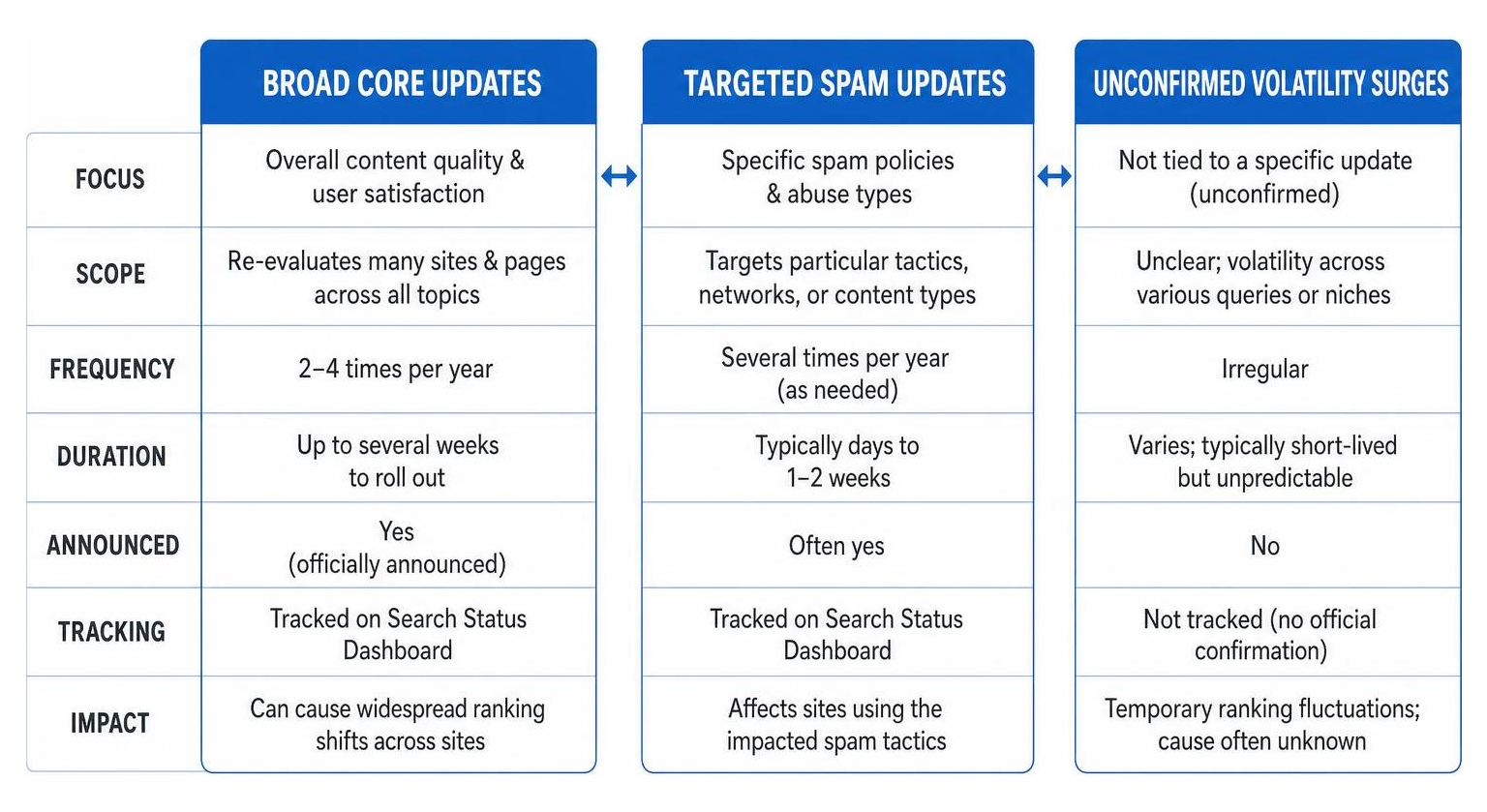
Broad core updates occur a few times per year and take up to several weeks to roll out globally. Rather than targeting specific web pages or single technical defects, broad core updates adjust how Google measures overall content quality and user satisfaction. Officially tracked on the History for Ranking | Google Search Status Dashboard, core updates evaluate whether another page on the web now provides a better experience for searchers than yours.
The Evolution of the Helpful Content System in Google Algorithm Updates
Google introduced the Helpful Content System as a standalone, site-wide signal in August 2022 to combat content written primarily for search engine rankings rather than human readers.
The system evolved significantly during the landmark March 2024 Core Update. Google retired the Helpful Content System as a distinct, standalone algorithm and integrated its evaluation criteria directly into its primary core ranking systems. This architectural shift allowed Google to assess content quality dynamically at the page level rather than relying solely on site-wide classifications. Google reported that incorporating these automated quality refinements into its core systems reduced unhelpful, unoriginal content in search results by 45%.
Major Recent SERP Shifts: Core Rollouts, Spam Enforcement, and Discover
Recent algorithm deployments highlight how Google balances core quality updates, manual spam enforcement, and specialized discovery feeds.
Key Broad Core Updates and Discover Shifts
Over recent years, core updates have reshaped search results across traditional search and Google Discover:
- March 2024 Core Update: Took 45 days to complete rollout. It fully integrated helpful content signals into core ranking algorithms and targeted unhelpful web pages at scale.
- August 2024 Core Update: Rolled out over four weeks following extensive feedback from independent creators. According to reporting on the rollout, such as coverage of Google August 2024 Core Update Rolling Out , the update aimed to better surface authentic, original content from small, independent publishers that had previously lost visibility.
- November 2024 Core Update: Continued Google’s focus on refining core quality evaluations and dynamic content reassessments across search and Discover feeds.
Spam Policy Updates and Unconfirmed Ranking Volatility
Google uses AI-driven tools like SpamBrain to enforce policies against scaled content abuse, expired domain abuse, and link spam. A major operational focus remains Site Reputation Abuse (also called parasite SEO), where established sites host low-quality third-party sponsored content to exploit the host domain’s reputation.
Outside of official updates, search results frequently experience short bursts of unconfirmed ranking flux. Third-party tracking tools like Semrush Sensor and Mozcast regularly detect sharp spikes in volatility that Google does not officially acknowledge. These fluctuations highlight how routine infrastructure maintenance, data refreshes, and unannounced micro-adjustments can briefly disrupt rankings. Staying resilient against unannounced volatility requires ongoing adjustments, as outlined in our guide to Adaptive SEO Services.
The Impact of AI Infrastructure and Machine Learning on Search
Machine Learning Milestones in Modern Google Algorithm Updates
Machine learning models help Google interpret human language and search intent:
- RankBrain (2015): Google’s initial deep-learning system used to parse ambiguous or novel search queries by connecting unfamiliar terms to known concepts.
- BERT (2019): A bi-directional transformer model designed to interpret sentence context, prepositions, and nuanced natural language.
- MUM (2021): Multitask Unified Model technology built to transfer knowledge across 75+ languages and process cross-modal tasks simultaneously.
Navboost, Glue, and the Future of Agentic AI Search
While generative AI models receive significant attention, foundational infrastructure systems continue to manage organic search layouts. Internal documentation released during legal proceedings highlighted how systems like Navboost rely on historical click logs and user interactions over extended periods to evaluate web page utility. Meanwhile, the Glue engine manages dynamic SERP components, organizing visual carousels, knowledge panels, and organic listings into unified page layouts.
Simultaneously, Google Search is expanding into an AI-driven, agentic system powered by Gemini models. In AI Mode—which surpassed 1 billion monthly users— search operates directly on multimodal inputs, including text, image, video, and upload files.
As detailed in research analyzing What RankBrain, BERT and Glue Mean for SERP and SEO in 2026, search is moving toward dynamic generative interface creation and automated background tasks. In addition to retrieving web pages, Search agents can monitor complex information 24/7 or place direct calls to local businesses to verify service availability. Maintaining visibility across these automated platforms requires targeted optimization strategies, detailed in The Ultimate Tools to Keep Your Brand Visible Across AI Search Platforms.
Diagnostic Framework and Recovery Roadmap for Impacted Websites

Detecting Core Update Impact with Search Console and Volatility Tools
When organic traffic declines, avoid making immediate site changes. Follow this structured diagnostic process using Google Search Console:
- Confirm Update Timelines: Cross-reference your traffic drop dates against official rollout windows on the Google Search Status Dashboard or third-party monitoring tools like Semrush Sensor and Mozcast.
- Isolate the Impacted Channels: Filter Search Console data by search type (Web, Image, Video, News) and country to ensure the decline isn’t localized to a specific media type or geography.
- Analyze Impressions vs. Clicks:
- Steady impressions with dropping clicks: Your organic positions may be intact, but AI Overviews, featured snippets, or user interface updates are absorbing user clicks.
- Dropping impressions with dropping clicks: Your pages have dropped in organic position, indicating an algorithmic re-evaluation of content relevance or quality.
- Segment Pages by Category and Intent: Group losing URLs by template (e.g., product pages, blog posts, service landing pages) to determine if the drop stems from site-wide technical issues, intent mismatches, or thin content.
Actionable Recovery Steps: Quality Self-Assessment, E-E-A-T, and Content Pruning
If your site loses organic positions following a broad core update, follow Google’s official advice outlined in Google Search’s Core Updates | Documentation to guide your recovery roadmap:
- Audit for Firsthand Experience (E-E-A-T): Upgrade generic, summary-style articles by adding original data, direct expert quotes, proprietary images, and verified author background details.
- Align Content with User Intent: Ensure your page titles, subheadings, and introductions directly answer the searcher’s core query without forcing them to scroll through introductory filler.
- Prune or Consolidate Unhelpful Pages: Identify low-performing, duplicate, or outdated pages. Merge thin pages into comprehensive resources using 301 redirects, or delete unsalvageable content built solely for search engines.
- Give Systems Time to Re-evaluate: While small ranking updates occur continuously, major ranking recoveries typically take several months or until the next major broad core update fully deploys across global data centers.
Frequently Asked Questions About Search Ranking Changes
How frequently does Google make updates to search algorithms?
Google updates its ranking infrastructure continuously, averaging roughly 13 adjustments per day (totaling 4,725 changes in 2022 alone). Most daily adjustments pass without notice. Broad core updates occur two to four times per year and trigger larger ranking shifts across global search results.
How long does it take to recover ranking losses after a core update?
Recovery depends on the nature of your content improvements and update rollout cycles. While minor rank adjustments happen continuously, substantial recoveries typically take several months. Sites often see meaningful progress when Google deploys its next broad core update and re-evaluates web-wide quality signals.
How do Google spam updates differ from broad core updates?
Spam updates target explicit violations of Google’s Search Essentials, such as link spam, scaled low-value content, and site reputation abuse. Core updates are not penalties; they broadly reassess web content to reward pages that provide better user value.
Conclusion: Building Sustainable Search Visibility in an AI-First Era
Navigating google algorithm updates requires shifting from quick technical fixes to building lasting domain authority. As Google integrates Gemini-powered AI features alongside core ranking infrastructure, search engines prioritize brands that offer genuine expertise, unique data, and clear answers.
Whether you run a Kansas City business, an industrial manufacturer, or an offshore professional services firm, long-term search performance comes from maintaining high editorial standards, matching user intent, and auditing your site structure regularly. For a closer look at modern ranking strategies, read our guide on Everything You Need to Know About Google’s New Algorithm Update.
If your organic traffic dropped after a recent update or you need to align your site with AI-driven search features, contact our team at CreatiVertical to build an adaptable digital growth strategy.