
Why Google Updates on SEO Keep Every Business Owner Up at Night
[The intro is already written, include it as is and ensure the rest of the article is consistent with the intro.]
Google updates on SEO affect every business with a website — and in 2026, the pace of change has never been faster.
Here is a quick answer to what you need to know:
| What | What It Means for You |
|---|---|
| Core updates | Broad ranking changes, several times a year. No penalty — just a reassessment of content quality. |
| Spam updates | Target manipulative tactics. Can cause sharp, fast drops. |
| AI content signals | Since July 2026, Google scores editorial oversight, strategic intent, and originality — not just content itself. |
| AI Mode & Search agents | Over 1 billion monthly users. Zero-click searches are rising. Being cited matters as much as ranking. |
| Recovery timeline | Days to several months, depending on the depth of changes and update frequency. |
Google makes thousands of changes to its search algorithms every year. Most are invisible. But several times a year, a broad core update lands — and when it does, rankings shift, traffic moves, and business owners start questioning everything they thought they knew about SEO.
The instinct is to panic and start rewriting everything. That instinct is almost always wrong.
This guide cuts through the noise. You will learn exactly what changed, what the data shows, and what practical steps actually move the needle — whether you are a Kansas City business owner watching your leads dry up, a B2B manufacturer trying to reach procurement buyers, or an offshore professional services firm building search visibility across international markets.
I’m Nicholas Cunha, founder of CreatiVertical — I have spent more than twenty years navigating Google updates on SEO for clients ranging from BVI government institutions to industrial manufacturers and local Kansas City businesses, which means I have watched these shifts play out across very different markets and content types. Let’s get into what is actually happening and what you should do about it.
Core Updates vs. Minor Tweaks: Navigating Google Updates on SEO
To steer your site through search volatility without losing your bearings, you must first understand what kind of algorithm change you are dealing with. Google’s machinery has many moving parts, and a drop in rankings is not always caused by the same system.
Historically, Google has made thousands of minor adjustments annually. But when we talk about major shifts, we are looking at three distinct categories: core updates, minor algorithmic tweaks, and manual penalties.
- Broad Core Updates: These are large-scale, system-wide adjustments designed to ensure Google delivers helpful, reliable, and relevant results. They do not target specific websites, niches, or technical errors. Instead, they re-evaluate how Google’s systems assess content quality as a whole. Think of it like a restaurant recommendation list: if a new, exceptional bistro opens in Kansas City, our favorite dining guide might update its top-10 list. The restaurants that dropped from position 2 to position 4 did nothing “wrong” — a newer, more relevant option simply earned a higher spot.
- Minor Algorithmic Tweaks: These are smaller, unannounced adjustments that happen almost daily. They might refine how local proximity is calculated or adjust how specific search features display on mobile. They rarely cause massive, sitewide traffic drops but can cause minor, query-level fluctuations.
- Manual Penalties (Manual Actions): Unlike core updates, manual actions are human-issued penalties. A human reviewer at Google has determined that your website violated their spam policies (such as hosting cloaked redirect maps, buying artificial backlinks, or participating in site reputation abuse). If you receive a manual penalty, Google will notify you directly via Google Search Console.
If your rankings drop during a core update rollout, it is not a penalty. Your content is simply being weighed against a newly calibrated scale. To survive these shifts, businesses must move away from rigid, legacy tactics and adopt Adaptive SEO Services: The Ultimate Guide to Staying Ahead of Google to build resilient, human-first digital systems.
How to Diagnose Traffic Drops After Google Updates on SEO
When traffic drops, the worst thing you can do is make immediate, sweeping changes to your website. Instead, treat the post-update period as a diagnostic window.
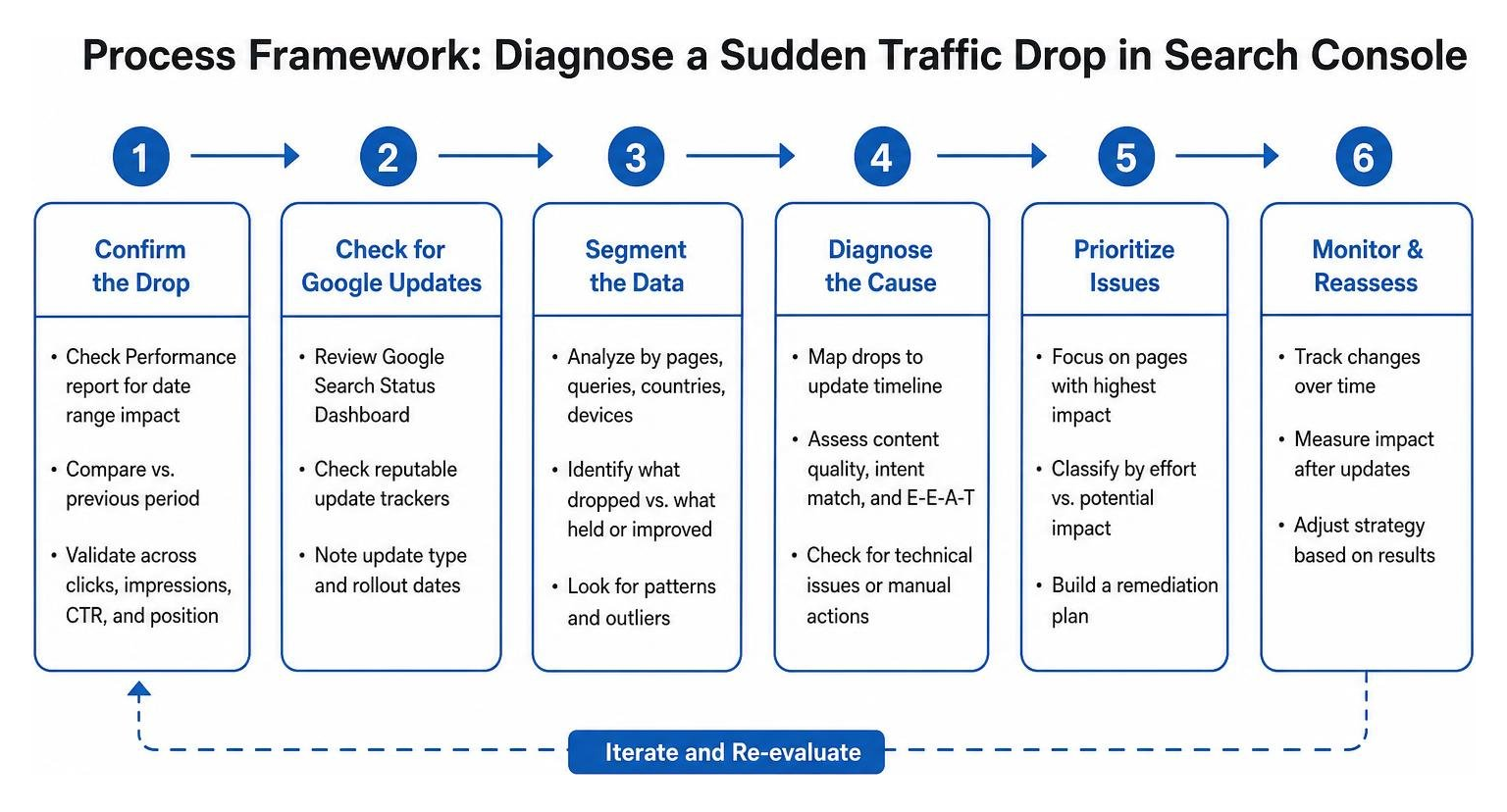
Your first diagnostic tool should always be Google Search Console (GSC). To determine if a traffic drop is truly tied to a broad core update, follow this structured diagnostic workflow:
- Confirm the Update Window: Check the official Google Search Status Dashboard to see if a core update was actively rolling out when your traffic began to decline. For instance, the March 2026 core update rolled out from March 27, 2026, to April 8, 2026 (a 12-day rollout), while the massive March 2024 core update took a full 45 days to complete. Never draw firm conclusions or edit your site mid-rollout; wait at least one full week after the update has officially completed.
- Isolate the Impact: Compare the week after the update completed to the week before the rollout began. Segment your data by Search Type (Web, Image, Video, News) to ensure a technical bug in one vertical isn’t masking overall performance.
- Evaluate Position Drops: Look at your query-level data. A drop from position 2 to position 4 is a minor fluctuation that does not warrant drastic action. A drop from position 4 to position 29, however, signals a fundamental reassessment of that page’s relevance or quality by Google’s core systems.
- Rule Out Technical Failures: Before blaming the algorithm, ensure a simple technical error isn’t mimicking a core update hit. Check for accidental
noindextags, server crawl errors, broken canonicalization (which can take up to two weeks to resolve in Google’s index), or broken redirects.
| Feature / Aspect | Broad Core Update | Minor Algorithmic Tweak | Manual Penalty / Action |
|---|---|---|---|
| Google Notification | Publicly announced via official channels; no individual alerts. | Unannounced, silent adjustments. | Direct message sent to Google Search Console. |
| Primary Cause | System-wide recalibration of content quality and relevance. | Minor refinements to specific search features or local signals. | Direct violation of Google’s spam policies (e.g., link schemes). |
| Typical Impact | Broad, sitewide or directory-wide shifts in keyword rankings. | Minor, query-level volatility over a few days. | Partial or complete deindexing of the entire domain. |
| Corrective Action | Long-term content quality improvements; aligning with E-E-A-T. | Standard, ongoing technical and on-page SEO maintenance. | Submit a formal Reconsideration Request after fixing the violation. |
Inside the July 2026 Core Update: The New AI Content Ranking Signals
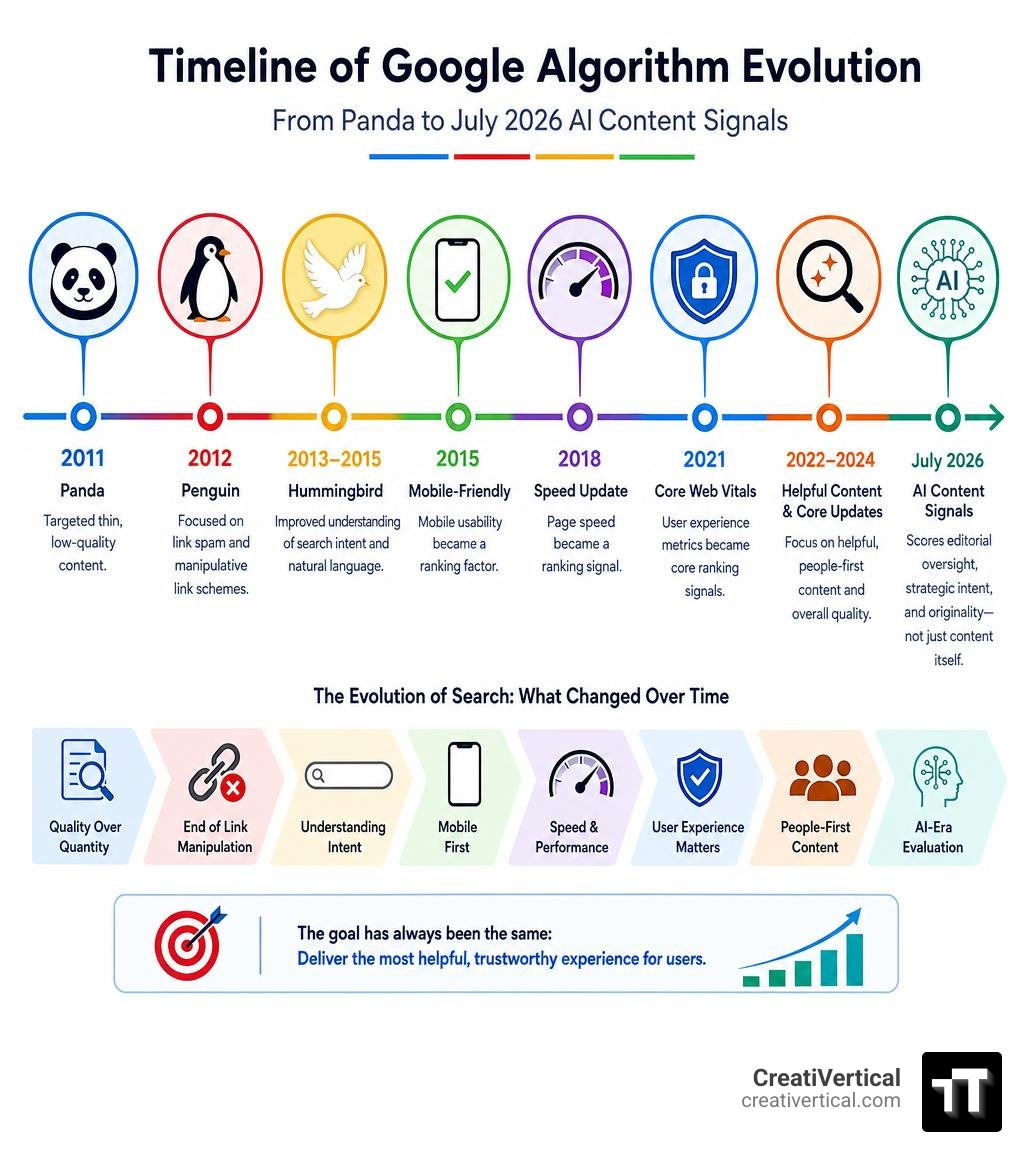
The landscape of google updates on seo changed permanently with the release of the July 2026 core update. Released on July 2, 2026, and completing its rollout on July 16, 2026, this update represents a massive shift in how search engines assess machine-generated text.
Google’s systems have moved entirely away from trying to detect whether content was written by an AI or a human. Instead, the July 2026 update introduced three sophisticated AI content ranking signals designed to evaluate the editorial ecosystem, strategic intent, and originality of every page.
These signals are detailed in the July 2026 Core Update: How Google Now Scores AI Content – WhatsMyGeoScore analysis:
1. Editorial Process Attribution
This signal measures visible, verifiable markers of human oversight, fact-checking, and quality control. Google’s systems look for clear author biographies, transparent editorial guidelines, and a documented update history.
The data post-update is stark: pages with clearly attributed authors maintained or improved their rankings 73% of the time, compared to a dismal 31% for unattributed, anonymous content. Furthermore, domains with publicly accessible editorial guidelines maintained 81% of their pre-update traffic, whereas those without dropped to 52%.
2. Purpose & Strategic Intent Scoring
Google is actively devaluing what we call “search-first” content — pages that exist solely because a keyword research tool flagged a high-volume phrase. The algorithm now scores the strategic intent of a page. Is this content designed to genuinely help a buyer complete a task, or is it merely an intermediary page designed to capture search volume and funnel it to an affiliate link?
Sites publishing unreviewed, commodity AI content experienced an average ranking drop of 12.7 positions post-update. Meanwhile, sites that used Best AI Tools for SEO 2025 as a starting point but backed them up with rigorous editorial review saw their rankings improve by an average of 8.3 positions for informational queries.
3. Content Originality & Information Gain
In an era where AI can generate a thousand words of generic text in seconds, Google rewards “information gain” — the introduction of unique data, experiences, or proprietary insights that do not exist elsewhere on the web.
Pages that cited primary sources, included original data, or featured expert commentary were 2.3 times more likely to maintain or improve their search rankings after the July 2026 update.
Adapting Your Content Strategy for Modern Google Updates on SEO
To survive and thrive under this new scoring system, content creators must abandon legacy keyword-stuffing tactics. The playbook has shifted from keyword targeting to building deep topical authority and user-first content.
- Establish Verifiable Topical Authority: Instead of writing scattered blog posts on unrelated topics, build comprehensive content clusters. Organize your site around core pillar pages that link to tightly focused sub-topics. Focus on answering the full scope of a user’s journey.
- Implement Strict Editorial Oversight: If you use AI to draft content, a subject matter expert must review, fact-check, and enrich every paragraph. Do not rely on cosmetic updates (like changing the publication date without changing the text), as Google’s systems are increasingly adept at flagging freshness manipulation.
- Optimize for Direct Answers: Structure your H2 and H3 headings as clear questions or distinct sub-topics. Answer the user’s primary query directly within the first two paragraphs of the page. This not only satisfies human readers but also makes your content easily extractable by AI search engines.
- Build Trust with E-E-A-T: Showcase your real-world experience and expertise. If you are an offshore law firm in the Cayman Islands, your legal content should be written or heavily reviewed by actual partners, complete with author bio pages, external professional links, and citations to primary legislation. If you are a B2B manufacturer, back your product pages with original engineering data, material safety data sheets, and real-world application case studies.
By prioritizing human review and original research, you align your site with Google’s long-term quality goals. You can find more strategies for building sustainable search traffic in our guide on Organic Traffic Growth Secrets Your Competitors Hope You Never Find.
The I/O 2026 Shift: From Blue Links to Agentic Search
For a quarter of a century, SEO was defined by the search box and the “ten blue links” that followed. But the announcements at Google I/O 2026 made it official: we have entered a new era of search. Google Search is transitioning from an information retrieval tool into an active, task-executing AI operating system.
These technical shifts represent a fundamental change in how users interact with information online. The core of this transformation lies in several major updates:
- The Redesigned Search Box (“Ask Google”): The traditional search box has been upgraded to encourage natural-language, conversational, and multimodal queries. Users can search using text, voice, images, or video files simultaneously.
- AI Mode: Powered by Gemini models, AI Mode has surpassed one billion monthly users, with search queries more than doubling every single quarter since its launch. AI Mode allows users to engage in continuous, side-by-side chatting while browsing webpages.
- Search Agents: These are autonomous AI background systems that run 24/7. Instead of a user searching for “cheap kid-friendly vegan restaurants” every Friday, an information agent can monitor the web continuously, synthesize real-time data, and alert the user when a matching spot opens in Lake Tapawingo or Kansas City.
- Generative UI and Mini-Apps: Using advanced coding frameworks, Google Search can now build custom user interfaces, interactive calculators, and personalized dashboards on the fly in response to a single natural-language prompt.
This shift has had a massive impact on traditional SEO metrics. Industry data shows that zero-click searches now account for more than half of all search queries. When an AI Overview is present, position-one organic results lose a significant portion of their clicks, and traditional click-through rates can drop substantially.
However, there is a massive silver lining: sites cited inside an AI Overview receive a substantial boost in organic clicks compared to a standard position-one result below the fold. AI search is not killing SEO; it is shifting the goal from simple organic rankings to securing high-value AI citations.
Becoming a Source That AI Systems Trust and Cite
To capture these highly qualified clicks, your business must become a trusted source that AI systems actively cite and link to. This requires a shift from traditional keyword optimization to Answer Engine Optimization (AEO) and Generative Engine Optimization (GEO).
Google has introduced several link attribution enhancements, including inline citations, hover previews, and suggested follow-up research angles. These updates are designed to balance user experience with the health of the open web by actively encouraging users to click through to the primary source.
To optimize your site for AI link attribution, focus on these practical steps:
- Publish Highly Citational Content: AI engines love structured data, statistics, and unique claims. Support your key points with concise explanations, and include at least 5+ citations to authoritative primary sources (like government databases, academic journals, or official industry standards).
- Build Focused Topical Authority: Generalist sites are losing ground to specialized publishers. Domains with focused topical authority receive significantly more AI citations than generalist sites with equivalent traffic levels. Keep your content tightly focused on your core industry.
- Ensure Machine Readability: Use clean HTML, descriptive heading structures (H1, H2, H3), and standard schema markup (such as Product, FAQ, or LocalBusiness schema). While there is no “AI-specific” schema, standard structured data helps Google’s core index parse your entities.
- Avoid Manipulative Tactics: Google has strongly warned against creating inauthentic brand mentions across the web to trick LLMs. Focus on earning natural digital PR, authentic third-party reviews, and genuine brand search volume.
To keep your brand visible across these emerging platforms, you can explore The Ultimate Tools to Keep Your Brand Visible Across AI Search Platforms to audit your AI search footprint.
Frequently Asked Questions About Google Updates
How long does it take to recover from a core update?
There is no fixed timeline for recovering from a broad core update. Some websites may see minor improvements within a few days as Google processes incremental, unannounced updates. However, for a substantial recovery, it typically takes several months for Google’s systems to crawl, index, and confirm that a site has established a long-term pattern of producing helpful, reliable content.
Because core updates rely on historical data, patience and consistent quality improvements are required.
What are the most common mistakes to avoid after an update?
- Panic-Editing: Rewriting your entire website the day after an update rolls out often introduces technical errors and destroys rankings for keywords that were unaffected.
- Deleting Content Prematurely: Deleting entire directories should be a last resort. If you feel you must delete vast sections of your site, it indicates that those pages were built for search engines first, rather than humans. Instead, focus on merging, rewriting, and improving thin content.
- Chasing “Quick Fixes”: Buying low-quality backlinks to offset a drop or using automated tools to spin content will likely trigger spam algorithms and make recovery harder.
How does the July 2026 update affect different content types?
The July 2026 core update evaluates content based on its editorial value, regardless of how it was generated. However, distinct performance patterns have emerged across different content creation methods, as documented in Google Confirms Search Behavior Has Changed: What It Means for SEO :
- AI-Assisted Content with Editorial Review: This approach has performed exceptionally well. Using AI for drafting and research, combined with rigorous human review, fact-checking, and original insights, yielded an average ranking improvement of 8.3 positions for informational queries.
- Purely Human-Authored Content: Maintained stable performance, seeing moderate ranking improvements when backed by clear author credentials and primary data.
- Unreviewed AI-Generated Content: Sites that published raw, unreviewed AI text to target high-volume keywords suffered severe declines, experiencing an average drop of 12.7 positions post-update.
Conclusion
Navigating google updates on seo in 2026 does not require chasing every minor algorithmic breeze. It requires building a technically sound, authoritative, and human-first digital system that search engines can easily understand and AI systems can confidently trust.
At CreatiVertical, we do not believe in short-term SEO hacks or one-off projects that leave you vulnerable to the next algorithm shift. As a family-run digital agency based in Lake Tapawingo and Kansas City, Missouri, we operate as an ongoing growth partner. We build complete, performance-focused digital systems — from web design and development to advanced SEO, PPC, and AI search visibility (GEO) — designed to keep your business visible, whether in the local Kansas City map pack or across highly competitive international B2B and professional services markets.
If you want to understand how the latest search shifts impact your specific business model, read our comprehensive breakdown on Everything You Need to Know About Google’s New Algorithm Update, or reach out to our team to chart a resilient course for your digital presence.