

What is Adaptive SEO and How Does It Differ from Traditional SEO?
Adaptive SEO services are a new category of search optimization built for a world where Google is no longer the only place people find answers — and where even Google itself now summarizes results before anyone clicks a link.
What are Adaptive SEO services?
| What they are | What they do | Who they’re for |
|---|---|---|
| A continuously updated SEO strategy | Optimizes visibility across Google, AI Overviews, ChatGPT, Perplexity, and other LLMs | Businesses that can’t afford to disappear from search as AI reshapes how people find information |
| More than keyword rankings | Builds citations, trust signals, and entity authority so AI engines recommend your brand | B2B firms, professional services, manufacturers, and any company with a long sales cycle |
| Human + AI collaboration | Combines technical SEO, content structure, and generative engine optimization (GEO) | Teams that want sustained organic growth, not one-time fixes |
Search has fundamentally changed. Today, 60% of searches end without a single click — users get their answer directly from an AI Overview or a generative engine. At the same time, visitors who do arrive through AI search are 4.4× more valuable than those from traditional organic results. That gap between visibility and invisibility is exactly what Adaptive SEO is designed to close.
This guide breaks down what Adaptive SEO actually means in practice, why traditional SEO alone no longer protects your rankings, and what a real adaptive strategy looks like for a B2B manufacturer, an offshore professional services firm, or a Kansas City business trying to grow.
I’m Nicholas Cunha, founder of CreatiVertical — I’ve spent over twenty years running digital agencies, first in the British Virgin Islands serving government and institutional clients, and now in Kansas City delivering adaptive SEO services alongside AI enablement and web development for B2B, industrial, and offshore clients. That background in small, competitive markets taught me early that rigid SEO strategies break the moment the environment shifts — which is exactly why the adaptive approach matters.
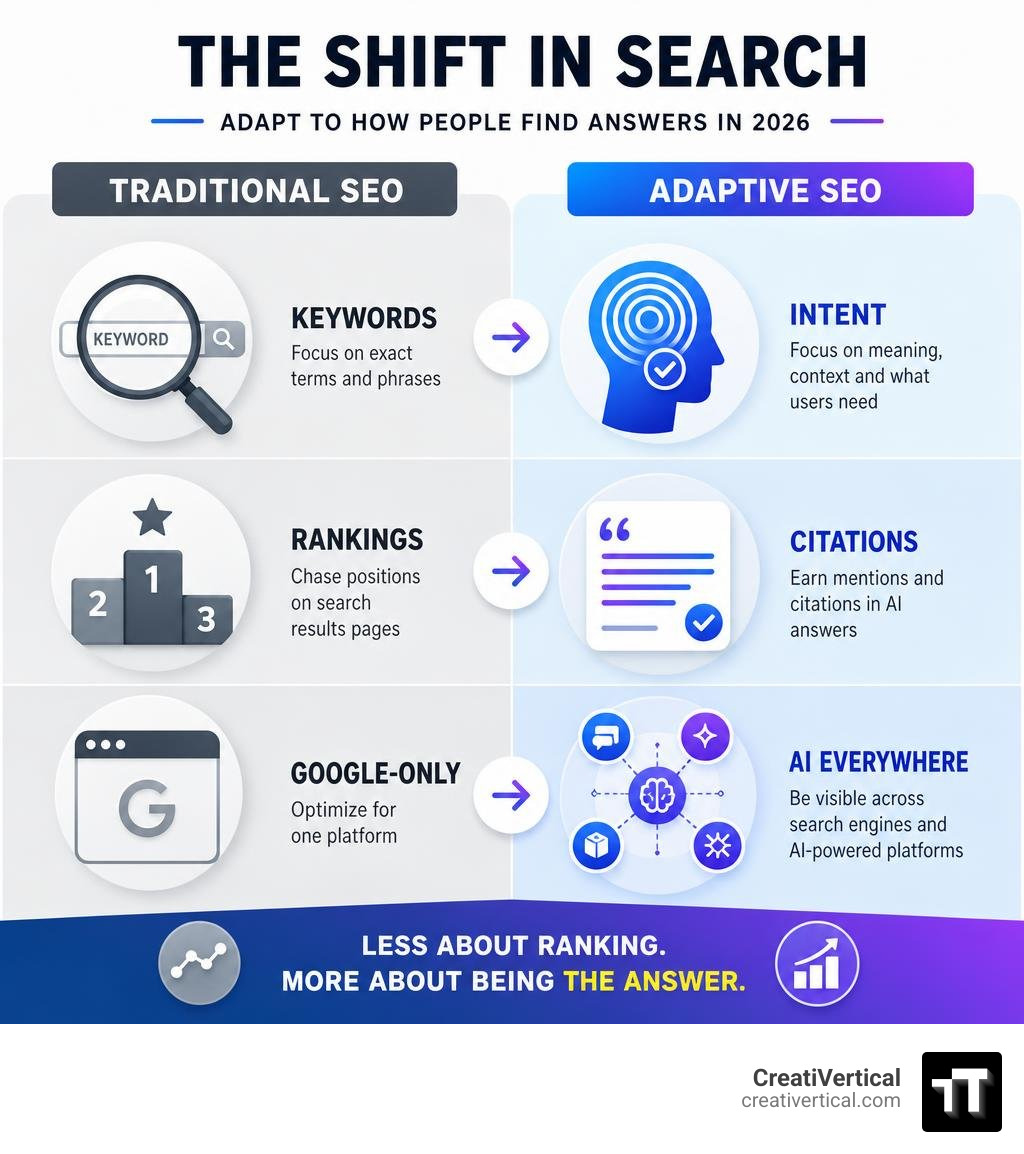
To understand adaptive search, we can look to Chaos Theory. In a complex system, a tiny change in one variable can trigger massive, unpredictable shifts across the entire network. The search ecosystem in June 2026 operates exactly this way. When search engines deploy core updates, they do not just shift search results by a position or two; they completely rewrite how intent is mapped, how answers are structured, and which sources are trusted.
Traditional SEO is fundamentally rigid. It relies on static keyword lists, cookie-cutter monthly deliverables (like “four blog posts and five backlinks”), and reactive adjustments. If an algorithm update drops, a traditional agency spends weeks analyzing the damage before proposing a new static plan.
Adaptive SEO relies on predictive adaptation. Instead of trying to force a website to rank for a fixed set of high-volume keywords, an adaptive strategy treats your digital presence as a fluid entity. It monitors real-time user behavior, semantic query shifts, and algorithmic volatility to adjust your site’s structure, content, and technical foundations before rankings drop.
| Feature | Traditional SEO | Adaptive SEO Services |
|---|---|---|
| Primary Goal | Rank #1 for specific keywords on Google | Broad visibility across Google, AI engines, and LLMs |
| Strategy Style | Fixed monthly playbooks and keyword quotas | Continuous discovery and real-time adjustment |
| Content Focus | Keyword density and search volume | Semantic depth, chunk formatting, and E-E-A-T |
| Technical Approach | Basic compliance (sitemaps, speed) | “Callability” for AI bots and structured data |
| Traffic Target | Maximum click volume | High-intent, high-value conversions |
This approach is critical because search engine algorithms are no longer updated once or twice a year. Google now uses deep learning systems that adjust rankings continuously. If you are still relying on a static strategy, you are optimizing for yesterday’s web. For a deeper look at this landscape, check out our guide on Everything You Need to Know About Google’s New Algorithm Update.
Why Your Business Needs Adaptive SEO Services in 2026
The rise of generative engines has altered user behavior. Over 71.5% of internet users now use AI tools for search purposes, and 42% of Gen Z and Millennials consult platforms like ChatGPT or Perplexity before using Google to find local services. When users do use Google, AI Overviews appear in nearly half of all search results, especially for complex, informational queries.

This shift has created a dual-track search reality. On one track, you have traditional “blue link” organic search. On the other track, you have conversational search, where an AI assistant synthesizes information from across the web to recommend a single, trusted answer.
To survive on both tracks, your business needs to build deep digital authority. AI engines do not recommend businesses based on keyword counts; they recommend them based on E-E-A-T (Experience, Expertise, Authoritativeness, and Trustworthiness). They look for clear, consistent entity signals across the web to verify that your business is real, reputable, and qualified to answer the user’s question.
Whether you are a local business in Lake Tapawingo or a regional enterprise seeking to expand your reach across Missouri, your digital footprint must be optimized for both human visitors and machine-learning crawlers. If you want to scale your digital presence across the Midwest, combining modern web design with a localized Local SEO strategy ensures your brand is visible wherever your clients are looking.
The Core Principles of Search Everywhere Optimization
If users are searching across Google, YouTube, Reddit, ChatGPT, and Apple Maps, your optimization strategy cannot be confined to your website’s blog. You must practice Search Everywhere Optimization. This methodology is built on four core principles:
1. Citations are the New Clicks
In traditional SEO, a link is a pathway for a user to visit your site. In conversational search, a citation is a validation stamp. When Perplexity or ChatGPT answers a query, it pulls facts from trusted sources and cites them. If your brand is not cited in the answer, you do not exist to that user. Building these citations requires earning natural mentions in respected publications, industry directories, and community discussions.
2. Trust & Entity Consistency
AI models rely on knowledge graphs to understand the relationships between brands, people, and topics. If your business name, address, phone number, or core services are described inconsistently across the web, AI engines cannot verify your identity. Keeping your business data uniform across Google Business Profile, Apple Maps, review sites, and social platforms builds the trust required for AI recommendations.
3. Every Page is a Conversion Page
Because AI search engines synthesize answers and often deep-link users directly to specific subpages, the traditional homepage-first conversion funnel is outdated. A qualified visitor might land on a highly specific technical article or a product subpage. Every page on your site must be designed to convert, featuring clear answers, social proof, scannable layouts, and straightforward next steps.
4. Technical Callability
Your website must be structured so that search engine spiders and LLM crawlers can easily parse, extract, and index your content. This is what we call technical callability.

Without clean code, proper header hierarchies, and fast page load speeds, AI bots will skip your site in favor of more accessible sources. You can learn more about building this foundation in our guide to Technical SEO.

Generative Engine Optimization (GEO): Getting Cited by AI Engines
Generative Engine Optimization (GEO) is the process of preparing your website’s content so that AI engines can easily quote, summarize, and reference it. Unlike traditional SEO, which often targets short-tail search terms, GEO focus on natural, conversational queries.
To optimize for generative engines, we use a structured GEO framework:
- Chunk Embedding: LLMs process information in blocks or “chunks.” By organizing your content into clear, self-contained sections—such as an H3 question followed by a direct, 2-3 sentence answer—you make it much easier for an AI model to extract and display your content in an AI Overview.
- Structured Data (Schema Markup): Using detailed schema markup (such as Organization, Product, FAQ, and Article schema) gives search engines explicit clues about the meaning of your page, helping them map your content to their knowledge graphs.
- Sentiment and Brand Context: AI engines analyze user sentiment across reviews, forums, and social media. Maintaining positive, authoritative mentions across the web ensures that when an LLM is asked to recommend “the best industrial manufacturer” or “top offshore law firm,” your brand is surfaced with positive sentiment.
For businesses looking to integrate these strategies locally, optimizing your digital presence can help position your brand in regional AI search results. If you are located near our Lake Tapawingo office, you can find us on MapQuest at CreatiVertical, 154 Anchor Dr, Lake Tapawingo, MO 64015, US .
To implement these strategies effectively, we use a variety of specialized tools. You can explore some of these options in our review of the Best AI Tools for SEO 2025.
Technical Foundations and Measuring Success in the AI Era
An adaptive strategy requires a strong technical baseline. If your site has crawl errors, slow page speeds, or poor mobile rendering, search engine bots will struggle to index your content, and AI models will not cite you.
Ensuring your site is responsive and optimized for conversational queries is a key part of modern search. For a detailed breakdown of these requirements, read our guide on Mobile SEO & Voice Search Optimization.

Measuring success has also evolved. Traditional SEO agencies often rely solely on keyword ranking reports. In an era of zero-click searches and conversational engines, those metrics do not tell the whole story. To measure the impact of adaptive seo services, we track a broader set of performance indicators:
- AI Overview (AIO) Visibility: How often does your brand appear as a cited source in Google’s AI Overviews for your target topics?
- Brand Mentions and Citation Share: The volume of times your brand is cited across conversational engines like ChatGPT, Claude, and Perplexity.
- Sentiment Analysis: Monitoring whether AI search tools describe your business with positive, neutral, or negative sentiment.
- Organic Conversions: Tracking high-value actions (like form fills, phone calls, or product purchases) rather than just raw, non-converting traffic.
Core Deliverables of Adaptive SEO Services
When you partner with an agency for adaptive search services, your engagement should go beyond basic content writing. A comprehensive adaptive package includes:
- Technical Adaptation: Regular technical audits to resolve crawl issues, optimize page speed, and implement advanced schema markup.
- Content Intelligence: Continuous updates to your existing content assets to ensure they align with shifting user intent and semantic search patterns. This includes targeting high-value transactional terms, which we cover in our guide to E-commerce SEO.
- Search Everywhere Audits: Analyzing how your brand is represented across social platforms, local directories, maps, and review sites to ensure entity consistency.
- Link Building & Digital PR: Securing high-quality, natural backlinks and mentions from respected industry publications to build your domain’s authority. For more details on this process, see our guide on Link Building.
- Keyword and Intent Mapping: Shifting from static keyword lists to dynamic intent mapping, helping you capture users at every stage of the buying cycle. Learn more about this in our guide to Keyword Research Strategy.


Choosing the Right Partner for Adaptive SEO Services
Many traditional agencies have simply rebranded their old services as “AI SEO” without changing their underlying methodology. A true adaptive partner does not rely on automated, low-quality AI content generation or rigid, outdated playbooks. Instead, they combine advanced technical expertise with human-guided strategy to build long-term digital authority.
If you are looking for local expertise, exploring SEO Services in Kansas City can help you find a partner who understands your regional market and can help you determine the best fit for your business goals.
Frequently Asked Questions About Adaptive SEO
How does Adaptive SEO differ from standard AI SEO?
Standard AI SEO typically refers to using AI tools to automate traditional SEO tasks, such as using AI writers to quickly generate blog posts or using automated software for basic keyword research.
Adaptive SEO is a broader, strategic framework. It focuses on how your brand is discovered across the entire digital ecosystem—including traditional search engines, conversational AI platforms, maps, and social networks. It combines advanced technical optimization, structured data, digital PR, and human-guided content strategy to ensure your business is trusted and cited by both humans and machine-learning models.
How long does it take to see results from an adaptive strategy?
Because search algorithms and AI models update continuously, some technical and on-page optimizations can yield improvements in visibility within a few weeks. However, building deep entity authority, securing high-quality digital PR mentions, and earning consistent citations in AI engines typically takes three to six months of sustained, iterative effort.
Why are citations and brand mentions more important than blue links now?
With the rise of zero-click searches and AI-generated summaries, users frequently get the answers they need directly on the search results page or within a chat interface without clicking through to a website. In this environment, traditional organic rankings are less valuable if your brand is not featured within the AI’s answer. Earning clear citations and authoritative brand mentions across the web is the only way to ensure AI engines recommend your business to high-intent users.
Conclusion
The search landscape is no longer static, and your digital strategy cannot afford to be either. As search engines and AI assistants continue to merge, the businesses that succeed will be those that build deep, verifiable digital authority across the entire web.
At CreatiVertical, we do not believe in one-off projects or rigid, hands-off retainers. We operate as an ongoing growth partner, delivering complete, performance-focused digital systems that combine modern web design, technical SEO, and advanced AI search visibility.
Whether you are a local business in Kansas City, an offshore professional services firm in the Caribbean, an industrial B2B manufacturer, or a government contractor working under strict compliance frameworks, we can help you build a resilient, future-proof search presence.
Ready to adapt your digital strategy for the AI era? Explore our Adaptive SEO Services and let’s discuss how we can grow your business together.