
Why Precision Equipment Web Development Is Different From Every Other B2B Website
Precision equipment web development is the practice of building websites specifically for manufacturers of high-tolerance industrial products — and it requires a fundamentally different approach than a standard B2B site.
Here’s what that means in practice:
| What you need | Why it matters |
|---|---|
| Technical product pages with real specs and tolerances | Engineers won’t request a quote without them |
| CAD file downloads and datasheets | Procurement teams need them to evaluate fit |
| ERP and CRM integration | Supports complex, multi-stakeholder sales cycles |
| Structured data and schema markup | Helps AI search engines cite your site as authoritative |
| Fast load times on mobile and factory-floor devices | Buyers research on the shop floor, not just at a desk |
| Compliance document portals | Required for regulated industries (aerospace, medical, semiconductor) |
Industrial B2B buyers aren’t browsing casually. An engineer sourcing components for a semiconductor lithography system — where overlay accuracy can be measured in nanometers — needs precise, trustworthy product information immediately. A procurement officer approving a six-figure RFQ needs ISO certifications, lead times, and downloadable datasheets without having to email your sales team.
Most websites aren’t built for that. Most agencies don’t know how to build one that is.
The gap between a generic web presence and a purpose-built industrial site is where qualified leads are won or lost. Industrial B2B websites with optimized UX and technical SEO see measurably higher RFQ conversion rates than non-optimized sites — and in precision manufacturing, where a single contract can run well into six figures, that gap is hard to ignore.
I’m Nicholas Cunha, founder of CreatiVertical, with over twenty years of agency experience spanning government, institutional, and industrial clients — including hands-on work in precision equipment web development for manufacturers with long sales cycles and technically demanding buyers. Throughout this guide, I’ll walk you through exactly what separates a high-performing industrial site from one that quietly costs you opportunities.
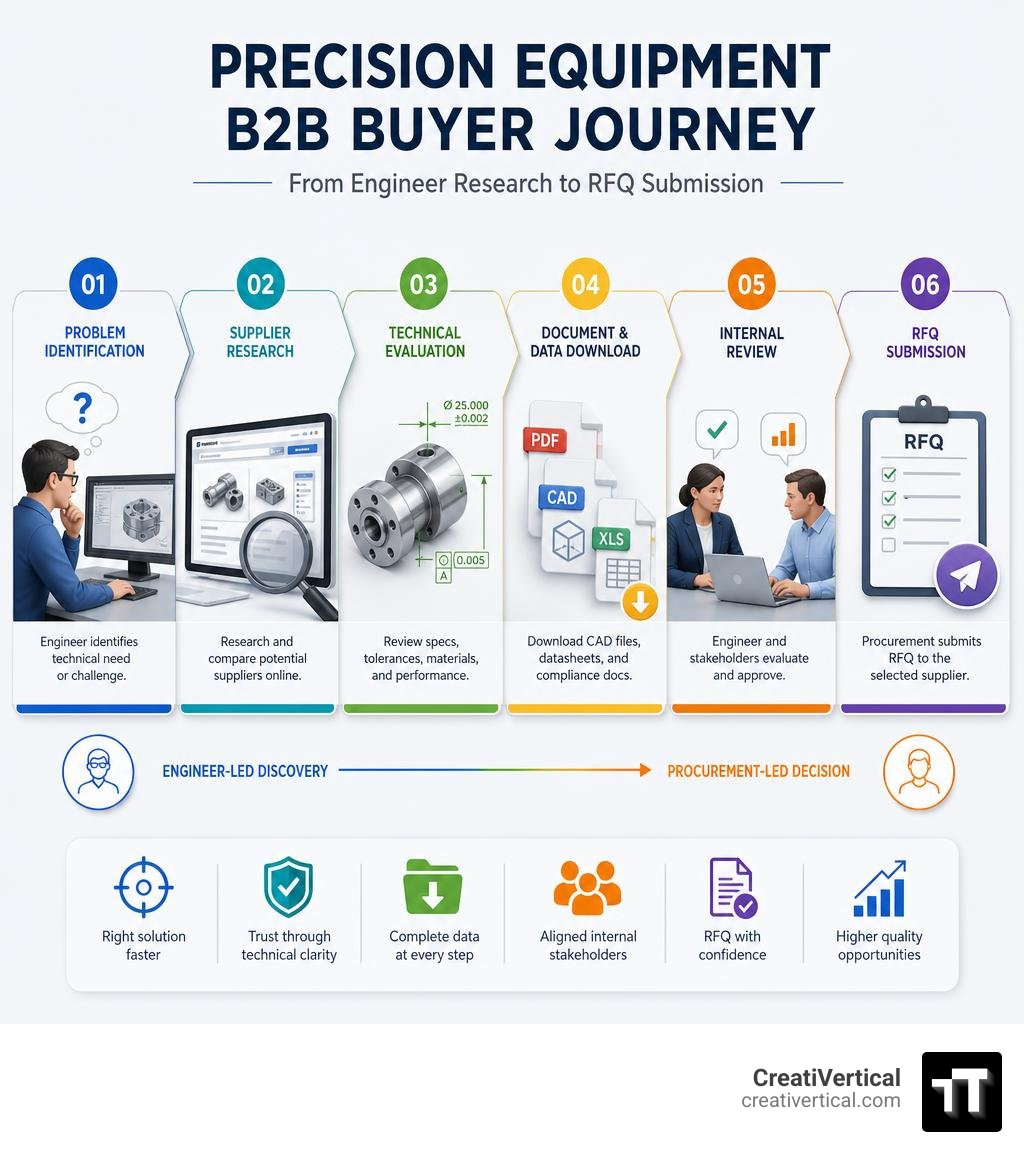
The Industrial Buyer Journey: Engineers vs. Procurement
When we build a website for industrial machinery or high-tolerance components, we are designing for two distinct, often conflicting personas: the design engineer and the procurement officer.
The engineer wants dirty details. They want to know if your component can withstand specific thermal cycles, what its exact physical dimensions are, and if you have the CAD files ready to drop into their SolidWorks assembly. If they cannot find this technical specification data within three clicks, they will leave your site and find a competitor who makes their job easier.
The procurement officer, on the other hand, is focused on risk mitigation, supply chain stability, and cost. They look for certifications (ISO 9001, AS9100, or sector-specific compliance), lead times, production capacity, and credit terms. They need to know that your facility can scale with their production runs and that you won’t leave them stranded with a broken supply line.
To balance these needs, we structure the user experience so both pathways are clear from the home page. You can learn more about our custom website development and how we map these distinct user pathways to keep both audiences engaged.
| User Persona | Primary Goals | Key Website Requirements | Friction Points |
|---|---|---|---|
| Design Engineer | Verify technical fit, test tolerances, integrate models | CAD file downloads, 3D viewers, detailed datasheets, material specs | Missing tolerances, gated data behind long forms, slow load times |
| Procurement Officer | Mitigate vendor risk, verify compliance, negotiate terms | Compliance vaults, ISO certificates, clear RFQ process, capacity data | Hidden certifications, unclear lead times, difficult contact forms |
Speaking the Language of 1nm Tolerances
If your business manufactures high-end equipment, your website must reflect the extreme precision of your shop floor. Let’s look at semiconductor lithography as an example. In this field, systems project intricate circuit patterns onto silicon wafers where overlay accuracy must be under 2.1 nm.
When presenting products like the NSR-S635E ArF Immersion Scanner, the FX-103SH FPD Scanner, or alignment systems like the Litho Booster, your website cannot afford vague marketing speak. It must present precise physical facts: throughput figures (such as “more than 275 wafers per hour”), laser wavelengths, and absolute grid distortion values.
Engineers recognize when a website was written by a generic copywriter who does not understand the difference between an i-line stepper and an excimer laser. By presenting high-density, structured technical data, you build immediate trust with the technical professionals who specify your parts.
Why Generalist Agencies Fail at Precision Equipment Web Development
Most web design agencies are built to serve local retail, professional services, or generic B2B SaaS companies. They excel at creating beautiful, minimalist brochures, but they fall apart when confronted with the realities of industrial buying cycles.
A generalist agency often does not know how to handle:
- Complex, multi-level product catalogs with tens of thousands of SKUs.
- Secure CAD file and 3D model delivery systems that protect your intellectual property.
- Compliance vaults containing sensitive FAT/SAT documentation or ITAR-regulated data.
- The nuances of niche industrial keyword research.
If you are looking for local partners in Missouri, you can review lists like the Top Web Development Companies In Kansas City – DesignRush to see the sheer variety of agencies out there. However, a generalist design won’t meet the needs of engineers and procurement teams who expect deep technical documentation and seamless industrial integrations.
Technical Architecture for Precision Equipment Web Development
To build a website that handles massive product catalogs and complex data without slowing to a crawl, you need a modern development stack.
At CreatiVertical, we often move away from heavy, monolithic database systems for high-performance projects. Instead, we lean toward decoupled architectures using modern frameworks like ReactJS, Node.js, and TailwindCSS, deployed on global networks like Vercel. This headless approach separates your website’s front-end design from its back-end data, resulting in incredibly fast load speeds and robust security.

For instance, when a precision manufacturer modernizes their site with a high-performance ReactJS stack, the results are immediate. In real-world applications, migrating to a optimized ReactJS architecture has helped industrial B2B companies achieve a 60% increase in organic search traffic and generate 5 or more new qualified leads per week within the first three months. By reducing page load times by 40% and cutting bounce rates in half, you ensure that busy engineers on the factory floor don’t abandon your site out of frustration.
Integrating ERP, CRM, and Inventory Systems
A precision equipment website shouldn’t sit on an island. It needs to connect directly to the systems that run your business, including your ERP (like SAP, Epicor, or Syspro) and your CRM (like Salesforce or HubSpot).
When we integrate these systems, we enable:
- Live Inventory and Production Capacity: Showing buyers what is in stock or current lead times for custom manufacturing runs.
- Automated RFQ Routing: Sending incoming technical RFQs directly to the correct application engineer based on the product category.
- Customer Portals: Allowing repeat B2B buyers to log in, view past orders, track shipments, and download custom invoices.
Integrating these complex systems can open up entirely new revenue streams. To understand how modern web platforms are reshaping industrial sales, you can read about how ecommerce websites are helping businesses transition from traditional offline sales to efficient, automated digital ordering systems.
CAD File Integration and Interactive Product Configurators
One of the most valuable features you can offer on a precision equipment website is an interactive product configurator. Instead of forcing engineers to browse a flat table of static parts, a configurator allows them to select custom bore diameters, materials, seal types, and mounting options in real time.
Once configured, the site should dynamically generate:
- A custom part number.
- A downloadable 3D CAD file (in formats like STEP, IGES, or SolidWorks).
- A dynamic PDF datasheet containing the exact specifications of the configured part.
Implementing these tools requires deep technical expertise. For example, companies specializing in layout and measurement systems, such as Precision Layout Solutions | Site Precision, rely on precise 3D scanning, 3D Laser Scanning, and digital layouts to bridge the gap between physical equipment and digital planning. Your website must do the same, allowing users to interact with your physical products digitally before they ever submit an RFQ.
Designing for the Factory Floor and the C-Suite
An industrial website must perform flawlessly across very different environments. A C-suite executive might review your corporate capability deck on a high-resolution monitor in a quiet office. Meanwhile, a field technician or shop-floor supervisor might be trying to look up a wiring diagram or troubleshooting guide on a mobile device, standing next to a loud machine with poor cellular reception.
This is why we prioritize mobile-industrial responsiveness and strict Core Web Vitals optimization. Buttons must be easy to tap, text must remain legible under harsh lighting, and PDFs must load instantly even on slow, industrial Wi-Fi networks.
When budgeting for a project of this scale, it is important to understand what drives development costs. To get a realistic sense of the investment required for custom features, security, and integrations, you can read our guide on what a new website should cost.
Balancing Performance and Visuals in Precision Equipment Web Development
It is a common mistake to assume that industrial websites have to look boring. While technical utility is paramount, high-end visual design builds immediate brand authority. You can see this balance in action by exploring custom product launches like the X-treme Manifold – Realistic, which demonstrates how industrial products benefit from clean branding, distinct user journeys, and color-coded sub-branding to separate industrial, medical, and specialty use cases.
The key is balancing these high-end visuals with strict performance budgets. We use modern web techniques like lazy-loading high-resolution images, hosting videos on lightning-fast content delivery networks (CDNs), and using SVG graphics for technical diagrams to keep load speeds incredibly fast while maintaining a premium aesthetic.
Compliance Vaults and Secure Portals
For manufacturers serving highly regulated industries like aerospace, defense, medical devices, or semiconductor fabrication, compliance is everything. Your website must make it easy for auditors and procurement teams to verify your credentials.
We build secure compliance vaults and customer portals that house:
- ISO 9001, AS9100, and other quality management certifications.
- Factory Acceptance Testing (FAT) and Site Acceptance Testing (SAT) documentation.
- Material Test Reports (MTRs) and Certificates of Conformance (CoCs).
- ITAR and export control registration details.
By using secure frameworks like the Precision Intranet Systems & SaaS Framework Home Page, we can implement multi-user authentication, secure cloud hosting, and zero-downtime publishing processes. This ensures that your sensitive compliance data is protected, easily accessible to authorized users, and always up to date.
Search and Answer Engine Optimization (AEO) for Niche Industrial Keywords
Traditional SEO is no longer enough. In 2026, engineers and procurement managers are increasingly using AI-driven search engines like Perplexity, Gemini, and Google’s AI Overviews to find technical components and vendors.
To rank for highly specific industrial terms, you must optimize your site for both human searchers and AI crawlers. This requires embedding high-density semantic data, structured schema markup, and clear FAQ sections. If you want to build a search strategy that captures these high-value technical queries, you can explore our professional web design services in Kansas City to see how we build search-optimized digital systems.
Becoming the AI ‘Source of Truth’ for Technical Queries
When an engineer asks Perplexity, “Which US-based manufacturer provides custom internal differential kits with under 5-micron tolerances?”, the AI does not browse beautiful imagery. It scans the web for raw, structured, and authoritative data.
To make sure your business is cited as the source of truth, we implement:
- Product Schema Markup: Giving AI crawlers direct, machine-readable access to your product dimensions, materials, tolerances, and model numbers.
- Semantic Content Hubs: Writing deep, authoritative guides on specific manufacturing processes, material behaviors, and engineering challenges.
- High-Density Technical Tables: Structuring your product data in clean, indexable HTML tables that AI engines can easily parse and present in search answers.
If your site is structured correctly, search engines can index and display your products in AI Overviews within weeks of launching.
Structuring Product Pages for High-Value RFQs
A high-performing product page for precision equipment should guide the user naturally from research to inquiry. To achieve this, we recommend a tiered content structure:
- Above the Fold: High-resolution product image, clear value proposition, primary specifications (dimensions, materials, key tolerances), and a prominent “Request Quote / Speak to an Engineer” button.
- Interactive Elements: A 3D CAD model viewer or an interactive configurator.
- Deep Technical Data: Expandable sections containing detailed tolerance tables, compliance certifications, and material safety data sheets (MSDS).
- Lead Magnets: Gated PDF datasheets, installation guides, or white papers that require a business email address to download, feeding your CRM with qualified, high-intent leads.
Frequently Asked Questions about Industrial Web Development
How do we handle complex CAD and 3D file downloads securely?
We secure your intellectual property by using gated access controls and secure cloud storage. Instead of leaving raw CAD files open to public indexing, we require users to verify their business email addresses before downloading. For highly sensitive defense or aerospace components, we can implement multi-factor authentication and restrict downloads to verified domestic organizations, helping you maintain ITAR and export control compliance.
What is the typical timeline and cost for an industrial website redesign?
The timeline and cost of an industrial web project depend heavily on the size of your product catalog and the complexity of your backend integrations (such as ERP and CRM syncing). A typical mid-sized industrial redesign takes anywhere from 12 to 24 weeks.
We utilize a collaborative “blueprint” phase to map out every integration, page template, and database requirement before writing any code. If you are looking to build on a flexible, scalable content management system, you can learn more about our approach to WordPress web design in Kansas City to see how we plan and execute custom builds.
How does Answer Engine Optimization (AEO) differ from traditional SEO for manufacturers?
Traditional SEO focuses on ranking your website for specific keywords in standard search results. AEO focuses on structuring your content so that AI-driven search tools (like ChatGPT, Perplexity, and Gemini) can easily extract facts from your site and cite you as their authoritative source. While traditional SEO relies heavily on backlink profiles and keyword density, AEO relies on structured schema markup, semantic clear writing, and high-density technical data tables.
Conclusion
Your website is the digital front door to your manufacturing facility. If your shop floor operates with nanometer precision, your digital presence should reflect that same level of engineering excellence. A generic B2B brochure site simply cannot communicate the technical depth, compliance standards, and product variety that modern engineers and procurement officers demand.
At CreatiVertical, we don’t just build websites; we build complete, performance-focused digital systems that act as an ongoing growth partner for your business. From our home base in Lake Tapawingo and the greater Kansas City, Missouri area, we help industrial manufacturers translate their physical precision into digital authority.
Ready to turn your complex product catalog into a high-performance lead generation engine? Fuel your industrial growth with our SEO services in Kansas City and let’s build a digital system that keeps your production lines running.