
Track Local SEO Performance From Search Visibility to Real Leads
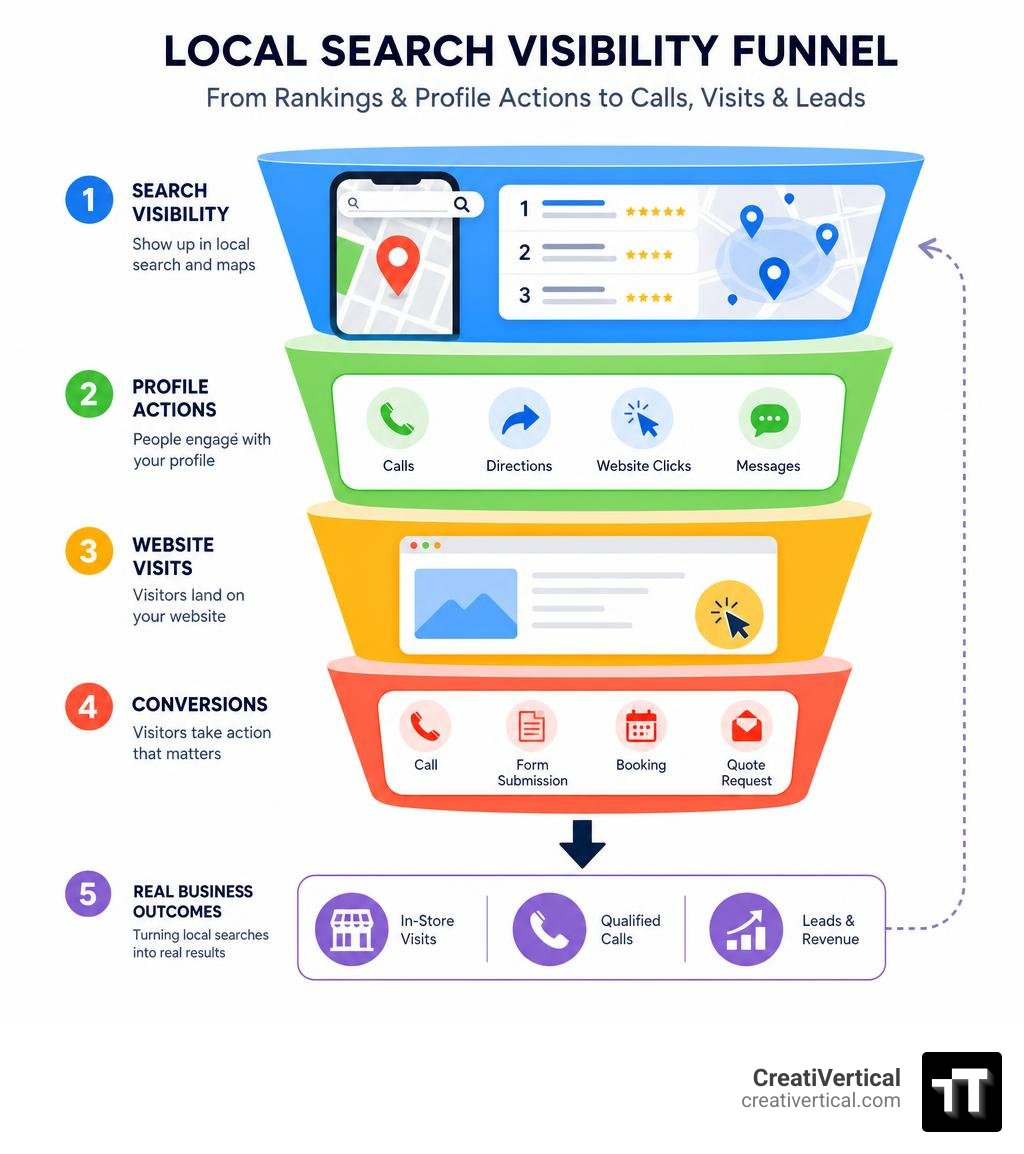
Effective local SEO performance tracking connects visibility with customer action. Start by measuring where you appear in Google Maps and local results, then track what happens next: profile calls, direction requests, website visits, form submissions, bookings, and qualified leads.
A practical starting set of metrics includes:
- Local Pack and map rankings for a focused set of high-intent service and location searches.
- Google Business Profile actions, including calls, website clicks, direction requests, and messages where available.
- Local website conversions in Google Analytics 4, especially calls, forms, quote requests, and bookings.
- Review and citation health, including review volume, rating trends, response activity, and consistent name, address, and phone data.
- Neighborhood-level visibility with a geo-grid tracker, since a business can rank well near its address and poorly a few miles away.
This matters because local search is not just a website traffic channel. Many customers decide directly from Google Maps or a Business Profile. Google Business Profile data can show demand and engagement, while call tracking, UTM-tagged links, and CRM outcomes help show whether that engagement becomes revenue.
Local search also behaves differently from national SEO. Rankings depend heavily on relevance, prominence, and proximity, so one citywide ranking average can hide meaningful gaps across neighborhoods, ZIP codes, or service areas. The goal is not a prettier dashboard. It is a repeatable way to find where potential customers discover you, where they drop off, and which improvement deserves attention next.
I am Nicholas Cunha, founder of CreatiVertical, with more than 20 years of agency and project experience across local businesses, offshore professional services, government institutions, and B2B organizations. My work in local SEO performance tracking combines practical SEO, web development, AI search visibility, and measurement systems that tie search activity to real business decisions.
Key terms for local seo performance tracking:
How Local SEO Measurement Differs from Traditional SEO
Tracking local visibility requires a completely different lens than evaluating traditional national or ecommerce campaigns. In standard SEO, performance evaluation centers on organic keyword positions, global domain authority, and pageviews flowing to landing pages. Local search algorithms operate on three core variables: relevance, prominence, and proximity.
Because physical proximity plays an unbending role in search engine results, a business does not hold a single, uniform rank across an entire metropolitan area. Instead, positions fluctuate street by street. Following a clear step-by-step local visibility online roadmap requires measuring coordinate-based visibility alongside physical customer actions.
Furthermore, roughly 46% of all internet searches carry local intent, and 50% of smartphone users visit a physical business within a single day of performing a local search. Many of these users never click through to a traditional website. They make buying decisions, request driving routes, or initiate phone calls straight from the Local 3-Pack or knowledge panel.
| Measurement Dimension | National / Traditional SEO | Local Map Pack & Local Organic SEO |
|---|---|---|
| Primary Visibility Metric | National or global average ranking position | Coordinate-based Local 3-Pack & geo-grid rank |
| Dominant Conversion Point | Website form fills, downloads, ecommerce checkout | Direct phone calls, driving directions, in-person visits |
| Core Conversion Channel | On-site website pages & digital funnels | Google Business Profile, Apple Maps, localized landing pages |
| Geographic Sensitivity | Broad country or state-level segmentation | Hyperlocal micro-markets (ZIP code, neighborhood radius) |
| Algorithmic Drivers | Backlink authority, technical crawlability, content depth | Physical proximity, review velocity, NAP consistency, local entity relevance |
Core Metrics for Local SEO Performance Tracking

Measuring local performance means looking at the entire discovery-to-revenue path rather than fixating on vanity impressions. Maintaining this visibility is supported by following a complete Business Profile management guide so that customer touchpoints remain active and accurate.
The fundamental metrics that form an actionable tracking system include:
- Google Business Profile Interaction Metrics: Track direct interactions including tap-to-call mobile clicks, driving direction requests, direct messaging inquiries, and website click-throughs. Direction requests serve as a strong proxy for physical foot traffic intent.
- Discovery vs. Direct Search Volume: Direct searches indicate existing brand awareness, while discovery searches reveal how often nearby users find your listings when searching for broader category solutions.
- Review Velocity and Sentiment Scores: Consumer trust and search prominence depend heavily on fresh social proof, with 97% of consumers reading online reviews before making a local purchasing decision. Monitor monthly review acquisition pace, average numerical ratings, and owner response times.
- Citation Accuracy and NAP Consistency: Discrepancies across external directories dilute search engine trust. Measuring the accuracy of your Name, Address, and Phone number (NAP) across major aggregators prevents algorithmic confusion.
- Localized Organic Engagement: Filter organic traffic within analytics tools down to specific geographic zones and dedicated localized landing pages to evaluate whether on-site visitors submit quotes or schedule appointments.
Tracking Map Pack Rankings and Geo-Grid Visibility
Because proximity limits visibility, evaluating local search via single-point keyword rankings provides an incomplete picture. A business might rank #1 at its physical front door while dropping completely out of the top 20 three miles away in a neighboring commercial district.
Geo-grid heatmaps solve this blind spot by plotting search results across a multi-point matrix (such as a 5×5 or 7×7 grid) over a defined radius (e.g., 5 to 15 miles). Using detailed geo-heatmaps documentation allows you to see exactly where your business occupies the top-3 Local Pack positions (often color-coded green) versus where rankings drop into lower tiers or unindexed states.
Monitoring this spatial distribution helps businesses rank for near me searches and evaluate their Share of Local Voice (SoLV) against competing local businesses within distinct micro-markets.
Monitoring Generative AI Citations and AI Overviews
Local discovery is no longer restricted to traditional SERPs. Google AI Overviews now appear in roughly 68% of local intent queries and 88.5% of commercial searches. Furthermore, 45% of consumers consult generative AI tools like ChatGPT and Perplexity to locate nearby services.
Because AI Overviews can cut standard Position-1 organic click-through rates by more than half (dropping them from approximately 40% to under 20%), tracking generative citations has become a fundamental operational requirement.
Research indicates that 44.2% of AI-generated citations originate from the top 30% of a webpage’s content, and incorporating structured schema increases AI citation rates by 3.2x. When optimizing for voice and conversational AI search, write with an “Answer-First” copy structure on localized landing pages and use validated LocalBusiness JSON-LD schema to ensure machine crawlers understand your exact service footprint.
Building Your Local Measurement and Reporting Architecture
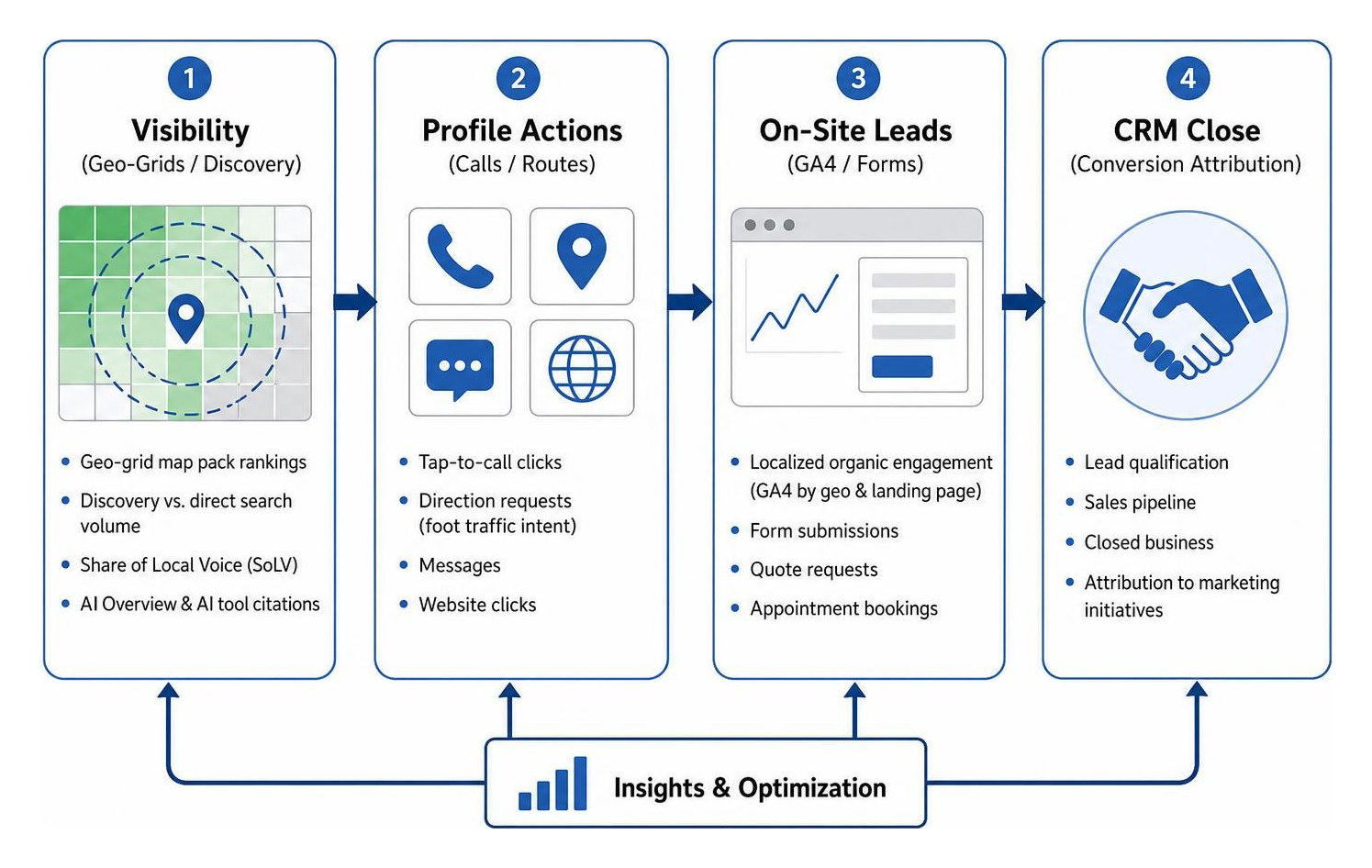
A reliable measurement framework unifies multiple data sources into a cohesive reporting dashboard. Relying on disconnected platforms makes it difficult to spot pipeline friction or attribute inbound calls to specific marketing initiatives.
To build an integrated reporting system, implement the following steps:
- Deploy Custom UTM Tracking on Google Business Profile: Append clear UTM parameters to your primary website button in your Business Profile (
?utm_source=google&utm_medium=organic&utm_campaign=gbp-profile). This allows Google Analytics 4 (GA4) to separate local profile visits from standard national organic traffic. - Configure GA4 Custom Conversion Events: Establish custom events for high-value actions such as click-to-call links, appointment schedule confirmations, driving direction link taps, and lead form submissions.
- Integrate Dynamic Call Tracking Software: Deploy call tracking software that uses dynamic number insertion (DNI) on your website while keeping your Google Business Profile primary number consistent with external citations (or utilizing your verified tracking number as the primary GBP number with your permanent landline set as an alternate).
- Automate Centralized Reporting Views: Connect your analytics platforms, Search Console properties, and geo-grid data directly into consolidated local SEO reporting dashboards to eliminate manual data imports.
Essential Tools for Local SEO Performance Tracking
Maintaining a clean measurement stack avoids software bloat while capturing critical KPIs across platforms:
- Google Business Profile Analytics: Delivers native visibility into direct actions, total profile views, discovery queries, and engagement trends.
- Geo-Grid Rank Trackers: Software solutions that plot coordinate-based map visibility across customizable neighborhood radiuses. Setting up Local SEO Rank Tracking in Looker Studio streamlines this visual data directly into client-ready dashboards.
- Google Search Console & Google Analytics 4: Essential for monitoring landing page indexation, impression trends on localized long-tail terms, and on-site user behavior.
- Call Tracking Platforms: Provide attribution data connecting phone inquiries to specific local keyword clusters and source campaigns.
- Citation & Listing Auditing Software: Monitors NAP consistency across dozens of regional directories and aggregator databases.
Establishing a Baseline for Local SEO Performance Tracking
Before implementing major changes or judging marketing momentum, capture an initial 60-to-90-day baseline snapshot. Local SEO progress compounds over time, and meaningful trend lines generally require 6 to 8 weeks of historical tracking data to emerge clearly.
Your starting baseline should document:
- Initial geo-grid average rank and Share of Local Voice across target radiuses.
- Monthly inbound phone call volume and driving direction request counts.
- Current citation consistency scores across primary directory ecosystems.
- Existing review acquisition velocity (number of new reviews per month) and average rating.
- Current organic impressions and conversions on localized service pages.
Core Local Search Keyword Targets to Track
- Primary Service Terms:
[Core Service] near me,[Core Service] [City Name] - Emergency / High-Intent Modifiers:
emergency [Core Service] [Neighborhood],best rated [Core Service] near me - Secondary Service Offerings: Specific sub-services paired with relevant geographic identifiers
Turning Measurement Data into Actionable Business Decisions
Data collection is only valuable if it drives specific, high-priority operational refinements. Analyzing local analytics patterns helps diagnose where prospects drop off in the conversion funnel:
- High Map Pack Rankings with Low Click-Throughs: If geo-grids confirm strong top-3 map pack visibility but inbound calls and direction requests remain low, audit your listing’s presentation. Check your aggregate star rating, review volume relative to adjacent competitors, primary photo presentation, and current business hours.
- High GBP Profile Views with Low Phone Calls: If thousands of searchers view your profile but few call, inspect your primary business category and service descriptions. Conducting a local SEO competitor analysis helps identify whether competitors highlight specialized attributes (such as 24/7 availability or online booking integrations) that capture searcher interest.
- Strong Website Visits with Low Contact Form Submissions: When UTM data shows robust landing page visits from your profile but conversion rates stall, examine on-page user experience. Ensure mobile page load speeds are fast, headlines confirm local service areas immediately, and direct call-to-action buttons sit prominently above the fold.
- Sudden Local Rank Declines in Specific Neighborhoods: If geo-grid tracking reveals localized drops in a single ZIP code, check directory citation accuracy in that sector and build localized content addressing specific projects completed in that neighborhood.
Common Local Measurement Mistakes to Avoid
Avoiding standard measurement pitfalls ensures marketing resources focus on activities that generate paying customers:
- Relying on Metro-Wide Ranking Averages: Treating a citywide rank average as an absolute KPI hides localized ranking drop-offs across adjacent suburbs and neighborhoods.
- Tracking Vanity Impressions Over Conversion Outcomes: High search impression counts are meaningless if they do not result in calls, directions, or scheduled consultations.
- Failing to Tag Business Profile Links with UTM Codes: Without UTM tracking parameters, GA4 groups Google Business Profile traffic into generic organic search, obscuring local listing performance.
- Overreacting to Daily Algorithmic Noise: Local search results fluctuate daily based on user location, search testing, and competitor updates. Reviewing performance on a monthly cadence provides a stable, actionable perspective.
- Neglecting Directory Inconsistencies: Overlooking small variations in street addresses, suite numbers, or phone formats across online citations quietly degrades algorithmic prominence. Utilizing reliable performance SEO reporting tools ensures listing discrepancies are identified and corrected early.
Frequently Asked Questions about Local Search Tracking
How often should a business review its local SEO performance data?
A monthly review cadence is optimal for evaluating local search metrics. While daily or weekly checks can be useful during an intensive optimization sprint or immediate website migration, daily data is subject to regular algorithmic testing and temporary proximity shifts. A monthly reporting cycle smooths out short-term fluctuations, revealing genuine growth trends and seasonal patterns.
How do you track Google Business Profile traffic separately in GA4?
To isolate Google Business Profile traffic inside Google Analytics 4, append specific UTM campaign parameters to the primary website URL listed in your Business Profile dashboard. Adding ?utm_source=google&utm_medium=organic&utm_campaign=gbp-listing ensures GA4 categorizes these visitors into a distinct campaign dimension, allowing you to measure dedicated on-site conversion behavior.
Why do local rankings vary drastically within just a few blocks?
Local search results are heavily weighted by the physical proximity of the searcher (or the simulated coordinate point) relative to competing businesses. As the distance from a business address increases, or as competing businesses with high prominence and relevance enter the radius, the algorithm adjusts the 3-Pack order, resulting in distinct ranking positions across short physical distances.
Conclusion
Measuring local search performance is a continuous operational discipline that ties hyper-local search visibility directly to real-world customer acquisition. By deploying multi-point geo-grid tracking, isolating listing traffic through UTM parameters, monitoring generative AI visibility, and attributing offline actions like driving directions and phone inquiries, businesses can make data-driven decisions that generate measurable revenue.
At CreatiVertical, we engineer complete, performance-focused digital systems that unify technical web development, applied AI workflow enablement, and full-funnel search visibility for local enterprises, industrial manufacturers, and professional service firms. To continue refining your local search strategy, explore these 7 actionable tips to improve local visibility online or contact our team to build a tailored local measurement architecture.