

Voice Search Is Now a Primary Search Channel — Here’s What to Do About It
Voice search optimization is the practice of structuring your website’s content, technical setup, and local listings so that voice assistants — Google Assistant, Siri, Alexa, and others — confidently choose your content as the spoken answer when someone asks a relevant question out loud.
Here’s what it requires, at a glance:
| What to Optimize | Why It Matters for Voice |
|---|---|
| Conversational, long-tail keywords | Voice queries average 7-9 words vs. 3 for typed searches |
| Featured snippet / position zero | Over 40% of voice answers come from featured snippets |
| Page speed and mobile performance | The average voice result loads in under 1.5 seconds |
| Local SEO and Google Business Profile | Around 76% of voice queries have local intent |
| Schema markup (FAQPage, LocalBusiness) | Helps assistants identify and extract your answers |
| Natural-language content structure | Assistants read one answer aloud — yours or a competitor’s |
Search behavior has shifted quietly but decisively. Over 1 billion voice searches happen every month. More than half of U.S. adults have tried voice search, and 28% use a voice assistant every single day. People are asking their phones and speakers full questions — “What’s the best industrial lubricant supplier near Kansas City?” or “Which law firm handles BVI company formation?” — and expecting a single, confident answer in return.
The stakes are different from traditional SEO. In a list of ten blue links, ranking fifth still earns you a click. In voice search, there is no second place. The assistant picks one source and reads it aloud. You’re either the answer or you’re invisible.
And in 2026, voice search and AI-generated answers have effectively merged into the same pipeline. Optimizing for one means optimizing for the other.
I’m Nicholas Cunha, founder of CreatiVertical, and I’ve spent over twenty years helping businesses — from Kansas City small businesses to offshore professional-services firms in the British Virgin Islands — build digital presences that actually get found. Voice search optimization is now a core part of every SEO engagement I run, precisely because the same signals that win voice answers also drive AI search citations in tools like ChatGPT and Perplexity.
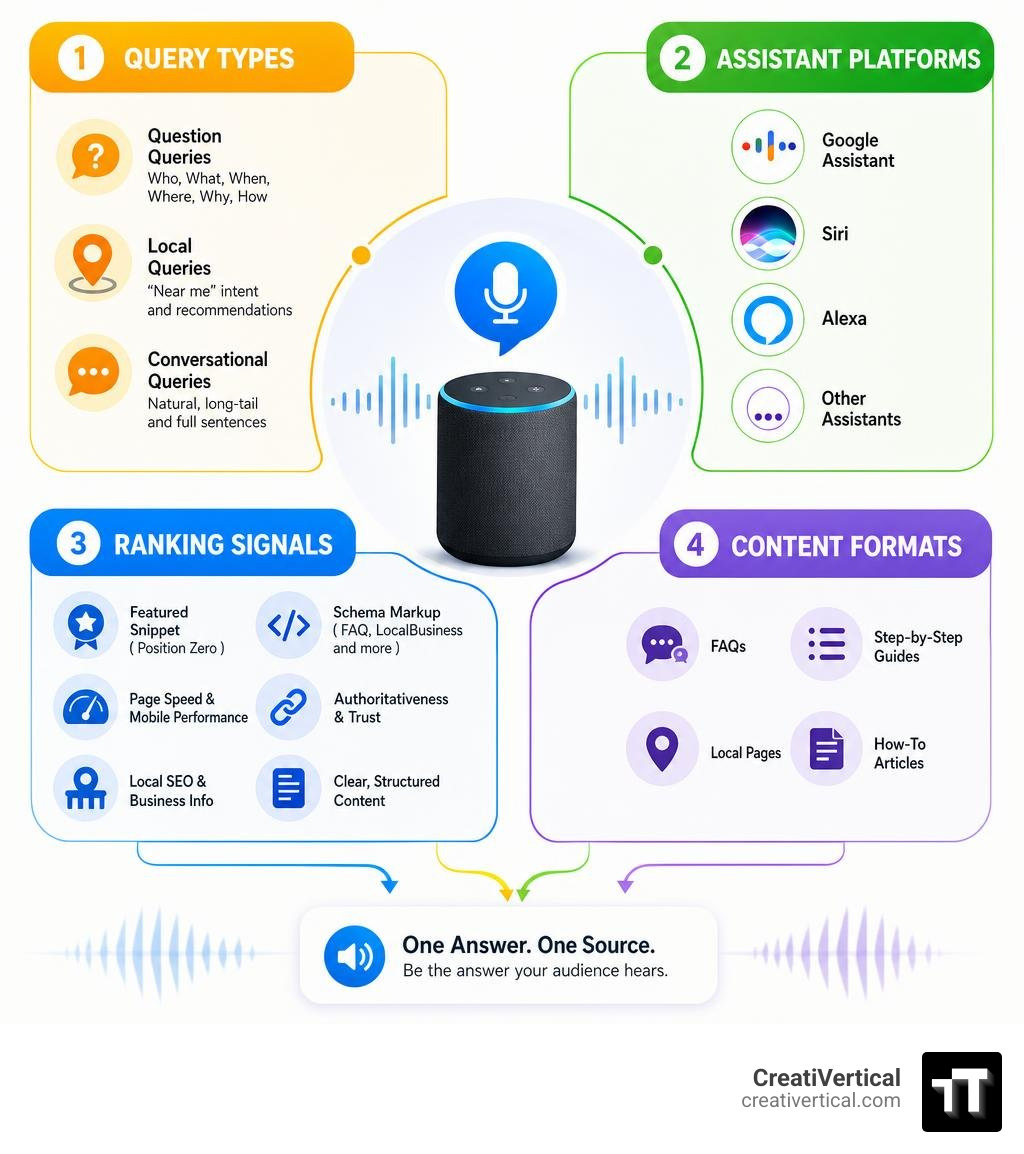
What is Voice Search Optimization and How It Differs from Traditional SEO
To win at voice search, we have to understand that speaking is fundamentally different from typing. Traditional SEO has spent decades training us to search like machines. We type “industrial valve manufacturer” or “BVI trust law.” But when we speak, we return to our natural state: we ask complete, conversational questions.
Understanding Mobile SEO Voice Search Optimization is the first step toward aligning your website with these spoken patterns. Unlike traditional desktop search, voice search is inherently mobile, immediate, and hands-free. This fundamental behavioral shift means your content cannot rely on keyword stuffing; it must mirror the rhythm of actual human speech.

For a deeper dive into how search engines process these spoken inputs, you can consult Voice Search SEO: How to Optimize for Spoken Queries. The core difference lies in how search engines parse natural language processing (NLP) to extract direct answers rather than matching exact-match keyword phrases.
The Mechanics of Spoken Queries vs. Typed Keywords
Consider how query dynamics change between desktop typing and verbal commands:
- Query Length: Typed searches are highly condensed, averaging 1 to 3 words. Spoken queries are significantly longer, typically averaging 7 to 9 words.
- Grammatical Structure: Typed queries are fragmented (“FedRAMP compliance checklist”). Spoken queries are syntactically complete questions (“What are the security controls required for a FedRAMP Moderate authorization?”).
- Pronominal and Question Words: Spoken queries heavily feature the five Ws and one H (Who, What, Where, When, Why, How). They are rich with pronouns and natural transitions.
- Immediacy and Intent: Spoken searches often carry immediate, high-intent action requirements, such as finding a physical location while driving or looking up a technical specification on a factory floor.
Why Voice Search Optimization Matters for B2B and Local Businesses
For local service providers in Lake Tapawingo or the broader Kansas City metro, voice search is often the primary driver of high-intent local leads. When a homeowner asks, “Where is an emergency plumber near me?”, or a purchasing agent asks, “Who sells custom machined parts in Kansas City?”, the voice assistant pulls directly from local business directories and localized web pages.
But this isn’t just a local small-business game. In specialized B2B sectors — such as offshore financial services in the Cayman Islands, precision industrial manufacturing, or government IT contracting — decision-makers use voice search in high-productivity moments. An engineering procurement manager walking a loud factory floor might ask their device, “What is the operating temperature range for synthetic gear lubricants?” A law partner commuting to work might ask Siri, “What are the filing requirements for a Cayman exempted company?”
If your site is optimized to answer these highly specific, conversational queries, you capture these buyers at the exact moment of intent. To capture these opportunities, look into our specialized SEO Services in Kansas City to align your local and regional search presence with modern conversational behavior.
The Technical Foundations of Voice-Discoverable Websites
Your content can be brilliantly written, but if your site’s technical infrastructure is sluggish or unreadable to search engine crawlers, voice assistants will ignore it. Technical optimization is the gatekeeper of voice search visibility.

Because voice assistants must deliver an answer in real time, they prioritize websites that load instantly and provide perfectly structured data. If you want to dive deeper into the technical mechanics, check out our guide on Technical SEO to see how we tune performance under the hood.

| Technical Metric | Traditional SEO Benchmark | Voice Search SEO Benchmark |
|---|---|---|
| Largest Contentful Paint (LCP) | Under 2.5 seconds | Under 1.5 seconds |
| Interaction to Next Paint (INP) | Under 200 milliseconds | Under 100 milliseconds |
| Security Protocol | HTTPS preferred | HTTPS mandatory (Non-secure sites are bypassed) |
| Mobile Usability | Responsive design | Mobile-first optimized with zero viewport errors |
| Structured Data | Optional but helpful | Mandatory (FAQ, LocalBusiness, Speakable) |
Implementing Structured Data and Schema Markup
Structured data acts as a translator for search engines. It takes your human-readable content and formats it into JSON-LD code that search bots can instantly parse and read aloud.
For voice search, three schema types are critical:
- FAQPage Schema: This tells search engines that a specific page contains a list of questions and answers, allowing them to pull your exact Q&A block directly into voice search results.
- LocalBusiness Schema: For any business serving a physical territory, this markup provides precise data regarding your Name, Address, Phone (NAP), operating hours, and service areas.
- Speakable Schema: This specialized markup identifies specific sections of a webpage (such as a concise summary paragraph) that are highly suitable for audio playback by text-to-speech engines.
To understand how to deploy these markups effectively, you can consult the official documentation provided by Schema.org and Google’s Search Central guides.
Page Speed and Mobile Performance Requirements
The average voice search result page loads in less than five seconds — which is double the speed of the average web page. If your site takes three or four seconds to render on a mobile connection, the voice assistant has already moved on to a competitor’s site.
To meet these demanding speed requirements:
- Compress and Defer: Compress all images using modern formats like WebP or AVIF, and lazy-load any media that sits below the fold.
- Minify Code: Clean up bogged-down CSS, JavaScript, and HTML. Eliminate render-blocking resources that delay page construction.
- Prioritize Mobile-First Indexing: Ensure your mobile navigation is flawless, font sizes are highly readable without zooming, and clickable elements have adequate spacing.
For businesses looking to integrate these technical elements directly into their digital platforms, modern web architecture must be built from the ground up to support conversational search.
Content Strategy: Structuring for Featured Snippets and AI Overviews
To rank for voice search, you must aim for “Position Zero” — the featured snippet block at the very top of Google’s search results. Because voice assistants typically read only one answer, they rely heavily on these snippets. In fact, featured snippets make up more than 40% of all voice search results.
Developing a content architecture that targets these snippets requires a systematic approach. You can explore our broader strategic insights on Category SEO to see how we structure content hubs for maximum visibility.
Crafting Conversational Content and FAQ Frameworks
The most effective way to win featured snippets is to structure your content using a clear “Question-and-Answer” framework.
- The Question Header: Use H2 or H3 headers that match the exact phrasing of a spoken voice query (e.g., “How does a BVI trust protect assets?”).
- The 29-Word Rule: Directly beneath the header, provide a concise, direct answer in 25 to 35 words. Research shows that the average voice answer read aloud by Google Assistant is approximately 29 words long.
- The Deep Dive: Below that concise answer block, provide your comprehensive, detailed explanation. This satisfies both the voice user looking for a quick answer and the desktop user looking for deep technical context.
Avoid corporate jargon and overly complex sentence structures. Write at an eighth-to-tenth-grade reading level using active voice and standard contractions. It should sound natural when read aloud by a robotic voice assistant.
The Convergence of Voice Search Optimization and Generative Engine Optimization (GEO)
In 2026, voice search is no longer an isolated technology. When you ask Siri or Alexa a question today, they don’t just search a basic index; they run the query through large language models (LLMs) and generative AI engines.
This has led to the rise of Generative Engine Optimization (GEO). The work you do to optimize for voice — structuring content clearly, citing reputable sources, using clear entity names, and answering questions directly — is the exact same work that gets your business cited as a primary source by ChatGPT, Gemini, and Perplexity.
If you are a B2B firm looking to dominate these AI-driven channels, positioning your brand as an authoritative source is essential for capturing high-value generative search traffic.
Local SEO: Winning the “Near Me” Voice Search Battle
Over half of all voice searches are used to find information about local businesses, and 76% of local voice searches result in a store visit or a direct call within 24 hours. If your local presence is fragmented, you are actively turning away ready-to-buy customers.

To build a bulletproof local presence, we must optimize across multiple directories. You can read our complete breakdown of local optimization strategies in our guide on Local SEO.

Optimizing for Local Intent and Directory Listings
Because different voice assistants rely on different search engines, you cannot focus on Google alone. Google Assistant pulls from Google Business Profile, but Apple’s Siri relies heavily on Apple Business Connect and Yelp, while Amazon’s Alexa pulls business data from Bing Places and Yext.
To win the local voice battle:
- Maintain Absolute NAP Consistency: Ensure your business Name, Address, and Phone number are identical across Google, Bing, Apple Maps, Yelp, and all local directories. Even minor discrepancies (like “Suite 100” vs. “Ste. 100”) can degrade search engine trust.
- Target Neighborhood Keywords: Spoken local searches rarely use formal city names alone. People ask for “machined parts supplier in Northland KC” or “business lawyer near Lake Tapawingo.” Incorporate local landmarks, neighborhood names, and regional terms into your localized landing pages.
- Actively Manage Reviews: Voice assistants prioritize businesses with high ratings and active, recent reviews. Encourage your clients to leave detailed reviews that naturally use conversational keywords.
To see how regional businesses scale their local visibility, implementing a cohesive local search strategy is essential for capturing high-intent voice queries.
Frequently Asked Questions about Voice Search
How is voice search different from regular SEO?
Traditional SEO focuses on ranking a list of websites for typed, fragmented keywords (e.g., “BVI law firm”). Voice search focuses on answering conversational, question-based spoken queries (e.g., “How do I set up a corporate entity in the British Virgin Islands?”). Additionally, traditional search yields a page of multiple results, whereas voice search typically delivers a single, spoken answer, making the competition for “Position Zero” far more intense.
What schema markup helps the most with voice search?
The three most impactful schema markups for voice search are:
- FAQPage Schema: Allows search engines to easily parse your question-and-answer content.
- LocalBusiness Schema: Provides search engines with verified local data like address, phone number, and operating hours.
- Speakable Schema: Explicitly identifies which sections of your content are optimized for text-to-speech reading by voice assistants.
How do I measure voice search performance?
Because search engines do not provide a direct “voice search” filter in their analytics platforms, you must track proxy metrics. The most reliable methods include:
- Monitoring your impressions and rankings for long-tail, question-based queries in Google Search Console.
- Tracking your ownership of featured snippets (Position Zero) and “People Also Ask” boxes using tools like Semrush or Ahrefs.
- Monitoring local voice-driven actions, such as clicks-to-call and direction requests, within your Google Business Profile and Apple Business Connect dashboards.
For those interested in exploring more about specialized voice optimization, focusing on structured data, conversational content, and local directory alignment remains the most effective path forward.
Conclusion: Build a Voice-Ready System with CreatiVertical
Optimizing for voice search isn’t a vanity project or a futuristic trend — it is a foundational requirement for digital survival in 2026. Whether you are a local Kansas City business looking to capture high-intent “near me” traffic, an industrial B2B manufacturer seeking procurement buyers, or an offshore professional-services firm aiming to be cited by global AI search tools, your audience is already speaking their queries.
At CreatiVertical, we don’t believe in piecemeal marketing tactics or one-off optimization projects. We build complete, performance-focused digital systems designed to fuel your long-term growth. From technical speed tuning and advanced schema deployments to conversational content architecture and generative engine visibility, we act as your ongoing digital growth partner.
As a rough market guide, professional monthly SEO retainers across the industry commonly run from a few hundred to several thousand dollars per month, depending entirely on your industry’s competitive landscape and the scope of your target market. Rather than chasing standard rankings that are rapidly losing real estate to AI overviews, we focus on building adaptive systems that ensure your brand is both seen and heard.
Ready to secure your position as the definitive answer in your industry? Launch your adaptive SEO strategy with CreatiVertical today, or find our physical headquarters at CreatiVertical, 154 Anchor Dr, Lake Tapawingo, MO 64015, US to discuss how we can chart a course for your digital growth.