

What is an Offshore Company Nominee Director?
An offshore company nominee director is a third party who appears on a company’s public records as the official director — while the actual owner (called the beneficial owner) retains full control behind the scenes through private legal agreements.
Quick answer: Here’s what you need to know at a glance:
| Question | Short Answer |
|---|---|
| What is a nominee director? | A third party who serves as the official director on public records on behalf of the real owner |
| Is it legal? | Yes — when properly documented and used for legitimate purposes |
| Does the nominee control the company? | No — they act only under the beneficial owner’s written instructions |
| Does the nominee access bank accounts? | No — the beneficial owner remains the account signatory |
| What documents protect you? | Power of Attorney, Nominee Service Agreement, Deed of Indemnity |
| Who can see the real owner’s identity? | Regulatory authorities, financial institutions, and law enforcement — not the general public |
If you’re setting up a company in Singapore, the BVI, the Cayman Islands, or another offshore jurisdiction, you’ve probably run into two realities quickly: some jurisdictions require a locally resident director, and public registries in many places make your name visible to anyone who looks. Nominee directors solve both problems — legally, and with the right paperwork, cleanly.
But there’s a lot of noise around this topic. Some providers oversell privacy. Others gloss over the risks. Transparency rules have tightened significantly across more than 45 jurisdictions worldwide, and what worked quietly a decade ago now comes with real compliance obligations attached.
This guide cuts through the noise. It explains how nominee director arrangements actually work, what documents you need, where the risks live, and how to use the structure without crossing legal lines.
I’m Nicholas Cunha, and my fifteen years running a digital agency in the British Virgin Islands gave me a ground-level view of how offshore company structures — including offshore company nominee director arrangements — operate in practice for law firms, company-formation agents, and fiduciary providers. That experience shapes how CreatiVertical helps offshore professional-services firms communicate these services clearly and compliantly to an international audience.
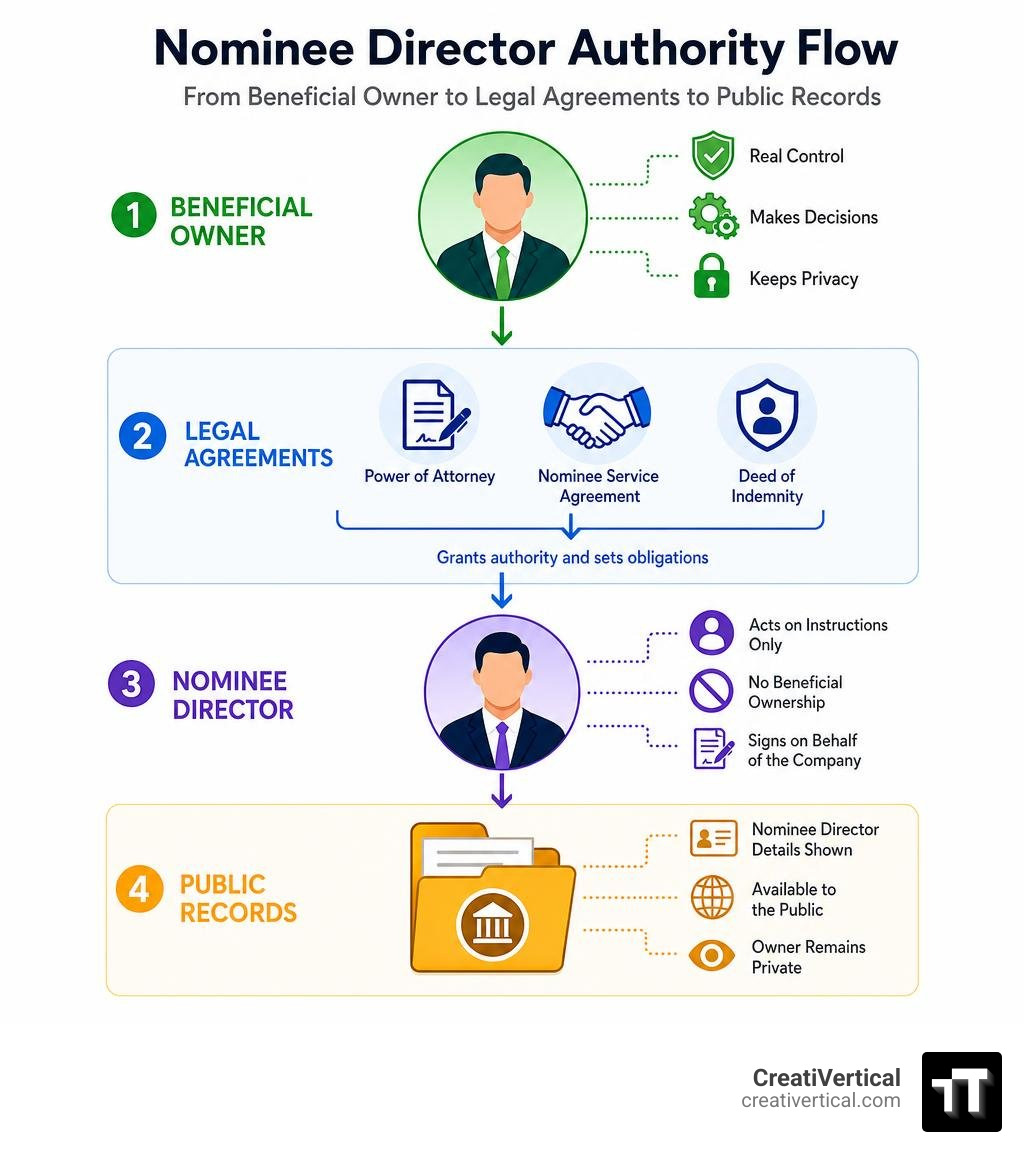
At its core, an offshore company nominee director (sometimes called a third-party director) is an individual or corporate entity registered as the official director of a company. On public registries, their name, address, and signature appear on all public-facing corporate filings.
However, they do not run the business. They have no operational power, do not make strategic decisions, and do not manage the day-to-day affairs of the company unless explicitly instructed to do so in writing by you—the beneficial owner.
In a traditional corporate setup, a director owes strict fiduciary duties to the company and exercises independent judgment. In a nominee arrangement, the relationship is governed by a private contract. The nominee is a placeholder, acting solely as an administrative proxy.
To understand the balance between this public-facing role and the private reality of who holds the reins, it helps to read a broader analysis of how these setups operate. You can explore this further in the guide on Nominee Services in Offshore Company Structures: Pros & Cons.

Why Businesses Appoint an Offshore Company Nominee Director
The primary reason business owners use nominee director services is privacy. In an era where personal data is frequently harvested, packaged, and leaked, keeping your name off public registries reduces your exposure to unwanted attention, competitors, and aggressive litigants.
- Privacy Protection: In many jurisdictions, corporate registries are open to the public. Anyone with an internet connection can look up who directs a company. A nominee acts as a legal shield, keeping your name out of public search results.
- Asset Protection: By decoupling your personal identity from the legal ownership and directorship of specific corporate assets, you establish a robust layer of operational privacy.
- Managing Competitive or Political Risk: Entrepreneurs operating in sensitive industries, highly competitive markets, or politically unstable home countries often use nominees to protect themselves and their families from targeted pressure.
Fulfilling Local Residency and Compliance Requirements
Beyond privacy, nominee directors are frequently used to satisfy local statutory laws. Many premier business hubs require companies to have at least one local resident director to remain in good standing.
- Singapore: Under the Singapore Companies Act, every company must appoint at least one locally resident director. If you are a foreign investor without a local employment pass, using a local nominee director is the standard legal mechanism to satisfy this requirement.
- Cyprus: To qualify for Cyprus’s favorable corporate tax regime, a company must demonstrate that its “management and control” takes place within Cyprus. Appointing a qualified local nominee director helps establish this tax residency.
- BVI and Cayman Islands: While these jurisdictions do not strictly require a local resident director for standard International Business Companies (IBCs), many businesses choose to appoint professional corporate nominees to maintain institutional privacy or satisfy specific licensing regimes (such as holding companies or digital asset structures).
Nominee Directors vs. Nominee Shareholders: Key Differences
It is common to confuse nominee directors with nominee shareholders, but they serve entirely different functions in corporate governance. A nominee director represents the management of the company, while a nominee shareholder represents the ownership of the company.
| Feature | Nominee Director | Nominee Shareholder |
|---|---|---|
| Primary Role | Publicly acts as the manager/governor of the company | Publicly holds the shares of the company |
| Legal Document Used | Nominee Service Agreement & Power of Attorney | Declaration of Trust (Bare Trust) |
| Public Record Profile | Listed as the officer directing corporate actions | Listed as the registered owner of corporate equity |
| Operational Power | Executes documents only on your written instruction | Holds no voting or dividend rights except as instructed |
To see how these roles are packaged together for global businesses, you can review the comprehensive overview of Nominee Director and Nominee Shareholder Services.
Roles and Limitations of Nominee Shareholders
A nominee shareholder is appointed to hold the legal title of the company’s shares on behalf of the beneficial owner. This relationship is secured by a Declaration of Trust (often structured as a bare trust).
Under this arrangement:
- The nominee shareholder’s name appears on the share certificates and the public registry.
- The nominee has no actual claim to the shares, cannot sell or transfer them without your consent, and must pass all dividends and financial benefits directly to you.
- The nominee cannot exercise voting rights at shareholder meetings unless you issue explicit, written instructions directing them how to vote.
Legal Framework: Retaining Control and Staying Compliant
A common question we hear is: Is using an offshore company nominee director actually legal?
Yes, it is entirely legal and has been a cornerstone of common-law corporate structuring for centuries. However, its legality hinges on transparency with regulatory authorities and financial institutions.
Using a nominee to protect your privacy from the general public is legal. Using a nominee to hide assets from tax authorities, evade sanctions, or bypass Anti-Money Laundering (AML) and Know Your Customer (KYC) regulations is highly illegal.

Essential Legal Documents for an Offshore Company Nominee Director
To ensure you retain absolute control over your company while protecting the nominee from liabilities they have no hand in creating, several legal documents must be executed during the setup process:
- Nominee Service Agreement: This contract outlines the terms of the engagement. It explicitly states that the nominee has no authority to act independently and must only act on the beneficial owner’s written instructions.
- Power of Attorney (POA): This is the document that makes the structure work operationally. The nominee director issues a notarized (and often apostilled) POA to you (the beneficial owner). This grants you the legal authority to sign contracts, open bank accounts, and run the business in the company’s name.
- Deed of Indemnity: Because the nominee’s name is on official filings, they face potential legal liability if the company is sued or fined. The beneficial owner signs a Deed of Indemnity, promising to cover any legal costs or damages the nominee incurs, provided the nominee acted strictly on the owner’s instructions.
- Undated Resignation Letter: To protect you from a nominee who goes rogue or becomes unresponsive, professional providers supply a signed, undated resignation letter from the nominee director at the start of the contract. You can date and file this letter at any moment to instantly remove the nominee.
Retaining Full Operational and Financial Control
Many founders worry that a nominee director could lock them out of their own business. In practice, the legal framework prevents this.
Because the nominee has signed a restrictive Nominee Service Agreement and issued you a Power of Attorney, they cannot legally enter into contracts, sell company assets, or alter the corporate structure without your written sign-off. You hold the ultimate authority to hire, fire, and direct all corporate movements.
The Operational Reality: Banking, Fees, and Replacement
While nominee structures look seamless on paper, running them day-to-day requires understanding how banks and service providers interact with these arrangements.
Bank Account Opening Challenges
Opening a bank account is the most challenging step for any offshore company, and using a nominee director adds a layer of complexity.
Modern high-street banks are bound by strict global KYC and AML rules. They are legally required to identify the ultimate beneficial owner (UBO) of the company.
- No Hiding from the Bank: You cannot use a nominee director to hide your identity from a bank. The bank will require your passport, proof of address, and source of wealth before opening an account.
- Signatory Control: The nominee director should never be a signatory on your company bank account. The bank account must be set up so that only you (the beneficial owner, via the Power of Attorney) have access to the funds.
- Due Diligence Pack: To open the account, you will need a complete corporate pack from the nominee, including their certified ID documents, utility bills, and professional references.
For a deeper dive into how this operational division of labor works, you can check out the resource Nominee Director – What is it and why do I need it?.
Fee Structures and Pricing Across Jurisdictions
Nominee director fees are typically structured as an annual maintenance fee. Pricing varies significantly based on the jurisdiction, the regulatory burden of that region, and whether the nominee is an individual or a licensed corporate entity.
Based on current market rates in June 2026, here is what you can expect to pay annually for professional nominee director services across major jurisdictions:
- Singapore: Typically ranges from $600 to $2,000 USD per year. High-integrity providers with robust legal safeguards generally price their services around $1,300 USD annually.
- Cayman Islands: Priced at approximately $1,500 USD per year due to strict regulatory oversight.
- British Virgin Islands (BVI): Typically runs around $1,200 USD per year.
- Hong Kong: Priced at approximately $1,800 USD per year.
- Seychelles: A more cost-effective option, averaging $800 USD per year.
- Mauritius: Typically priced at $1,800 USD per year.
- Belize & St. Vincent and the Grenadines: Generally priced around $900 USD per year.
- Cyprus: Runs around $1,500 USD per year to help satisfy EU resident director requirements.
- Baseline Services: Some entry-level providers in smaller jurisdictions offer basic, unbundled nominee services starting as low as $400 USD per year, though these often exclude essential documents like apostilled Powers of Attorney.
To compare specific packages and structural options, you can explore the service listings at Nominee Services – 500 Offshore.
Resignation and Replacement Procedures
What happens if your nominee director decides to resign, retires, or if you simply want to take over the public directorship yourself?
Because you hold the undated resignation letter and the Nominee Service Agreement, the process is straightforward:
- Triggering the Change: You submit the signed resignation letter to the company’s registered agent.
- Appointing a Successor: You simultaneously file the resolution to appoint a new director (either yourself or a replacement nominee).
- Registry Filing: The registered agent updates the local corporate registry. In most jurisdictions, this administrative transition can be executed within 24 to 48 hours without interrupting your business operations.
Risks, Drawbacks, and Evolving Transparency Rules
Using a nominee director is a highly effective tool, but it is not without operational risks and tax implications.
The “Management and Control” Tax Risk
Many business owners mistakenly believe that setting up a company in a tax-free jurisdiction automatically exempts them from taxes at home. This is a dangerous assumption.
Most high-tax countries (including the US, UK, and EU nations) use the “Place of Effective Management” (POEM) or “Management and Control” test. If a tax authority can prove that the strategic decisions of a BVI or Singapore company are actually being made by you sitting at your desk in Kansas City, they will deem the company a tax resident of your home country and tax it accordingly.
A passive nominee director who simply signs documents on your instruction does not shift the “management and control” of your business offshore. If you need to establish genuine offshore tax residency, you must ensure the company has actual substance (local offices, employees, and active local directors making independent decisions) in that jurisdiction.
For a clearer picture of how modern providers balance these strict compliance realities with robust control mechanisms, read the guide on Nominee Director Service: Identity Privacy & Full Control | Koobiz.
Evolving Transparency and Beneficial Ownership Registers
The days of absolute corporate secrecy are gone. Over the last decade, international initiatives like the Common Reporting Standard (CRS), FATCA, and the push for centralized Ultimate Beneficial Ownership (UBO) registers have changed the landscape.
- Centralized UBO Registers: Most offshore jurisdictions now maintain private, centralized registries of beneficial ownership. While the public cannot see your name, the registered agent is legally required to upload your details to a secure database accessible by local law enforcement and tax authorities.
- Automatic Information Exchange: Under CRS, financial institutions automatically share account information with the tax authorities of your home country.
Therefore, a nominee director acts as a shield against public exposure, competitors, and identity thieves—but never as a tool to hide assets from legitimate government authorities.
Frequently Asked Questions about Offshore Nominee Directors
Is using a nominee director legal?
Yes. Appointing a nominee director is entirely legal in more than 45 jurisdictions worldwide. It is a standard corporate practice used to protect privacy and satisfy local residency requirements. However, it must be fully disclosed to banks, tax authorities, and corporate registries.
Can a nominee director access my company bank account?
No. When setting up the company’s bank account, the beneficial owner is designated as the sole authorized signatory. The nominee director has no access to the account, cannot view transactions, and cannot withdraw funds.
How do I replace a nominee director if they resign?
If a nominee resigns or you choose to terminate the agreement, you can use the undated, pre-signed resignation letter provided at the start of your contract. You then instruct your registered agent to file the resignation and register a new director.
Conclusion
An offshore company nominee director is a powerful instrument for protecting your personal privacy, securing your corporate assets, and satisfying local residency laws in premier jurisdictions like Singapore, the BVI, or Cayman. When structured with the correct legal safeguards—such as a robust Power of Attorney, a clear Deed of Indemnity, and an undated resignation letter—you retain absolute operational control of your business while keeping your personal name off public registries.
However, navigating the intersection of international corporate structures, banking compliance, and digital visibility requires a clear, strategic approach.
At CreatiVertical, we specialize in building the digital infrastructure that supports offshore service providers, law firms, and trust companies. We design high-performance websites, manage secure hosting, and build search visibility systems that help fiduciary firms present their services clearly, professionally, and compliantly to a global audience.
If your Caribbean or international professional services firm needs a digital presence that reflects your institutional expertise, we are here to partner with you. Learn more about how we build specialized systems by visiting our guide on Websites for Caribbean Companies.