

What You Need to Know Before You Register an Offshore Company
If you’re looking to register an offshore company, here’s the short version:
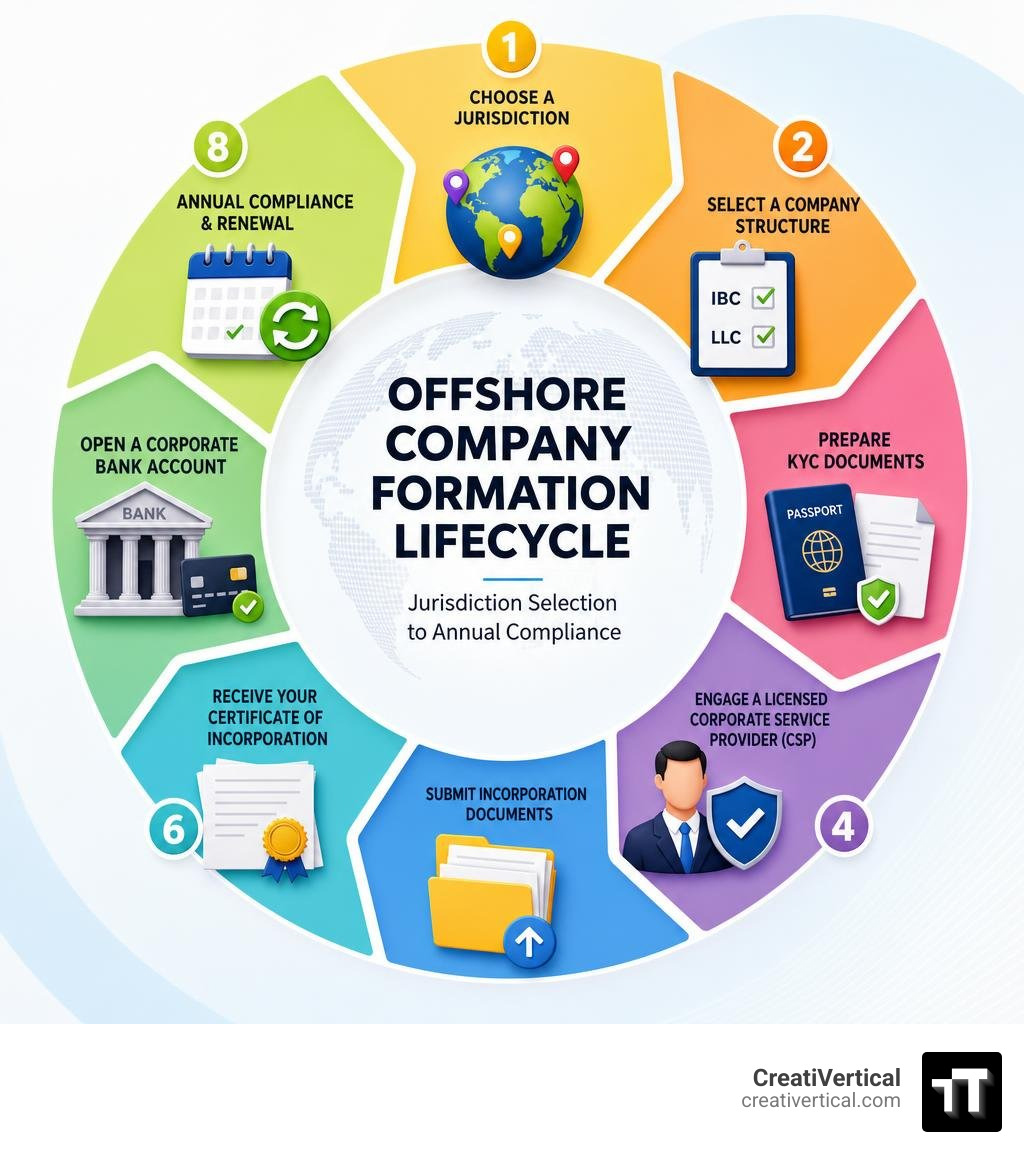
How to register an offshore company — quick overview:
- Choose a jurisdiction — Seychelles, BVI, Cayman Islands, Nevis, Panama, and others each offer different tax, privacy, and compliance profiles.
- Select a company structure — typically an IBC (International Business Company) or LLC.
- Prepare KYC documents — a certified passport copy and proof of address (issued within 3 months) for all directors and shareholders.
- Engage a licensed Corporate Service Provider (CSP) — required in most offshore jurisdictions.
- Submit incorporation documents — the CSP files with the local registry on your behalf.
- Receive your Certificate of Incorporation — typically within 3 to 7 business days, sometimes as fast as 24 hours.
- Open a corporate bank account — requires additional KYC, a business plan, and source-of-funds documentation.
The entire process can be completed remotely. No travel required.
The appeal is real: zero corporate tax, strong privacy protections, asset separation, and a legal structure that works across borders. Most popular offshore jurisdictions charge no capital gains tax, no inheritance tax, and no withholding tax. Registration fees start around USD 595 for a Seychelles IBC and range up to USD 2,900 or more for a Cayman Islands Exempted Company.
But the landscape has changed. In 2026, offshore incorporation means navigating Economic Substance Rules, Beneficial Ownership registries, CRS 2.0 reporting, and tighter bank compliance. Getting the structure right from day one matters more than it ever did.
This guide walks you through every step — jurisdiction selection, documentation, costs, banking, and ongoing compliance — so you can make an informed decision and move forward with confidence.
I’m Nicholas Cunha, founder of CreatiVertical — I spent fifteen years running a digital agency in the British Virgin Islands, working directly with BVI government bodies and institutions, which gave me a understanding of what it takes to register an offshore company and operate compliantly in a small offshore jurisdiction. That experience shapes how I approach this topic: practically, accurately, and without the hype.
Register offshore company terminology:
Why Global Businesses Choose to Register Offshore Company Structures
When you decide to register offshore company entities, you are not just looking for a tax shelter. In 2026, global entrepreneurs, asset managers, and B2B firms use offshore structures as strategic toolkits.
Here is why these structures remain highly popular:
- Asset Protection & Lawsuit Deterrence: The US holds roughly 4.4% of the world’s population, yet it is home to 70% of the world’s lawyers and an astonishing 96% of the world’s lawsuits. This litigious environment makes domestic assets incredibly vulnerable. An offshore structure, particularly a Nevis LLC, acts like a legal “moat with alligators.” In Nevis, a creditor must post a substantial, court-determined bond before they can even file a lawsuit against your company. Because foreign court judgments are not automatically recognized, plaintiffs face massive financial and procedural hurdles, which deter frivolous claims entirely.
- Tax Neutrality: Most traditional offshore jurisdictions operate under a zero-tax framework. This means 0% corporate tax, 0% capital gains tax, 0% withholding tax, and no inheritance taxes on foreign-sourced income. It allows your business to reinvest its gross profits directly into growth, rather than losing a substantial portion to immediate taxation.
- International Trade & E-Commerce: Operating globally requires a flexible entity. An offshore company simplifies cross-border transactions, contract signatures, and international supply chain management. For e-commerce entrepreneurs, Web3 startups, and specialized manufacturers, an offshore company acts as a neutral hub that is legally recognized worldwide.
- Structural Privacy: While absolute secrecy no longer exists due to global transparency initiatives, offshore jurisdictions still offer robust privacy. In places like the Seychelles and Cayman Islands, the names of shareholders and directors are kept out of public registries. They are only accessible to law enforcement and regulatory bodies through authorized channels, keeping your personal financial affairs private from competitors and public scraping.
For a deeper look into how these elements connect, check out our Step-by-Step Guide to Offshore Company Formation.
Top Recommended Jurisdictions for 2026
Choosing where to register offshore company structures depends entirely on your business goals, budget, and compliance comfort level. There is no “one-size-fits-all” island.
The table below compares the top recommended offshore jurisdictions in 2026:
| Jurisdiction | Typical Setup Time | Corporate Tax Rate | Public Registry? | Best For |
|---|---|---|---|---|
| Seychelles | 24 – 48 Hours | 0% (on foreign income) | No | E-commerce, startups, low-cost entries |
| Nevis | 3 – 5 Days | 0% | No | Maximum asset protection, lawsuit shielding |
| British Virgin Islands (BVI) | 3 – 5 Days | 0% | No | International trade, joint ventures, holding assets |
| Cayman Islands | 3 – 5 Days | 0% | No | Investment funds, tech startups, institutional deals |
To explore the legal frameworks and structural benefits of these locations further, you can read about Company Registration in Cayman Islands | Offshore Incorporation .
How to Register Offshore Company Entities in the Cayman Islands
The Cayman Islands is widely considered the gold standard of offshore jurisdictions. Over 75% of the world’s hedge funds are domiciled here, and the jurisdiction is favored by institutional investors, venture capital firms, and multinational corporations.
The most popular structure is the Exempted Company, which represents over 81% of all local registrations. It offers a 20-year tax exemption guarantee (extendable to 30 years), requires no minimum share capital, and allows for single-director and single-shareholder ownership.
In 2026, Cayman has modernized its corporate landscape through key legislative updates:
- The Companies (Amendment) Act 2024: Effective January 2026, solvent Cayman companies can now reduce their share capital without undergoing a lengthy Grand Court approval process.
- Direct Conversions: LLCs and Foundation Companies can convert directly into Exempted Companies without dissolving the original entity, preserving your operational history and assets.
- Tokenised Funds & Tech: The Cayman Islands Monetary Authority (CIMA) has rolled out a dedicated tokenised funds framework, making it a premier destination for digital asset structures and Web3 projects.
- Special Economic Zone (SEZC): Tech and knowledge-based businesses can set up in Cayman Enterprise City to easily secure 5-year work visas for foreign staff and maintain a physical, compliant presence.
For firms looking to build trust in this jurisdiction, establishing an authoritative digital presence is critical. You can learn more by reading about how to Stop Hiding Online and Hire a Cayman Islands SEO Expert Today.
Why You Might Register Offshore Company Structures in the BVI
If the Cayman Islands is the king of investment funds, the British Virgin Islands (BVI) is the undisputed leader for international trade, holding companies, and joint ventures.
The BVI Business Company (BC) is incredibly flexible, cost-effective, and recognized by financial institutions globally. BVI operates under a strict zero-tax framework, meaning zero income, corporate, capital gains, or withholding taxes.
However, BVI registration requires navigating modern compliance:
- Economic Substance Rules (ESR): To align with international standards, the BVI requires companies engaged in “relevant activities” (such as banking, insurance, fund management, or holding company activities) to demonstrate a physical and operational presence in the territory. If you run a pure equity holding company, the substance requirements are passive, but other activities require local management and operating expenses.
- Transparency: Under BVI laws, companies must maintain up-to-date registers of directors, shareholders, and beneficial owners. While these registers are kept confidential and are not open to the general public, they are accessible to regulatory authorities to prevent illegal activities.
Before you begin, it is important to understand the full scope of setup costs. You can read No Hidden Fees Your Guide to All-Inclusive BVI Company Formation to budget accurately.
If you are ready to structure your BVI business, check out How to Form a BVI Company with These 7 Quick Changes for practical implementation steps.
Step-by-Step Requirements and Documentation
To successfully register an offshore company in 2026, you must pass through strict Know Your Customer (KYC) and Anti-Money Laundering (AML) gates. Gone are the days of anonymous, paperwork-free setups. Today, every reputable Corporate Service Provider (CSP) must verify your identity thoroughly.

Here is the exact documentation required for all individual directors, shareholders, and Ultimate Beneficial Owners (UBOs):
- Certified Passport Copy: Must be a clear, high-resolution scan of the photo page, valid for at least 6 months.
- Proof of Residential Address: A utility bill, bank statement, or government letter issued within the last 3 months. P.O. Boxes are strictly rejected; it must show your physical residential address.
- Source of Funds Declaration: A brief document outlining how you earned the money used to fund the company (e.g., business profits, real estate sale, inheritance).
- Brief Business Plan: A simple, one-page summary describing what your offshore company will do, who its clients are, and where its transactions will take place.
The Modern Onboarding Process
To make this process painless, modern providers utilize remote online video notarization. For a typical fee of around USD 250, you can hop on a secure, encrypted video call with a notary to verify your identity and documents digitally. This completely eliminates the need to visit an embassy or mail physical paperwork across the world.
If you are considering utilizing professional nominees to keep your personal name off public documents, it is vital to understand the legal limits. Read our guide on Offshore Nominee Directors Staying Anonymous Without Staying Shady to understand how to structure this legally and safely.
Navigating Offshore Banking and Compliance Challenges
Setting up your offshore company is actually the easy part. The real challenge in 2026 is opening and maintaining a corporate bank account.
Traditional offshore jurisdictions do not have their own massive retail banking systems for international trade. Instead, your offshore company will likely open an account with an international bank, a digital neobank, or an EMIs (Electronic Money Institution) that supports offshore entities.
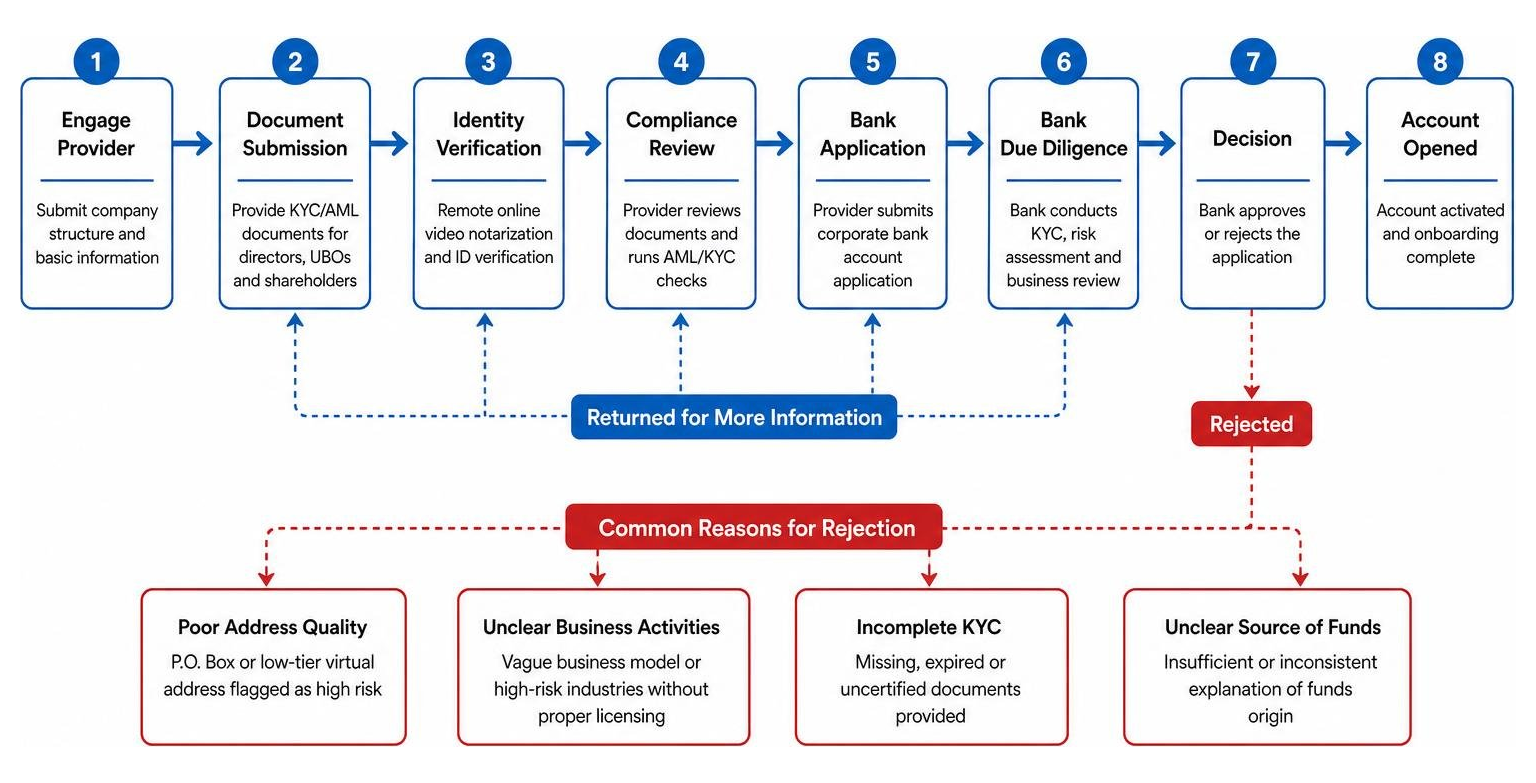
Why Corporate Bank Accounts Get Rejected
Banks are highly risk-averse. The most common reasons offshore bank applications get rejected include:
- Cheap Virtual Addresses: Banks routinely run checks on business addresses. If they see your company is registered to a generic, low-tier P.O. Box or a shared business center address that hosts thousands of other shell companies, they will likely reject the application. Opting for a higher-tier commercial address or a virtual office with dedicated phone and mail services is highly recommended.
- Unclear Business Activities: If your business plan is vague or involves high-risk sectors like unregulated crypto, forex, or multi-level marketing without the proper local licensing, traditional banks will decline to onboard you.
- Incomplete KYC or Poor Source of Funds: Failing to provide clear, certified documentation or a logical explanation of where your startup capital originated is an immediate red flag.
2026 Compliance Standards
Once your account is open, you must actively maintain compliance to keep it active:
- Beneficial Ownership Transparency Act (BOTA 2023): Implemented across major jurisdictions, this framework requires companies to upload beneficial ownership details to secure, non-public government databases.
- CRS 2.0 & FATCA: Under the Common Reporting Standard (CRS) and the US Foreign Account Tax Compliance Act (FATCA), financial institutions automatically report account balances and transaction data back to the tax authorities in your home country.
- Economic Substance Filings: You must submit an annual declaration proving whether or not your company engaged in “relevant activities” and, if so, how it met the local physical substance requirements.
Frequently Asked Questions About Offshore Incorporation
Staying compliant requires clear answers. Here are the most common questions entrepreneurs ask when preparing to register offshore company structures.
Is it legal to own an offshore company?
Yes, it is 100% legal to own an offshore company. However, the legality hinges entirely on transparency and tax compliance.
As a business owner, you are legally obligated to report your offshore holdings, assets, and income to the tax authorities in your home country. For US citizens, this means filing FBAR (Foreign Bank and Financial Accounts) reports and complying with FATCA and Controlled Foreign Corporation (CFC) rules. For UK and European residents, CFC rules and global income tax laws apply. An offshore company is a tool for tax optimization and asset protection, not tax evasion.
How much does it cost to set up and maintain an offshore company?
The cost varies significantly depending on the jurisdiction and the level of service you choose:
- Seychelles IBC: Typically the most affordable. Registration starts around USD 595, with annual renewal fees (covering the registered agent and address) hovering around USD 590.
- BVI Business Company: Mid-range. Registration packages generally run from USD 1,690 to USD 1,880, with annual renewals costing around USD 1,450 to USD 1,590.
- Cayman Islands Exempted Company: Premium. Government registration fees alone start at KYD 700 (approx. USD 854) for standard capital, but total first-year professional setup, registered office, and compliance fees typically range from USD 2,500 to USD 6,000+. Annual maintenance fees are similar, averaging USD 2,610+.
Note: Always budget for annual renewal fees and additional compliance costs, such as filing economic substance declarations, which are rarely included in basic registration packages.
Do I need to travel to register an offshore company?
No. The entire incorporation process, document submission, identity verification, and even bank account applications can be handled remotely. Modern digital onboarding platforms and secure online video notarization allow you to establish your company from the comfort of your home or office.
Conclusion
Registering an offshore company remains one of the most effective ways to protect your hard-earned assets, streamline international trade, and structure your business for global growth. But in 2026, success requires a compliance-first mindset. Trying to cut corners with cheap, unverified addresses or incomplete paperwork will only lead to frozen bank accounts and regulatory headaches.
At CreatiVertical, we specialize in helping offshore professional services, law firms, and fiduciary providers in jurisdictions like the BVI and Cayman Islands stand out in an increasingly digital world. We build high-performance, secure digital systems, custom AI workflow automations, and search-optimized platforms that help global firms connect with the international clients who need them most.
If you are an offshore service provider looking to grow your digital footprint, let’s chart a course together. Explore how we design and promote Websites for Caribbean Companies to elevate your firm’s global reach today.