

What Is Offshore Company Formation — and Is It Right for You?
Offshore company formation is the process of registering a business entity in a jurisdiction outside your home country — one chosen for its favorable tax laws, strong privacy protections, asset protection framework, or flexible corporate regulations.
Here’s the short answer if you’re evaluating your options:
| Question | Quick Answer |
|---|---|
| What is an offshore company? | A company registered in a foreign jurisdiction for tax, privacy, or asset protection benefits |
| Is it legal? | Yes — provided you meet reporting obligations in your home country |
| How long does it take? | Typically 3 to 10 business days, depending on the jurisdiction |
| What does it cost? | Roughly USD $595 to $5,000+ for formation, depending on jurisdiction and structure |
| Do I need to travel? | No — the entire process is typically completed remotely |
| What are the most popular jurisdictions? | Seychelles, BVI, Cayman Islands, Belize, Nevis, Vanuatu, UAE (RAK) |
| What entity types are available? | IBC, LLC, Exempted Company, SPC, Foundation Company, CSL |
| What are the main benefits? | Tax neutrality, asset protection, financial privacy, international banking access |
Offshore structures are used by international traders, digital entrepreneurs, holding companies, family offices, fund managers, and professional services firms across the world. They are not exclusively the domain of large multinationals — and when structured correctly, they are fully legitimate tools for international business.
That said, the landscape has changed. Compliance requirements — KYC, beneficial ownership registers, economic substance rules, CRS, and FATCA — have tightened significantly. Getting the structure right from the start matters more than ever.
I’m Nicholas Cunha, and I spent fifteen years running a digital agency in the British Virgin Islands, delivering projects for BVI government bodies and institutional clients in one of the world’s most active offshore company formation jurisdictions. That experience in an offshore market shapes how I approach this guide — practically, not theoretically.
The Strategic Benefits of Offshore Company Formation

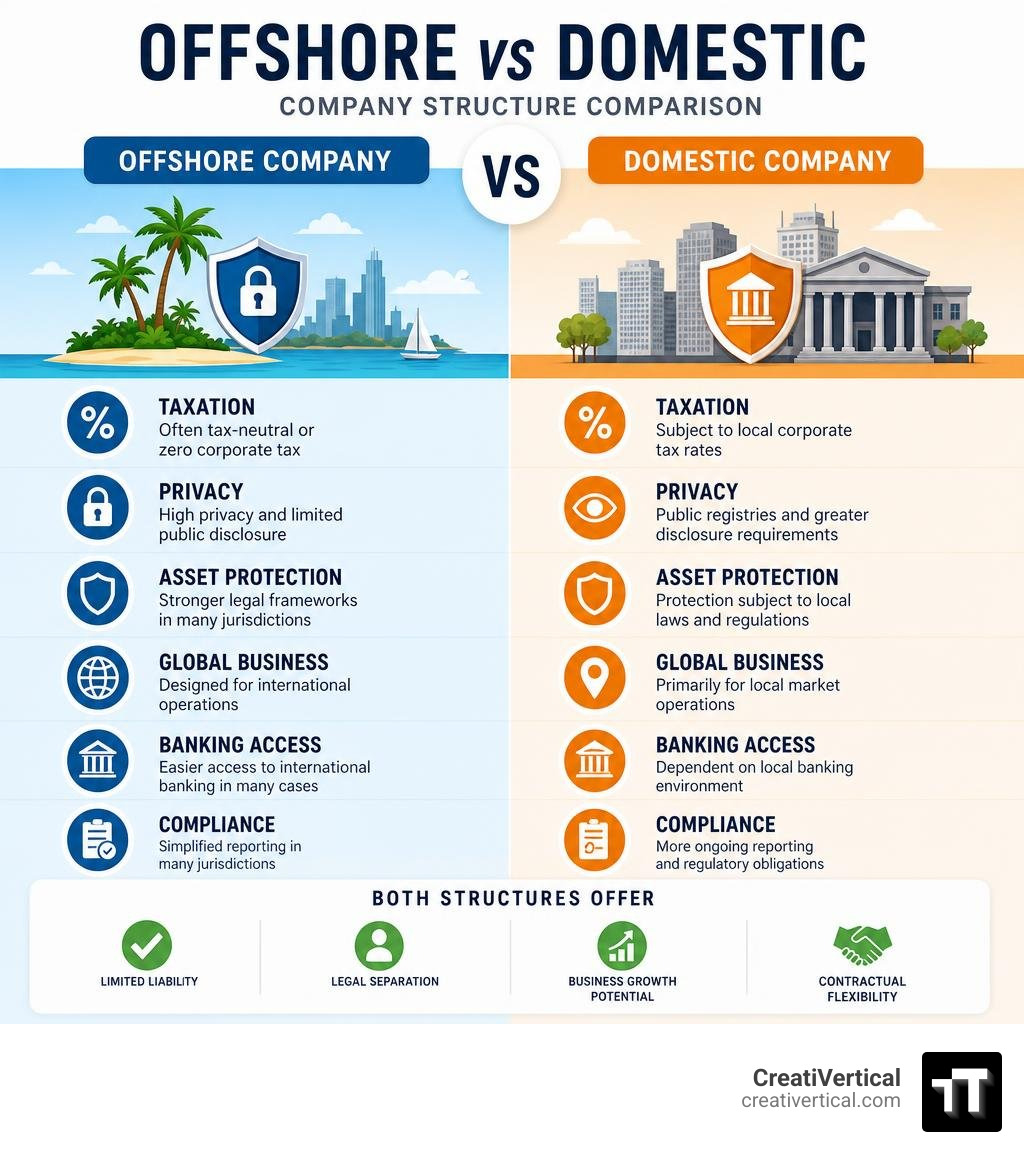
When business owners look beyond their local borders, they are usually searching for stability, security, and simplicity. A domestic company is tightly bound to the legal and fiscal framework of a single nation. For business owners operating in highly litigious environments or under restrictive regulatory regimes, establishing a corporate presence offshore creates an invaluable buffer.
The primary strategic benefits of offshore company formation focus on three core pillars: asset protection, tax efficiency, and financial privacy. By separating your operational activities, personal wealth, and intellectual property into distinct corporate structures, you build a resilient operational system.
Lawsuit Protection and the Nevis LLC Moat
For business owners in the United States, litigation is an ever-present operational risk. The United States accounts for roughly 4.4% of the world’s population, yet it is home to 70% of the world’s lawyers and 96% of the world’s lawsuits. In this climate, a domestic corporate structure offers only limited protection.
Offshore jurisdictions, however, establish formidable barriers against predatory litigation. The Nevis LLC is a prime example of this legal firewall. In Nevis, the corporate statutes are intentionally designed to deter frivolous claims:
- The Creditor Bond: Before a creditor can bring any legal action to collect a judgment against a member of a Nevis LLC, they must post a non-refundable $100,000 bond with the Nevis court.
- No Foreign Judgment Recognition: Courts in Nevis do not automatically recognize foreign court judgments. A creditor must litigate the case from scratch in a Nevis court, using local counsel, under strict standards of proof.
- Sole Remedy Charging Orders: Creditors are limited to a charging order against the member’s interest, meaning they cannot seize the company’s assets or force a liquidation.
When combined with an asset protection trust, an offshore LLC acts as a “moat with alligators,” encouraging settlements and discouraging speculative lawsuits before they even start.
Tax Neutrality and Wealth Preservation
Tax neutrality is often misunderstood as tax evasion, but the two are entirely different. Legitimate tax neutrality means that the offshore jurisdiction does not impose an additional layer of taxation on foreign-source income, capital gains, dividends, or withholding distributions.
By utilizing a zero-tax regime, international businesses can consolidate their global revenues without being double-taxed. For example, an international trading company purchasing goods in Asia and selling them in Europe can route transactions through a tax-neutral offshore hub. This preserves capital, allowing the business to reinvest its gross profits into expansion, inventory, or intellectual property development without immediate domestic tax drag.
Choosing Your Jurisdiction and Entity Type
No single offshore jurisdiction is perfect for every scenario. The ideal location depends on your business model, target markets, banking needs, and budget.
| Jurisdiction | Typical Setup Cost | Annual Renewal | Key Strengths | Best For |
|---|---|---|---|---|
| Seychelles | USD $1,950+ | USD $1,200+ | Low government fees, 1-3 day setup, high privacy | International trading, IP holding, consulting |
| Cayman Islands | USD $4,500+ | USD $3,100+ | Institutional gold standard, CIMA regulated | Investment funds, family offices, joint ventures |
| Vanuatu | USD $1,995 | USD $1,250 | Constitutional 0% tax, no treaty pressures | Pacific-focused trading, holding companies |
| Nevis | USD $1,500+ | USD $1,100+ | Unmatched LLC lawsuit protection, $100k bond | Asset protection, wealth preservation |
| RAK (UAE) | USD $2,500+ | USD $2,000+ | Highly reputable, double-tax treaty access | Middle East operations, holding companies |
Selecting the Right Jurisdiction for Offshore Company Formation
When evaluating where to incorporate, you must weigh cost and speed against regulatory reputation and banking access.
For founders seeking a highly cost-efficient, regulated offshore vehicle, the Indian Ocean hub of Seychelles is exceptionally competitive. A Seychelles Company Formation — IBC Registration 2026 offers a 1-to-3-day setup timeline, a flat $150 annual government fee, and a highly modernized International Business Companies Act. It is an excellent starter jurisdiction for digital nomads, consultants, and software developers.
At the other end of the spectrum is the Cayman Islands. Known as the world’s pre-eminent fund and structuring jurisdiction, a Cayman Islands Company Formation 2026 | Sovera Global is the institutional standard. While setup costs and annual maintenance are significantly higher, Cayman entities enjoy unparalleled credibility with global investment banks, venture capital firms, and stock exchanges.
Other regions offer specific structural advantages. Vanuatu provides a clean, constitutional zero-tax status that is not built on complex offshore carve-outs, making it highly stable. The British Virgin Islands (BVI) remains the historic giant of the offshore world, offering a balanced mix of mid-tier pricing and global banking recognition.
Understanding Entity Structures: IBC vs. LLC
The legal structure of your offshore entity determines how it operates, how it is managed, and how it is treated by foreign tax authorities.
- International Business Company (IBC): The classic offshore corporate structure. An IBC is a share-based corporation designed specifically for international activities. It features a board of directors, officers, and shareholders. IBCs are ideal for holding intellectual property, acting as a group holding company, or conducting international B2B trade.
- Limited Liability Company (LLC): A member-managed structure that combines the asset protection of a corporation with the operational flexibility of a partnership. LLCs are highly favored for asset protection strategies because of the charging order protection afforded to members’ ownership interests.
- Segregated Portfolio Company (SPC): A specialized corporate structure (highly popular in the Cayman Islands) that allows a single company to segregate its assets and liabilities into distinct “portfolios.” If one portfolio faces a lawsuit or bankruptcy, the assets of the other portfolios remain legally protected.
- Company Special Licence (CSL): A unique Seychelles structure that offers access to double-taxation treaties while maintaining a low-tax domestic rate, making it suitable for businesses requiring treaty protection.
The Step-by-Step Offshore Company Formation Process

Forming an offshore company is a structured, legal process that must be executed through a licensed corporate service provider. You cannot simply file papers directly with an offshore registry yourself; the law in almost all reputable jurisdictions requires the intervention of a local registered agent.
Step 1: Name Reservation and Structure Definition
The process begins by selecting a unique corporate name. The name must not conflict with any existing entities on the local corporate registry. Offshore registries enforce strict naming guidelines:
- Suffixes: Your company name must end with an approved suffix indicating corporate status (e.g., “Ltd,” “Limited,” “Inc,” “Corp,” “LLC,” or “IBC”).
- Restricted Words: Words like “Bank,” “Trust,” “Insurance,” “Royal,” or “Imperial” are heavily restricted and require special licensing.
- Business Description: You must provide a brief description of the company’s intended business activities to ensure they comply with local laws.
Step 2: Appointing a Registered Agent and Office
By law, your offshore company must maintain a physical presence in its jurisdiction of incorporation. This presence is established via a registered office and a licensed registered agent.
The registered agent serves as your official legal representative on the ground. They are responsible for receiving official government correspondence, maintaining your corporate records, and ensuring your company remains in good standing with the local registry. For modern digital nomads and global businesses, utilizing a service like Offshore Company Formation | Clevver – your digital virtual office for … allows you to combine your legal registered office with a virtual office, complete with mail forwarding and local telephone services.
Step 3: Document Submission and KYC Verification
The era of anonymous offshore shell companies is over. To comply with global anti-money laundering (AML) and counter-terrorist financing (CFT) standards, every offshore registry and registered agent must collect comprehensive Know Your Customer (KYC) documentation.
To successfully incorporate, you must submit:
- A Certified/Notarized Passport Copy: A high-resolution color copy of your valid passport, certified by a notary public, lawyer, or certified accountant.
- Proof of Address: A utility bill, bank statement, or government letter issued within the last three months, showing your full name and residential address.
- Professional Reference: A reference letter from a bank, lawyer, or accountant confirming a professional relationship of at least two years.
- Source of Wealth Declaration: A signed document outlining how you generated the funds used to establish and run the business.
Legal Compliance, Taxation, and Banking Realities
Setting up the company is only the first step. To keep your offshore structure safe, legal, and operational, you must navigate international banking compliance and home-country tax reporting.
Legal and Compliance Realities of Offshore Company Formation
Modern offshore jurisdictions are highly regulated. To avoid being blacklisted by international bodies like the OECD or the FATF, jurisdictions have implemented strict compliance protocols:
- Ultimate Beneficial Owner (UBO) Registers: Most jurisdictions require companies to declare their UBOs — individuals who own or control 25% or more of the company. While these registers are generally kept confidential from the general public to protect your privacy, they are fully accessible to local regulatory authorities and international tax inspectors.
- Economic Substance Regulations (ESR): If your company conducts “relevant activities” — such as acting as a holding company, shipping business, fund management, or intellectual property holding — you must prove that you have physical substance in the jurisdiction. This means having local employees, physical office space, and local operating expenses. For structures registered under RAK Offshore – Nexo Services Global, understanding ESR guidelines is critical to maintaining your corporate standing and preventing regulatory penalties.
Navigating the Offshore Banking Challenge
Opening a corporate bank account is often more challenging than incorporating the company itself. Tier-1 banks in financial hubs like Singapore, Hong Kong, or Switzerland maintain incredibly strict compliance filters for offshore entities.
To increase your chances of success:
- Consider Electronic Money Institutions (EMIs): For day-to-day transaction processing, digital banking platforms and EMIs often offer faster onboarding and lower fees than traditional bricks-and-mortar banks.
- Prepare a Strong Business Plan: Banks want to see clear, logical business models, invoices from real suppliers, and proof of target market transactions.
- Leverage Professional Introductions: Work with registered agents who have established relationships with partner banks to streamline the introduction and review process.
Home Country Tax Reporting and Legality
It is a common misconception that owning an offshore company is illegal. In reality, it is entirely legal, provided you comply with the tax reporting laws of your home country.
For example, if you are a US citizen or resident, you are taxed on your worldwide income. Under the Controlled Foreign Corporation (CFC) rules, you must report your ownership of any foreign corporation (typically using IRS Form 5471) and may be subject to immediate taxation on your share of the company’s earnings under Subpart F or GILTI regulations. Similarly, the Common Reporting Standard (CRS) and the Foreign Account Tax Compliance Act (FATCA) ensure that offshore banks automatically report your account balances directly to your home country’s tax authorities.
Disclaimer: We are digital strategy and web development experts, not tax attorneys or certified public accountants. Always consult with a qualified international tax professional in your home country before establishing an offshore corporate structure.
On a domestic level, if you are looking to start a business locally within our home region, you would follow the standard Starting a Business – Missouri Secretary of State – MO.gov requirements, or review the Step-by-Step Guide for Setting up a Company in Kansas and Missouri. For those looking into Offshore Company Registration in Missouri USA – YKG Global, or running a local business near Lake Tapawingo or within the Home | City Of Lake Tapawingo, MO area, the domestic corporate path is distinct from international offshore structuring. Both pathways serve different strategic purposes depending on whether your goals are local operations or global asset protection.
Frequently Asked Questions About Offshore Companies
Is it legal to own an offshore company?
Yes, it is entirely legal. However, your legal safety depends on complete transparency. You must report your ownership, assets, and income to your home country’s tax authorities (such as the IRS in the US) under frameworks like FATCA, CRS, and CFC rules.
How long does the formation process take and what are the typical costs?
Incorporation timelines range from 24 hours (in Belize) to 3 to 10 working days for most standard jurisdictions like Seychelles or BVI. Cayman Islands structures can take 2 to 3 weeks due to deeper compliance reviews.
In terms of costs, you can Incorporate In Vanuatu: IC Formation, US$1,995 for a highly competitive starter rate, while top-tier institutional structures like a Cayman Exempted Company typically start around USD $4,500 for the initial setup, with annual maintenance fees running between USD $1,200 and $3,500+ depending on the jurisdiction.
When is an offshore structure better than an onshore or treaty-based company?
An offshore structure is ideal when your primary goals are asset protection, lawsuit deterrence, tax-neutral consolidation of global revenues, or holding intellectual property. If your business relies heavily on physical operations, local employees, or access to specific double-taxation treaties, an onshore entity or a treaty-based structure (like a UK LLP or a Singapore Private Limited) is often a more suitable choice.
Launching Your Global Presence with CreatiVertical
At CreatiVertical, we are a family-run digital agency based in Kansas City, serving as a dedicated growth partner for local businesses and specialized B2B industries alike. One of our deepest areas of expertise is supporting offshore and Caribbean professional services — including law firms, fiduciary providers, and company-formation agents operating in premier jurisdictions like the British Virgin Islands and the Cayman Islands.
We don’t build generic corporate websites; we design high-performance, secure digital systems that build authority, protect client trust, and drive visibility. Whether you are an offshore service provider looking to attract international founders, or a global business needing a secure, compliant web infrastructure, we handle everything from web development and advanced SEO to AI search visibility (GEO) and custom workflow automation.
Let’s build a digital presence that matches the strength of your corporate structures. Explore our specialized services and discover how we build Websites for Caribbean Companies that turn global search traffic into lasting corporate clients.