

What You Need to Know About BVI Company Formation in 2026
BVI company formation is one of the fastest and most straightforward ways to establish an international business structure — and in 2026, it’s more in-demand than ever.
Here’s the quick answer for decision-makers:
| What you want to know | The short answer |
|---|---|
| How long does it take? | 24–48 hours via the VIRRGIN electronic registry |
| Minimum requirements | 1 director, 1 shareholder (can be the same person), any nationality |
| Corporate tax rate | 0% — no income tax, no capital gains tax, no withholding tax |
| Annual government fee | USD 550 (up to 50,000 authorized shares) |
| Is beneficial ownership public? | No — but accessible under a legitimate-interest regime since April 2026 |
| Do you need to visit BVI? | No — the entire process is handled remotely through a licensed registered agent |
| Typical first-year cost | USD 1,500–3,500 depending on services and banking |
The British Virgin Islands hosts more than 360,000 active Business Companies — more than Cayman, Bahamas, and Belize combined. That scale reflects something real: the BVI’s legal framework, built on English common law, is clean, well-tested, and widely recognized by banks and regulators worldwide.
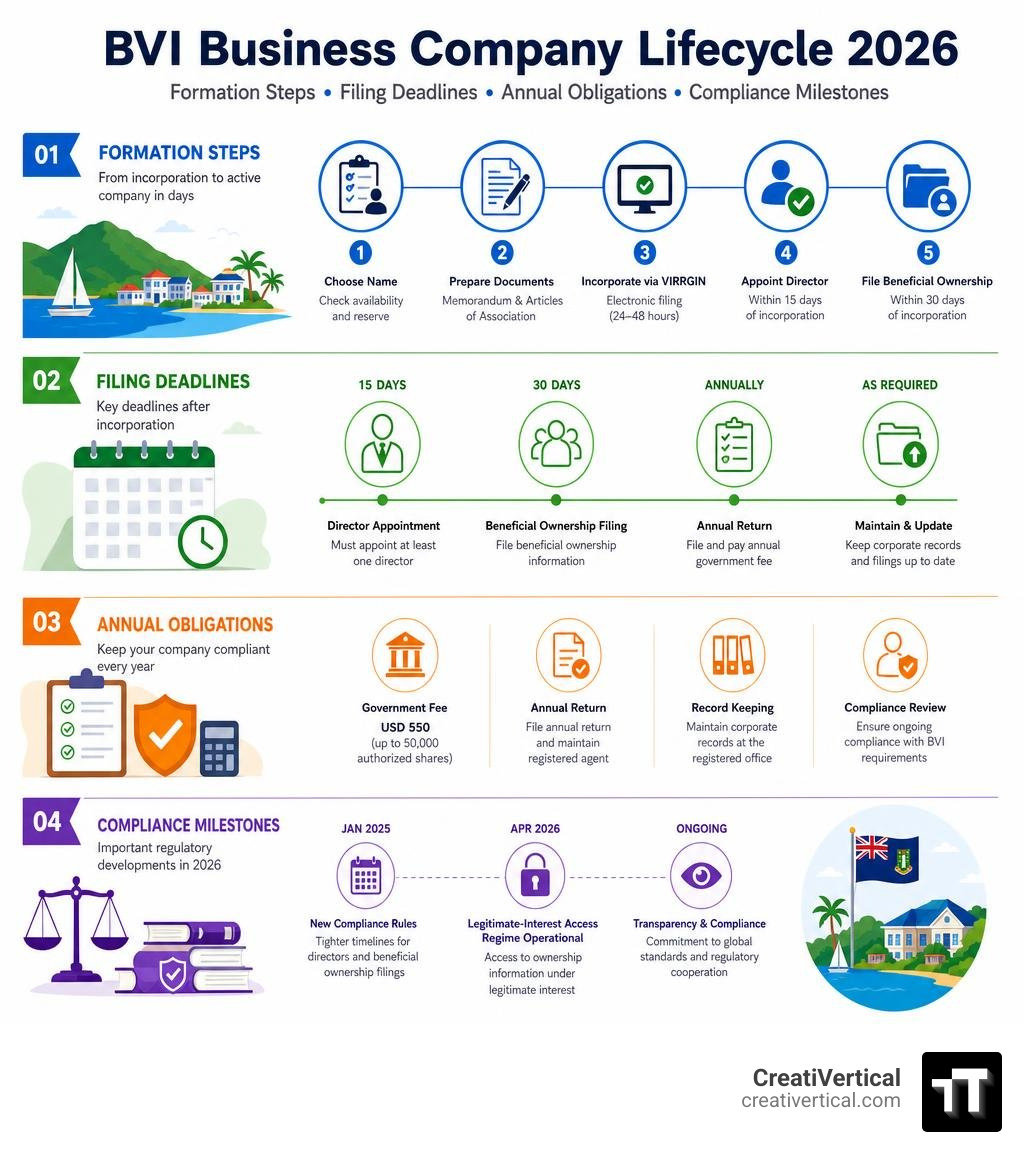
But the landscape has shifted. Since January 2025, new compliance rules have tightened timelines — directors must be appointed within 15 days, beneficial ownership must be filed within 30 days, and a legitimate-interest access regime for ownership information became fully operational in April 2026. Anyone incorporating now needs to understand the current rules, not the ones from five years ago.
I’m Nicholas Cunha. Before founding CreatiVertical, I spent fifteen years running a digital agency in the British Virgin Islands, delivering projects for BVI government entities and institutions — which gave me a ground-level understanding of BVI company formation, offshore compliance culture, and the professional-services ecosystem there. That experience shapes how we help Caribbean and offshore firms build credible, search-visible web presences for the international clients they’re trying to reach.
1. Understand the Corporate Structures Available
Choosing the right legal structure is the first step when planning a bvi company formation. The BVI Business Companies Act 2004 (which replaced the old International Business Companies Act) offers several flexible options, as detailed by Setup a BVI Company, Benefits of Formation and Registration .
BVI Business Company (BC) Limited by Shares
This is the standard offshore vehicle, accounting for roughly 99% of all active registrations. Shareholders’ liability is strictly limited to the amount unpaid on their shares. The BVI abolished the rigid capital maintenance doctrine, meaning a BC has the full capacity of a natural person, can issue treasury shares, and has no minimum share capital requirements.
Segregated Portfolio Company (SPC)
An SPC allows a single company to create segregated portfolios. The assets and liabilities of each portfolio are legally isolated from one another and from the company’s general assets. This structure is highly favored by multi-class mutual funds, umbrella funds, and captive insurance businesses.
Limited Partnership (LP)
An LP requires a written partnership agreement and consists of at least one general partner (who carries unlimited liability) and one limited partner (whose liability is capped at their contribution). It is widely used in private equity and venture capital fund structures.
VISTA Trust
Under the Virgin Islands Special Trusts Act (VISTA), these trusts are designed specifically to hold shares in a BVI Business Company. Unlike traditional trusts, a VISTA trust disengages the trustee from monitoring and intervening in the daily management of the underlying company, allowing the founders to retain control. It must have at least one BVI-licensed trust company acting as trustee.
Micro Business Company (MBC)
Designed for small-scale entrepreneurs, MBCs are limited to natural individuals with a maximum of five participants. However, the MBC Act is currently suspended until further notice, making the standard BC the primary route for startups.
2. Navigate the Modern BVI Company Formation Process
In the BVI, you cannot file incorporation paperwork yourself. Under local law, only Trust and Corporate Services Providers licensed by the BVI Financial Services Commission (FSC) can act as registered agents and submit filings.
The entire registration process is digitized through the FSC’s proprietary VIRRGIN (Virtual Integrated Registry Regulatory General Information Network) system. Once your registered agent submits the required documentation, the registry typically approves the incorporation within 24 to 48 hours.
For official regulatory procedures, you can consult the BVI Financial Services Commission Guide.

Step-by-Step BVI Company Formation Requirements
To set up a standard BVI Business Company, you must fulfill these baseline requirements:
- Company Name: The name must end with an approved suffix like Limited, Ltd, Corporation, Corp, Incorporated, or Inc. You can also register a foreign character name (such as Chinese characters) alongside the English name, provided a certified translation is submitted.
- Authorized Shares: The standard structure is 50,000 authorized shares of USD 1.00 each. Keeping your authorized shares at or below 50,000 ensures you pay the lowest government fee tier (USD 550 annually). Going above 50,000 shares increases the annual government fee to USD 1,350.
- KYC and Due Diligence: You must submit certified, high-resolution color copies of your passport and a utility bill or bank statement (not older than 3 months) showing your physical residential address (P.O. boxes are not accepted).
- Director and Shareholder: A minimum of one director and one shareholder is required. They can be the same person, do not need to be BVI residents, and can be corporate entities.
- The 15-Day Director Rule: Under the latest amendments, the registered agent must formally appoint the company’s first directors within 15 days of incorporation.
The Crucial Role of a Licensed Registered Agent
Your registered agent is your legal anchor in the territory. By law, every BVI company must maintain a registered office (a physical address in the BVI) and a registered agent at all times.
The registered agent is responsible for:
- Maintaining the statutory registers (Register of Members, Register of Directors, and Register of Beneficial Owners).
- Filing the Register of Directors with the Registry of Corporate Affairs.
- Submitting mandatory annual filings and ensuring government renewal fees are paid on time to prevent the company from being struck off.
3. Adapt to the 2026 Privacy and Confidentiality Landscape
The BVI has long been valued for its balanced approach to privacy. While it is not a “secret” jurisdiction, it protects legitimate business confidentiality.
Historically, director and shareholder details were held privately by the registered agent. Today, the BVI operates a secure, non-public database called the BOSS (Beneficial Ownership Secure Search) system. Registered agents upload beneficial ownership data (for anyone holding 10% or more of the shares or voting rights) directly to this encrypted system.
Legitimate-Interest Access Regime (April 2026)
Following global tax transparency initiatives and court rulings in the EU, the BVI implemented a “legitimate-interest” access framework on April 1, 2026. This is not an open public register. The general public cannot browse owner names. However, law enforcement, competent regulatory authorities, and third parties who can prove a legitimate legal or financial interest (such as banks conducting fraud investigations) can apply to the FSC to access specific corporate ownership records.
If you are curious about what daily life and business look like in the territory beyond the corporate registry, you can read more About Living in the Virgin Islands. If you need to navigate between islands for local meetings, you might also find our guide on booking a local Water Taxi helpful.
4. Master Tax Neutrality and Economic Substance
The primary financial draw of a BVI company is tax neutrality. Under the BVI Business Companies Act, offshore business companies are completely exempt from:
- Corporate income tax
- Capital gains tax
- Withholding taxes on dividends, interest, or royalties
- Value-added tax (VAT) or Goods and Services Tax (GST)
This structure is explained further in the video No Tax, No Stress – Open a Company in the British Virgin Islands … .
Understanding Economic Substance Requirements
To comply with the OECD’s global standards, the BVI enacted the Economic Substance (Companies and Limited Partnerships) Act. Every BVI entity must file an annual Economic Substance declaration through its registered agent.
The rules depend on whether your company conducts any of the nine “relevant activities”:
- Banking
- Insurance
- Fund Management
- Finance and Leasing
- Headquarters Business
- Shipping
- Holding Company Business
- Intellectual Property Business
- Distribution and Service Center Business
If your company is classified as a pure equity holding company (meaning it only holds shares in other companies and earns only dividends and capital gains), it is subject to a passive, low-level substance test. You only need to maintain a registered office and agent in the BVI and have adequate human resources to manage the holdings.
However, if you conduct active relevant activities—such as Intellectual Property holding or Finance & Leasing—you must prove “adequate” physical presence, local operating expenditure, and physical offices in the BVI. Non-compliance penalties can scale up to USD 400,000 and lead to the company being struck off the register. For a detailed breakdown of compliance costs, review BVI Company Formation | CFS Formations.

5. Compare the BVI to Other Offshore Jurisdictions
When deciding where to incorporate, most international founders compare the BVI to the Cayman Islands or Seychelles. Each jurisdiction serves a slightly different market segment.
| Feature | British Virgin Islands (BVI) | Cayman Islands | Seychelles |
|---|---|---|---|
| Primary Use Case | Holding companies, startup structures, joint ventures, crypto | Institutional investment funds, large-scale private equity | Low-cost entry-level holding companies |
| Legal System | English Common Law (Privy Council) | English Common Law (Privy Council) | Mixed Civil and Common Law |
| Setup Timeline | 24–48 hours | 3–5 business days | 24–48 hours |
| First-Year Government Fees | USD 550 | USD 850+ | USD 150–300 |
| Registry Reputation | High (White-listed by EU/FATF) | Extremely High (Premium pricing) | Moderate |
The BVI is generally favored for its cost-to-reputation ratio. It is significantly more affordable than Cayman while offering an identical level of legal security under English common law. For specific structural comparisons, you can review the regional context provided by Company Formation in British Virgin Islands | CompanyFormation24 .
6. Maintain Ongoing Compliance and Reporting Obligations
To keep your BVI company in good standing, you must meet several annual reporting deadlines. Failing to do so results in heavy financial surcharges and eventual strike-off.
The Annual Financial Return
Since 2023, every BVI Business Company must submit an Annual Financial Return to its registered agent within nine months of the end of its financial year.
- This return includes a basic balance sheet and income statement.
- It does not need to be audited.
- It is not filed with the government or made public; it is kept securely on file by your registered agent.
- Failing to submit this return carries a maximum penalty of USD 5,000.
Annual Renewal Fees
Annual government fees are due either on May 31st or November 30th, depending on which half of the year your company was incorporated. If you miss this deadline, a 10% late penalty is applied immediately, rising to 50% if the payment remains outstanding. If unpaid after 90 days, the company is struck off the register.
For businesses operating in the region, having a professional digital presence is increasingly tied to demonstrating legitimacy to international banks. You can explore how professional regional web presences are built in our guide on Websites for Caribbean Companies, and read About Working as a Web Designer in the Virgin Islands to see how local design standards impact corporate credibility.
Frequently Asked Questions about BVI Company Formation
Can a non-resident manage a bvi company formation?
Yes. BVI law imposes no residency or citizenship requirements on shareholders or directors. A single non-resident individual can serve as the sole shareholder, sole director, and ultimate beneficial owner. Corporate entities can also serve as directors.
How long does a bvi company formation take in 2026?
The incorporation itself takes only 24 to 48 hours once submitted to the VIRRGIN platform. However, gathering your KYC documents, having them certified, and passing the registered agent’s compliance screening typically adds 3 to 5 business days.
Opening a traditional corporate bank account for an offshore company is the longest part of the process, often taking 4 to 12 weeks. Many modern founders opt for international fintech business accounts (such as those based in Singapore, Hong Kong, or Switzerland) which can be established in 1 to 2 weeks.
What are the tax filing requirements for a BVI company?
A BVI company does not file local tax returns because its local corporate tax rate is 0%. However, you must file your annual Economic Substance declaration and submit your Annual Financial Return to your registered agent within 9 months of your financial year-end.
Conclusion
Forming a company in the British Virgin Islands remains one of the most effective strategies for international asset holding, joint ventures, and cross-border trade. While the regulatory landscape has evolved to embrace modern compliance standards, the core benefits—speed, flexibility, legal security, and tax neutrality—remain intact.
At CreatiVertical, we don’t handle corporate filings or provide legal advice. Instead, we are a digital growth partner. We build performance-focused websites, manage SEO, and implement AI search visibility (GEO) systems for the offshore law firms, registered agents, and fiduciary providers who facilitate these formations.
If your firm is looking to capture more international corporate clients searching for offshore structures, we can help optimize your digital reach. Explore how we help firms get found on search engines through our specialized guide on BVI Google Search and read about our broader Caribbean Marketing strategies to position your professional services firm for growth.