

Why AI Enablement for Offshore Law Firms Is No Longer Optional
AI enablement for offshore law firms is the process of integrating artificial intelligence tools and workflows into how offshore legal practices research, draft, review, and deliver legal services — so they can do more work, at lower cost, without sacrificing quality or compliance.
Here is what that looks like in practice:
| Goal | How AI Enables It |
|---|---|
| Faster document review | AI flags risk clauses; lawyers validate findings |
| Lower staffing costs | Automate repetitive tasks; redeploy human talent to complex work |
| Multi-jurisdictional consistency | AI surfaces precedents and regulatory updates across offices |
| Competitive pricing | Reduce overhead without reducing partner-level quality |
| Data security | On-premise or enterprise-hosted AI keeps client data protected |
Offshore law firms — particularly those in jurisdictions like the BVI, Cayman Islands, and similar centers — are under real pressure right now. Clients expect faster turnarounds. Alternative legal service providers (ALSPs) and Big Four consulting arms are moving into the same market. And internal workloads keep growing.
At the same time, AI adoption in law is accelerating fast. According to a Thomson Reuters survey, 82% of legal professionals believe AI will be essential to their workflows within two years. Firms that figure out how to integrate AI thoughtfully — not just which tool to buy — are pulling ahead.
The challenge for offshore firms is that the path isn’t straightforward. Multi-jurisdictional work, strict confidentiality obligations, data residency concerns, and the traditional partnership structure all create friction that firms in larger onshore markets don’t face in the same way.
This guide walks through how to navigate that — from restructuring workflows and teams, to protecting privilege, to competing with new market entrants.
I’m Nicholas Cunha, founder of CreatiVertical, and I spent fifteen years running a digital agency in the British Virgin Islands serving government bodies, financial institutions, and professional services firms in an offshore market — which gives me a direct understanding of what AI enablement for offshore law firms actually requires on the ground, beyond the generic advice. That experience shapes everything in this guide.
The Shift to AI Enablement for Offshore Law Firms

Offshore law firms operate in a unique environment. They manage complex, cross-border transactions, structured finance, trust litigation, and corporate restructuring across multiple time zones and legal systems. Historically, scaling these services meant adding headcount. Today, that model is hitting its limits.
The shift to AI enablement is about moving from linear growth (where revenue is tied directly to billable hours and lawyer headcount) to exponential growth (where technology handles high-volume analytical tasks, allowing a lean team to manage a much larger volume of files).
This transition is already happening at the highest levels of the offshore market. For example, prominent offshore firm Harneys Adopts Harvey Firmwide to support both its transactional and litigation practices globally. By deploying advanced artificial intelligence across all offices, they have established a secure environment where technology and human expertise work in tandem to navigate massive document sets and speed up turnaround times.
Balancing AI Automation with Human Oversight in Bespoke Offshore Services
While the efficiencies of AI are undeniable, offshore legal services are rarely “one-size-fits-all.” A complex trust dispute in the Cayman Islands or a bespoke corporate restructuring in the BVI requires deep jurisdictional nuance and human relationships.
We must emphasize that AI is an incredible assistant, but a terrible partner. In highly bespoke offshore practices, maintaining client trust depends entirely on human oversight. AI can parse thousands of pages of discovery or draft a standard compliance checklist, but it cannot weigh the political, commercial, or personal dynamics of a cross-border dispute.
For this reason, we advocate for a strict “human-in-the-loop” model. AI should be used to draft, triage, and analyze, but every final deliverable must be reviewed, refined, and signed off by a qualified attorney. This balanced approach ensures that firms reap the speed benefits of automation without risking their professional liability or eroding client trust. After all, chatbots are no replacement for people when it comes to the strategic, relationship-driven advisory work that clients actually pay premium offshore rates for.
Task Substitution vs Task Augmentation in Multi-Jurisdictional Work
When planning an AI strategy, it is helpful to divide legal work into two categories: task substitution and task augmentation.
- Task Substitution: This is where AI completely replaces human effort for a specific, repeatable task. Examples include document classification, basic contract triage, and initial conflict-of-interest checks. By automating these repetitive steps, firms can drastically reduce the time spent on administrative bottlenecks.
- Task Augmentation: This is where AI acts as a bicycle for the mind, enhancing the lawyer’s ability to perform complex, qualitative work. Instead of replacing the lawyer, the tool accelerates their process. For instance, an attorney drafting compliance documents can use specialized platforms like AI for Offshore Tax Lawyers: Draft Better legal compliances, Faster | Casely to access pre-built templates, automatically check for regulatory updates, and customize clauses per jurisdiction in minutes rather than hours.
By understanding where to substitute and where to augment, offshore firms can design workflows that keep their lawyers focused on high-value strategy while letting algorithms handle the heavy lifting.
Restructuring the Traditional Partnership for the AI Era
The traditional Professional Partnership (P2) model is built on a simple premise: leverage junior associate hours to generate profits for partners, with capital investments funded directly out of partner distributions. This model is poorly suited for the massive capital expenditures and long-term horizons required to build and maintain modern AI infrastructure.
To thrive in an era where global spending on AI technologies is projected to exceed $337 billion, forward-thinking offshore firms are looking at alternative organizational and business models:
| Dimension | Traditional P2 Partnership Model | AI-Enabled Corporate/Hybrid Model |
|---|---|---|
| Primary Revenue Driver | Billable hours worked by human professionals | Value-based pricing, subscriptions, and tech-enabled delivery |
| Capital Sourcing | Partner capital contributions and withheld distributions | Retained corporate earnings, external debt, or private equity |
| Team Composition | Strictly lawyers, paralegals, and basic support staff | Multidisciplinary teams (lawyers, data scientists, project managers) |
| Investment Horizon | Short-term (annual profit distributions to partners) | Long-term (multi-year technology and R&D roadmaps) |
| Value Proposition | Bespoke bespoke advice billed by the hour | Scalable legal operations, compliance consulting, and tech platforms |
Transitioning from Traditional Advisory to AI-Enabled Business Models
As technology matures, the traditional legal advisory model is being joined by two next-generation business models: legal operations and legal technology consulting.
Rather than just selling legal advice, firms can package their proprietary jurisdictional expertise into custom software, automated compliance portals, and subscription-based legal operations services. This shift allows firms to capture recurring revenue streams and service a broader segment of the market that might otherwise find traditional billable rates prohibitive.
As noted in recent industry analyses, AI Native Firms Gain Foothold in Changing Legal Industry | News, the firms winning this transition are those that treat technology not just as an internal utility, but as a core component of their external client value proposition.
Building Multidisciplinary Teams and Accessing External Capital
Building custom AI models or fine-tuning enterprise platforms requires skills that traditional law firms do not possess in-house. To succeed, offshore firms must recruit multidisciplinary teams that bring together:
- Legal Engineers & Prompt Engineers: Professionals who understand the law but also know how to structure prompts and train models to yield highly accurate legal outputs.
- Legal Project Managers (LPMs): Experts in process mapping who can dissect a legal workflow, identify bottlenecks, and integrate AI tools seamlessly.
- Data Scientists & IT Security Specialists: Personnel dedicated to maintaining data integrity, managing proprietary datasets, and ensuring absolute compliance with security standards.
To fund these multidisciplinary teams and the underlying technology, offshore firms are increasingly exploring corporate structures. By operating parallel service companies or restructuring the partnership into a corporate form, firms can access external capital, reinvest profits more efficiently, and build long-term enterprise value without violating the strict professional regulations governing the practice of law.
Mitigating Risks: Security, Privilege, and Regulatory Compliance

For offshore law firms, data security and attorney-client privilege are not just operational concerns—they are the bedrock of the entire business. Offshore jurisdictions host sensitive corporate assets, high-net-worth trust structures, and confidential tax planning. A single data breach or a waived privilege claim can destroy a firm’s reputation overnight.
Because of this, generic, public AI tools like ChatGPT or Claude are highly dangerous for legal work. When a lawyer pastes a confidential client agreement into a public LLM, that data is often ingested to train future models, resulting in a direct breach of confidentiality.
Maintaining Attorney-Client Privilege in AI Enablement for Offshore Law Firms
To build a secure, privilege-aware environment, offshore firms must partner with developers who understand the unique boundaries of legal work. Platforms must utilize enterprise-grade hosting where client data is completely siloed and never used for model training.
According to the legal development standards outlined by AI Development for Law Firms — IP, Workflow, Privilege-Aware | Wolrix, a defensible legal tech stack requires:
- Encryption-at-Rest and in-Transit: Ensuring that all data is unreadable to unauthorized parties at every stage of its lifecycle.
- Row-Level Role-Based Access Control (RBAC): Restricting document access so that only the specific legal team assigned to a matter can view or process those files within the AI system.
- Comprehensive Audit Logs: Maintaining an unalterable, chronological record of every document read, write, and query to prove data integrity in the event of an audit or dispute.
Firms must also ensure they are adhering to ethical guidelines, such as those discussed in Artificial intelligence and the legal profession: Practical and ethical …, which highlight the duty of competence, the duty of confidentiality, and the vital duty of supervision over both human and technological assistants. For firms operating in highly regulated financial spaces, deploying a specialized AI Concierge for Financial Legal Services is an excellent way to ensure compliance while streamlining client onboarding and query triage.
Navigating Cross-Border Data Transfer and Offshore Regulations
Offshore jurisdictions have strict data sovereignty and residency laws (such as the BVI Data Protection Act and Cayman Islands Data Protection Act). Moving client data to servers hosted in foreign jurisdictions can trigger immediate regulatory violations.
To solve this, many leading firms are opting for sovereign, on-premise, or localized cloud deployments. For instance, major firms are transforming their operations by utilizing dedicated, secure enterprise hardware to run proprietary models behind their own firewalls.
This is the approach taken by major international firms, as highlighted in reports on how Dell Technologies announces Lakshmikumaran & Sridharan Attorneys to use its AI legal assistant built using Dell AI Factory – The Times of India and detailed in Lakshmikumaran & Sridharan Attorneys Transforms Legal Service Delivery with Dell AI Factory with NVIDIA – IT Voice . By using localized, accelerated computing infrastructure, firms can maintain absolute sovereignty over their data while scaling up agentic workflows that automate back-office operations and complex IP research.
Maximizing Margins and Competing with ALSPs and the Big Four
The legal market is no longer a closed club of traditional law firms. Alternative Legal Service Providers (ALSPs) and Big Four consulting firms are leveraging technology and scale to capture high-volume corporate and compliance work. To protect their market share and improve their profit margins, offshore law firms must learn how to combine remote human talent with AI automation.
Understanding how to market these modern capabilities is also critical. Developing a strong digital presence and clear messaging is essential to showing clients the value of your tech-forward approach; for a deeper dive into this, see our guide on How to Approach Financial Services Marketing.
Reducing Staffing Costs While Maintaining Quality and Responsiveness
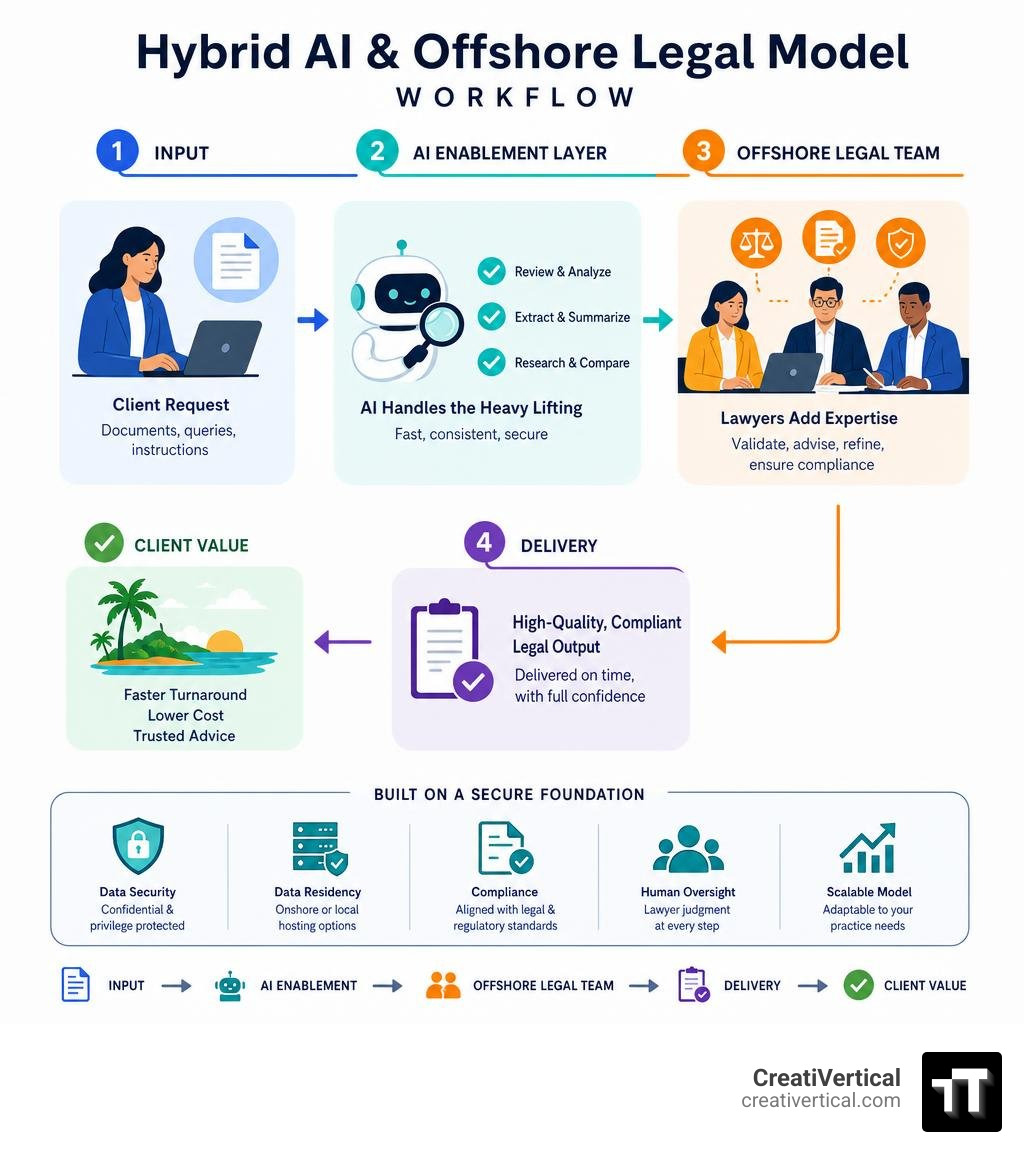
One of the most powerful aspects of the modern legal operations model is the synergy between AI and remote legal talent. While a US-based or local offshore senior associate is highly expensive, firms can build a hybrid delivery model that pairs AI tools with remote paralegals and offshore support teams.
Consider the cost dynamics:
- Traditional Staffing: Relying solely on local, on-island talent can lead to high overheads and capacity bottlenecks during peak transaction seasons.
- The Hybrid Model: Utilizing remote legal talent can reduce staffing costs by up to 60% while maintaining exceptional quality and responsiveness.
In practice, this hybrid approach works beautifully. AI tools are used to perform the first-pass review of a contract or draft a compliance document in minutes. A remote paralegal then reviews and localizes the draft, and a senior on-island attorney performs the final strategic check.
This model has been proven at scale; for example, Unilever’s legal department combined offshore legal resourcing with automation tools to reduce their internal legal workload by 30% to 40%. For smaller firms, this approach unlocks massive capacity without the need to hire expensive, full-time local staff.
Positioning Offshore Firms Against Non-Traditional Market Entrants
To win against ALSPs and the Big Four, offshore firms must leverage their deepest competitive advantage: their specialized, localized legal expertise. While a massive consulting firm can offer generic compliance at scale, they lack the deep, nuanced relationships with offshore regulators, court systems, and local corporate registries.
By integrating AI into their workflows, offshore firms can offer the best of both worlds: the speed, efficiency, and scale of a technology company, combined with the bespoke, trusted advisory of a traditional partnership.
To make sure clients understand this unique value proposition, firms must move away from outdated marketing tactics. Traditional legal advertising often fails because it focuses on the firm’s history rather than the client’s actual outcomes. To understand how to position your firm effectively, read our breakdown of Why Legal Marketing Campaigns Fail and What Works Instead and explore our curated list of Great Legal Marketing Advice.
The Evolution of Professional Identity and Lawyer Training
The rise of AI is fundamentally changing what it means to be a lawyer. Historically, a junior lawyer’s value was measured by their ability to memorize case law, manually review documents, and draft standard agreements from templates. Today, those tasks are highly automated.
As a result, we are seeing the emergence of the “hybrid professional”—an attorney who combines deep legal expertise with technological literacy, data analysis, and process management.
This shift is driving massive demand for new skill sets. For instance, the Rising Demand for Prompt Engineers is no longer confined to tech startups; modern law firms are actively seeking professionals who know how to communicate effectively with large language models to extract highly precise, compliant legal reasoning.
Training the Next Generation of Hybrid Offshore Lawyers
To prepare for this future, offshore law firms must restructure how they train junior talent. Instead of assigning first-year associates to spend hundreds of hours in manual document review rooms, firms must train them to design, manage, and audit AI-driven workflows.
This transition requires a proactive, firm-wide approach to capability building. A great example of this is the Indian powerhouse Cyril Amarchand Mangaldas, which selected Legora as its firm-wide generative AI partner after conducting a rigorous, multi-phase pilot involving 380 lawyers, as detailed in their official Press Release. By investing heavily in hands-on training and collaborative co-development, they ensured their legal teams were fully equipped to orchestrate complex legal tasks through agentic workflows.
Adapting Professional Identity to AI Enablement for Offshore Law Firms
As AI handles the analytical heavy lifting, the professional identity of the offshore lawyer is shifting from a “human database” to a trusted strategic advisor.
This is a positive evolution. When lawyers spend less time searching for documents and copying clauses, they have more time to spend with clients, understanding their business goals, navigating complex regulatory landscapes, and structuring creative solutions.
The future belongs to firms that view AI not as a threat to their billable hours, but as an engine that frees their lawyers to do the creative, high-value work they went to law school to perform in the first place.
Frequently Asked Questions about Offshore Legal AI
How do offshore law firms ensure compliance with local data protection laws when using AI?
Offshore firms ensure compliance by avoiding public AI tools and instead deploying enterprise-grade, localized, or on-premise AI solutions. These systems must feature strict encryption-at-rest, row-level role-based access controls, and comprehensive audit logs. Additionally, firms must conduct rigorous vendor assessments to verify that data is hosted in compliant jurisdictions and is never ingested to train external models.
Can AI completely replace junior lawyers or paralegals in offshore jurisdictions?
No. AI is designed to automate repetitive, analytical tasks (task substitution) and accelerate complex drafting (task augmentation), but it lacks human judgment, emotional intelligence, and jurisdictional nuance. Rather than replacing junior staff, AI shifts their role toward managing, auditing, and refining AI-generated outputs, turning them into highly efficient “hybrid professionals.”
What is the first step for a mid-sized offshore firm to begin its AI journey?
The first step is process mapping. Before buying any software, a firm should map out its current workflows to identify the specific bottlenecks that consume the most non-billable time (such as document triage, conflict checks, or standard compliance drafting). Once these bottlenecks are identified, the firm should run a small, focused pilot program with a secure, specialized legal AI tool to measure time savings and establish clear quality control protocols before rolling the technology out firm-wide.
Conclusion
The era of ai enablement for offshore law firms is not a distant prospect—it is the current reality of the offshore legal market in 2026. Firms that embrace this transition are scaling their operations, protecting their margins, and delivering unprecedented value to their clients. Those that cling to the traditional, unaugmented billable-hour model risk being left behind by nimbler, tech-enabled competitors.
At CreatiVertical, we specialize in helping professional services firms, B2B manufacturers, and government-facing vendors navigate complex digital transformations. As a family-run digital agency, we don’t just deliver one-off technology projects; we serve as an ongoing growth partner.
Whether you need to build custom AI agents to automate your internal workflows, modernize your web design, or improve your AI search visibility so your firm gets cited by tools like ChatGPT and Perplexity, we build the complete, performance-focused systems your business needs to scale.
If you’re ready to chart a new course for your firm’s growth, discover the Best AI Tools for SEO 2025 to see how modern technology can fuel your marketing, or reach out to us today to discuss how we can build a custom, secure AI enablement strategy for your offshore practice.