

Understanding Local SEO Competitor Analysis and Finding True Competitors
Executing a successful local competitor analysis seo strategy begins with a fundamental truth: digital search markets operate on real-time search engine results pages (SERPs), not physical addresses. Organic search accounts for 53% of overall website traffic across industries, while 46% of all Google searches carry local intent. Knowing who captures this traffic is essential to building an effective strategy.
When potential buyers search for local services, Google evaluates over 200 ranking signals to assemble the Local 3-Pack and localized organic listings. Businesses that invest time into analyzing competitor strategies routinely identify high-leverage growth opportunities. Research indicates that 54% of businesses actively build links and refine their search presence through competitor research and link targeting.
For further reading on foundational local marketing frameworks, consult BrightLocal’s Guide to Local Competitor Analysis and our guide to Improving Local Visibility.
What Sets Local Competitor Analysis SEO Apart from General SEO?
Traditional organic SEO typically focuses on national or global keyword difficulty, overall domain authority, and large-scale content publishing. In contrast, local search relies heavily on proximity, precise business categorization, local citation accuracy, and Google Business Profile engagement metrics.
In traditional search campaigns, a national brand can rank purely through high domain authority and extensive backlink volume. In local SEO, however, proximity to the searcher acts as a major filter. Google’s algorithm recalculates map results block-by-block based on real-time user location data. Furthermore, while traditional search features 10 blue links, local intent queries prominently feature the Local 3-Pack—a distinct map interface that displays business location, average star rating, review volume, hours, and direct call or direction triggers.
How to Identify True Local Competitors vs. Physical Neighbors
A frequent mistake in local marketing is assuming that your closest physical neighbor is your main digital competitor. Online local competitors are often completely different from the business down the street.
True search competitors are the domain names and Google Business Profiles that consistently appear across multiple high-intent commercial keyword searches in your target service area. To identify true local competitors:
- Filter directory listings out of direct business comparisons: Websites like Yelp, Angi, and YellowPages frequently occupy top organic ranks. Rather than treating directories as direct operational rivals, treat them as high-priority citation channels where your business should maintain optimized profiles.
- Calculate SERP overlap: Track search results across 3-5 core service queries. Note which specific businesses appear repeatedly across both the local map pack and organic web listings. The 15-25 unique entities that show up most consistently constitute your true digital competitor universe.
- Use location spoofing techniques: Because Google personalizes results based on exact GPS or IP coordinates, marketers auditing local rankings from outside a target city must use browser location-spoofing extensions or location-specific search APIs. This ensures you evaluate street-level map results as seen by local consumers.
For a deeper look into optimizing for local proximity signals, see our breakdown on How to Rank for Near Me Searches.
The 5-Step Process for Executing Local Competitor Analysis SEO
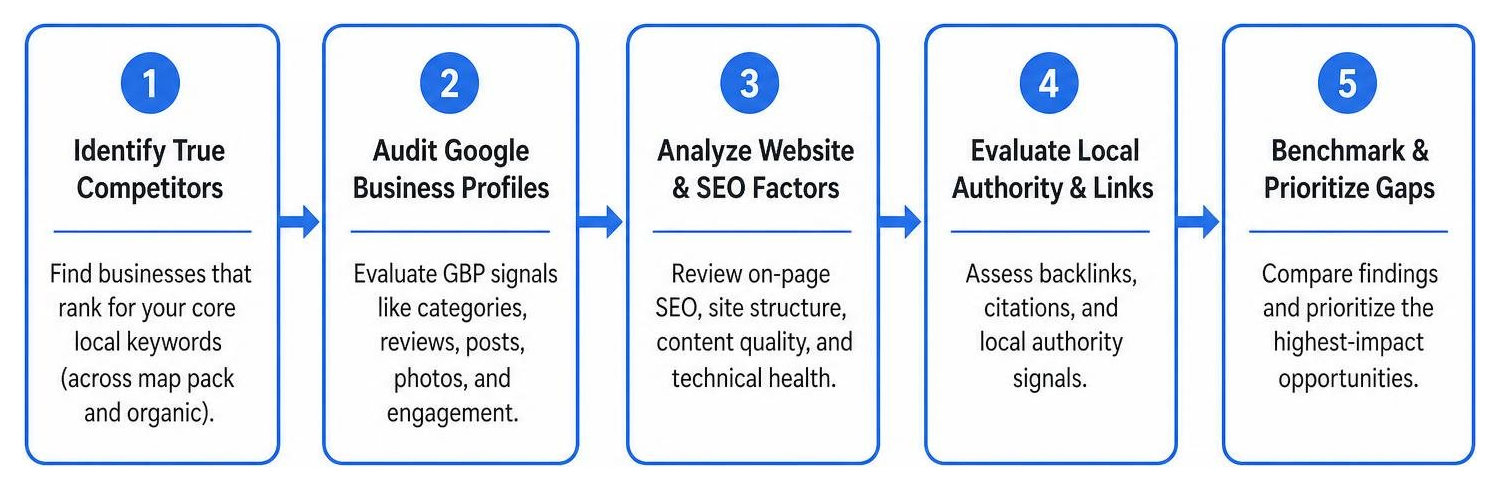
Executing an actionable audit requires moving past surface-level observations. A complete local competitor analysis seo audit systematically measures profile parameters, technical site health, link distribution, and content quality.
Step 1: Auditing Competitor Google Business Profiles
Google Business Profiles (GBP) serve as the foundation of map pack visibility. Auditing competitor profiles on a signal-by-signal basis reveals key gaps in your own local setup.
When examining rival GBPs, evaluate these specific fields:
- Primary and Secondary Categories: Primary category selection carries heavy algorithmic weight. Use browser extensions or inspection tools to view the hidden secondary categories top competitors select. Missing secondary categories represent immediate quick-win opportunities.
- Review Volume, Velocity, and Sentiment: Look beyond the aggregate star rating. Calculate their average monthly review acquisition speed (review velocity) and review response rate. Research indicates top-ranking local businesses maintain high review response rates, while profiles receiving consistent review updates send positive engagement signals to Google.
- Photo Cadence and Upload Diversity: High-performing profiles frequently post visual content. In fact, Google data shows profiles with over 100 photos earn substantially more website clicks than less active competitors. Track whether competitors upload interior photos, team photos, or job-site visual proof.
- Post Cadence and Service Menus: Document how often rivals publish Google Posts, use call-to-action buttons, update promotional offers, and explicitly list detailed sub-services within their profile menus.
To optimize your primary search engine profile, read our complete Business Profile Management Guide.
Step 2: Evaluating On-Page and Technical Local Competitor Analysis SEO Factors
A well-optimized Google Business Profile requires a structurally sound website to sustain long-term rankings. When evaluating competitor landing pages, analyze:
- Local Schema Markup: Inspect page source code or use structured data testing tools to verify if rivals use
LocalBusiness,PostalAddress,GeoCoordinates, or service-specific Schema. Proper structured data helps search engines interpret address details, operating hours, and service parameters. - Core Web Vitals and Mobile Performance: Google evaluates user experience metrics on mobile devices, including Interaction to Next Paint (INP), Largest Contentful Paint (LCP), and Cumulative Layout Shift (CLS). Target performance benchmarks for mobile sites include LCP under 2.5 seconds, INP under 200 milliseconds, and CLS under 0.1.
- Content Depth and Local Intent: Page-one Google results average 1,447 words across broader organic searches, but local service pages should aim for a competitive threshold of 1,200 to 2,000 words to cover user questions thoroughly. Check whether competitor service pages include location-specific details, project case studies, embedded map elements, and localized customer FAQs.
Step 3: Auditing Local Citations and Backlinks
Off-page authority remains a foundational local ranking factor. Top-ranking Google pages maintain roughly 3.8x more backlinks than pages ranking in positions 2 through 10, while 66% of web pages online currently have no backlinks pointing to them.
When conducting a link and citation audit:
- Identify High-Authority Citation Gaps: Run competitor business Name, Address, and Phone number (NAP) details through citation auditing tools to uncover directories where top competitors are listed but your business is absent. Focus primary efforts on high-authority directories, regional chambers of commerce, and trade association networks.
- Filter Backlinks by Local Relevance: Evaluate competitor backlink profiles in backlink checking tools. Filter results using regional anchor text keywords (such as city or neighborhood names) or local top-level domains. Local editorial links—such as regional news features, local event sponsorships, or community partner links—often provide strong local authority signals.
- Assess Trust Metrics: Analyze the quality of competitor link profiles. A healthy link profile typically maintains a Trust Flow to Citation Flow ratio of 0.5 or higher, indicating natural link acquisition rather than manipulative low-quality directories.
For specialized technical tooling and open-source frameworks, explore the Local Competitor Analysis Skill Documentation.
Turning Analysis into Strategy: Implementation and Monitoring
Raw competitive data only delivers value when converted into a practical execution plan. Structuring implementation into distinct quick wins and long-term milestones ensures balanced execution.
Building an Actionable Local SEO Strategy
After completing profile, technical, and off-page audits, organize your findings using an impact matrix:
| Strategy Horizon | Action Item | Typical Execution Window | Expected Impact Window |
|---|---|---|---|
| Quick Wins | Add missing GBP secondary categories, fill missing profile attributes, respond to unaddressed reviews, fix broken internal links. | 1 to 7 Days | 2 to 4 Weeks |
| Medium-Term Strategy | Expand thin local landing page content (1,200+ words), implement LocalBusiness Schema, claim missing high-authority citations. | 2 to 4 Weeks | 4 to 8 Weeks |
| Long-Term Campaigns | Execute automated review generation workflows, build local news and sponsorship backlinks, expand geographic landing page silos. | Ongoing (3 to 12 Months) | 3 to 6 Months |
Beyond basic SEO factors, evaluate competitor conversion paths. Note whether rivals offer instant scheduling widgets, automated web chat options, clear phone triggers, or direct quote forms. Improving conversion options helps ensure that incoming search traffic turns into qualified leads.
For a comprehensive guide to building sustainable growth frameworks, refer to our No-Nonsense Local SEO Strategy.
Tracking Local Rankings and AI Search Visibility Over Time
Because proximity alters local pack results across short physical distances, standard single-location rank tracking is insufficient for local businesses.
- Implement Geo-Grid Rank Tracking: Geo-grid tools track local map pack visibility by sampling rankings across an interactive map grid overlaid across your service area. This pinpoints exact neighborhoods where your profile ranks in the top 3 versus areas where visibility drops off.
- Monitor AI Search Engine Citations: Modern search continues to evolve. Google AI Overviews now appear on roughly 20% to 35% of local service queries. Furthermore, prospective clients increasingly use conversational AI engines like ChatGPT, Perplexity, and Gemini to source local recommendations. Track whether your brand appears in AI-generated local summaries alongside traditional search engines.
- Maintain Ongoing Reporting Dashboards: Establish automated reporting systems to monitor review acquisition speed, geo-grid ranking movement, organic impression patterns, and conversion inquiries on a routine basis.
To build custom tracking architectures, consult our guide on The Ultimate Local SEO Reporting Dashboard.

Frequently Asked Questions About Local SEO Competitor Analysis
How often should you conduct a local SEO competitor analysis?
We recommend performing a comprehensive local competitor analysis seo audit on a quarterly basis. However, targeted mini-audits should be conducted immediately if your business experiences a sudden drop in local map rankings, when a aggressive new competitor enters your market, or when Google rolls out major local algorithm updates.
What are the best tools for discovering and analyzing local competitors?
A thorough local SEO toolkit combines several specialized applications:
- Location Spoofing Tools: Browser extensions (such as GS Location Changer) allow marketers to view accurate street-level map packs without physical travel.
- Geo-Grid Trackers: Platforms like BrightLocal, Local Viking, or Places Scout provide visual grid heatmaps showing rank distribution across target service radii.
- Backlink & Keyword Scanners: Industry-standard tools like Ahrefs, Semrush, and Moz Pro enable detailed keyword gap and backlink profile analysis.
- Profile & Citation Auditing Software: Specialized platforms help streamline category comparison, citation coverage checks, and review sentiment tracking.
How long does it take to see results after closing competitive gaps?
Implementation timelines vary based on business age, existing domain authority, and local market competitiveness. Immediate quick wins—such as updating missing secondary categories or claiming unverified profile attributes—can produce visible local map pack shifts within 2 to 4 weeks. Broader content expansion, citation indexing, and link acquisition strategies typically demonstrate sustained ranking improvements within 3 to 6 months.
Conclusion
Conducting a thorough local SEO competitor analysis removes guesswork from digital marketing. By evaluating local search overlap, auditing Google Business Profiles, analyzing technical site health, and closing link and citation gaps, your business builds a solid, data-backed foundation for long-term visibility.
At CreatiVertical, we partner with local businesses, professional service providers, manufacturers, and technology organizations to build high-performing digital systems across web development, search engine optimization, and AI search readiness.
To explore actionable steps for improving your digital presence today, read our companion guide 7 Tips to Improve Local Visibility Online.