

How to Make Cayman Legal Services PPC Precise and Compliant
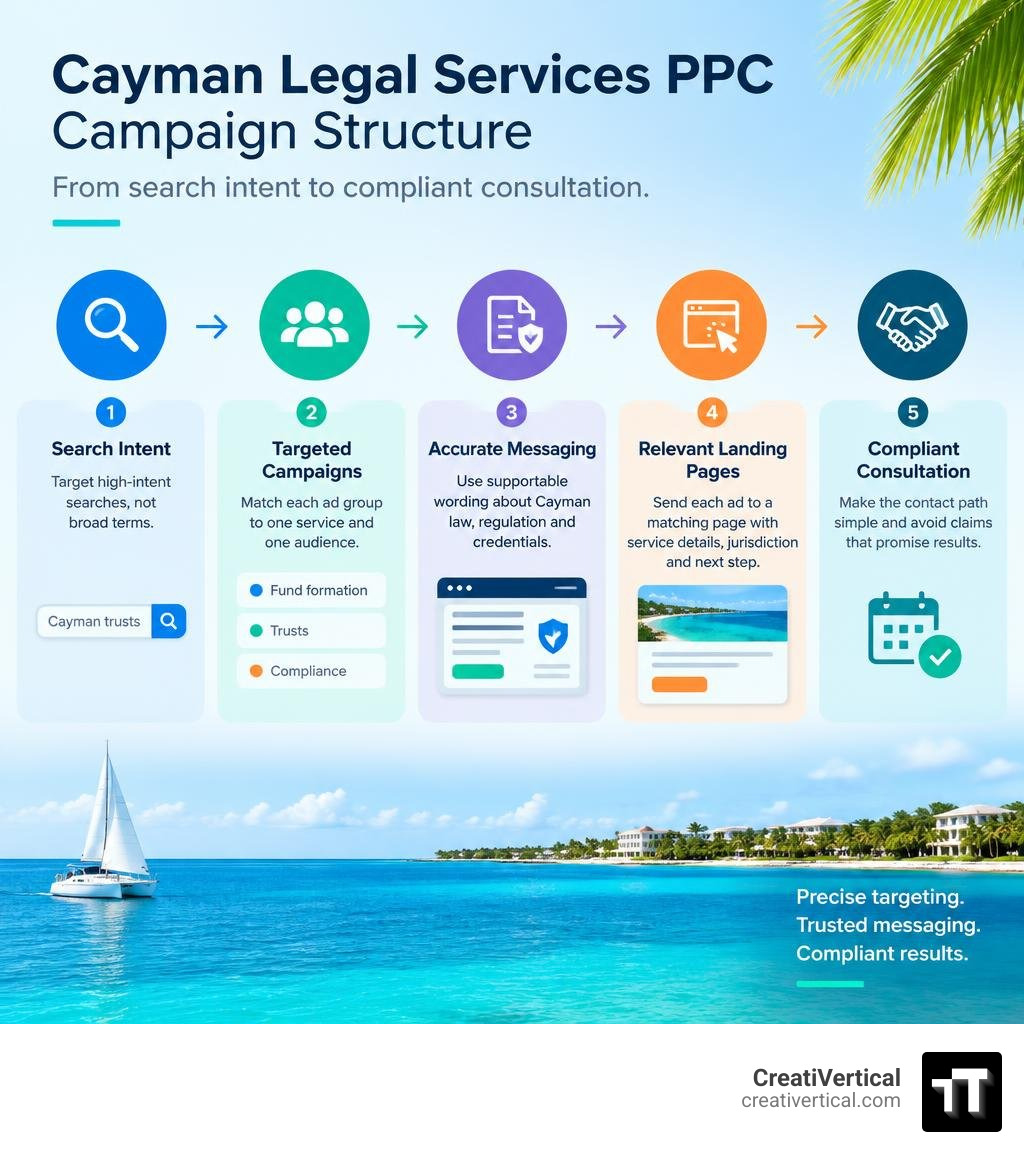
Cayman legal services PPC works when you separate the legal qualification meaning of “PPC” from pay-per-click advertising, then build campaigns around specific client problems. Start with narrow practice-area campaigns, such as fund formation, trusts, fiduciary disputes, company structuring, or regulatory compliance. Send each ad to a matching page that explains the service, jurisdiction, and next step in plain language.
A practical starting point:
- Target high-intent searches, not broad terms such as “Cayman lawyer.”
- Match each ad group to one service and one audience, such as institutional fund managers or private wealth advisers.
- Use accurate, supportable wording about Cayman law, regulation, and professional credentials.
- Make the contact path simple while avoiding claims that promise legal outcomes.
In Cayman, “PPC” can also mean the Post Graduate Diploma in Legal Practice. The programme supports the path toward attorney qualification through practical, Cayman-focused legal training, qualifying examinations, and articles of clerkship. That professional context matters in marketing: sophisticated buyers expect evidence of jurisdictional knowledge, ethical standards, and a clear understanding of the local legal landscape.
Cayman’s legal market also serves complex cross-border work. Public procurement, financial-services compliance, trusts, funds, corporate structures, and disputes all demand messaging that is specific enough to earn trust without drifting into vague offshore marketing language.
I’m Nicholas Cunha, founder of CreatiVertical, a family-run agency with more than two decades of digital project experience, including fifteen years serving government and institutional clients in the British Virgin Islands. I apply that small-jurisdiction experience to Cayman legal services PPC, SEO, web development, and AI search visibility for offshore professional-service firms.
Must-know Cayman legal services PPC terms:
Understanding the Cayman Islands Regulatory and Legal Education Ecosystem

Marketing offshore legal services requires an intimate appreciation of the jurisdiction’s institutional weight. The Cayman Islands operates as a premier international financial centre governed by a legal system rooted firmly in English common law, complemented by local statutory enactments.
The primary legislation governing local practice is the Legal Practitioners Act (2022 Revision). The court hierarchy provides clear dispute pathways: minor civil and criminal matters up to CI$20,000 are resolved in the Summary Court, while high-value cross-border litigation, complex corporate restructurings, and international trust disputes sit under the jurisdiction of the Grand Court (including its specialized Financial Services Division), with final appellate rights lying with the Judicial Committee of the Privy Council in the United Kingdom.
For global law firms and boutique fiduciary providers, demonstrating a grasp of this ecosystem is the foundation of qualified client acquisition. When family offices, institutional asset managers, or onshore general counsel search for offshore guidance, they evaluate a firm’s statutory fluency, institutional standing, and regulatory rigor.
The Professional Practice Course (PPC) and Attorney Qualification Pathways
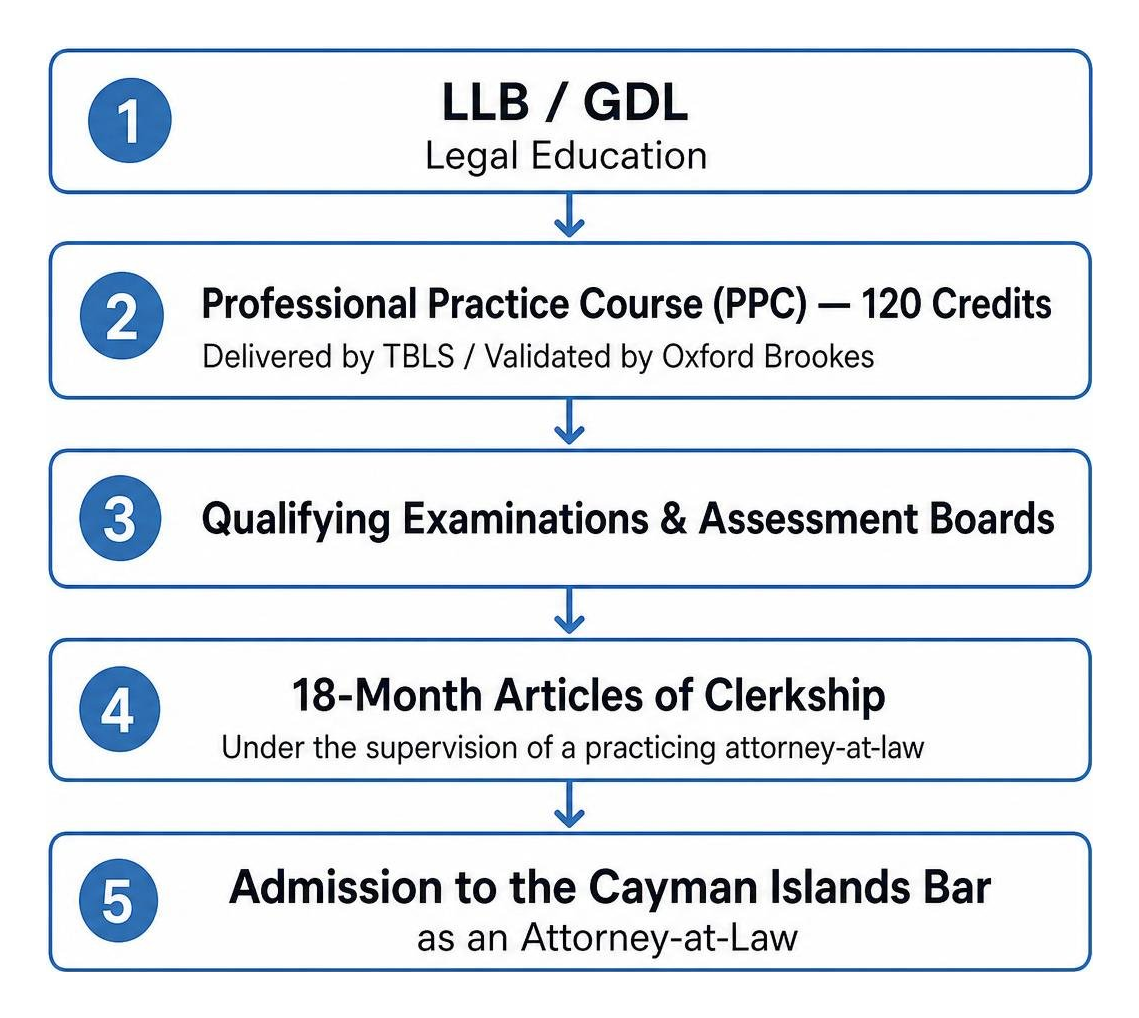
Within the Cayman Islands legal fraternity, the acronym “PPC” refers specifically to the Professional Practice Course (Post Graduate Diploma in Legal Practice). Delivered locally by the Truman Bodden Law School (TBLS) and validated by Oxford Brookes University under the oversight of the Cayman Legal Advisory Council, the PPC is the mandatory benchmark for local bar admission.
The programme spans a rigorous 120-credit curriculum designed around a practical active-learning sequence (“tell, show, do, review”). Spanning two semesters, it requires students to complete ten compulsory modules covering core practice areas:
- Conveyancing and Property Law
- Litigation (Civil and Criminal Procedure)
- Probate and Succession Law
- Legal Accounts (including closed-book accounting assessments)
- Corporate Practice and Cayman Statute Law
- Professional Conduct, Ethics, and Practical Legal Research
Following successful completion of the qualifying examinations, candidates must undertake an 18-month articles of clerkship under the supervision of a practicing attorney-at-law, as prescribed by the Legal Practitioners (Students) Regulations. Throughout this pipeline, entities such as the Cayman Islands Legal Practitioners Association (CILPA) foster professional standards, ensuring that local practitioners are fully equipped to manage cross-border instructions alongside international firms offering comprehensive legal services.
Public Procurement Frameworks and the Solicitor General’s Office
Beyond private wealth and offshore corporate structures, the Cayman legal landscape encompasses an active public-sector legal framework. The Solicitor General’s Office (SGO) provides central legal advisory support to public entities, particularly regarding procurement and major public-works projects.
Working alongside the Central Procurement Office, the SGO reviews procurement documentation, oversees competitive tendering compliance, and assists in drafting robust commercial agreements under key statutes such as the Public Management and Finance Law and the Public Service Management Law. Furthermore, the SGO advises government bodies on post-contract dispute resolution, mitigating litigation risks in complex public infrastructure projects.
Understanding the interplay between public compliance frameworks and private sector services gives offshore practitioners a distinct perspective when advising contractors, financial institutions, and corporate entities entering government-adjacent partnerships.
Strategic Execution for Cayman Legal Services PPC Campaigns
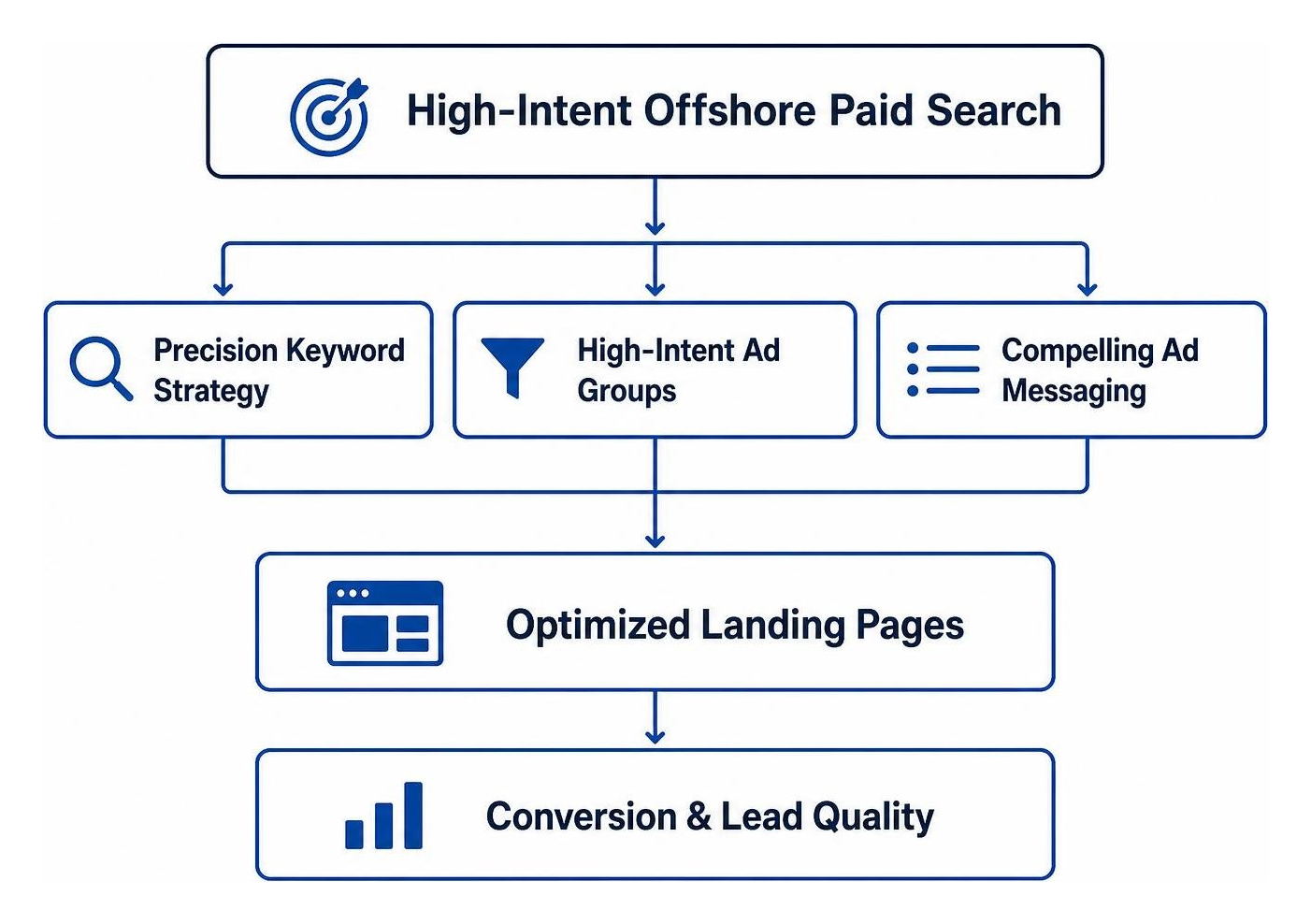
In digital acquisition, pay-per-click (PPC) advertising functions as a precision instrument to connect offshore practitioners with global business leaders, private wealth advisers, and institutional fund managers. However, offshore campaigns operate in an environment where individual clicks can be costly and vague search queries waste marketing spend.
Success in paid search for offshore law practices requires building campaigns that filter out retail queries and attract institutional buyers. Whether you are marketing entity formation or multi-jurisdictional private wealth advisory, ad groups must be structured with exact jurisdictional intent.
Structuring High-Intent Keyword Ad Groups for Cayman Legal Services PPC
Broad search phrases like “Cayman lawyer” attract unqualified consumer queries, visa inquiries, or academic searches related to law courses. Paid campaigns should instead isolate commercial, high-value practice areas into discrete ad groups.
For example, law practices handling corporate structuring and private wealth should organize dedicated campaigns around specific legal structures:
- Investment Funds & SPVs: Keywords focusing on exempted limited partnerships, private fund registrations, and master-feeder fund formations.
- Private Client Wealth & Foundations: Searches concerning Cayman foundation companies, succession planning, and discretionary trust structuring.
- Digital Assets & FinTech: Queries for compliant token issuer formation, decentralized autonomous organization (DAO) foundation structures, and virtual asset service provider (VASP) compliance.
- Commercial Dispute Resolution: Targeted terms for Grand Court representation, shareholder appraisal rights (Section 238 disputes), and cross-border insolvency.
Implementing structured PPC campaign architecture allows offshore firms to write ad copy that speaks directly to corporate decision-makers. Pairing paid search with broader offshore digital marketing strategies creates an acquisition funnel that captures urgent, high-intent client demands.
Aligning Regulatory Mandates with Cayman Legal Services PPC Ad Copy
Offshore marketing requires total factual precision. Overly promotional language undermines institutional credibility and can trigger regulatory scrutiny.
Ad copy must accurately reflect the jurisdiction’s governing rules. In the Cayman Islands, the Cayman Islands Monetary Authority (CIMA) enforces strict anti-money laundering and counter-terrorist financing (AML/CFT) rules, which include rigorous customer due diligence, sanctions screening, and mandatory compliance appointments.
Furthermore, international reporting frameworks under the Department for International Tax Cooperation (DITC) govern economic substance obligations, FATCA, and the Common Reporting Standard (CRS). Entities must also account for regulatory requirements like appointing a resident Principal Point of Contact (PPoC) to manage DITC portal communications.
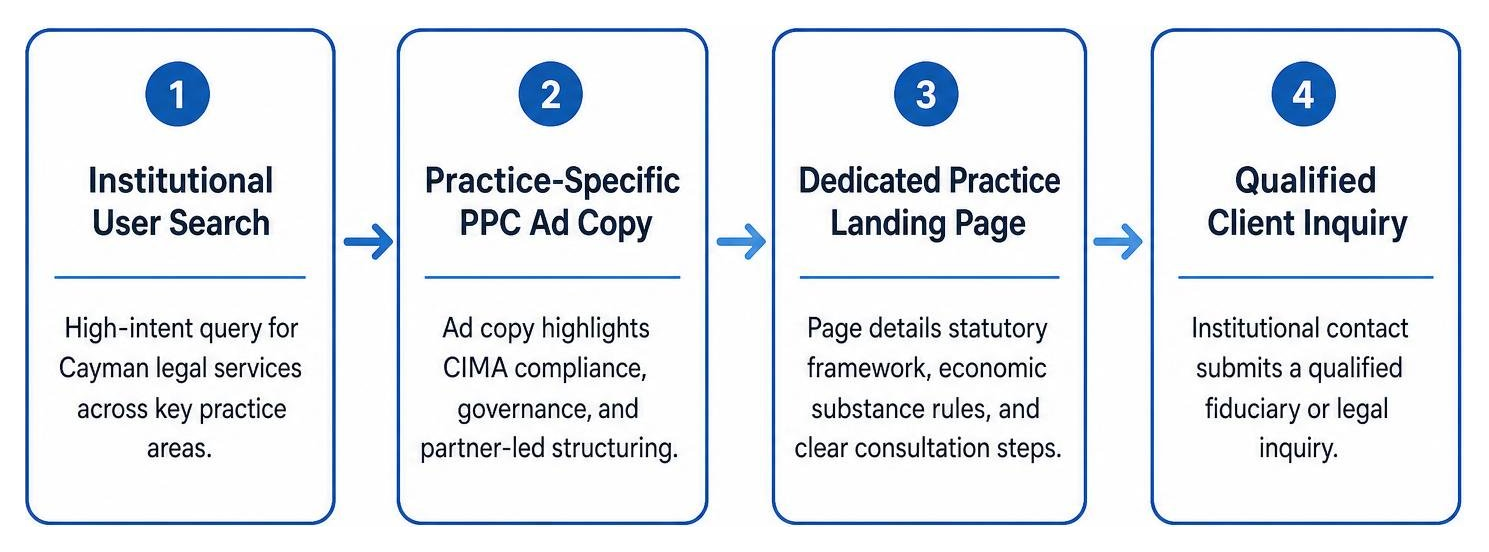
When running paid ads, messaging should emphasize institutional governance, regulatory readiness, and partner-led advisory rather than unsubstantiated claims. Combining this targeted messaging with natural organic discovery ensures that your firm’s paid search and organic presence reinforce each other, as explored in our guide on why search engine marketing and SEO work better together.
Integrating Offshore Authority: Practical Training to High-Value Lead Conversion

Converting clicks into high-value retainer clients requires landing pages that prove deep jurisdictional capability. Institutional decision-makers look for clear evidence that an offshore team possesses real transactional and dispute-resolution experience.
Leveraging Institutional Credibility and Clinic Experience in Practice Positioning
Local legal training emphasizes practical application. For instance, the Cayman Islands Legal Assistance Clinic (CILAC) provides practical experience for supervised students and graduates of the Professional Practice Course, working alongside practicing attorneys from respected local firms. In this environment, practitioners hone skills in client advice drafting, statutory research, and ethical compliance before entering full-time practice.
Firms can demonstrate this same commitment to professional standards across their digital presence by highlighting:
- Partner-Led Teams: Corporate clients want direct access to senior practitioners who navigate complex cross-border transactions.
- Specialized Practice Niches: Highlighting specific disciplines—such as defending fiduciary liability claims, managing professional liability disputes, or advising independent trustees—differentiates a firm from generalist agencies.
- Cross-Border Collaboration: Outlining how your team coordinates seamlessly with onshore counsel in London, New York, Hong Kong, and Miami.
Conversion Architecture for Cross-Border Corporate and Private Wealth Clients
Landing pages must be structured to guide prospective corporate clients and family offices through their decision-making process without friction. High-net-worth individuals and corporate officers seek clarity regarding company setup processes, tax neutrality guarantees (such as 20- to 30-year government tax exemption undertakings), and statutory governance rules.
To ensure your ad spend targets genuine business opportunities rather than retail traffic, search queries should be evaluated by commercial intent:
| Search Query Category | Example User Query | Intent & Conversion Strategy |
|---|---|---|
| Retail / Consumer (Negative Intent) | “How to become a lawyer in Cayman”, “PPC legal course cost” | Exclude using negative keywords. These are academic and consumer queries that consume budget without generating client fees. |
| Offshore Entity Structuring | “Cayman exempted company formation counsel”, “Foundation company digital assets” | Direct to practice-specific landing pages detailing statutory incorporation steps, registered office support, and governance frameworks. |
| Institutional Fund Governance | “Cayman private fund legal advisory”, “CIMA mutual fund registration lawyer” | Direct to asset management pages outlining fund structuring, AML officer appointments, and ongoing CIMA compliance. |
| Contentious Cross-Border Matters | “Grand Court insolvency attorney Cayman”, “Section 238 fair value appraisal counsel” | Route to commercial litigation pages highlighting courtroom admissions, cross-border dispute experience, and creditor advisory. |
Firms looking to build a sustainable digital pipeline should integrate high-intent paid campaigns with long-term organic authority, as detailed in our guide to Cayman legal search engine optimization.
Frequently Asked Questions about Cayman Legal Services and Paid Acquisition
What is the distinction between the Cayman PPC qualification and legal services PPC advertising?
In the Cayman Islands legal sector, “PPC” carries two completely distinct meanings depending on context:
- Professional Practice Course (PPC): A post-graduate legal diploma delivered by the Truman Bodden Law School (validated by Oxford Brookes University). It is the mandatory academic and vocational training course that Caymanian law graduates complete prior to undertaking their 18-month articles of clerkship and gaining admission to the Cayman Bar.
- Pay-Per-Click Advertising (PPC): A digital marketing model where law firms, fiduciary providers, and corporate service firms run targeted search ads on engines like Google to attract clients seeking offshore legal, fund, or company-formation advice.
Campaign managers must configure negative keyword lists to prevent pay-per-click ad budgets from being spent on searches related to law school syllabi, tuition fees, and bar examinations.
How do new CIMA and DITC regulations impact marketing Cayman legal services?
Regulatory updates in the Cayman Islands directly shape client demand and ad messaging. When CIMA updates its AML/CFT guidelines or enforces stricter sanctions compliance, institutional entities require legal and fiduciary reviews of their governance frameworks.
Similarly, evolving DITC requirements—such as economic substance reporting, CRS compliance, and the appointment of a resident Principal Point of Contact (PPoC)—create specific advisory needs for offshore entities. Digital campaigns that clearly address these compliance requirements provide immediate utility to corporate directors and fund managers searching for up-to-date guidance.
What offshore legal practice areas deliver the strongest return on paid search spend?
Paid search delivers the highest return when applied to complex, high-value corporate and private wealth disciplines where clients actively search for specialized offshore expertise:
- Private Fund Structuring & Registration: Advising private equity, venture capital, and hedge funds on Cayman fund launches and CIMA licensing.
- Foundation Companies & Digital Assets: Structuring governance vehicles for international family offices, Web3 foundations, and decentralized protocols.
- Cross-Border Litigation & Restructuring: Representing institutional creditors, shareholders, and fiduciaries in Grand Court proceedings and cross-border insolvencies.
- Fiduciary & Trustee Advisory: Structuring discretionary trusts, private trust companies (PTCs), and succession plans for high-net-worth international families.
Conclusion
Building a successful digital presence for offshore legal and fiduciary practices requires technical precision, regulatory literacy, and a clear understanding of your ideal client. By differentiating academic inquiries from high-intent commercial searches, structuring campaigns around specific practice areas, and maintaining factual accuracy in ad copy, offshore firms can run paid search campaigns that reliably attract institutional clients.
At CreatiVertical, we serve as an ongoing digital growth partner for offshore law practices, fiduciary companies, and corporate service providers. We design and manage integrated digital systems—spanning performance-focused bespoke web development, search engine optimization, AI search visibility, and paid advertising—built specifically for the demands of international offshore jurisdictions.
If your firm is ready to establish a precise, compliant, and high-performing digital acquisition system, we are here to help you chart the course.