

Understanding FedRAMP and Federal Cloud Hosting Mandates
Finding and evaluating FedRAMP compliant website hosting requires three immediate steps: verifying active authorization status in the official FedRAMP Marketplace Directory, aligning hosting baselines with your website’s FIPS 199 impact level (Low, Moderate, or High), and leveraging control inheritance through pre-authorized IaaS or PaaS environments to minimize compliance overhead. At its core, the Federal Risk and Authorization Management Program (FedRAMP) is a government-wide initiative that standardizes the security assessment, authorization, and continuous monitoring of cloud services. Codified into federal law via the FedRAMP Authorization Act, the program eliminates redundant agency audits by allowing public sector teams to reuse authorized security packages under a “do once, use many times” framework.
Any organization handling federal data must understand who falls under this mandate:
- Federal Executive Agencies: Required by law to ensure all operational cloud deployments possess a recognized FedRAMP authorization.
- Government Contractors and Subcontractors: Prime contractors delivering public web portals, software systems, or data warehouses for public sector clients must deploy within authorized hosting boundaries to satisfy their Federal Information Security Modernization Act (FISMA) obligations.
- Cloud Service Providers: Any vendor offering Infrastructure as a Service (IaaS), Platform as a Service (PaaS), or Software as a Service (SaaS) to federal entities must achieve and maintain an active authorization status.
To verify whether a hosting platform meets these criteria, teams consult the Official FedRAMP Marketplace Directory. The marketplace maintains a searchable registry of vetted hosting platforms and recognized Third-Party Assessment Organizations (3PAOs), enabling agencies to review authorization levels and active security packages directly.
The Three FedRAMP Impact Levels: Low, Moderate, and High
Federal systems do not follow a one-size-fits-all security standard. Instead, web properties are categorized under Federal Information Processing Standards (FIPS) 199, which evaluates the potential adverse impact on an agency’s operations, assets, or individuals if the system suffers a breach of confidentiality, integrity, or availability.
Determining your impact level early is vital. While a simple public information site might operate under Low impact baselines, adding features like user registration forms, citizen feedback workflows, or integrated databases often elevates the system into Moderate territory.
The Shared Responsibility Model in FedRAMP Compliant Website Hosting
One of the most persistent misunderstandings in public sector IT is the belief that choosing a compliant cloud provider eliminates all security duties. In reality, security in the cloud operates on a shared responsibility model, dividing obligations across the technology stack based on how you deploy cloud hosting architectures.
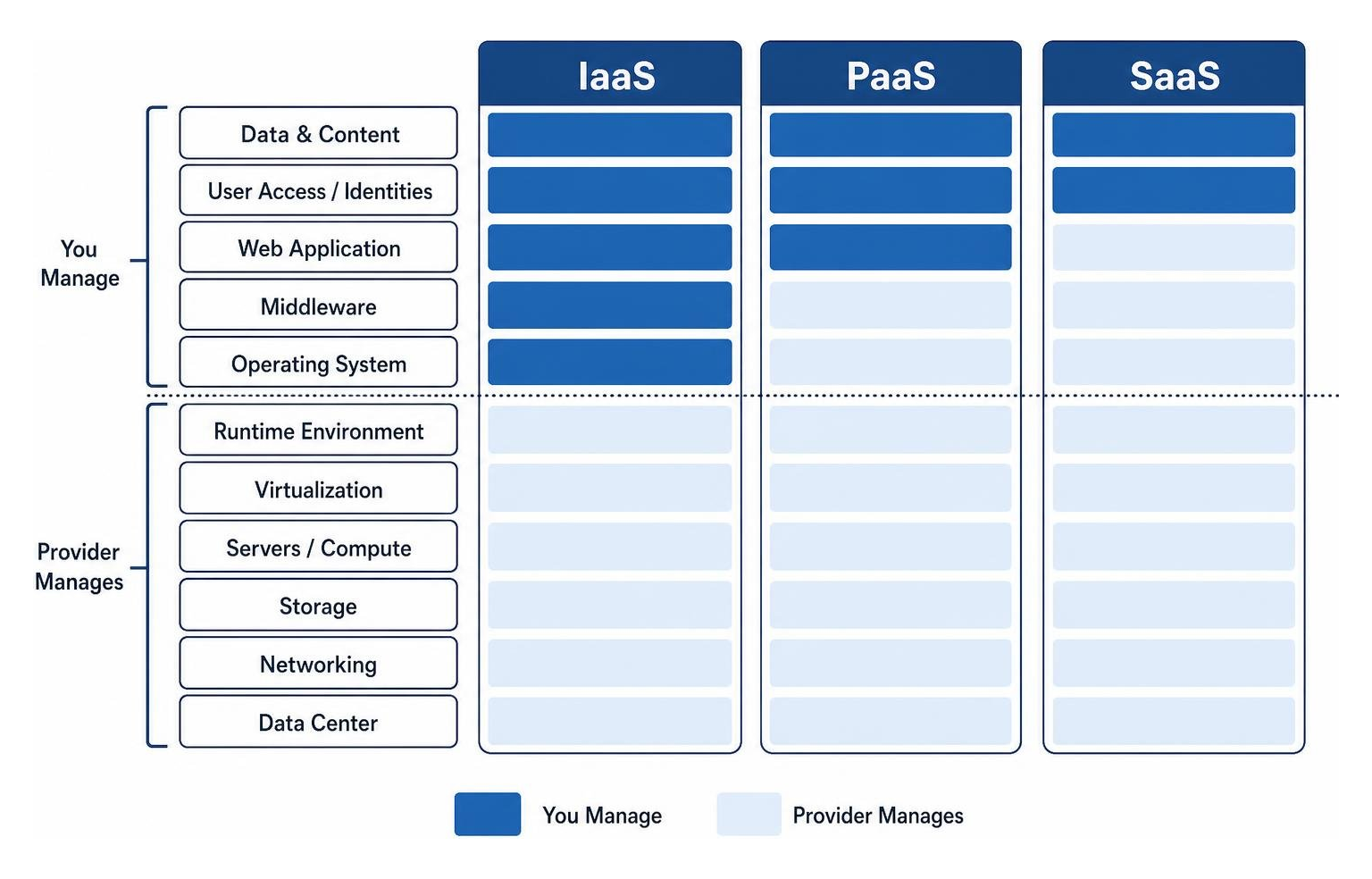
- Infrastructure as a Service (IaaS): The cloud provider (such as AWS GovCloud) secures physical data centers, core networking, hardware virtualization, and environmental controls. The customer or agency manages everything above that layer, including operating system hardening, middleware, database configuration, web application software, and user permissions.
- Platform as a Service (PaaS): The hosting vendor manages the physical hardware, hypervisor, operating system patching, and runtime environment. The customer remains responsible for securing their custom web code, content management configuration, and identity lifecycles.
- Software as a Service (SaaS): The provider operates and maintains the entire stack from hardware up through the core application. The customer is responsible for configuring access controls, managing roles, and governing what data users upload into the system.
If a vendor claims they are “fully compliant because we run on AWS,” they are confusing infrastructure authorization with application authorization. Your web application still requires its own operational controls, access governance, and continuous vulnerability monitoring to earn an Authority to Operate (ATO).
Core Evaluation Criteria for FedRAMP Compliant Website Hosting
Finding the right host requires reviewing specific architectural and compliance capabilities mapped to the National Institute of Standards and Technology Special Publication (NIST SP) 800-53 Rev 5. This framework organizes federal security requirements into 17 distinct control families, covering domains such as Access Control (AC), Audit and Accountability (AU), Configuration Management (CM), Incident Response (IR), and System and Communications Protection (SC).
When evaluating hosting environments, review whether the provider offers comprehensive operational support or simply unmanaged raw compute. Teams looking for a deeper breakdown of full-service hosting can explore our in-depth guide to managed hosting to see how operational maintenance differs from basic server provisioning.
Control Inheritance and NIST SP 800-53 Rev 5 Baselines
Building a federal security boundary from scratch on raw infrastructure is a resource-intensive endeavor. Organizations starting from zero spend an average of $1.5M to $3M and require 12 to 24 months (averaging 18 months) before a single system goes live.
Control inheritance solves this bottleneck. When you host a website on a pre-authorized FedRAMP High PaaS platform, your application can inherit roughly 300+ NIST 800-53 security controls directly from the underlying environment.
This inheritance covers physical security, environmental safeguards, network edge defenses, and hardware-level FIPS 140-2 encryption. As a result, your team only needs to document and defend the remaining application-layer controls (around 100 controls under a Moderate baseline), reducing your initial ATO documentation burden by an estimated 40% to 60%.
Hardening Content Management Systems for Government Portals

Content management systems power the vast majority of federal public web portals. WordPress alone powers roughly 41% of the web, and Drupal remains widely utilized across civilian and defense agencies. However, open-source content platforms introduce unique security considerations that standard commercial hosting environments cannot satisfy.
Industry data shows that 97% of WordPress vulnerabilities originate from third-party plugins rather than core software. Typical federal web portals utilize between 20 and 50 plugins to deliver necessary interactive features. In an unmanaged hosting environment, unpatched plugins create a large attack surface.
Federal web hosting environments must enforce strict baseline safeguards:
- DISA STIG Server Hardening: Operating systems, web runtimes (such as Apache, Nginx, or PHP engines), and databases must be configured strictly against Defense Information Systems Agency Security Technical Implementation Guides (DISA STIGs).
- Automated Flaw Remediation (NIST SI-2): Hosting providers must maintain a structured patch pipeline. Routine monthly security updates for CMS core, modules, and plugins should run through automated staging environments to verify stability before production deployment.
- Emergency Patch SLAs: For critical Common Vulnerabilities and Exposures (CVSS 9.0+) or listings on the CISA Known Exploited Vulnerabilities (KEV) catalog, hosting providers must deploy validated fixes within a strict 24 to 72-hour window.
- Design and Layout Compliance: Public portals must integrate Section 508 and WCAG 2.1 AA accessibility guidelines alongside the U.S. Web Design System (USWDS). Aligning these operational requirements early is explored in our guide to FedRAMP compliance web design.
Authorization Paths, Timelines, and True Cost Breakdown
Securing a formal FedRAMP authorization is an extensive compliance journey requiring careful budgetary and project planning. Understanding the authorization mechanisms and lifecycle phases helps teams prevent costly delays. For an introductory look at these mechanics, review our practical guide to FedRAMP compliant web hosting.
Comparing Agency Sponsorship vs. JAB Authorization
There are two primary administrative paths to achieving authorization:
Because JAB prioritization is highly selective, the vast majority of web platforms and SaaS solutions enter the federal ecosystem via direct agency sponsorship.
Navigating the 5-Phase FedRAMP Lifecycle from Prep to ConMon
Whether pursuing Agency or JAB authorization, every cloud service offering moves through five defined stages:
- Preparation (2–4 Months): The organization determines its FIPS 199 boundary, performs a comprehensive gap analysis against NIST SP 800-53 controls, and remediates foundational architectural deficiencies.
- Documentation (3–6 Months): The vendor drafts a detailed System Security Plan (SSP). For a Moderate baseline, an SSP routinely exceeds 300 pages, mapping every operational process, encryption boundary, and control implementation.
- Assessment (2–4 Months): An accredited Third-Party Assessment Organization (3PAO) executes extensive functional and penetration testing, assembling their findings into a formal Security Assessment Report (SAR).
- Authorization (1–3 Months): The Authorizing Official (AO) reviews the SSP, SAR, and the vendor’s Plan of Action and Milestones (POA&M) to issue a formal ATO.
- Continuous Monitoring (Ongoing): The provider conducts monthly vulnerability scanning, active POA&M tracking, regular incident reporting, and mandatory annual 3PAO re-assessments.
Step-by-Step Procurement Workflow for Federal Web Teams
Federal procurement teams cannot rely on generic vendor marketing claims. When drafting Requests for Proposals (RFPs) and selecting partners, following a structured vetting procedure prevents non-compliance findings down the road. Working with an experienced FedRAMP compliant digital agency helps ensure that both technical requirements and administrative documentation align smoothly.
Vetting Vendors for FedRAMP Compliant Website Hosting
Use this structured evaluation workflow when assessing potential hosting solutions:
- [ ] Marketplace Verification: Confirm the vendor’s exact package ID on the official FedRAMP Marketplace rather than taking marketing materials at face value.
- [ ] Impact Level Alignment: Verify the authorization matches or exceeds your system’s required FIPS 199 baseline (Low, Moderate, or High).
- [ ] Control Responsibility Matrix (CRM): Request the host’s CRM to identify precisely which controls are fully inherited, which are shared, and which remain your team’s responsibility.
- [ ] Annual Assessment Recency: Confirm the vendor completed an independent 3PAO assessment within the past 12 months.
- [ ] Active POA&M Health: Inspect open remediation items to ensure the provider has no overdue high-severity vulnerabilities (CVSS 7.0+).
- [ ] Encryption Standards: Validate that all data at rest and data in transit utilize FIPS 140-2 or 140-3 validated cryptographic modules.
- [ ] Disaster Recovery Objectives: Confirm multi-zone cloud replication with concrete Recovery Time Objectives (RTO) and Recovery Point Objectives (RPO).
Post-Authorization Continuous Monitoring and Audit Governance
Authorization is not a static milestone; it is an ongoing operational commitment. Once an agency grants an ATO, the hosting provider must execute continuous monitoring (ConMon) protocols to maintain that status.
Monthly vulnerability scans of all operating systems, web applications, databases, and network boundaries must be delivered to agency security teams and Authorizing Officials. Any discovered vulnerabilities must be recorded in the system’s POA&M, with strict remediation deadlines based on severity: 30 days for high-severity findings, 90 days for moderate findings, and 180 days for low findings. Providers must also maintain a dedicated 24/7 Security Operations Center (SOC) capable of escalating Priority 1 security incidents within hours.
Frequently Asked Questions About FedRAMP Web Hosting
Does hosting a website on AWS GovCloud automatically make it FedRAMP compliant?
No. AWS GovCloud holds FedRAMP High authorizations at the physical and infrastructure (IaaS) levels. However, placing a web application on GovCloud does not automatically authorize the application layer. Web teams remain responsible for operating system hardening, CMS configurations, user authentication, access logging, and regular vulnerability patching. Full compliance requires obtaining an ATO covering the entire operational stack.
How many security controls can a web application inherit from a pre-authorized host?
When deploying on a pre-authorized FedRAMP High PaaS provider, web teams can inherit roughly 75% of required security controls (over 300 NIST SP 800-53 controls). This allows your team to focus primarily on the remaining ~25% (~100 controls) governing the application layer, user management, and custom business logic.
What are the primary authorization differences between FedRAMP Low and Moderate?
FedRAMP Low requires implementing approximately 125 security controls and is designated for publicly accessible informational websites where a compromise would not disrupt agency operations or expose sensitive information. FedRAMP Moderate encompasses roughly 325 security controls and represents approximately 70% of all federal cloud authorizations. Moderate is mandatory whenever a website processes Controlled Unclassified Information (CUI), collects personal citizen data via web forms, or manages authenticated user accounts.
Conclusion
Securing federal web infrastructure requires balancing user-friendly content delivery with rigorous cybersecurity compliance. By leveraging control inheritance from established hosting platforms and applying structured CMS hardening, federal web teams and contractors can significantly compress their authorization timelines while maintaining an uncompromised security posture.
At CreatiVertical, we help organizations bridge the gap between design excellence and federal technical requirements. Whether you are modernizing a public-facing portal, integrating automated workflow governance, or architecting compliant digital systems, our team is here to support your mission. Explore our federal website development services to see how we build resilient, accessible, and compliant web platforms tailored for public sector performance.