

Understanding FedRAMP Certification for Federal Web Applications
The Federal Risk and Authorization Management Program (FedRAMP) is a U.S. federal government-wide program that standardizes security assessment, authorization, and continuous monitoring for cloud products and services. Enacted by executive order in 2011 and officially codified into law by Congress, FedRAMP operates under the policy directive that federal agencies must adopt secure, cloud-first solutions—often referenced under the federal Cloud Smart strategy.
When an agency builds or migrates a web application, it cannot simply launch on standard commercial web infrastructure. Federal agencies, cloud service providers (CSPs), and government prime contractors must ensure their cloud environments adhere to stringent baseline security specifications derived from National Institute of Standards and Technology (NIST) Special Publication 800-53.
Under the updated regulatory framework known as the FedRAMP Consolidated Rules for 2026 (CR26), the official terminology has evolved. What was historically termed “FedRAMP Authorization” is now formally designated as “FedRAMP Certification.” CR26 also introduced Collaborative Continuous Monitoring (CCM) and mandatory Significant Change Notifications (SCN), requiring cloud vendors to report material operational modifications promptly to agency clients.
Who Needs FedRAMP Compliant Web Hosting Services?
FedRAMP compliance is mandatory for any cloud service hosting U.S. federal government data or connecting directly to agency IT networks. This requirement spans three main groups:
- Public Sector Agencies: Federal civilian departments and defense organizations required by federal law to host public portals, internal intranets, and web applications on certified cloud infrastructure.
- SaaS and Web Software Vendors: Commercial software companies marketing digital platforms (such as content management systems, citizen engagement portals, or data platforms) to federal buyers.
- Government Prime Contractors: Technology integrators and agencies fulfilling government contracts that involve building, hosting, or maintaining federal web applications.
For digital agencies and defense supply chain vendors, partnering with host platforms that meet these strict standards is essential. If you are evaluating technical partners for public sector web design, reviewing our guide on how to choose the best FedRAMP compliant digital agency can help you align your software architecture with federal procurement requirements.
Navigating FedRAMP Impact Levels and the Classes A-D Transition
Historically, cloud systems were categorized under Federal Information Processing Standard (FIPS) 199 guidelines into three primary impact levels: Low, Moderate, and High. These levels measure the potential adverse effect an incident would have on an organization’s operations, assets, or individuals:
- Low Impact: Systems where the loss of confidentiality, integrity, or availability would have a limited adverse effect.
- Moderate Impact: Systems where security compromises would cause serious adverse effects on operations or personnel.
- High Impact: Critical infrastructure, emergency services, and financial systems where security failures could cause severe or catastrophic consequences.
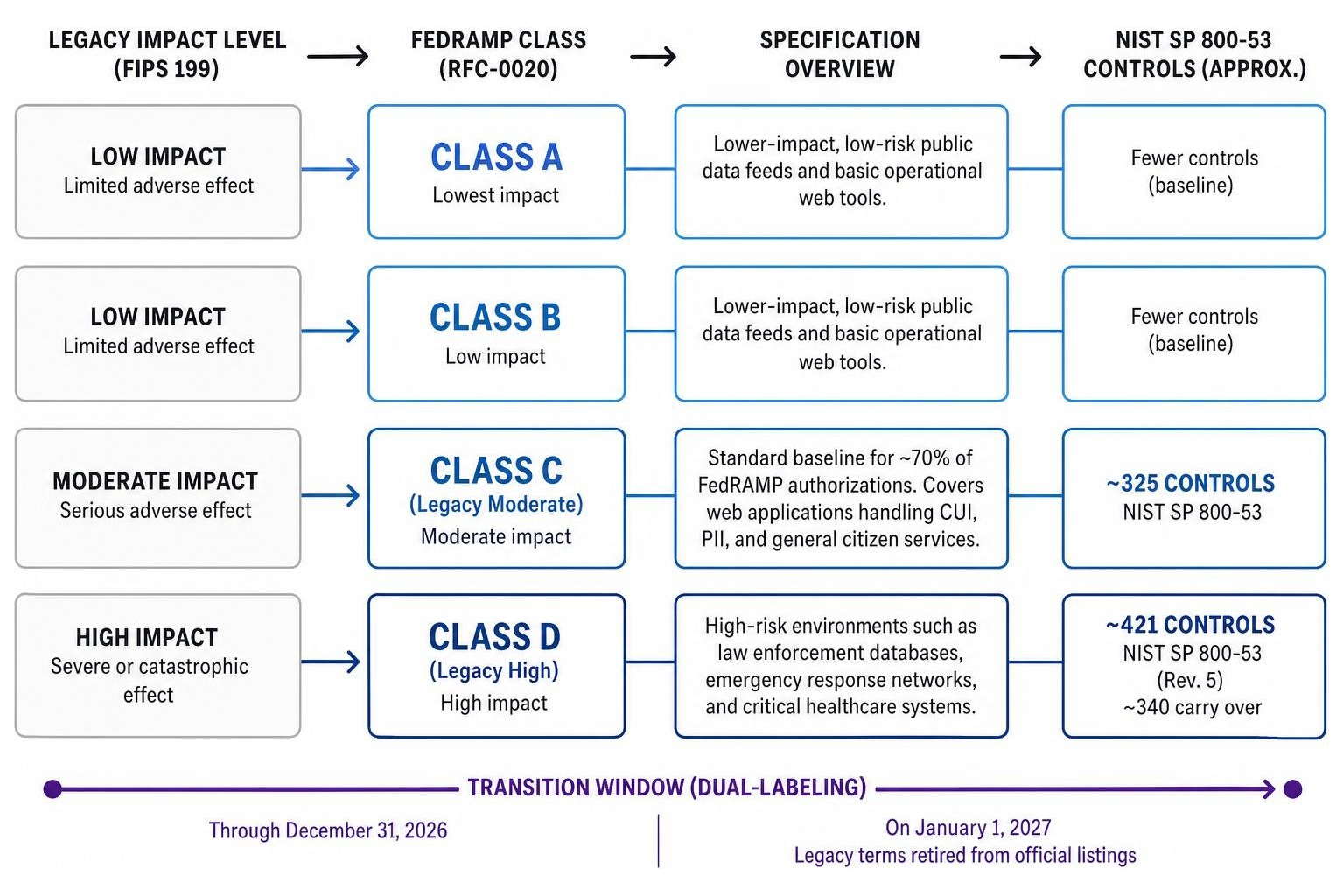
To modernize package evaluation and streamline technical reviews, the program established package specifications based on RFC-0020, replacing legacy impact levels with a new framework: Classes A through D.
During the ongoing transition window, public records and vendor matrices list legacy impact levels in parentheses alongside new Class designations. This dual-labeling policy remains active through December 31, 2026. On January 1, 2027, the transition becomes fully enforced, and legacy terms like “Moderate” and “High” will be retired from official marketplace listings.
Mapping Legacy Baselines to New Class Specifications
Understanding how historical security baselines align with the new Class architecture is vital when drafting compliance documentation or procurement contracts:
- Class A & Class B Specifications: Align with lower-impact, low-risk public data feeds and basic operational web tools.
- Class C Specification (Legacy Moderate Baseline): Represents the standard baseline for approximately 70% of all FedRAMP authorizations. Class C encompasses roughly 325 NIST SP 800-53 security controls and covers web applications handling Controlled Unclassified Information (CUI), Personally Identifiable Information (PII), and general citizen services.
- Class D Specification (Legacy High Baseline): Covers high-risk environments such as law enforcement databases, emergency response networks, and critical healthcare systems. Class D mandates approximately 421 NIST SP 800-53 controls (carrying over 340 controls under NIST SP 800-53 Rev. 5).
Core Technical Requirements for FedRAMP Web Systems
Achieving certification for fedramp compliant web hosting requires satisfying strict technical parameters across infrastructure, operating systems, and web application layers. The primary foundation of this effort is the System Security Plan (SSP)—an extensive document detailing how every security control is implemented. For a Moderate/Class C workload, an SSP routinely spans several hundred pages.
Key technical requirements across the web hosting stack include:
- Independent Assessments: Every implementation must be audited by an accredited Third-Party Assessment Organization (3PAO) before submitting the package for certification.
- Cryptographic Enforced Encryption: Encryption of data at rest and in transit must utilize FIPS 140-2 or 140-3 validated cryptographic modules. Weak or deprecated ciphers, such as 3DES, must be disabled in alignment with NIST SP 800-131A Rev. 2.
- Web Application Firewalls (WAF): Real-time inspection of inbound web traffic to prevent SQL injection, cross-site scripting (XSS), and distributed denial-of-service (DDoS) attacks.
- Role-Based Access Control (RBAC): Strict access control with mandatory multi-factor authentication (MFA) using FIPS-compliant hardware tokens for administrative access.
CMS application security represents another crucial layer. Industry security research reveals that the vast majority of WordPress vulnerabilities originate from third-party plugins rather than core application software. Because a typical federal web property runs dozens of plugins, automated vulnerability scanning, rapid patching pipelines, and strict plugin governance are essential. To learn how front-end architecture intersects with these security parameters, read our article on Secure by Design: Best Practices for FedRAMP Compliance Web Design.
Control Inheritance in Infrastructure and PaaS Platforms
Building a compliant cloud stack entirely from scratch is costly and time-consuming. Organizations attempting to build infrastructure from zero face substantial financial investments and extended development timelines before launching a single system live.
Control inheritance provides a practical solution. By deploying web applications on an established, pre-certified Infrastructure as a Service (IaaS) or Platform as a Service (PaaS) host, you inherit the underlying physical, environmental, and network controls directly from that provider.
When hosting on a certified PaaS platform, organizations can inherit a substantial majority of the required security controls. This significantly reduces the Authority to Operate (ATO) documentation burden, allowing teams to focus on application-layer controls rather than physical data center security. Specialized infrastructure providers such as DataBank Government Cloud Solutions illustrate how inherited PaaS controls streamline compliance boundaries for public-sector workloads.
Authorization Paths, Timelines, and Cost Structures
Cloud service providers seeking certification generally pursue one of two primary pathways: Agency Authorization or Joint Authorization Board (JAB) Authorization. While both result in a valid certification, they differ in timeline, cost, and oversight structure.
- Agency Authorization Path: The cloud provider partners with a specific federal agency sponsor. The agency reviews the 3PAO assessment package, issues an initial Authority to Operate (ATO), and submits the package to the FedRAMP Program Management Office (PMO) for certification. This process typically takes several months and incurs notable initial compliance costs.
- JAB Authorization Path: The Joint Authorization Board (comprising CIOs from the DoD, DHS, and GSA) selects a limited number of high-demand cloud offerings annually to receive a Provisional Authority to Operate (P-ATO). This pathway involves broader oversight and a longer review cycle, with substantial initial compliance investments.
| Consideration | Agency Authorization Path | JAB Authorization Path |
|---|---|---|
| Sponsoring Entity | Individual Federal Agency | Joint Authorization Board (DoD, DHS, GSA) |
| Primary Artifact | Agency ATO | Provisional ATO (P-ATO) |
| Typical Timeline | Standard Review Timeline | Extended Review Timeline |
| Initial Cost Range | Agency-partnered investment | High-volume multi-agency investment |
| Best Suited For | Specific agency contract requirements | Broad, multi-agency commercial SaaS tools |
The 5-Phase FedRAMP Compliance Lifecycle
Obtaining and maintaining certification follows a structured, five-phase operational lifecycle:
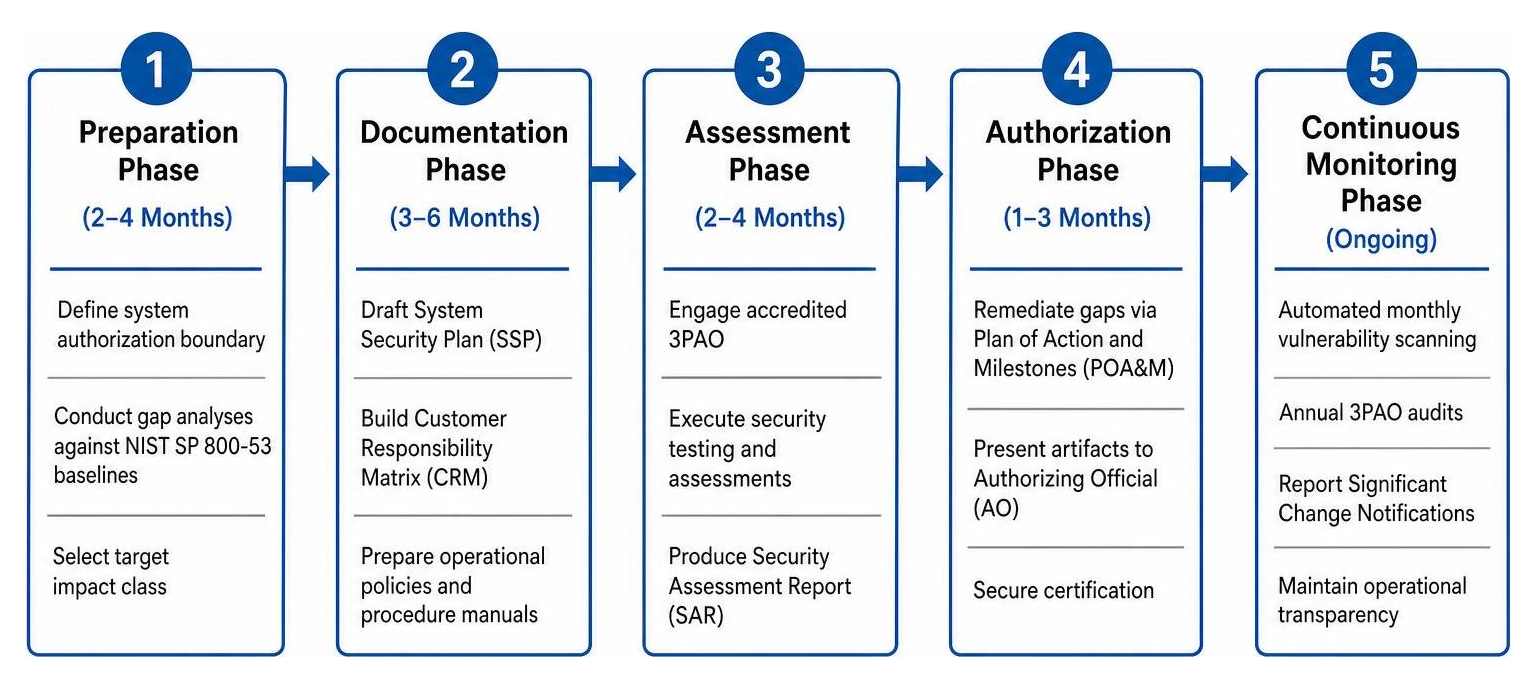
- Preparation Phase: Define the system authorization boundary, conduct gap analyses against NIST SP 800-53 baselines, and select the target impact class.
- Documentation Phase: Draft the System Security Plan (SSP), build the Customer Responsibility Matrix (CRM), and prepare operational policies and procedure manuals.
- Assessment Phase: Engage an accredited 3PAO to execute full-scale security testing, vulnerability scanning, penetration testing, and produce the final Security Assessment Report (SAR).
- Authorization Phase: Remediate identified security gaps via a Plan of Action and Milestones (POA&M), present artifacts to the Authorizing Official (AO), and secure certification.
- Continuous Monitoring Phase (Ongoing): Perform automated monthly vulnerability scanning, submit annual 3PAO audits, report material infrastructure updates via Significant Change Notifications, and maintain operational transparency throughout the system lifetime.
How to Evaluate and Select FedRAMP Compliant Web Hosting Providers

Evaluating potential hosting vendors requires looking beyond a marketing badge. Buyers must verify candidate platforms directly on the official database via the FedRAMP Marketplace Products Directory. The marketplace indexes hundreds of authorized cloud solutions, providing exact package IDs, authorization boundaries, and sponsoring agency details.
When comparing hosting architecture, consider the financial and operational structure of candidate offerings:
- Consumption Billing vs. Fixed Pricing: Raw hyper-scaler IaaS billing (such as standard public cloud compute and storage) can fluctuate monthly due to data egress, API calls, and transaction volume. Certain specialized providers offer bundled, fixed monthly subscriptions that combine compute, security tools, and compliance management into predictable operating costs.
- Managed Application Layer Support: Standard IaaS hosts manage physical hardware and hypervisors, leaving OS patching, runtime updates, and database hardening to your team. Managed federal web hosts assume responsibility up through the middleware and CMS layers.
- Patch Management SLAs: Verify provider patching timelines. Under standard federal frameworks, critical Known Exploited Vulnerabilities (KEVs) must be remediated in production environments within strict mandatory deadlines.
For broader context on structural differences across hosting models, consult our in-depth guide to managed hosting.
Technical Criteria for FedRAMP Compliant Web Hosting Environments
Federal web hosting options fall into two main deployment patterns: hyperscale cloud providers and fully managed government cloud platforms.
Hyperscale providers—such as Amazon Web Services FedRAMP Compliance Solutions and Google Cloud Assured Workloads—offer scalable infrastructure using dedicated physical regions (like AWS GovCloud) or logical software-defined boundaries. These platforms provide raw building blocks, requiring your engineering team to configure security controls, execute operating system hardening using DISA STIG standards, and manage ongoing monitoring tools.
Alternatively, bundled platforms such as the GovDataHosting Cloud Platform integrate IaaS infrastructure, Security-as-a-Service (SECaaS), 24/7 U.S.-based Security Operations Center (SOC) monitoring, and pre-populated SSP documentation into a single solution.
To evaluate cloud deployment architectures for your project, review our breakdown on what cloud hosting is and how it works.
Frequently Asked Questions About FedRAMP Web Hosting
How does control inheritance simplify the ATO process for web hosting?
Control inheritance allows a web application owner to adopt the pre-verified security controls of an underlying certified cloud host. By deploying on an authorized IaaS or PaaS platform, physical security, network perimeter defenses, data center environmental controls, and core hardware maintenance are addressed by the provider within its authorization boundary. The application team still needs to document and test its own application-level security responsibilities, but inherited controls can substantially reduce the SSP documentation workload.
What is the deadline for transitioning from legacy impact levels to Classes A-D?
The formal transition timeline established by the Program Management Office extends through December 31, 2026. During this period, legacy designations (Low, Moderate, High) may appear alongside Classes A through D in documentation. On January 1, 2027, legacy impact level terms will be fully retired from official marketplace listings and certification packages.
Why can’t standard commercial web hosts be used for federal websites?
Standard commercial hosting platforms lack the mandatory technical controls, FIPS-validated encryption modules, DISA STIG server hardening, and independent 3PAO assessments required under federal law. Furthermore, commercial web hosts typically do not execute continuous monitoring reporting or sign formal Customer Responsibility Matrices, putting federal agencies and prime contractors at risk of compliance violations and audit failures.
Building a Compliant Digital Strategy

Deploying a government-facing website requires aligning software code, plugins, content workflows, and infrastructure with federal security standards. Achieving certification for fedramp compliant web hosting is not a one-time setup–it is an ongoing operational commitment that involves active monitoring, patching, and compliance reporting.
At CreatiVertical, we help government contractors, technology vendors, and public-sector organizations build performant, highly visible digital platforms designed for secure compliance frameworks. From secure front-end web design and CMS architecture to long-term maintenance, our team helps support your digital security, compliance, and search visibility efforts.
To learn how we support ongoing technical operations and platform maintenance, explore our services for website maintenance and support in Kansas City or get in touch with our team today to discuss your project requirements.