
How Industrial Lubricant Suppliers Can Reach Technical Buyers
To improve organic visibility, build pages around what buyers need to specify, not just broad terms like “industrial lubricants.” Give each product an easy-to-find page with its viscosity grade, applications, approvals, packaging, and technical and safety documents. Then connect those pages to application guides and regional distributor information. Make the catalog fast, mobile-friendly, and easy for search engines to crawl.
An engineer may search by machine, operating condition, or required standard before asking for a quote. Your site should help them check fit at each step.
I’m Nicholas Cunha, founder of CreatiVertical, and I work hands-on in web development, SEO, and AI search for industrial and B2B clients. My approach to industrial lubricant supplier SEO draws on more than 20 years of agency work and a focus on making technical websites useful to buyers.

Industrial lubricant supplier SEO definitions:
Core Technical Architecture for Industrial Lubricant Supplier SEO
Industrial websites often handle thousands of distinct part numbers, complex fluid formulations, and heavy documentation libraries. When plant managers and reliability engineers pull up a product page on a tablet in the middle of a noisy factory floor, a slow or clunky interface ruins the experience. Building on modern web architecture for high-tolerance industrial manufacturers ensures your technical catalog loads instantly, passes Core Web Vitals, and feeds search engines clean, structured data.

To capture serious B2B traffic, server-rendered page architecture is far superior to client-side JavaScript rendering. Search engine bots can read specifications, viscosity indices, and compatibility charts immediately without waiting for heavy scripts to execute. Pairing a modern frontend with cloud-hosted file storage (like Amazon S3) lets you serve large Safety Data Sheets (SDS) and Technical Data Sheets (TDS) without dragging down your main server speed. Understanding how to design an industrial website that actually drives leads means structuring the entire technical environment so both human procurement specialists and search crawlers find answers without friction.
Schema Markup and Product Data Structuring
Search engines rely on structured data to decode the exact engineering properties of your fluids. By deploying detailed JSON-LD schema across your product catalog, you transform plain web text into machine-readable technical attributes:
- Product Schema: Embed exact properties such as viscosity index, flash point, pour point, base oil group (Group I through Group V), and packaging units (from 5-gallon pails to 275-gallon IBC totes).
- TechnicalArticle Schema: Structure in-depth oil analysis guides, lubrication schedules, and fluid changeover protocols so search engines index them as authoritative engineering resources.
- Compliance and Standard Arrays: Detail official API service categories (such as CK-4 or SP), ACEA European performance sequences (such as E8 or A7/B7), and ISO viscosity grades (ISO VG 32, 46, 68, 220).
Catalog Hierarchy and Safety Data Sheet (SDS) Management
A disorganized product hierarchy dilutes domain authority and creates crawl errors. Group your catalog logically:
- Primary Fluid Categories (e.g., Hydraulic Fluids, Industrial Gear Oils, Metalworking Fluids, Greases)
- Base Oil Subcategories (e.g., Mineral-Based, Synthetic PAO, PAG, Bio-Based)
- Application Tiers (e.g., Food Processing NSF H1, High-Temperature Heavy Equipment, Rust Preventives)
- Individual SKU Pages (Specific formulations with downloadable documentation)
Integrating enterprise website development practices for scalable infrastructure keeps your crawl depth shallow so important SKU pages remain three clicks or fewer from the home page. House your SDS and TDS documents on dedicated HTML product pages with direct download links rather than burying them in unindexed database queries or raw folders.
High-Intent B2B Keyword Strategy and Specifier Content

General consumer keywords like “best motor oil” attract hobbyists, not procurement professionals buying 55-gallon drums for an assembly plant. Effective B2B search visibility relies on understanding the buyer journey for search engine optimization. Plant specifiers search by operating conditions, equipment types, and OEM manufacturer tolerances.
Executing Keyword Mapping for Industrial Lubricant Supplier SEO
Plant engineers search using exact operational language. Your keyword map must mirror the precise queries used during plant maintenance planning, fluid consolidation projects, and equipment overhaul cycles.
| High-Intent Specification Query | Target Buyer Role | Key On-Page Content Required | Search Intent Stage |
|---|---|---|---|
| ISO VG 46 anti-wear hydraulic oil bulk supply | Plant Maintenance Director | Viscosity table, anti-wear additive pack data, tote pricing, lead times | Commercial / Procurement |
| NSF H1 food grade grease for high-temp bearings | Quality Assurance / Plant Engineer | FDA 21 CFR compliance, dropping point, wash-out resistance specs | High-Spec Selection |
| Water-soluble cutting fluid for CNC aluminum machining | Machine Shop Superintendent | Dilution ratios, sump life data, biocide profile, SDS download | Application Matching |
| Synthetic open gear lubricant heavy mining equipment | Reliability Engineer | AGMA classification, load carrying capacity (Four-Ball Weld) | Technical Specification |
Developing High-Value Technical Assets and Application Guides
Brochure-style websites do not rank well for high-spec engineering terms because they lack depth. High-performing suppliers build comprehensive technical resources that solve real-world machinery issues:
- Machinery-Specific Application Guides: Create detailed walkthroughs for specialized systems, such as plastic injection molding hydraulic maintenance or food processing conveyor gearboxes.
- Fluid Compatibility & Conversion Charts: Help engineers safely switch base oils without causing seal swelling, additive drop-out, or filter clogging.
- Regulatory & Food-Grade Compliance Breakdowns: Provide clear summaries explaining NSF H1 vs. H2 distinctions, Halal/Kosher manufacturing certificates, and REACH compliance.
Real-world performance demonstrates that in-depth, specifier-focused content takes consistent execution. In an external 12-month B2B campaign analyzed in a JJSEO industrial oil case study, an industrial fluid specialist achieved a 49.68% increase in organic users and a 50.12% rise in active users by consistently publishing technical application guides and restructuring product data. Traffic surged significantly during Q4 maintenance procurement cycles after search engines fully indexed the technical assets.
Regional Authority, Local SEO, and Industrial Backlink Acquisition

Industrial lubricants are heavy, expensive to transport, and often needed on short notice to avoid unplanned line shutdowns. Consequently, regional proximity plays a massive role in supplier selection. Plant buyers regularly filter their vendor searches to distributors capable of providing same-day drum delivery or emergency bulk pump-offs.
Local Search Optimization for Regional Distribution Corridors
To dominate regional manufacturing hubs, structure your digital footprint to emphasize local distribution networks:
- Warehouse and Hub Landing Pages: If you operate facilities or primary distribution networks across regional industrial areas, create unique landing pages for each hub detailing local stock holding, bulk terminal delivery capabilities, and emergency response times.
- Google Business Profile Optimization: Claim and verify every physical distribution facility. Ensure accurate primary categories (such as Industrial Equipment Supplier or Lubricant Supplier) and maintain consistent Name, Address, and Phone (NAP) details.
- Proximity and “Near Me” Query Targeting: Implement our proven strategies on how to rank for near me searches and win local customers to capture operations managers looking for immediate local inventory.
- Competitive Regional Analysis: Use a step-by-step guide to local SEO competitor analysis to evaluate how regional competitors rank for localized supply terms.
Building Authoritative Niche Backlinks in Heavy Industry
Search engines measure domain trust through authoritative, industry-relevant links. Avoid generic link-buying schemes and focus on established industrial directories and trade references:
- Major Industrial Directories: Secure verified company profiles on established platforms like the ThomasNet industrial lubricant supplier index and the IQS Directory lubricating grease manufacturer listings.
- OEM Partnerships & Distributor Listings: Obtain supplier links from the fluid and base-stock manufacturers you distribute (e.g., Shell, Mobil, Chevron, or specialized private-label blenders).
- Trade Association Memberships: Gain backlinks from organizations such as the Society of Tribologists and Lubrication Engineers (STLE), the National Lubricating Grease Institute (NLGI), and regional manufacturing councils.
- Profile Audits: Conduct regular reviews using our guide to a painless backlink profile audit to disavow spammy domains and preserve your technical search standing.
AI Search Optimization and Seasonal Purchasing Cycles
The search landscape is changing rapidly. Maintenance directors and procurement officers increasingly use large language models and answer engines like ChatGPT, Microsoft Copilot, and Perplexity to identify direct fluid equivalents, cross-reference obsolete MIL-SPEC numbers, and locate compliant regional suppliers.
Optimizing for AI-Driven Search and Industrial Recommendation Engines
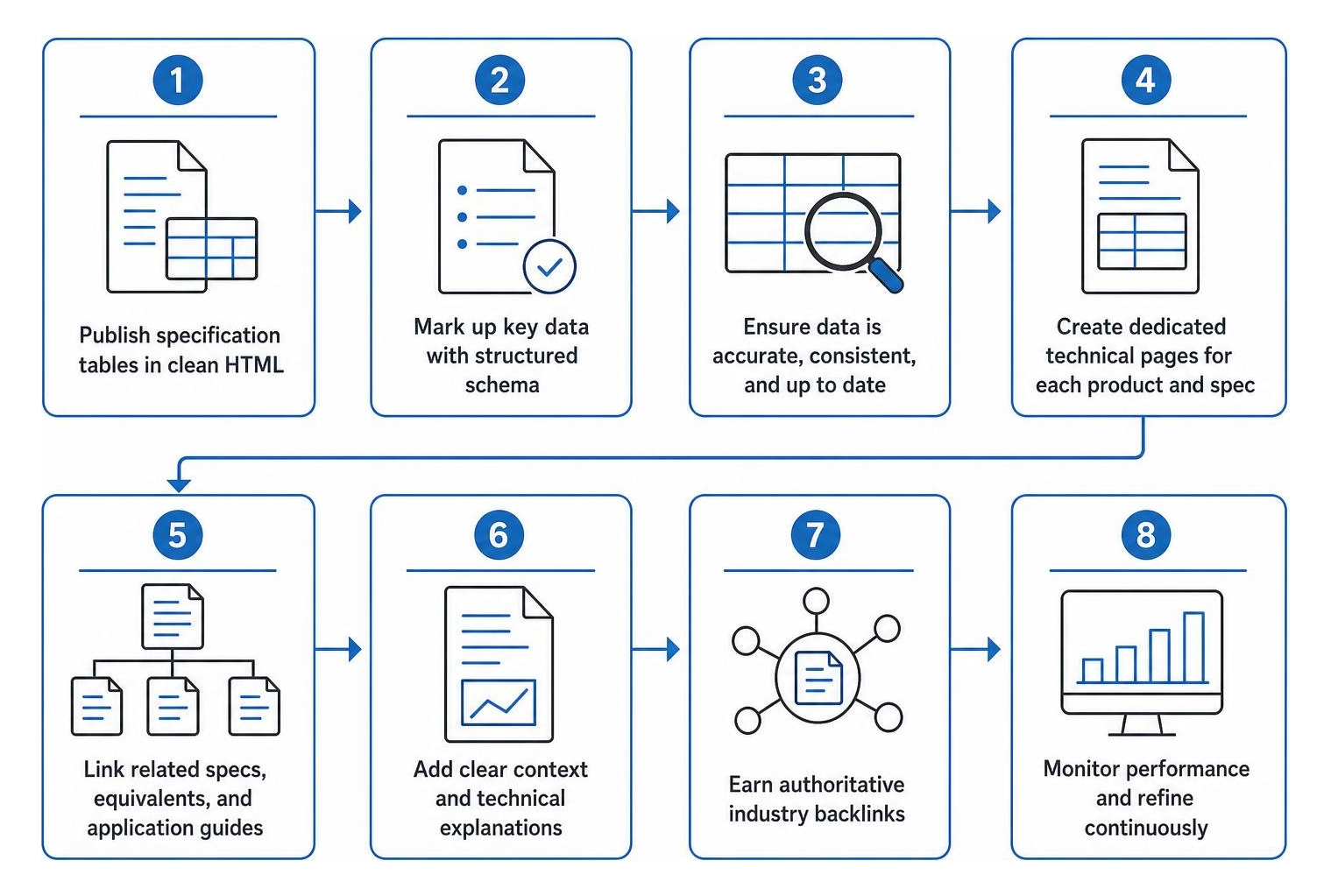
Generative engines do not read websites like traditional scrapers; they parse semantic entities, structured tables, and clear technical assertions. To get your brand recommended in AI-synthesized answers:
- Publish Plain-Text Specification Tables: Place raw kinematic viscosity (cSt at 40°C and 100°C), viscosity index, density, and 4-ball wear test results in clean HTML
elements rather than burying them inside unformatted PDF flyers.
- Direct OEM Equivalent Mapping: Include explicit comparison language on product pages (e.g., “Formulated as a direct functional alternative to ISO VG 68 anti-wear hydraulic oils meeting Parker Hannifin HF-0 specifications”).
- Deploy Generative Search Visibility Tools: Track your citations across LLMs using the ultimate tools to keep your brand visible across AI search platforms and evaluate performance trends with our comprehensive guide to AI search optimization tools.
Measuring Long-Term ROI from Industrial Lubricant Supplier SEO
Industrial SEO does not behave like direct-to-consumer marketing. Procurement cycles take months, and traffic volumes are naturally lower but carry high commercial value.
- Traction Timelines: Expect comprehensive technical guides and restructured product catalogs to take 3 to 6 months to establish organic indexation and build domain authority.
- Q4 Purchasing Surges: Heavy industry consistently experiences seasonal procurement spikes in the fourth quarter. Plants utilize remaining annual capital budgets, stock up for scheduled holiday maintenance shutdowns, and negotiate annual fluid supply agreements.
- Tracking Qualified RFQs: Monitor technical inquiries, SDS downloads, and Request for Quote (RFQ) submissions using the best performance SEO reporting tools to connect search traffic directly to commercial pipeline growth.
Regarding investment, monthly SEO retainers across the B2B industrial sector commonly run from a few hundred to several thousand dollars per month depending on catalog size, technical scope, and regional competition.
Frequently Asked Questions About Industrial Lubricant SEO
Why does technical B2B content take 3 to 6 months to rank for industrial lubricants?
Search algorithms require time to crawl, test, and validate deep technical content against existing authoritative sources. In heavy industry, search engines look for strong signals of technical accuracy, domain history, consistent citation across industrial directories, and user engagement with complex specification sheets before awarding top rankings.
How should lubricant manufacturers handle downloadable SDS and TDS files for SEO?
Do not rely exclusively on standalone PDF files. Instead, create dedicated, crawlable HTML product pages containing the core product descriptions, viscosity tables, and compliance badges in live text. Then, provide clearly marked download links to the PDF versions of the SDS and TDS hosted on fast cloud storage. Add structured metadata so search engines understand the direct relationship between the webpage and the PDF documents.
What is the biggest SEO mistake made by industrial fluid distributors?
The most frequent mistake is publishing thin, generic product pages that only list a brand name and a short marketing paragraph while leaving out essential engineering data. When pages omit critical details like ISO viscosity grades, base oil composition, OEM approvals, and operating temperature ranges, engineers quickly bounce back to the search results to find a supplier that provides complete technical specifications.
Conclusion
Winning high-value supply contracts requires building a digital presence that reflects the precision of your fluids. When plant engineers, procurement managers, and machine operators search for lubricants that meet exact OEM tolerances, your site must deliver instant, authoritative technical data. By combining solid server-rendered web architecture, detailed JSON-LD schema, rigorous specifier content, and strong regional local SEO, your company can build a predictable pipeline of qualified commercial inquiries.
At CreatiVertical, we work as an ongoing growth partner for industrial manufacturers, chemical suppliers, and equipment brands. We design, build, and optimize end-to-end digital systems that turn technical specifications into measurable business growth. Explore our approach to custom industrial website development and digital systems to start building your technical search authority.