

Why Most Industrial Websites Fail to Generate Leads (And What to Do About It)
B2B technical products web design is one of the most under-invested areas in industrial marketing — and it’s costing manufacturers real revenue.
Here’s what effective industrial website design looks like in 2026:
| Element | What It Means in Practice |
|---|---|
| Clear product architecture | Specs, certifications, and CAD files within 3 clicks |
| Persona-aware content | Separate paths for engineers, procurement, and C-suite |
| Trust signals | ISO certs, tolerances, case studies — shown as data, not promises |
| Fast load times | Under 2 seconds; slow pages lose procurement visitors fast |
| RFQ/lead capture | Frictionless quote forms and gated resource downloads |
| AI-ready structure | Clean heading hierarchy so Gemini and Perplexity can cite you |
| Interactive visuals | 3D models, scrollytelling, hover animations for complex products |
Most industrial companies build great products. Their websites, though, tell a different story.
According to research by TREW Marketing, 82% of engineers begin their purchasing research directly on supplier and manufacturer websites. That means your site isn’t just a brochure — it’s often the first and most important touchpoint in the entire sales cycle.
And yet, most industrial websites are hard to navigate, slow to load, and written for no one in particular. Procurement officers and engineers arrive looking for specific data — tolerances, certifications, material grades, lead times — and leave within 90 seconds when they can’t find it. That’s not a product problem. It’s a design problem.
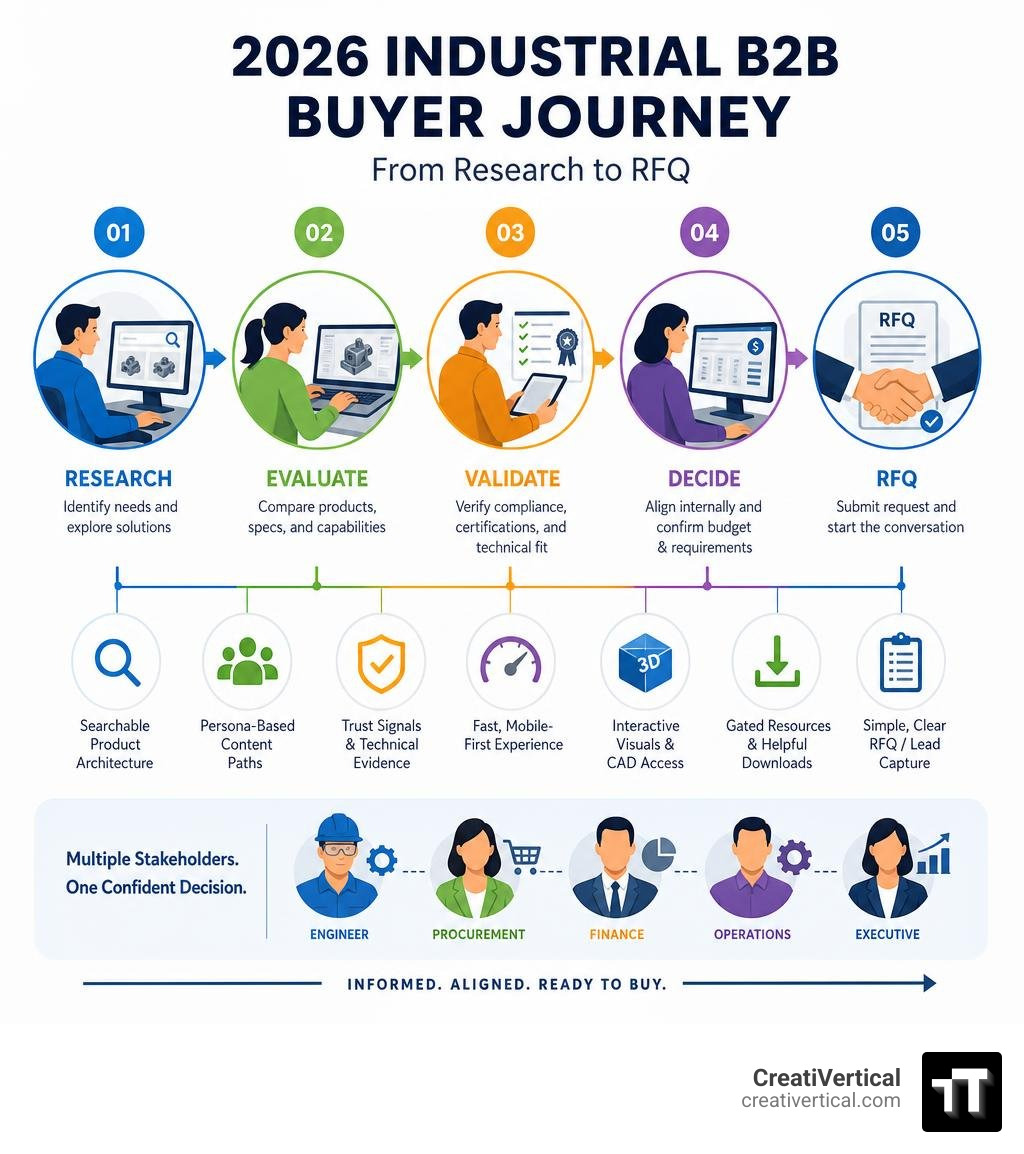
The stakes are high. B2B buying decisions are rarely made by one person. Groups of six to ten stakeholders typically research independently before reaching consensus, and 77% of B2B buyers describe the purchasing process as very complex or difficult. A website that can’t guide each of those stakeholders to the right information at the right time isn’t just underperforming — it’s actively losing deals.
This guide walks through exactly how to design an industrial website that earns trust, communicates technical depth, and converts qualified visitors into real inquiries.
I’m Nicholas Cunha, founder of CreatiVertical, and I’ve spent over twenty years building websites for industrial manufacturers, government institutions, and B2B service providers — the kind of clients where B2B technical products web design has to work as hard as the products themselves. In the sections ahead, I’ll share the frameworks and design decisions that actually move the needle for procurement-driven buyers.
B2B vs. B2C: Why Technical Product UX Requires a Different Blueprint
Designing a website for highly engineered components, industrial lubricants, or custom battery systems is fundamentally different from building a retail storefront. In the B2C world, the goal is often to spark an emotional impulse, minimize the steps to checkout, and secure an immediate transaction.
In B2B industrial sales, nobody buys a $100,000 CNC milling machine or a bulk chemical contract on an impulse. The sales cycle is measured in months, not minutes.

To build a high-performing digital system, we must first understand how these two worlds diverge. We often integrate specialized E-commerce Web Design strategies into our industrial projects, but the user experience (UX) blueprint remains highly distinct.

| UX Dimension | B2C Consumer UX | B2B Technical Buyer UX |
|---|---|---|
| Primary Audience | Single consumer seeking personal satisfaction | Multi-member buying groups (Engineers, Procurement, C-Suite) |
| Buying Motivation | Emotional, convenience, or lifestyle-driven | Risk mitigation, technical compliance, operational efficiency |
| Information Density | Minimalist, lifestyle photography, brief descriptions | High density, spec sheets, CAD models, tolerance limits |
| Conversion Action | Direct online purchase (Add to Cart) | Request for Quote (RFQ), custom specification, direct sales contact |
| Pricing Model | Fixed, transparent, identical for everyone | Tiered, volume-based, custom-quoted, or contract-specific |
If you are looking to build a platform that matches these strict B2B demands, partnering with a firm that understands these differences is essential. Our team provides specialized professional web design services in Kansas City that bridge the gap between high-level engineering data and user-friendly digital layouts.
Designing for the Multi-Stakeholder Buying Journey
A successful industrial website cannot speak to just one person. It must accommodate a committee. When we design websites for precision manufacturers, we map out distinct pathways for the three primary stakeholders who visit your site:
- The Engineer: This user is looking for hard numbers. They want to know if your component can withstand 500°C, if you support STEP files, and what your exact tolerances are. If you hide this data behind a “Contact Us” form, they will leave and find a competitor who displays it openly.
- The Procurement Officer: This visitor is focused on risk and logistics. Can you scale production to 100,000 units? Do you hold AS9100 or ISO 9001 certifications? What are your typical lead times? They need quick access to your capabilities deck and certification records.
- The C-Suite Executive: This stakeholder cares about business outcomes, ROI, and long-term viability. They want to see proof that you have solved similar problems for other industry leaders. They look for case studies, financial stability, and long-term support agreements.
To keep these diverse users engaged over a long buying cycle, we use structural patterns like sticky menus and grid layouts. Sticky menus ensure that no matter how deep an engineer scrolls down a technical spec page, they are always one click away from downloading a CAD drawing or initiating an RFQ. Grid layouts allow us to present dense, multi-faceted product lines in clean, digestible matrices, preventing the visual complexity that often makes industrial sites feel dated and overwhelming.
When evaluating options, understanding how modern agencies structure these complex user journeys can give you a clearer picture of what to expect. If you are exploring regional partners, benchmarking capabilities against established industry standards ensures you find a team that can handle both technical depth and user experience.
Balancing Technical Depth with Scannability in B2B Technical Products Web Design
One of the greatest challenges in B2B technical products web design is balancing technical depth with scannability. Some marketing agencies will tell you to strip out all industry jargon to make the copy “accessible.”
In the industrial sector, this is a mistake. Procurement engineers evaluate cutting tools, custom electronics, and industrial pumps by the numbers. If your copy is too generic, you lose credibility.
The secret lies in organizing information hierarchically through robust website development. We use a progressive disclosure model: lead with a clear, benefit-driven value proposition that any executive can understand, then follow with a scannable grid of key performance metrics, and finally, offer expandable tabs or dropdowns containing the highly detailed engineering data. This keeps the page visually clean while preserving the deep technical specifications that engineers require to champion your product internally.
For businesses looking to implement this balance across midwest operations, collaborating with a dedicated regional agency can help ensure your technical narrative is structured correctly for both local and global audiences.
Core Pillars of B2B Technical Products Web Design in 2026
As we navigate 2026, the visual and functional standards for industrial websites have evolved. Visually complex websites are rated as “less beautiful” and harder to trust than websites with simpler, straightforward designs. Today’s industrial buyers expect a clean, modern interface that functions with the speed and precision of a high-end application.
To meet these expectations, we design around three core pillars: visual simplicity, rapid access to data, and interactive storytelling. We call this a “Data Command” visual identity. It uses deep, functional tones, high-contrast layouts, and intentional accents to highlight key data points and action items without creating unnecessary visual noise.
Interactive Visuals and 3D Product Modeling
Static, low-resolution product photos no longer cut it. When buyers are sourcing high-ticket custom components, they need to verify form, fit, and function before they ever reach out to your sales team.
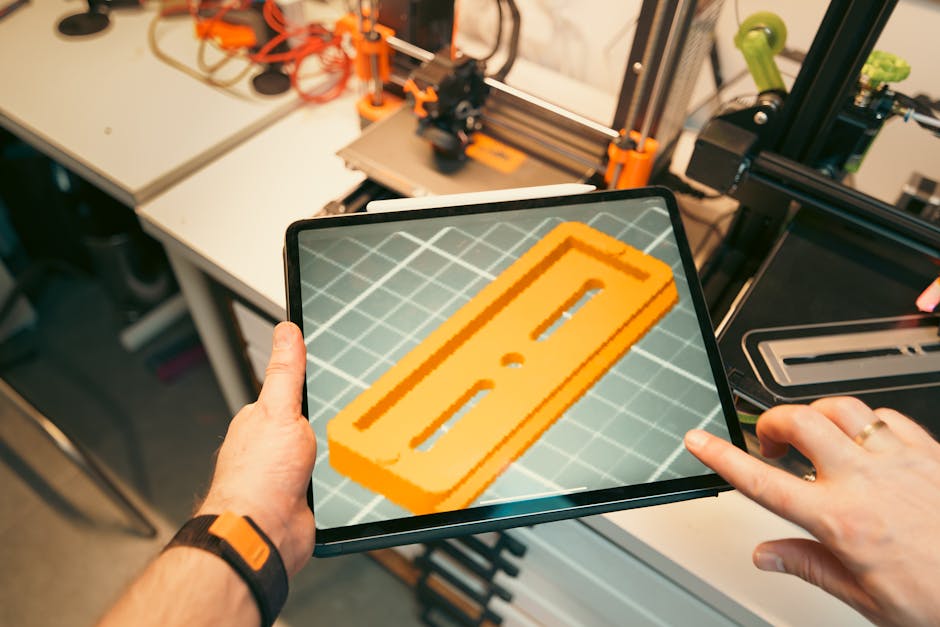
Integrating interactive 3D product models directly into your website is one of the most effective ways to build immediate trust. By allowing visitors to rotate, zoom, and dissect a 3D rendering of a complex valve or custom battery housing, you eliminate guesswork.
This interactive approach is especially critical for advanced platforms like Product Lifecycle Management (PLM) software or complex machinery. For instance, the Vox – Intelligent PLM Landing Page Template | Build Fully Functional Applications with Rocket demonstrates how interactive data grids and simulated command-and-response interfaces can help technical buyers experience a product’s capabilities in real time, even on locked-down corporate networks where software downloads are restricted.
Scrollytelling and Motion Graphics for Complex Systems
How do you explain a multi-stage industrial filtration process or a complex automated assembly line without putting your reader to sleep? You use scrollytelling.
Scrollytelling is a web design technique where visual elements (such as 3D models, exploded diagrams, or flow charts) animate dynamically as the user scrolls down the page. Instead of dumping a massive paragraph of text next to a static image, the website guides the user through a step-by-step narrative.
For example, as you scroll, a custom industrial pump might slowly disassemble itself on screen, highlighting the ceramic seals, the impeller design, and the smart sensor housing in sequence.
The key here is restraint. Animations should never be purely decorative or distracting. We focus on subtle, purposeful motion graphics and hover effects that respond directly to the user’s actions. This approach is highly visible in modern frameworks like the Smart Industrial Document System Landing Page Template, which uses scroll-reveal animations and interactive terminal elements to demonstrate AI-powered document parsing without overwhelming the visitor with static walls of text.
Anatomy of a High-Converting Technical Product Page
Your homepage exists to route visitors to the right place; your product pages exist to convert them. A high-converting industrial product page is structured like an engineered spec-sheet document, designed to answer every question a procurement team might ask before they think to ask it.
We design our product pages around a five-part narrative flow:
- The Hero Section: A high-resolution, head-on visual of the product paired with a clear, performance-focused headline (e.g., “High-Yield Coated End Mills for Aerospace Alloys”).
- The Performance Matrix: A clean, grid-based layout showing the critical operating limits, material compatibility, and key certifications at a glance.
- The Interactive Explorer: A 3D viewer or an exploded interactive diagram allowing the user to examine the internal engineering of the product.
- Validation and Proof: Real-world case studies, customer testimonials, and specific performance data demonstrating the product in action.
- The Next Steps (CTAs): Dual conversion paths that offer both a direct RFQ path and a low-friction resource download.
For precision tooling and manufacturing lines, organizing this information cleanly is paramount. You can see this spec-sheet approach in action on templates like the Tool & Die Making Careers & Recruitment Website Template | Rocket, which is built specifically to display high-density technical data, tolerances, and custom tooling capabilities for aerospace and defense machine shops.
Spec Sheets, CAD Downloads, and Trust Validation
For an engineer, a CAD drawing is worth a thousand marketing brochures. If your website makes it easy for an engineer to download a STEP, IGES, or SolidWorks file of your product, you have just removed the single largest barrier to being designed into their project.
Alongside CAD files, your product pages must prominently feature your trust signals. In the industrial sector, trust isn’t built with generic promises; it is built with verifiable data. Your pages should clearly highlight:
- Certifications: ISO 9001, AS9100, ISO 13485, or Mil-Spec compliance.
- Tolerances: Exact dimensional accuracy (e.g., “CMM accuracy verified to ±2 micrometers”).
- Material Grades: Complete lists of supported materials, resins, or chemical compositions.
This data-first approach is highly evident in the Fabricore – Consumer Goods OEM Supplier Landing Page Template, which organizes dense manufacturing capabilities, material lists, and certifications into a hub-and-spoke anchor navigation structure, making it easy for procurement teams to benchmark suppliers in seconds.
Lead Generation and Gated Resources in B2B Technical Products Web Design
Not every visitor is ready to submit an RFQ on their first visit. Many are in the early research phase, comparing multiple potential suppliers. To capture these high-value leads, your website must offer a dual-conversion architecture.
- Primary CTA (High-Intent): A prominent “Request a Quote” or “Submit RFQ” button. This form should be highly optimized, collecting only essential project details (such as estimated annual volume, product category, and a CAD drawing upload field).
- Secondary CTA (Low-Intent): A gated technical resource, such as a comprehensive material selection guide, a capabilities deck, or an engineering white paper. This allows you to capture the contact information of researchers who are still benchmarking options.
By pairing these two paths, you ensure that you capture leads at all stages of the buying journey. If you need help structuring these conversion funnels, working with a specialized B2B marketing agency in Kansas City can help you design a lead-generation system that filters out unqualified inquiries while capturing high-intent opportunities.
If you’d like to visit our office to discuss your conversion strategy in person, you can easily map your route to our location at CreatiVertical, 154 Anchor Dr, Lake Tapawingo, MO 64015, US.
Engineering for the Future: AI Integration and Technical SEO
In 2026, we are no longer designing websites solely for human eyes. We are designing them for AI search engines and answer engines.
When a procurement team asks ChatGPT, Gemini, or Perplexity to “find an AS9100 certified custom battery manufacturer in the Midwest,” those AI systems do not scroll through pretty pictures. They crawl raw code, looking for structured data, semantic schema, and clear content hierarchies.
We build websites with a dual-focus strategy: traditional search engine optimization and Answer Engine Optimization (AEO). This ensures your site is technically prepared for the modern search landscape:
- Semantic HTML: Using clean heading tags (H1, H2, H3) that follow a logical hierarchy so AI crawlers can easily parse your capabilities.
- Schema Markup: Embedding detailed JSON-LD schema that explicitly defines your products, manufacturing capabilities, certifications, and service areas.
- Optimized Technical Documentation: Structuring your technical guides, PDFs, and FAQs so AI search engines can easily index and cite your content as an authoritative source.
By aligning your Technical SEO with modern Web Performance AI Integration standards, you ensure your business remains highly visible whether buyers use traditional Google search or AI-powered conversational tools. Implementing these subtle Technical Adaptation protocols early protects your digital presence from sudden shifts in search engine behavior.



Measuring and Optimizing Industrial Website Performance
A beautiful website that loads slowly is a failed investment. Nearly 70% of consumers say that page speed directly impacts their willingness to buy, and the highest conversion rates occur on pages that load in under 2 seconds.
Industrial buyers are often reviewing your site on factory floors, field tablets, or locked-down corporate networks with limited bandwidth. If your page takes 5 seconds to load because of unoptimized 3D assets or heavy video backgrounds, those buyers will click away.
We approach optimization as a continuous loop of testing and refinement:
- Performance Tuning: Compressing images, lazy-loading heavy interactive elements, and using clean, lightweight code to ensure rapid load times.
- Behavior Analytics: Using tools like heatmaps and scroll-maps to see exactly where users get stuck, where they lose interest, and which technical sections they interact with most.
- Conversion Rate Optimization (CRO): Running A/B tests on your RFQ form layouts, button placements, and copy to systematically reduce friction and increase submissions.
For midwestern manufacturers looking to build their digital foundation on a reliable, highly customizable platform, our team specializes in custom WordPress web design in Kansas City. We build custom, lightweight WordPress themes from the ground up, avoiding bloated pre-made templates to ensure your site loads fast, ranks high, and is easy for your team to update as your product lines grow.
Frequently Asked Questions about Industrial Web Design
How do we balance technical jargon with user-friendly copy?
We use a progressive disclosure layout. We place clear, high-level benefits at the top of the page for executives and non-technical decision-makers, and use expandable tabs, dropdown grids, and downloadable spec sheets below to house the raw technical data and industry-specific jargon that engineers require.
Why is page speed so critical for engineering and procurement buyers?
Engineering and procurement buyers are busy professionals who often research on mobile devices or slow corporate networks. Slow load times increase friction, drive up bounce rates, and project a lack of operational quality. Keeping your load times under 2 seconds is essential to capturing their attention.
How does AI search visibility impact our website design?
AI engines like Gemini and Perplexity cite websites that have highly structured, semantically clean content. By designing your site with clear header hierarchies, detailed schema markup, and easily crawlable technical resources, you increase the likelihood that these AI tools will recommend your business to buyers.
Conclusion
Your website is the digital storefront of your manufacturing capability. It is the place where prospects validate your expertise, evaluate your technical specs, and decide whether to invite you into their supply chain.
At CreatiVertical, we don’t just build websites — we build complete, performance-focused digital systems designed to fuel your growth. As a family-run agency in Lake Tapawingo and the Kansas City area, we act as an ongoing partner for B2B manufacturers, government contractors, and professional service providers. We handle everything from custom web development and technical SEO to AI search visibility and workflow automation.
Ready to turn your website into a high-converting lead generation engine? Explore our SEO services in Kansas City or reach out to us today to chart a new course for your digital marketing.