

How to Choose a Local Visibility Marketing Agency
Before you hire a local visibility marketing agency, ask for an audit of your Google Business Profile, website, local search results, and presence in AI search answers. Then ask what the agency would fix first and how it would measure calls, form leads, and booked work. Rankings alone won’t tell you whether the work is paying off.
A traditional SEO plan may focus on website rankings. A local visibility plan should also account for Google Maps, accurate business listings, and the facts AI tools can find about your business. The right partner will explain which of these matters most to your customers.
I’m Nicholas Cunha, founder of CreatiVertical, a family-run Kansas City agency with more than 20 years of agency and project experience. I work hands-on in web development, SEO, and AI search visibility; this guide will help you ask better questions of any local visibility marketing agency you consider.
Know your local visibility marketing agency terms:
What Is a Local Visibility Marketing Agency vs a Traditional SEO Agency?
Search discovery has fundamentally expanded. A decade ago, winning organic search meant optimizing title tags, building generic backlinks, and targeting the standard list of ten organic blue links. Today, consumer discovery is a multi-surface ecosystem. When someone in Blue Springs or Lee’s Summit searches for a specialist, they rarely click a single blue link and call it a day. They evaluate the Google Map Pack, read customer reviews, check social proof, or ask an AI assistant for a direct recommendation.
A traditional SEO agency generally limits its scope to website ranking factors: on-page keywords, backlink profiles, and domain authority. While those technical elements remain valuable, they represent only a slice of the discovery landscape. When evaluating your local business visibility across modern search, you quickly find that search intent is fragmented.
A dedicated local visibility agency builds a cohesive digital system. We coordinate your primary website, map presence, localized entity records, local directory citations, and conversational AI readiness to capture demand wherever prospects look.
| Service Capability | Traditional SEO Agency | Modern Local Visibility Agency |
|---|---|---|
| Primary Target | Nationwide/regional organic SERPs | Google Map Pack, AI answers, local organic results |
| Discovery Channels | Google and Bing organic links | Map Pack, AI Overviews, Ask Maps, ChatGPT, Apple Maps |
| Entity Strategy | Keyword-focused site content | Structured schema markup, localized entity validation, NAP data |
| Core Conversion Focus | Site visits and form fills | Direct calls, direction requests, booking actions, qualified leads |
| Reputation Handling | Often ignored or outsourced | Active review generation, sentiment tracking, response strategy |
| Technical Stack | Standard CMS, broad blog posts | Fast mobile architecture, localized service-area pages, AI FAQs |
Traditional SEO vs Generative Engine Optimization (GEO)
Traditional SEO aims to position a specific webpage URL on search engine results pages based on keyword relevance and link authority. Generative Engine Optimization (GEO), by contrast, optimizes your business entity so artificial intelligence models understand your operational facts, recognize your authority, and cite your business directly in synthesized answers.
AI answer engines do not read websites the same way traditional crawlers do. They rely heavily on entity-based extraction, looking for clear structural relationships between your service offerings, physical locations, professional certifications, and client outcomes.
Using structured data markup (such as LocalBusiness, MedicalClinic, or HomeAndConstructionBusiness schema) provides unambiguous data points that large language models ingest with high confidence. Adding schema alongside localized service pages and factual FAQ content gives search engines and AI assistants the structured context required to evaluate your business accurately. For a deeper breakdown of these tactics, explore the definitive guide to improving local online visibility.
Why Every Local Visibility Marketing Agency Must Prioritize AI Search
AI-driven discovery tools like ChatGPT, Perplexity, Google AI Overviews, and Ask Maps have shifted how consumers research local services. Instead of typing shorthand terms like “emergency plumber Lake Tapawingo,” users are increasingly asking complex conversational questions: “Which licensed contractor near me can fix a broken commercial heat pump this evening and has verified customer reviews?”
To answer these nuanced queries, AI platforms pull data from multiple interconnected sources, including Bing Places, structured on-page content, and authoritative web listings. If your agency focuses entirely on standard Google indexing while ignoring Bing Places synchronization or AI entity training, your business remains invisible across modern conversational search channels.
Core Pillars: Google Business Profile, Local Signals, and Reputation
A successful local visibility strategy rests on three interrelated pillars: verified business entities, consistent directory signals, and active reputation management.
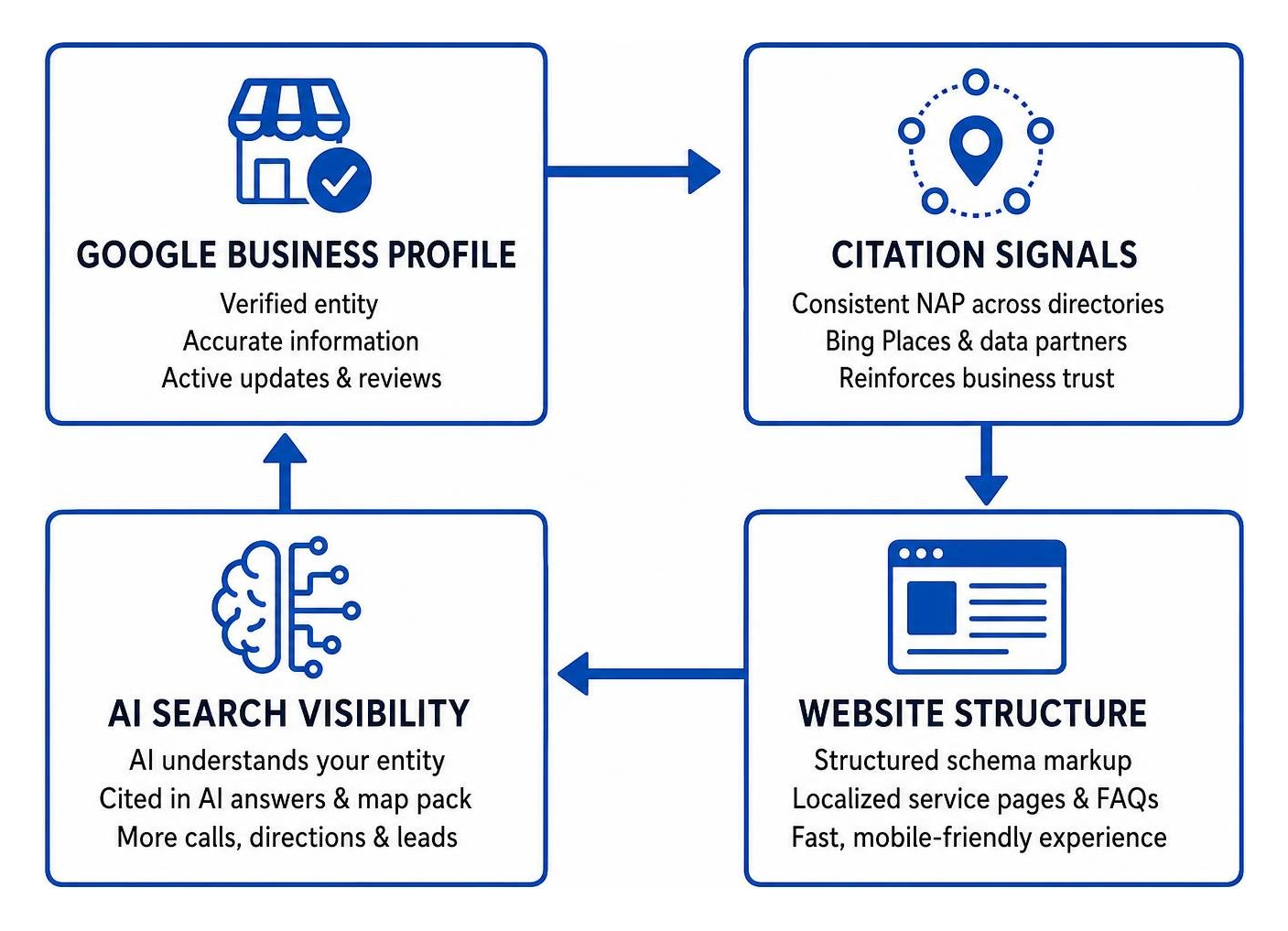
When an agency treats these components as disconnected chores rather than a unified digital system, visibility stalls.
Google Business Profile Optimization and Common Traps
Your Google Business Profile (GBP) is often the first operational touchpoint a prospect encounters. Google Maps pack signals carry substantial weight for local intent, frequently driving phone calls and physical visits before a user ever lands on your website.
Yet many businesses fall into common setup traps:
- Mismatched primary categories: Selecting a general category instead of the most specific, accurate primary classification dilutes local ranking signals immediately.
- Inconsistent NAP details: Having minor discrepancies in Name, Address, or Phone number across your website, GBP, and external directories confuses search algorithms and weakens entity trust.
- Infrequent visual updates: Profiles without authentic, geo-relevant photos of real work, facilities, and team members see lower engagement compared to profiles that publish regular visual updates.
- Ignoring weekly profile posts: Failing to share service updates, seasonal maintenance advice, and answers to common questions signals inactivity to local search algorithms.
To avoid these pitfalls and build an active profile, review our guide on how to stop ghosting Google: the complete business profile management guide. Once your profile foundation is clean, you can implement fast ways to improve local Google ranking for neighborhood businesses across your specific service areas.
Review Velocity and Customer Trust Signals
Online reviews serve a dual purpose: they provide clear social proof to prospective buyers and deliver vital sentiment and relevance signals to search algorithms. A substantial majority of consumers rely on social media and online review profiles when making purchasing decisions.
A high-performing local visibility strategy requires consistent review velocity—the steady, natural acquisition of genuine client feedback over time. A sudden influx of twenty reviews followed by six months of silence looks unnatural and fails to sustain ranking momentum.
Furthermore, customer reviews that naturally reference specific services and neighborhood locations provide valuable algorithmic context. For actionable tactics on optimizing for hyper-local buyer intent, read our breakdown on how to rank for near me searches and win local customers.
Specialized Industry Strategies: Contractors to Medical Practices
Generic marketing playbooks rarely work across disparate local business models. A residential roofing contractor in Independence operates under completely different operational constraints, consumer timelines, and regulatory considerations than a specialized medical practice in Kansas City.
A knowledgeable local growth partner tailors its technical architecture and content frameworks to the unique buyer journey of your specific vertical.
Home Service Contractors and Emergency Search Capture
Home service providers—such as HVAC technicians, electricians, plumbers, and roofers—deal with intense seasonal demand shifts and high-stakes emergency queries. When a furnace fails during a freezing Midwestern winter, the homeowner is not conducting weeks of casual research; they need immediate, trustworthy assistance.
Capturing these high-intent emergency searches requires:
- Dedicated neighborhood service-area pages: Building out targeted pages for specific communities like Grain Valley or Blue Springs that clearly describe local service coverage.
- Fast mobile page loads: Sluggish mobile load times cause businesses to lose a substantial portion of their prospective visitors. When a pipe bursts, slow websites immediately forfeit the lead.
- Emergency schema and click-to-call functionality: Ensuring structured contact endpoints and operating hours are explicitly marked up with Schema.org structured data for search crawlers and AI answer engines.
Local service providers benefit greatly from establishing unified regional frameworks to understand how structured local search positioning drives inbound service calls.
Healthcare Practices and Patient Trust Signals
For medical clinics, dental practices, and specialized healthcare providers, local visibility requires strict adherence to privacy boundaries alongside robust trust signals. Healthcare decisions involve high personal risk, making clinical credibility paramount.
Effective medical search visibility strategies focus on:
- Practitioner and facility entity schemas: Linking individual physicians to their respective clinics using detailed
PhysicianandMedicalClinicstructured markup. - HIPAA-aware content and review management: Structuring patient communication and review responses with strict confidentiality, ensuring zero protected health information is ever compromised.
- Educational, symptom-based content hubs: Developing medically accurate, helpful resources that answer common patient questions and establish clear clinical authority.
To see how specialized clinics structure their search visibility without compromising compliance, see our resource on how medical clinics win the battle for local search visibility, as well as our guidance on enhancing local search presence for growing small businesses.
Evaluating Your Partnership: Selection Criteria, Metrics, and ROI
Hiring an external team to manage your local visibility is a significant operational decision. The market contains everything from automated software tools to traditional full-service firms. Knowing what questions to ask and which metrics matter will keep your marketing investment aligned with actual business growth.
How to Vet and Select the Right Local Visibility Marketing Agency
When vetting potential marketing partners, look past flashy presentations and evaluate the underlying operational structure.
Consider these practical evaluation criteria:
- Direct access to strategists: Will you collaborate directly with the senior specialist configuring your technical SEO, schema, and AI visibility, or will your account be handed off to an inexperienced account coordinator?
- Contract terms and transparency: Agencies confident in their technical execution generally offer flexible, month-to-month retainers rather than locking clients into rigid, multi-year contracts.
- Underlying data reporting: Ensure the agency provides access to raw performance metrics—including organic call logs, direction requests, and conversion actions—rather than curated vanity charts.
For a comprehensive evaluation framework, review our breakdown on what you should consider hiring a digital marketing agency.
Niche Specialist vs Industry-Agnostic Growth Partners
A common question business owners face is whether to hire an agency that specializes exclusively in their exact trade or an industry-agnostic firm.
Niche agencies offer deep baseline familiarity with industry terminology and standard customer intake workflows. However, they frequently serve direct competitors in the same geographic territory, creating an inherent conflict of interest. Furthermore, strict niche specialization can lead to recycled, templated content that fails to stand out in local AI and search results.
An adaptable, industry-agnostic agency brings diverse technical frameworks developed across multiple competitive markets. At CreatiVertical, we apply cross-industry experience—drawing insights from our work with Kansas City neighborhood businesses, industrial B2B manufacturers, offshore professional services, and compliance-driven government technology vendors.
This multi-sector perspective helps your local strategy benefit from solid technical standards while maintaining strict market exclusivity. If you need strategic clarity on your operational positioning, explore our guide to finding a digital marketing consultant.
Measurable Timelines and Key ROI Metrics
A competent local marketing partner tracks KPIs tied directly to revenue generation and customer acquisition.
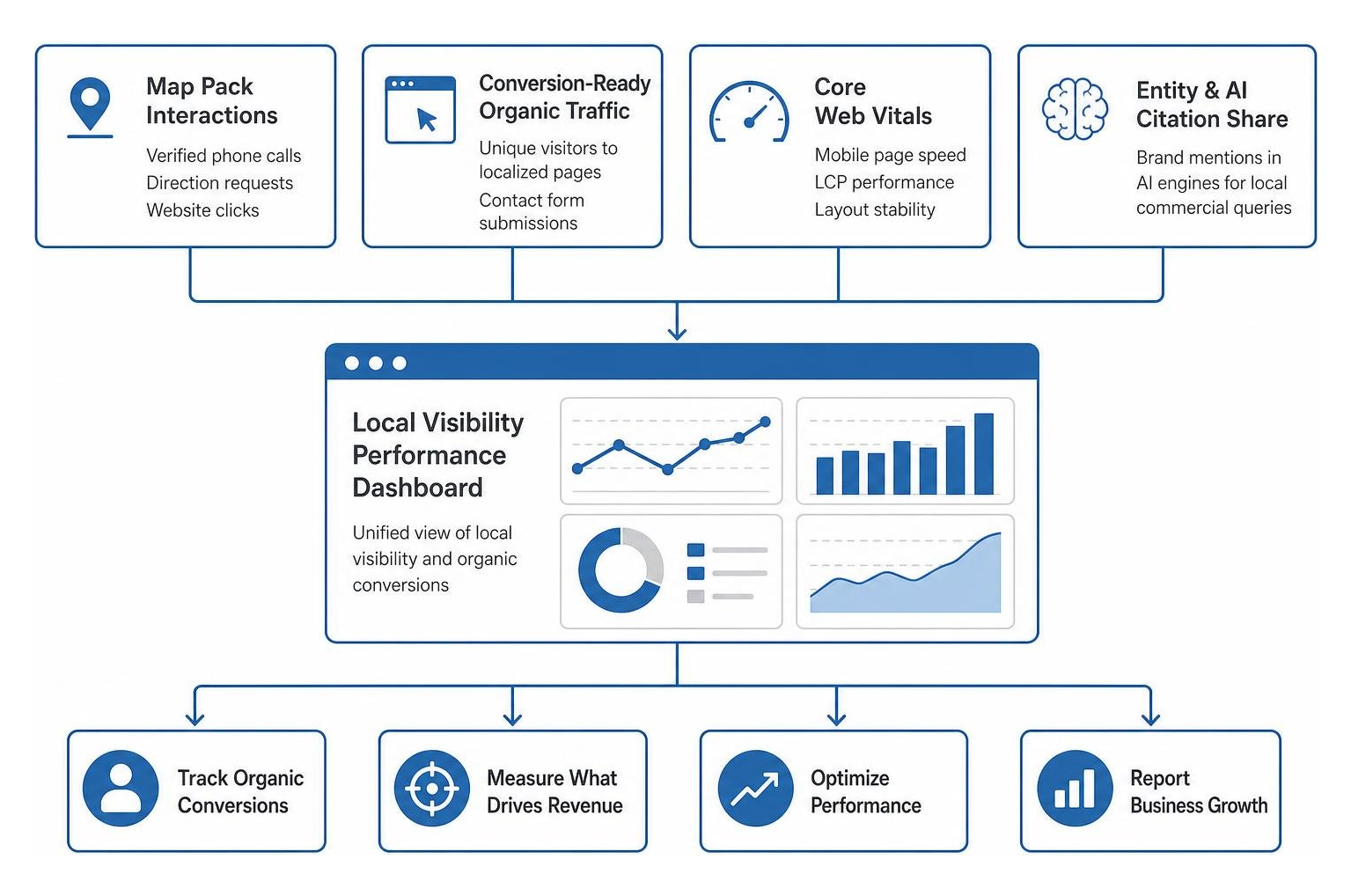
Key performance metrics your growth partner should measure include:
- Map Pack interactions: Verified phone calls, direction requests, and direct website clicks originating from Google Maps.
- Conversion-ready organic traffic: Unique visitors landing on localized service-area pages and completing contact forms.
- Core Web Vitals: Mobile page load speed, Largest Contentful Paint (LCP), and layout stability across all primary landing pages.
- Entity and AI citation share: The frequency with which your brand is cited by generative AI engines (such as ChatGPT, Perplexity, and Google AI Overviews) for local commercial queries.
- Review velocity and sentiment health: Continuous acquisition rate of positive, attribute-rich customer reviews.
For practical steps on setting up your baseline measurement stack, consult a quick start guide to local SEO performance tracking.
Frequently Asked Questions About Local Search and Visibility
How long does it take to see measurable results from local SEO and AI search optimization?
Local visibility improvements occur in phases. Foundational technical corrections—such as resolving Google Business Profile category errors, cleaning up contradictory NAP data across directories, and fixing broken schema markup—often produce noticeable improvements in local map impressions within 30 to 60 days.
Substantial organic rankings for competitive search queries and comprehensive citation indexing across AI answer engines typically take between 90 and 180 days of sustained technical execution. For an in-depth breakdown of these implementation milestones, refer to our step-by-step guide to local visibility online.
How can a small local business outrank competitors with massive budgets?
Large corporate chains and multi-location franchises possess larger aggregate marketing budgets, but they are often constrained by centralized, bureaucratic marketing structures. They rely on standardized, generic location landing pages that lack authentic community relevance.
A local independent business can outmaneuver larger competitors by establishing hyper-local authority:
- Creating detailed, localized content that answers neighborhood-specific questions.
- Maintaining a fast, high-performance website with pristine Core Web Vitals.
- Gathering genuine, detailed reviews from local customers that mention specific services and regional landmarks.
- Implementing comprehensive
LocalBusinessschema markup that larger competitors frequently neglect.
For actionable positioning strategies, read our guide on no more hide and seek: a no-nonsense local business SEO strategy.
What is Generative Engine Optimization (GEO) and why is it essential in 2026?
Generative Engine Optimization (GEO) is the technical and editorial practice of structuring your digital footprint so artificial intelligence models can easily discover, extract, and cite your business in generated answers. In 2026, conversational search platforms like ChatGPT, Claude, Perplexity, and Google AI Overviews handle a growing portion of complex consumer research.
If your website contains ambiguous service descriptions, unorganized data, or missing entity schemas, generative AI engines will bypass your brand in favor of competitors whose business facts are clearly defined and verified across trusted web directories.
Conclusion: Partnering for Sustainable Local Growth
Achieving durable local visibility is not a one-time setup task; it is an ongoing engineering and marketing discipline. As search engines evolve into conversational AI answer platforms, staying discoverable requires a coordinated digital system that connects fast web architecture, precise local signals, active reputation management, and machine-readable structured data.
At CreatiVertical, we operate as a dedicated, family-run growth partner for businesses throughout Kansas City, Lake Tapawingo, Blue Springs, Lee’s Summit, Independence, and Grain Valley. We deliver complete, performance-focused digital systems—combining custom web design and development, search engine optimization, Generative Engine Optimization (GEO), paid search management, and applied AI workflow automation.
Whether you operate a local service business, manage an industrial manufacturing enterprise, or deliver specialized professional services, we help you build a resilient digital presence engineered for long-term growth. To begin auditing and modernizing your own digital footprint, explore our 7 tips to improve local visibility online or reach out to our team to chart your path forward.