
How Precision Parts Manufacturer AI Search Replaces Traditional Keyword Lookups
Precision parts manufacturer AI search replaces traditional keyword lookups by using natural language understanding, neural embeddings, and multi-database retrieval to match engineering intent and specifications instead of exact SKU strings. When an engineer searches for a “304 stainless 1/2-inch hydraulic check valve 3000 PSI,” the system can still identify your enterprise record labeled “VALV-CHK-SS304-050-3K” because it analyzes the semantic meaning, physical properties, and engineering context behind the query.
Traditional catalog lookup depends on an unforgiving premise: the buyer must know your exact part number, SKU format, or naming convention. If a query has a typo, uses industry slang, or omits punctuation, literal string matching fails. This mismatch creates lost orders for custom machine shops and hours of wasted time for maintenance teams.
AI-powered search replaces literal text matching with neural retrieval. Instead of hunting for identical strings, generative search models analyze the semantic intent, physical properties, and engineering context behind a query.
| Search Dimension | Traditional Keyword Search | AI-Powered Neural Search |
|---|---|---|
| Input Flexibility | Requires exact part numbers or precise product titles | Accepts natural language descriptions, partial specs, and colloquial terms |
| Context Awareness | None; treats terms as isolated strings | Understands operating pressures, materials, tolerances, and assembly context |
| Typo & Variation Tolerance | Low; often returns zero results for minor spelling or formatting differences | High; resolves abbreviations, metric/imperial conversions, and alternate naming |
| Legacy & Superseded Data | Requires explicit manual redirects for every discontinued SKU | Maps historical revisions and superseded parts automatically via relational links |
| Speed & Accuracy | Fast for exact IDs, but slow and error-prone for exploratory searches | Studies from industrial neural search tools show parts identification up to 3.3x faster and 51% more accurate |
Industrial neural search platforms like nyris demonstrate that switching from brittle keyword lookups to visual and semantic engines helps engineers pinpoint components in seconds rather than digging through multi-page PDF catalogs.
Multi-Agent Retrieval and Graph Databases in Precision Parts Manufacturer AI Search
Matching high-tolerance machined components requires more than basic text parsing. A precision component must fit specific geometric, thermal, and mechanical constraints. Modern search architectures use multi-agent AI systems that query multiple database types simultaneously.
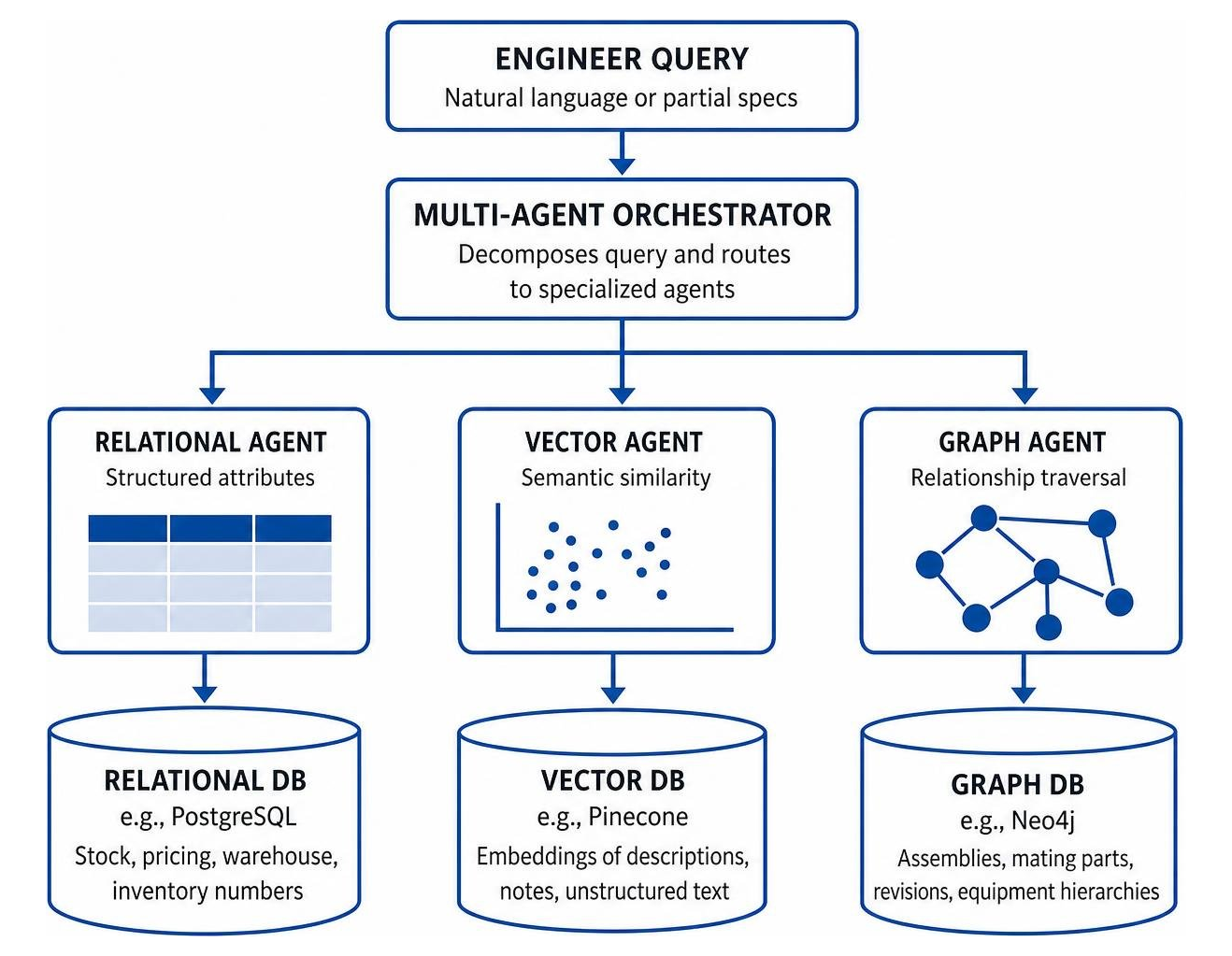
When an engineer searches for a custom replacement spindle or bushing, a multi-agent framework splits the query into parallel tasks:
- Relational Database Search (e.g., PostgreSQL): Queries structured attributes such as stock availability, base pricing, warehouse location, and raw inventory numbers.
- Vector Database Search (e.g., Pinecone): Scans high-dimensional vector embeddings to evaluate semantic similarity across natural language descriptions and unstructured notes.
- Graph Database Search (e.g., Neo4j): Traverses complex relationships between assemblies, mating parts, legacy revisions, and equipment hierarchies.
Platforms such as PartsIQ run parallel queries across these three database types to achieve up to 95% match accuracy. When you build custom AI agents for manufacturing, these parallel retrieval pipelines allow your systems to parse messy customer descriptions and recommend exact-match precision components with high reliability.
Visual Search and Optical Recognition for Unstructured Parts Data
Machined parts wear down. Nameplates get covered in grease, stamped serial numbers corrode, and field technicians frequently lack access to original schematics. In these situations, visual AI search bridges the gap between physical hardware and digital catalogs.
Modern visual AI models process multiple unstructured visual inputs:
- Mobile Field Photos: Visual search models extract key geometry, bore diameters, and tooth counts directly from photos taken on the shop floor.
- Optical Character Recognition (OCR): AI isolates faded, stamped, or partially obscured serial codes on castings and data plates.
- 2D Technical Drawings and Schematics: Neural parsers read title blocks, dimension callouts, and tolerance blocks from scanned blueprints.
To train these models without photographing thousands of individual components, solutions like nyris use synthetic data pipelines generated from 3D CAD files. This approach produces visual training data 99% faster and 90% cheaper than traditional physical photography. Technicians can photograph a failed component and immediately pull up the corresponding manufacturing CAD file and reorder specs.
Structuring Industrial Catalogs for Generative Engines and AI Sourcing Agents
To make your parts discoverable by external generative engines like ChatGPT and Perplexity, as well as specialized sourcing platforms like PartsFinder, your catalog data must be structured for machine readability.
Generative AI agents do not read websites like human users. They crawl pages looking for structured entity relationships, clear numerical limits, and standardized engineering units.
Using modern AI search optimization tools for industrial discovery ensures your technical specifications are formatted so that Large Language Models (LLMs) can reliably extract and cite your capabilities during automated procurement workflows.
Cross-Referencing Legacy Numbers and Compatible Substitutes in Precision Parts Manufacturer AI Search
Supply chain interruptions and aging machinery mean buyers frequently search for discontinued parts. When an exact match is unavailable, AI search systems evaluate compatible alternatives based on physical dimensions, operating thresholds, and material grades.
Specialized platforms like the AI Tech Industrial Component Finder use hybrid graph and vector retrieval to identify direct equivalents across different manufacturers. By establishing bidirectional relationships between obsolete SKUs and modern replacements, manufacturers ensure their inventory surfaces even when buyers search for competitor part numbers or superseded catalog codes.
Confidence Scoring and Data Enrichment to Prevent Sourcing Hallucinations
In precision machining, a fraction of a millimeter determines whether a component fits or causes a catastrophic machine failure. AI search platforms cannot rely on guesswork. To protect sourcing accuracy, enterprise parts engines employ strict confidence scoring mechanisms.
Industrial intelligence software like Partium enriches incomplete part data by 30% to 60%, cross-referencing records against manufacturer datasheets to fill in missing dimensions, country of origin, and material grades. When a user submits an inquiry through tools like Partium Find, the system calculates an aggregate confidence score based on:
- Semantic text alignment
- Dimensional and tolerance validation
- Graph relationship proximity
- Equipment make and model compatibility
If a match falls below a set confidence threshold (for example, 85%), the platform routes the query to a human estimator or engineering sales rep. This human-in-the-loop workflow prevents hallucinations while speeding up routine RFQ turnarounds.
Tailoring AI Search Optimization Across OEMs, Distributors, and MRO Teams
Different tiers of the manufacturing supply chain use AI search engines in distinct ways. Optimizing your technical brand requires tailoring data for each buyer persona.

- Original Equipment Manufacturers (OEMs): OEMs require integrated part-selection portals where aftermarket clients can look up complex Bills of Materials (BOMs). Embedding AI visual and natural language search into OEM customer portals cuts repetitive customer support inquiries and shortens warranty part verification.
- Industrial Distributors: Distributors handle millions of SKUs from diverse suppliers. They rely on AI engines to normalize messy vendor data, eliminate duplicate inventory records, and automate customer quote generation.
- Maintenance, Repair, and Operations (MRO) Teams: Plant technicians face costly unplanned downtime. They need rapid mobile part identification—often using a photo of a broken part or a vague description from an old maintenance log—to source drop-in replacements immediately.
Adopting comprehensive brand visibility strategies across AI search platforms ensures your precision products and custom machining services are visible across all three buying channels.
Business Value and ERP Integration for Machine Shops
Deploying AI-powered parts search delivers direct, measurable improvements to operational efficiency and procurement costs.

Real-world implementations highlight the financial and operational impact of these systems:
- Procurement Cost Reductions: Enterprise teams using Partium report up to a 37% reduction in procurement costs by identifying duplicate inventory, finding alternative suppliers, and eliminating wrong-fit orders.
- Working Capital Optimization: Industrial maintenance operations have achieved a 20% inventory reduction by identifying dead stock and consolidating duplicate records across facilities.
- Labor Efficiency at Scale: Large-scale enterprise deployments demonstrate massive labor savings. For instance, European railway operator Deutsche Bahn implemented AI part search across 95 maintenance facilities and 12,200 technicians, saving 46,800 person-days in a single year by cutting part lookup times.
Modern AI search tools integrate directly with existing ERP (Enterprise Resource Planning) and CMMS (Computerized Maintenance Management Systems) software such as SAP, Oracle, and modern cloud databases via REST APIs. This allows machine shops and suppliers to modernize their part discovery without undergoing expensive or disruptive overhauls of their underlying enterprise software.
Frequently Asked Questions About Precision Parts Manufacturer AI Search
How do generative search engines discover precision machined components without exact part numbers?
Generative engines use semantic vector search and hybrid knowledge graphs rather than literal keyword matches. When an engineer describes a component by its functional characteristics—such as outer diameter, thread pitch, material grade, or operating temperature—the AI maps these descriptors to vector embeddings and structured catalog entities. This lets the engine identify matching components even if the query uses non-standard phrasing or functional descriptions rather than formal part numbers.
How can precision machine shops optimize technical websites for ChatGPT and Perplexity recommendations?
Machine shops should structure their websites using clean, machine-readable HTML and JSON-LD schema markup. Clearly list material grades, dimensional tolerance capabilities, CNC machine models (such as 5-axis mills or Swiss lathes), industry certifications (like ISO 9001 or AS9100), and typical lead times on dedicated service pages. Avoid burying critical engineering data inside flat CAD files, locked PDFs, or unindexed image galleries.
What backend databases are required to support AI-driven industrial parts search?
An industrial AI search platform typically uses a hybrid architecture combining three distinct database types:
- Relational Databases (e.g., PostgreSQL): For managing structured inventory data, current pricing, lead times, and warehouse stock levels.
- Vector Databases (e.g., Pinecone): For storing mathematical embeddings of natural language descriptions, technical notes, and CAD visual features.
- Graph Databases (e.g., Neo4j): For mapping complex hierarchical relationships between parent assemblies, mating parts, legacy revisions, and manufacturer cross-references.
Conclusion: Dominating AI-Driven Industrial Procurement
Generative AI is changing how procurement managers, design engineers, and MRO technicians source precision parts. Relying solely on basic keyword search and legacy PDF catalogs leaves your business invisible to the automated AI agents and neural engines driving modern industrial procurement.
At CreatiVertical, we help precision manufacturers, custom machine shops, and industrial component suppliers build digital foundations for this shift. As an ongoing growth partner, we develop high-performance industrial websites, implement structured generative engine optimization (GEO), and build custom AI search workflows tailored to high-tolerance engineering audiences.
To learn more about modernizing your technical web architecture and preparing your catalog for generative search, explore our approach to custom manufacturing website development and AI enablement.