
Understanding Custom AI Agents for Manufacturing vs. Standard Chatbots
Custom AI agents for manufacturing are purpose-built software systems that combine large language model reasoning with direct connections to plant-floor and enterprise data. They sense operational events, reason through multi-variable constraints, and execute governed actions across systems such as ERP, MES, CMMS, and SCADA. Unlike generic chatbots, they are grounded in your engineering drawings, standard operating procedures, and live production telemetry, so they can act on your actual operating reality rather than open-web training data.
To understand why custom AI agents represent a fundamental shift for industrial operations, it helps to distinguish them from standard conversational bots and traditional robotic process automation (RPA).
Generic chatbots process natural language prompts and predict textual responses based on open-web training data. They lack situational awareness, have no persistent memory of physical plant assets, cannot verify facts against your internal operating reality, and cannot take direct actions across enterprise systems.
Legacy RPA platforms execute rigid, rule-based scripts. They excel at repetitive screen-scraping and moving data from point A to point B, but they break immediately when presented with unstructured documents, edge cases, sensor anomalies, or unexpected production variables.
Custom AI agents combine the reasoning capabilities of large language models with deterministic industrial software execution. Grounded directly in your plant’s engineering drawings, standard operating procedures (SOPs), SCADA feeds, enterprise resource planning (ERP), and computerised maintenance management systems (CMMS), an agent perceives operational events, reasons through complex multi-variable constraints, and triggers governed, closed-loop actions.
| Feature / Capability | Static Generic Chatbots | Legacy RPA Scripts | Custom Manufacturing AI Agents |
|---|---|---|---|
| Primary Function | Conversational text generation | Repetitive deterministic task execution | Autonomous reasoning, decision support, and workflow execution |
| Data Grounding | Broad internet data (hallucination risk) | Hardcoded field mapping | Proprietary plant systems (ERP, MES, CMMS, SOPs, SCADA) |
| Handling Unstructured Data | High linguistic fluency, low contextual accuracy | Fails on format changes or ambiguous inputs | High comprehension of manuals, tickets, work orders, and logs |
| Execution Capability | Informational output only | Executes predefined click paths | Initiates API calls, schedules lines, drafts orders, triages defects |
| Autonomy & Governance | Open-ended, ungoverned responses | Rigid binary rules (pass/fail) | Configurable human-in-the-loop gates, role-based controls, audit trails |
Autonomous Action vs. Conversational Chatbots
The central difference between a simple conversational interface and an industrial AI agent lies in closed-loop action execution. A chatbot can summarize a maintenance manual if asked. An industrial AI agent actively listens to vibration telemetry from a high-speed milling spindle, recognizes an emerging bearing defect pattern, cross-references spare parts inventory inside the ERP, generates a work order draft inside the CMMS, and notifies the shift supervisor.
We have long emphasized that chatbots are no replacement for people, particularly in specialized commercial environments where nuance, trust, and accountability matter. When purpose-built agents are deployed instead, they function as digital co-workers. They do not displace human engineering judgment; rather, they eliminate a significant portion of the shift time frontline personnel spend hunting down documentation, compiling shift reports, and chasing manual approvals.
Agents operate on continuous perception-action loops:
- Sense: Ingest multimodal inputs across shop-floor PLCs, machine vision cameras, operator forms, and enterprise databases.
- Think: Evaluate the situation against engineering tolerances, production priorities, safety boundaries, and historical resolution logs.
- Act: Formulate an action plan, request human sign-off when safety or financial thresholds require it, and execute transactions across connected software systems.
Multi-Agent Orchestration and the Agentic Digital Twin
Complex manufacturing plants rarely rely on a single monolithic AI model. Instead, modern industrial architecture deploys multi-agent systems where specialized sub-agents collaborate within a shared workspace.
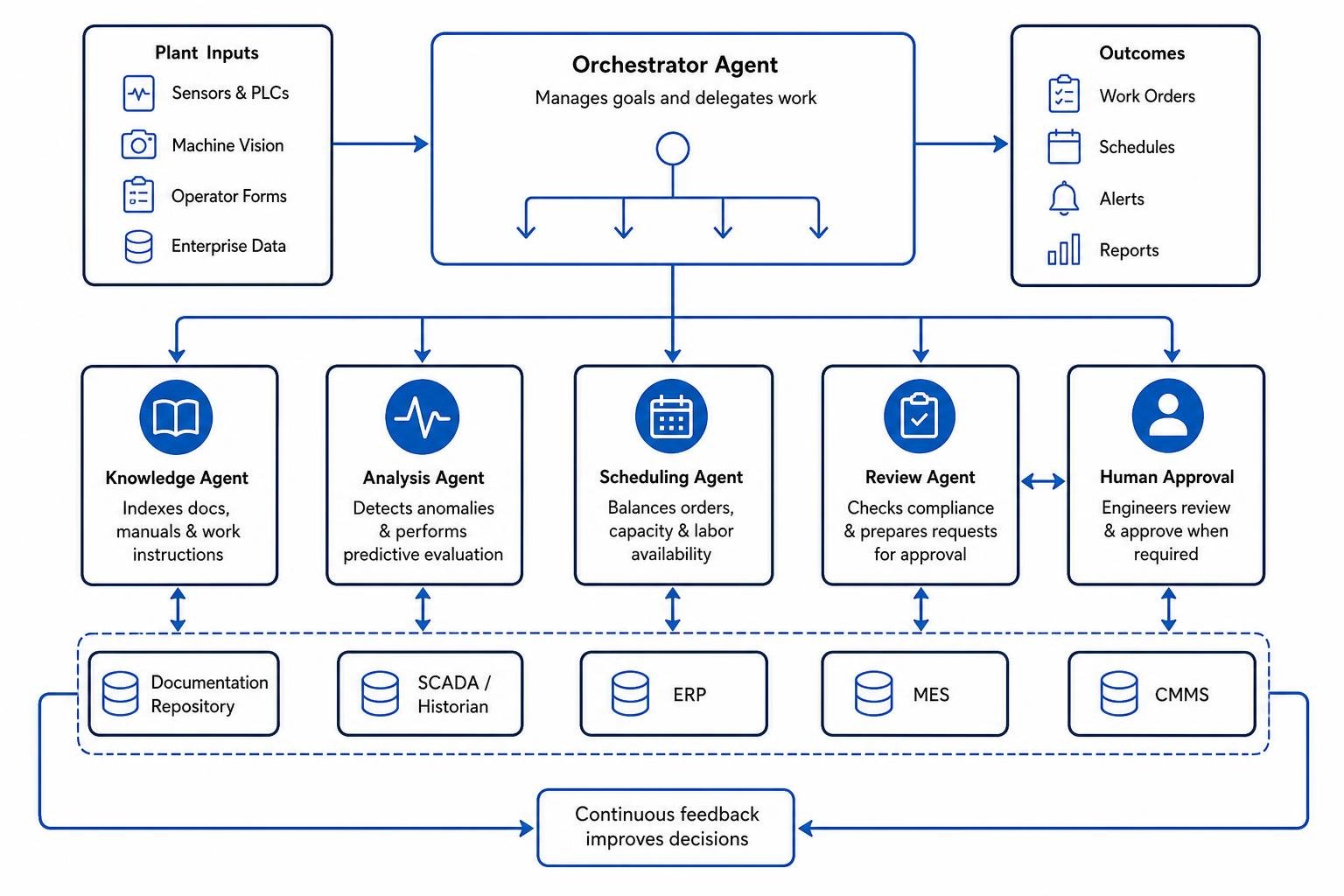
In this framework, an Orchestrator Agent manages high-level plant goals and delegates sub-tasks:
- A Knowledge Agent indexes technical documentation, equipment manuals, and historic work instructions to answer frontline technical questions accurately.
- An Analysis Agent runs anomaly detection and predictive evaluation against incoming machine telemetry.
- A Scheduling Agent balances customer order priorities against current machine capacity and labor availability.
- A Review Agent compiles findings, checks compliance boundaries, and prepares structured requests for plant engineers to approve.
This collaborative network creates a dynamic digital representation of your plant floor. Platforms utilizing an agentic twin architecture for high-mix manufacturing go beyond static 3D models. They maintain a live operational model of every machine, operator skill profile, inventory lot, and production constraint, allowing agents to simulate thousands of scenarios in parallel and execute dynamic rescheduling the moment an operational bottleneck arises.
Core Manufacturing Workflows Powered by Industrial AI Agents
Industrial AI agents deliver the highest return on investment when applied to operational friction points where information is fragmented and decision latency creates costly downtime.
Real-Time Production Scheduling and Disruption Handling
High-mix, low-volume manufacturers face constant schedule volatility. A single delayed raw-material shipment, a sudden CNC tool fracture, or an unscheduled operator absence can invalidate a weekly production schedule in minutes.
Traditionally, master schedulers spend hours manually reshuffling orders across spreadsheets and MES software, often relying on incomplete data. A custom scheduling agent monitors production status in real time. When an unplanned stoppage occurs, the agent evaluates capacity constraints, identifies alternative machine routing, checks tooling compatibility, and generates an optimized, rescheduled plan within seconds. Frontline teams maintain operational momentum without waiting for administrative re-planning cycles.
Predictive Maintenance and Automated CMMS Dispatch
Unplanned equipment downtime remains one of the largest cost drivers in industrial facilities. While basic condition monitoring alerts technicians when a threshold is breached, it often leaves the diagnostic and administrative burden on human staff.
Custom maintenance agents connect machine condition data directly to execution software. When thermal or vibration sensors signal mechanical wear:
- The agent cross-checks historical failure modes and mean-time-between-failures (MTBF) data.
- It identifies the exact replacement components required and checks stock availability in your ERP.
- It drafts a prioritized work order inside your CMMS, attaching relevant step-by-step repair guides and required torque specs.
- It routes the ticket to an appropriately certified technician rostered on that shift.
By leveraging no-code industrial AI agent studio tools, plant engineers can curate these maintenance behaviors directly, defining custom trigger thresholds and verification steps without custom software development.
Closed-Loop Quality Assurance and SOP Verification
Quality management often suffers from manual data entry lags and disjointed root-cause investigations. When an inline automated optical inspection (AOI) camera flags a surface defect on a machined component, a quality agent can immediately isolate the affected lot, compare the defect signature against historical non-conformance reports (NCRs), and identify whether the anomaly correlates with specific tool batches, ambient humidity fluctuations, or recent feed-rate adjustments.
The agent drafts a structured root-cause investigation package, compiles all relevant sensor logs, and presents the engineer with actionable mitigation steps. Every step is timestamped and recorded, ensuring full traceability for ISO 9001, AS9100, or IATF 16949 audit readiness.
Architectural Integration: Connecting Agents to ERP, MES, and Shop-Floor Data
An AI agent is only as capable as the systems it can reach. Deploying agents into an industrial environment requires bridging the gap between Operational Technology (OT) on the shop floor and Information Technology (IT) in the enterprise stack.
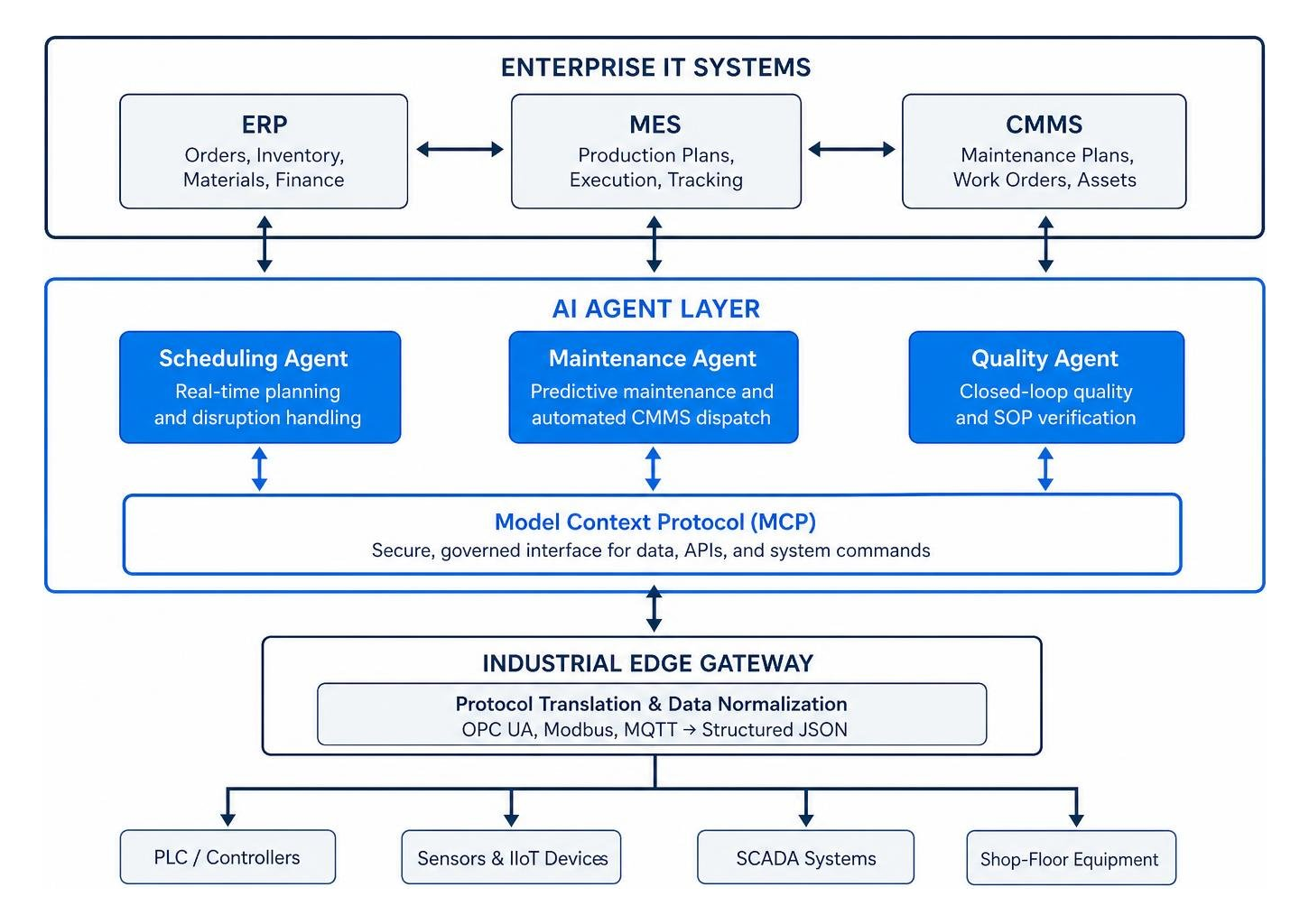
Model Context Protocol (MCP) and Legacy Industrial Integrations
Historically, integrating AI models with plant-floor assets required building brittle, custom point-to-point connectors for every PLC, database, and software tool. The emergence of standardized communication layers, such as the Model Context Protocol (MCP) and modern industrial API gateways, has fundamentally streamlined this architecture.
MCP provides a governed, structured interface that allows AI agents to query databases, call external APIs, and execute system commands securely. For brownfield manufacturing environments populated by legacy PLCs and SCADA networks, agents connect through secure edge gateways that translate industrial protocols (such as OPC UA, Modbus, and MQTT) into structured JSON payloads that the agent’s reasoning engine can evaluate.
Applying proven enterprise scalable infrastructure practices ensures that these communication pipelines maintain low latency, data isolation, and high availability across distributed plant networks.
Data Readiness and Infrastructure Requirements for Custom AI Agents for Manufacturing
Before deploying custom ai agents for manufacturing, facilities must ensure their foundational data environment is prepared. Successful agent implementations do not require perfect data, but they do require accessible, authentic systems of record.
Key infrastructure prerequisites include:
- Centralized Knowledge Repositories: Digitized SOPs, troubleshooting guides, asset manuals, and engineering specifications in readable formats (PDF, Markdown, structured databases).
- Accessible System Interfaces: Documented read/write APIs or database connections for core systems including ERP, MES, CMMS, and QMS.
- Edge Compute Readiness: On-premise industrial PCs or localized edge gateways capable of running local inference models or handling encrypted outbound telemetry for low-latency decision loops.
- Master Data Hygiene: Clean, consistent asset naming conventions across equipment registries, part numbers, and maintenance logs to prevent cross-referencing errors.
Implementation Roadmap: How to Deploy Custom AI Agents for Manufacturing
Deploying industrial AI agents successfully requires an incremental, risk-managed rollout strategy. Attempting to automate an entire plant simultaneously introduces unnecessary operational risk. We recommend a structured four-stage methodology:
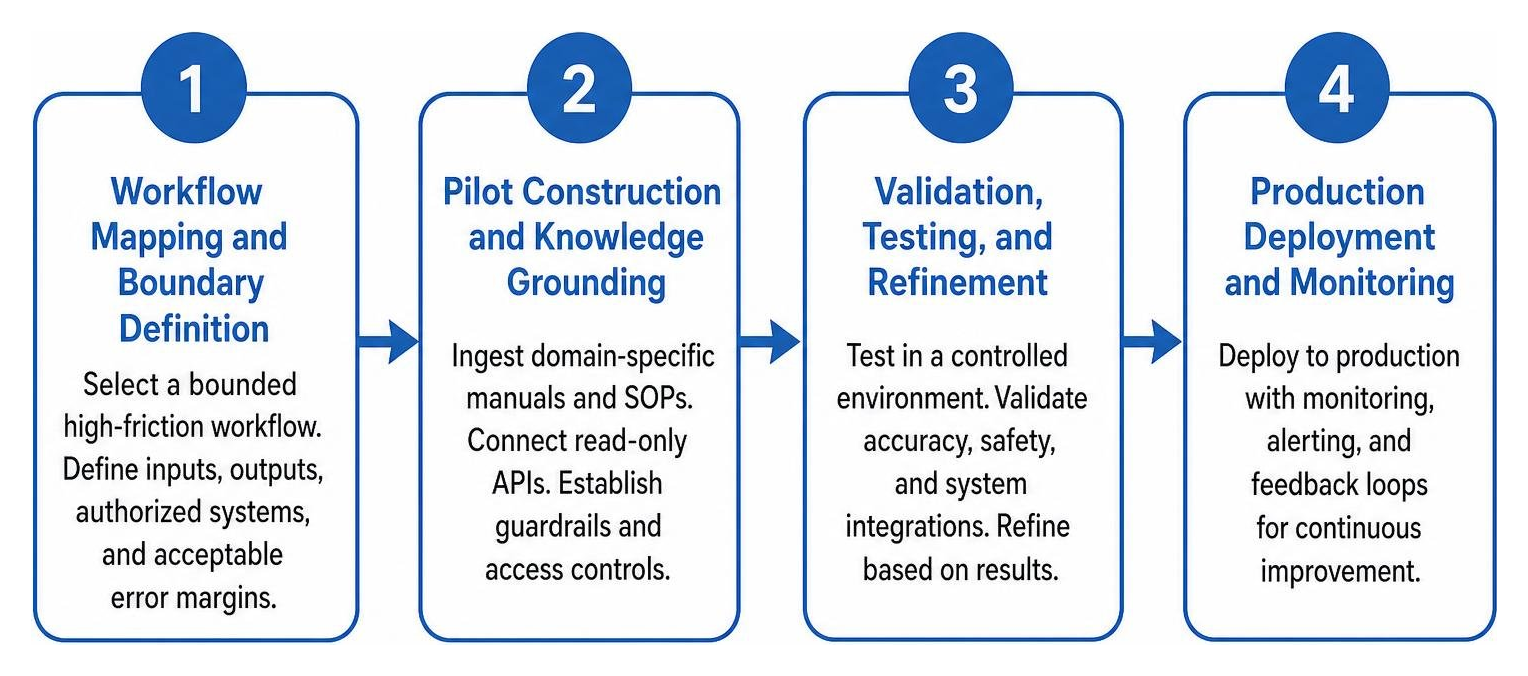
Stage 1: Workflow Mapping and Boundary Definition (Week 1–2)
Select a single high-friction, bounded workflow—such as incoming raw material quality triage, maintenance work order preparation, or RFQ inventory lookups. Define explicit inputs, outputs, authorized systems, and acceptable error margins.Stage 2: Pilot Construction and Knowledge Grounding (Week 3–4)
Ingest domain-specific manuals and SOPs into the agent’s retrieval layer. Connect read-only APIs to target systems. Establish deterministic guardrails and role-based access parameters.Stage 3: Shadow Mode and Human-in-the-Loop Validation (Weeks 5–8)
Deploy the agent in “shadow mode,” where it runs alongside human operators. The agent analyzes live data and drafts recommendations, but actions require explicit human review and sign-off before execution. Track decision accuracy, time saved, and edge-case exceptions.Stage 4: Governed Production Rollout and Scaling (Week 9+)
Transition validated tasks to automated execution while retaining approval gates for high-risk operations (such as high-value purchase orders or safety overrides). Expand the agent framework to adjacent production lines or sister facilities.
Governance, Compliance, and Human-in-the-Loop Autonomy Controls
Safety and regulatory compliance are non-negotiable in manufacturing. Autonomous decision engines must operate within strictly defined guardrails that align with international industrial standards, including SOC 2 Type II, ISO 27001, GDPR, and IEC 62443 for operational technology cybersecurity.
Understanding how organizations manage compliance when adopting compliant AI frameworks in regulated environments provides a clear blueprint for manufacturing teams:
- Deterministic Fallbacks: If an agent encounters conflicting sensor data or low model confidence, it must automatically escalate the decision to an assigned human engineer rather than guessing.
- Granular Role-Based Access Control (RBAC): Ensure that agents possess only the minimum permissions necessary to perform their specific role. A maintenance agent should never have write access to financial payroll ledgers.
- Immutable Audit Logging: Every data point retrieved, reasoning step executed, human approval logged, and API call triggered must be stored in an immutable, tamper-evident audit trail for regulatory and safety reviews.
- Air-Gapped and Localized Processing: For defense contractors or facilities managing highly sensitive intellectual property, agents can be deployed on localized, on-premise infrastructure to ensure zero data leaves the physical plant boundary.
Frequently Asked Questions About Custom Manufacturing AI Agents
How fast can a plant deploy its first industrial AI agent?
A focused pilot targeting a bounded workflow—such as an SOP retrieval assistant or an RFQ parts availability look-up—can typically be built, integrated, and deployed into a test environment within two to four weeks. Full production rollouts with human-in-the-loop validation generally take four to eight weeks, depending on existing API accessibility and data readiness.
How do autonomous agents resolve sudden equipment failures or supply chain delays?
When an unexpected disruption occurs, the agent detects the state change through connected MES or sensor feeds. Instead of halting production, it runs scenario simulations evaluating alternative machine routings, current labor skill matrices, and buffer stock availability. It then presents the shift supervisor with prioritized mitigation options along with the projected impact on delivery timelines.
What security standards protect proprietary factory operational data?
Industrial AI agents are engineered to maintain strict enterprise data privacy. Your proprietary operational data, formulas, and CAD designs are never used to train public language models. Deployments operate within dedicated, encrypted enterprise cloud tenants or on-premise edge servers, fully compliant with SOC 2, ISO 27001, IEC 62443, and GDPR frameworks.
Conclusion: Building Resilient Operations with Custom AI Agents
Manufacturing success has always belonged to facilities that eliminate operational friction and adapt quickly to disruption. Custom industrial AI agents represent the next natural phase of Industry 4.0: transitioning from passive dashboards and rigid automation to proactive, intelligent systems that assist frontline workers, protect institutional knowledge, and streamline routine decisions.
By starting with a well-defined workflow, enforcing strict governance boundaries, and keeping human expertise at the center of critical decisions, manufacturers can build resilient, highly adaptable production environments.
At CreatiVertical, we work as an ongoing growth partner to help industrial manufacturers, B2B engineering firms, and technical organizations design, deploy, and scale applied AI enablement and integrated digital infrastructure. Whether you are seeking to streamline shop-floor communication, automate complex internal workflows, or establish secure digital platforms, our team provides practical, performance-driven systems tailored to your operating reality.