

Key Signals That Your SaaS Website Is Hurting Pipeline
A SaaS website redesign that protects search visibility requires a conversion-led approach: audit existing user behavior, preserve technical SEO equity through careful URL mapping and metadata migration, and rebuild pages around a clear hierarchy of evidence before launch. When a marketing site falters, the symptoms rarely stay hidden in analytics tools—they ripple across your entire sales organization. Research indicates that design-led companies achieved 56% higher total returns to shareholders over five years (McKinsey, 2018), proving that digital design directly impacts commercial value.
The most evident warning sign is a mismatch between traffic and inbound pipeline: your marketing team drives qualified visitors through organic search and paid campaigns, yet demo requests and self-serve trial signups remain stagnant. If your homepage bounce rate climbs above 65% or your primary conversion rate drops below 2%, the user experience is creating friction.
Another signal comes directly from your sales team. When account executives spend the first five minutes of a discovery call untangling confusion caused by your homepage copy, or feel hesitant to send enterprise prospects to specific product pages, your messaging has fallen behind. Following a structured b2b website redesign roadmap helps align digital touchpoints with modern product realities.
Evaluating Triggers for a SaaS Website Redesign
SaaS companies evolve through distinct growth stages, and their websites must adapt alongside them:
- Ideal Customer Profile (ICP) Shifts: Moving upmarket from self-serve developers or SMBs to enterprise buyers requires a fundamental shift in tone, security disclosures, and proof architecture.
- Product Positioning and Messaging Debt: Rapid feature shipping often leaves websites describing what a product used to do rather than the strategic outcome it now delivers.
- Platform Fragmentation: Adding new product tiers, add-ons, or services without updating site architecture forces visitors through confusing navigation structures.
- Technical Performance Bottlenecks: Every fraction of a second matters. Research from Akamai shows that a 100ms increase in load time can decrease conversion rates by 7%.
Cosmetic vs. Conversion-Led Design Approaches
A cosmetic redesign focuses almost entirely on visual aesthetics: new color palettes, trendy gradients, and updated typography. While visual polish matters, visual updates alone rarely fix underlying revenue bottlenecks.
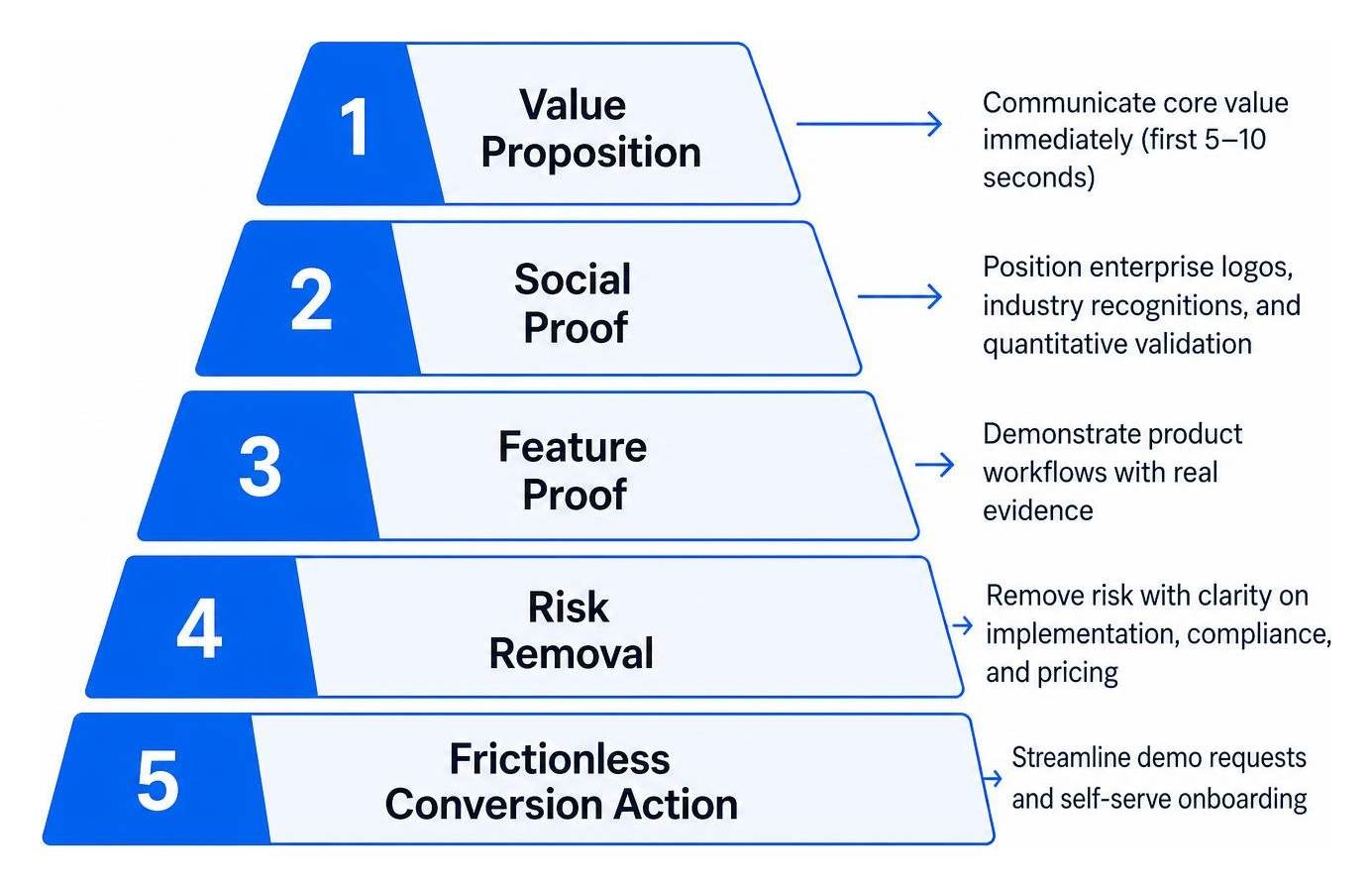
A conversion-led redesign reorganizes pages around a rigorous hierarchy of evidence:
- Value Proposition (First 5–10 Seconds): Communicating core value immediately. Eye-tracking data from Nielsen Norman Group reveals that 57% of page viewing time is spent above the fold.
- Social Proof: Positioning enterprise logos, industry recognitions, and quantitative validation directly beneath hero sections.
- Feature Proof: Demonstrating actual product workflows using interactive walkthroughs, clean interface graphics, or concise video previews rather than abstract illustrations.
- Risk Removal: Clarifying implementation timelines, compliance standards (such as SOC 2 or GDPR), and straightforward pricing tiers.
- Frictionless Conversion Action: Streamlining demo forms and self-serve onboarding flows.
The SaaS Website Redesign Roadmap: From Audit to Launch
Executing a redesign without risking pipeline disruptions requires a methodical process. Rather than relying on assumptions, successful teams audit real user behavior, document technical requirements, and follow a detailed website redesign process across defined phases.
- Conversion and UX Audit: Analyze heatmaps, scroll depth, drop-off funnels, and search console query performance to pinpoint where high-intent visitors abandon journeys.
- Information Architecture & Wireframing: Map navigation paths for distinct buyer personas (such as technical users versus executive buyers) before writing production code.
- Collaborative Design Sprints: Build scalable UI component libraries in Figma, iterating through regular stakeholder checkpoints to eliminate late-stage revisions.
- Engineering, SEO Quality Assurance, and Launch: Develop clean front-end components, implement technical SEO protections, test third-party integrations (like HubSpot or Salesforce), and verify mobile performance.
Technical Stack Selection: Webflow vs. Next.js
Choosing between Webflow and Next.js depends on team workflows, engineering resources, and application architecture.
| Feature / Consideration | Webflow | Next.js (Headless Architecture) |
|---|---|---|
| Primary Beneficiary | Marketing & Content Teams | Engineering & Technical Teams |
| Publishing Autonomy | High (Visual CMS, zero-code updates) | Moderate (Requires headless CMS integration like Sanity or Contentful) |
| Performance & Core Web Vitals | Excellent out-of-the-box with clean CSS/JS management | Superior custom optimization via Static Site Generation (SSG) and edge caching |
| Programmatic SEO | Limited to CMS collection boundaries | Unlimited flexibility for dynamic, database-driven page generation |
| Security & Compliance | Managed hosting (SOC 2, ISO 27001 standard) | Custom engineering deployment (Vercel, AWS) tailored to strict enterprise governance |
Webflow empowers marketing teams to launch landing pages and publish editorial content without engineering bottlenecks. Conversely, Next.js provides complete technical flexibility for platforms requiring deep in-app integrations, shared component libraries with the core SaaS application, or extensive programmatic SEO directories.
Project Timelines, Deliverables, and Investment Models
A focused redesign of 6 to 12 core pages typically spans 4 to 8 weeks, while comprehensive enterprise overhauls covering large content hubs and complex custom integrations run 8 to 12 weeks.
In the digital agency market, SaaS redesign costs vary based on scope, technical complexity, and architectural requirements. General industry rates for comprehensive B2B SaaS website overhauls typically range from $30,000 to upwards of $100,000+ for enterprise platforms utilizing custom headless stacks. Focused sprint scopes or specialized design-only phases fall into lower tiers, while ongoing SEO and digital growth retainers across the market commonly range from a few hundred to several thousand dollars per month depending on competitive demands.
Deliverables should include:
- A comprehensive conversion and UX audit report
- Complete Figma design systems with modular UI kits
- Responsive production code built on Webflow or Next.js
- Headless CMS configurations with structured editing workflows
- Integrated growth stack hooks (Google Tag Manager, CRM form handlers, analytics tracking)
- A complete technical SEO migration map
Technical SEO Architecture: Protecting Organic Rankings and Visibility
The greatest hazard during a marketing site overhaul is unintended loss of search engine equity. When URLs change, internal linking structures break, or metadata goes missing, organic impressions and revenue drop. Reviewing core strategies for maintaining SEO rankings during a site redesign is an essential pre-launch requirement.
SEO Preservation Checklist for Your SaaS Website Redesign
Before pointing DNS records to your new production build, execute a comprehensive SEO audit across five technical focal points:
- URL Mapping and 301 Redirects: Inventory every legacy URL using a crawler. Map every modified, consolidated, or retired page to its direct, relevant replacement on a 1:1 basis.
- H1 and Heading Parity: Retain primary keyword targeting in header tags. Never replace an established, keyword-targeted H1 with ambiguous marketing slogans that strip away topical relevance.
- Metadata and Schema Parity: Migrate optimized title tags, meta descriptions, canonical URLs, and structured JSON-LD data (such as SoftwareApplication, Organization, and FAQ schemas).
- Indexation Safeguards: Audit staging environments to prevent rogue
noindextags, canonical misconfigurations, or aggressiverobots.txtdisallow rules from reaching production. - Performance and Core Web Vitals: Verify that Largest Contentful Paint (LCP), Cumulative Layout Shift (CLS), and Interaction to Next Paint (INP) meet Google’s performance thresholds.
Documented outcomes from structured overhauls, such as this AI SaaS conversion case study, demonstrate that combining visual enhancements with strict technical execution leads to measurable performance gains without sacrificing search traffic.
Content Migration and Information Architecture Planning
Preserving organic search authority requires maintaining strong internal linking hierarchies. When reorganizing product categorization or expanding resource sections, use strategic SEO planning for B2B brands to structure topic clusters and maintain link equity across top-performing pages.
Group product capabilities into logical silos that direct link authority toward high-intent conversion pages:

Post-Launch Performance Optimization and Expected Impact
Launching your redesigned site is the start of an ongoing optimization cycle rather than the finish line. Monitoring metrics across the first 30 to 90 days validates your design and technical choices.
Documented post-launch SaaS benchmarks highlight the measurable impact of conversion-led engineering. Structured redesigns commonly produce meaningful improvements in demo request volume, faster page load times, higher free trial signup rates, and reduced support ticket volume as self-service pathways improve. Organic search traffic also tends to grow over several months when technical SEO preservation is paired with stronger engagement signals and cleaner site architecture.
Maintaining these gains requires evolutionary site redesign principles—continuously testing copy variations, CTA placements, and navigation flows based on real user analytics.
Frequently Asked Questions About SaaS Website Redesigns
How long does a typical SaaS marketing website redesign take?
A focused 6-to-12-page SaaS marketing site redesign typically takes 4 to 8 weeks from initial audit to production launch. Larger enterprise web builds involving complex headless CMS migrations, deep product documentation structures, and multi-layered stakeholder reviews average 8 to 12 weeks.
Will redesigning our SaaS marketing site temporarily drop organic rankings?
A brief fluctuation in search visibility can occur as search engine crawlers process updated site architectures and 301 redirects. However, if URL mapping, metadata preservation, internal linking, and Core Web Vitals are managed carefully, traffic stabilizes quickly and often improves due to enhanced page speed and engagement signals.
When should we choose Webflow over Next.js for our marketing site?
Choose Webflow when your primary objective is marketing team agility—allowing non-technical team members to publish landing pages, edit copy, and manage content assets without developer dependencies. Choose Next.js when your site requires deep integrations with your SaaS application, dynamic in-app user states, programmatic SEO at scale, or strict engineering-managed deployment pipelines.
Conclusion
A successful SaaS website redesign balances buyer psychology, clean design, and technical SEO architecture. By structuring pages around proven evidence hierarchies, choosing the right tech stack, and enforcing strict URL redirection protocols, you can transform your marketing site into a dependable pipeline engine without risking the organic search equity you have built over years of operation.
At CreatiVertical, we engineer complete digital systems—combining strategic web design, technical search optimization, and AI visibility—to help businesses launch and sustain their digital growth. Explore our custom website development services to see how we build high-performing digital platforms that turn visitors into pipeline.